AI delivers 'zero financial payoff' to most companies, Apollo economist says
Posted by throwoutway 10 hours ago
Comments
Comment by simonw 9 hours ago
I don't think that one has held up very well. A cynic might opine that they've realized how easy it is to grab headlines and attention by putting out research that feeds people who are hungry for negative stories about AI.
UPDATE: I'm going to take this one back a a bit: it turns out Apollo publish articles like this on a daily basis, so the occasional headline that appeals to the "hungry for negative stories about AI" crowd is less of a pattern than if they published less frequently than that.
Comment by jdlshore 9 hours ago
“The US Census Bureau conducts a biweekly survey of 1.2 million firms, and one question is whether a business has used AI tools such as machine learning, natural language processing, virtual agents or voice recognition to help produce goods or services in the past two weeks. Recent data by firm size shows that AI adoption has been declining among companies with more than 250 employees, see chart below.”
Two questions:
1) What does that chart show today? (Genuine question. I’m curious and don’t know where to find it.)
2) Regardless of what it shows now, why do you think Apollo reporting on it is noteworthy?
Comment by simonw 8 hours ago
I'm writing up a new version of the chart at the moment, but here's a preview: https://static.simonwillison.net/static/2026-11-01/5821A414-...
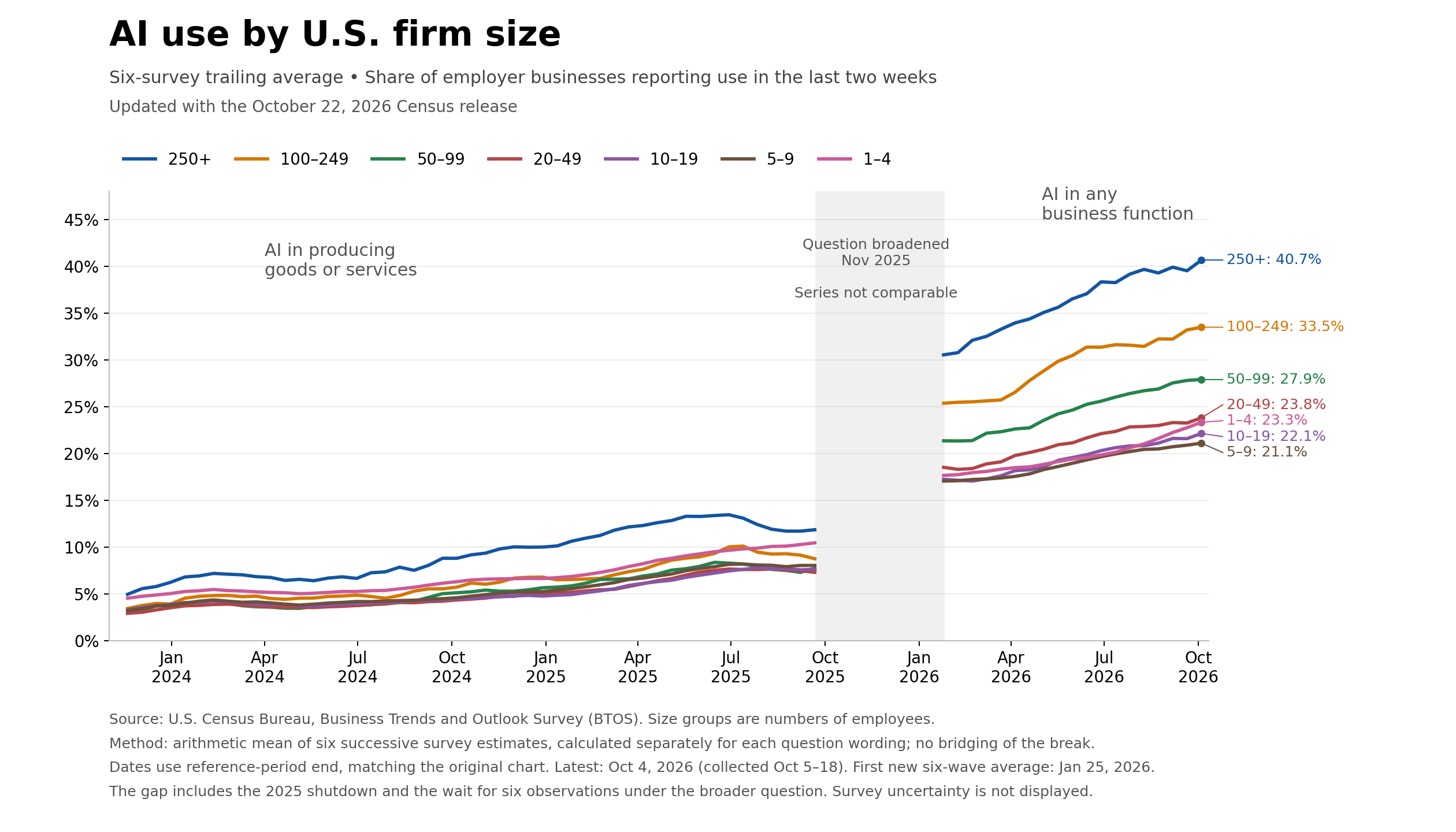
Notes on where to find the data here: https://simonwillison.net/2025/Sep/9/apollo-ai-adoption/
Comment by timr 6 hours ago
I think the Apollo thing is a fairly dumb hot take based on a near-term wiggle in a graph, but it's hilarious that you are calling them biased.
Pot, kettle, black, etc.
Substantively, I don't think it's surprising at all to see those lines go up -- it would be shocking if they didn't go up, given the intensity of the hype. The slope is what matters. In particular, I wouldn't argue that your graph shows any kind of acceleration in adoption over time.
Comment by jdlshore 3 hours ago
It’s too bad they changed the definition midstream, too. It would have been nice to see the two lines side by side.
(Thanks, simonw, for the updated chart.)
Comment by simonw 4 hours ago
Comment by refurb 6 hours ago
In fact, they often put forward a hypothesis about a company or market and argue for it. I couldn’t think of anything less biased.
Comment by threatofrain 10 minutes ago
Comment by tjwebbnorfolk 8 hours ago
Comment by anonymous908213 8 hours ago
Comment by qlte 8 hours ago
I've seen dozens of posts/top comments in the last few years dunking on "AI skeptics" for statements that didn't even vaguely resemble an actual prediction.
Like the front page post from Karpathy which got 600+ upvotes by throwing an AI model at old Hacker News comments without any human vetting to score "predictions". And upon further inspection included a bunch of unambiguously factual statements of the present or conditional if-then logic about the future which when glossed over for convenience become "failed" predictions.
Comment by 80fj0348i 6 hours ago
Comment by gnabgib 8 hours ago
Comment by Barrin92 5 hours ago
The person whose comment we're discussing literally has a sponsorship from an AI company on top of his blog that just raised 50 million bucks lol
Comment by simonw 8 hours ago
Comment by mrheosuper 6 hours ago
Comment by Retric 9 hours ago
Comment by magicalist 8 hours ago
This is kind of gross. Make the claim or not, don't do this pseudo-sealioning thing. Moreover, engage with the actual content (or you could just not engage at all!), not this shallowest possible dismissal.
Comment by simianwords 1 hour ago
There's no way AI is going away, nor any way companies are going to use AI even less than they are today. Hell, even Linus Torvalds is using AI. At this point, there's no need for a serious rebuttal to these arguments.
Comment by disgruntledphd2 49 minutes ago
The real question is how much other knowledge work can be sped up by AI, as that's what the valuations depend on.
My guess is lots, but it will take a lot longer than the boosters expect.
Comment by daveguy 8 hours ago
Comment by EA-3167 9 hours ago
Comment by thisismyanon2 8 hours ago
Comment by ManBeardPc 9 hours ago
Comment by blltprfmnk 9 hours ago
I don’t think anyone is disputing that it makes many kinds of work easier and/or faster, just the degree of those improvements and how much of those improvements actually translate to dollars earned or saved.
Seeing hard data on that would help settle the issue.
Comment by Esophagus4 9 hours ago
If developers are shipping more code (and most of the enablement is in software right now) does that show up in top line? Maybe… if sales and marketing are also selling more, and product people are building the right thing, and…
It’s not a straight line from AI -> $$$
Comment by paaloeye 8 hours ago
With AI, keeping good quality gets even harder because it normally only produces tricky defects.
Comment by Grombobulous 6 hours ago
I see this in a very non-AI way working at a company that’s a hodgepodge of acquisitions. Some of our products just don’t make a lot of money, don’t resonate, or are behind the competition in various ways.
The amount of code or general engineering complexity of the application seems completely detached from profitability a lot of times.
Now the bar is going to be higher for software to actually be worth buying when it’s so easy to make your own for yourself, so that also means that our ability to pump out code loses value.
Comment by Esophagus4 7 hours ago
But I also think:
- there are a lot of companies that don’t need to be 5 9s[1]
- I have a feeling it’s possible to ship fast without drastic quality drops
[1] Claude code is 99.85% available and is one of the world’s most important products
Comment by paaloeye 7 hours ago
Really? If we delete CC today, will humanity stop functioning? Nope. It's so far from one of the world's most important products.
About 5 9s, reliability is just one of the axes which suffers from fast generation.
There are a lot more: architecture, accuracy, etc...
> I have a feeling it’s possible to ship fast without drastic quality drops
at what scale and for how long?
Comment by Supermancho 5 hours ago
This is FUD. It isn't necessarily a good or bad thing.
At the very least, using AI to audit your code is responsible use. The testing is the same as it ever was. If there was a chronic problem with shipped AI assisted code, it would be a popular talking point.
> If quality isn't controlled properly, it eventually shows up as negative in the top line.
This an idealistic pillar of capitalism that has been falsified across time. Depending on what someone means by "controlled properly", I don't think this wasn't been true before AI and I don't think it's demonstrated post-AI. Momentum (notably capture) keeps the software markets resistant to quality defects.
Comment by claytongulick 9 hours ago
That seems like it might be a bit of a problem for those frontier model CEOs who have been making exactly the opposite claims.
Comment by Esophagus4 7 hours ago
Most of the claims I’ve seen are around productivity (bottom line).
And while it’s hard to say “we would’ve had to hire more devs to be this productive without Claude” it kind of feels like the case, doesn’t it?
Comment by vuurmot 3 hours ago
Or maybe it was! And investors were actually great humanitarians!
Comment by skydhash 8 hours ago
Comment by vconnor 2 hours ago
Think security, optimization work, refactoring, etc. Today everybody is drunk with AI, but what happens when the hype is over and you can’t justify to the finance dept. why the company is spending X on tokens?
Comment by s1artibartfast 8 hours ago
Comment by Veelox 8 hours ago
Agents accelerated rollout of a data model change by at least 2 months of eng effort.
Those unblocked a $100k/month infra downsizing. That 2 months pays for my team's AI spend for the year.
Comment by cornell532 5 hours ago
Comment by archagon 1 hour ago
Comment by mbesto 7 hours ago
That's about as hard of data as you can get.
Comment by Denzel 6 hours ago
Are the consultants delivering more billable hours per person now?
All sorts of reasons why the answer to that may be: no.
Comment by mbesto 5 hours ago
Comment by Denzel 4 hours ago
Comment by fnordpiglet 6 hours ago
This is the first cycle in my (relatively) long career where the demand for return felt instant. The tools and techniques are almost comically immature and the average person interfacing with the tools is largely bewildered.
For word processing for instance people spent years upon years coming up to speed on wordstar, word perfect, word. Decades later they’re a common part of life and the tangible benefit over secretarial pools is obvious - there is no such thing as a secretarial pool.
AI it feels like almost a blink of an eye and the demand is “well, it’s been a few years, where’a the post scarcity society I was promised?”
Comment by rurp 6 hours ago
Comment by skissane 6 hours ago
A new technology can deliver significant increases in real economic value in terms of utility per $ expended without significantly increasing revenue for the average firm.
Comment by Grombobulous 6 hours ago
As an example, my X is that boilerplate and general speed/effort of modifying my code is lower, but I’m noticing that this doesn’t necessarily make my team any more effective overall.
It seems like it’s been a code review burden and it’s led to some team members being too ambitious with picking up more projects that don’t make sense.
I have seen some managers in particular toss prototype work that they shouldn’t be doing at underlings, and one of those projects in particular really ended up taking me longer than if I had done it from scratch without AI. The fastest result would probably been if I did it from scratch with AI, but because I took it over from someone who didn’t understand the fundamentals and farmed out decisions to AI I had to spend a lot of time correcting mistakes.
Obviously, good management beats bad management all day long, but I bet you most companies don’t have stellar management.
Comment by ManBeardPc 8 hours ago
Comment by batshit_beaver 7 hours ago
Well yes when your tokens are nearly free, then getting literally any business value is a good outcome.
Comment by kooi 6 hours ago
Our company has secured projects and executed them to a standard which we would not have otherwise were it not for AI or hiring more people. Now, these are at least 3 year projects, so we are only seeing ~3 being AI accelerated.
For us, yes, it's a multiplier, directly translated to more $$.
Comment by WheatMillington 6 hours ago
Comment by watwut 1 hour ago
Comment by solyin 8 hours ago
Comment by oblio 6 hours ago
That "je ne sais quoi" is called hygiene and it's hard to measure but when you stop cleaning, generally bad things happen.
Comment by whateveracct 9 hours ago
Nobody even tries to measure this. Their CEOs and board members have AI shares, and potential investors need to see your AI story to justify your valuation. It's a prison of lies.
Comment by nradov 6 hours ago
Comment by vuurmot 3 hours ago
Next step is 9to9/7days for the American worker to compete, or else you'll be left behind
Comment by lelandbatey 7 hours ago
The teams throughly reviewed and brought up 2 overlooked cases, but mostly we all reminisced about things forgotten that AI discovery had turned up which would have been totally overlooked otherwise. Forgotten discussions, designs, outages, odd decisions, weird edge cases prepared for but never encountered, etc. Then they were migrated, it went smoothly, all to save a low seven-figures per year dollar amount.
The fundamental approach of exhaustively researching to that degree would never have been possible without AI. It's just not feasible to analyze 5 years of even one of those discussions sources (e.g. slack) to figure that out, let alone ALL of them. Now a team of ~1.5 engineers has tackled all that by leveraging AI.
The hard data is piling up in companies, but it'll take a while to get out there.
(Numbers and details lightly greeked in the above account)
Comment by UltraSane 6 hours ago
Comment by fuzztester 8 hours ago
Comment by 0c3ca83 9 hours ago
At what stage did the engineering fail?
Comment by ManBeardPc 9 hours ago
Comment by 0c3ca83 9 hours ago
Comment by ManBeardPc 8 hours ago
Comment by 0c3ca83 8 hours ago
But the problem identified that is talking to people and having them record data.
Comment by ManBeardPc 8 hours ago
Comment by 0c3ca83 6 hours ago
Comment by macintux 8 hours ago
Comment by ManBeardPc 7 hours ago
Comment by FabHK 7 hours ago
The AI analyses sample data from old and new system, and then builds a prototype deterministic mapping pipeline. The experts can then inspect said pipeline and with their domain expertise catch edge cases/exceptions/uncovered cases, fix them and improve things, and then you use the vetted deterministic pipeline for migration. Yet, the initial AI draft saves enormous time.
Comment by macintux 6 hours ago
Comment by belorn 8 hours ago
This area is one which AI has shown to be pretty good (as long as some error rate is acceptable). Character recognition, voice transcribing, converting documents from one standard to an other. I can see an argument that if people spent most time doing those things, AI will speed it up (with a bit of added errors).
I am reminded however that in translations and AI generated subtitles, there is still a lot to be desired compared to the human touch. Handwritten papers in a different language, using local short hand and assumptions, may result in some odd and error prone AI transcription.
Comment by BobbyTables2 9 hours ago
In a webpage the UI design, authentication, etc. are all “boilerplate” if one just wants to do “X” instead of worry about infrastructure.
Comment by Grombobulous 6 hours ago
I look at stuff like terraform code or AWS infrastructure and it’s annoying and repetitive as hell sometimes but at the same time it’s incredibly impressive that you can just describe something as complex as your own private company’s network existing on global data centers and on a relative level you can just bake in pretty complex stuff like a spiderweb of IAM rules, disaster recovery/backup/databases you barely have to think about, horizontal scaling, security policy and all kinds of other stuff I’m forgetting off the top of my head.
It’s heavy boilerplate because like you said you can basically design an infinitely complex corporation as code and once you’re done with that deploy it instantly which used to be pretty much unheard of.
Comment by slau 9 hours ago
I see dozens of teams that are doing cloud to the wazoo when really they need to just be told “we’ll load your routes from main.py, build your assets in /static, you need a DB click the button to provision it”.
It boggles the mind that so many teams are reinventing the wheel a million times over to publish their APIs, register AWS accounts, setup CI, decide on ECS vs Lamda, etc.
Comment by jacquesm 8 hours ago
Comment by Grombobulous 6 hours ago
That’s pretty much the answer. The simple stuff has already been tried and there’s already some reason why we can’t just make XYZ simpler.
Comment by boplicity 8 hours ago
Comment by somenameforme 7 hours ago
When you look at old-school code that just hacked things together, it was ugly, but also very easy to in turn further hack. There was no elegance or grand base types with 80 levels of inheritance to enable clean extension at every possible juncture of types. And no spending forever to find out the exact function you want to be able to override, only to discover that it's outside your modifiable codebase and wasn't marked virtual. Everything just worked.
Comment by 0c3ca83 6 hours ago
Comment by somenameforme 6 hours ago
Engineering isn't about creating some perfect thing that is prepared for any conceivable scenario, but about solving a problem as efficiently as possible.
Comment by AnimalMuppet 6 hours ago
What I've seen (at least at one place I worked) is that the code may be very well engineered for further modification - but only by people who have worked quite a bit on that code. For someone coming from outside, it's almost impossible. It takes forever to find your way around, and figure out where the magic place is that you need to modify in order to work within the existing design.
Well, you say, that's what the design documents are for! But they didn't have enough detail. They described the major objects, but not all the ancillary helper objects. They didn't describe the flow of data through the system in enough detail to know what to modify. The knowledge was there, in peoples' heads, but it was hard to get those peoples' time.
So, yeah. "Well engineered", but not engineered for maintenance by people who are not those already in the group.
Comment by 0c3ca83 6 hours ago
That's like saying "that's the irony of it, a well engineered bridge sometimes drops chunks of concrete onto cars that pass underneath".
Comment by grebc 8 hours ago
Comment by hackernud3s 9 hours ago
Comment by milkshakes 9 hours ago
speed of iteration is more important than quality of iteration; high iteration speed lowers the cost of failure and compounds improvements
Comment by kibwen 8 hours ago
Comment by nightski 6 hours ago
I also find that thinking through a design first helps me achieve a result faster. So I prefer languages that encourage you to think first, type later. Interpreted languages encourage you to type first, think later.
Comment by Supermancho 7 hours ago
Moving the goalpost is not compelling.
Comment by kibwen 6 hours ago
Comment by ManBeardPc 9 hours ago
Comment by hackernud3s 9 hours ago
Comment by ManBeardPc 8 hours ago
Comment by hackernud3s 8 hours ago
Comment by jonwinstanley 9 hours ago
Comment by roosterIllusi0n 5 hours ago
AI is going to effectively let random people compete and displace big tech companies with free software they simply release. This is why google wants to lock android down, they see it coming. CEO led companies with layers of management and lots of investors are obsolete. We are going to go back to teams of 1-6 people doing all the work on their own like in the 90s.
Comment by ex-aws-dude 7 hours ago
That’s the whole distinction
Comment by ares623 9 hours ago
I understand there's some benefit of this. But is it worth putting the global economy into a death spiral? So ManBeardPc can save 4-9 business days to go and say "yeah, that doesn't work".
Comment by greesil 7 hours ago
Comment by smugtrain 9 hours ago
Comment by krona 9 hours ago
Comment by ryandrake 8 hours ago
So, AI is making 5-10% of your project much faster. Whoopdie doo.
Comment by senordevnyc 6 hours ago
The firms of 2031 won’t be doing business like the firms of 2021 but just using AI for coding or in a few places to accelerate the same workflows.
Comment by smugtrain 3 hours ago
Comment by claytongulick 8 hours ago
I think it sums up to something along the lines of "you get what you pay for".
Comment by sick_of_slop 8 hours ago
Comment by hyperpape 9 hours ago
This is a healthy corrective to the most insane AI maximalist takes (mass disemployment in late 2027, 10% GDP growth in a year), but it shows nothing about whether the actual economic impact of AI spending is.
First, to show that, you'd have to justify the counterfactuals (if those companies hadn't spent on AI, would their position be better or worse?)
Second, while AI spending is increasing rapidly, normal companies aren't spending 1% of their revenue on it. So how can you look at a noisy chart of revenue and expect that "oh, it's not up, the AI spending must be useless?" Those companies could be spending < 1% of their revenue on AI, deriving value from it, and it wouldn't be guaranteed to show in a chart like this.
Comment by quixoticelixer- 8 hours ago
Comment by mullingitover 7 hours ago
I wouldn't be surprised to see a 5% GDP drop with all the wasteful spend that will end up getting deleted.
Comment by judge2020 6 hours ago
(Of course this breaks down heavily if the human buying power stops constantly rising and there's de-facto less demand for goods and services)
Comment by mullingitover 6 hours ago
This is what I'm talking about. I can easily envision waves of layoffs in areas like the service industry that historically have been highly resistant to productivity increases in the past. Hell, there's a whole industry based on arguing with insurance companies over billing that could potentially evaporate overnight[1]. That alone is hundreds of billions of dollars, and that's just one example.
[1] https://www.americanprogress.org/article/excess-administrati...
Comment by watwut 1 hour ago
It wont. Instead, insurance companies will deploy AI to defend. You will have same industry, with more convoluted rules and more tech.
Comment by toomuchtodo 4 hours ago
Comment by mullingitover 3 hours ago
Comment by toomuchtodo 2 hours ago
https://en.wikipedia.org/wiki/Joe_Lieberman
> During debate on the Affordable Care Act (ACA), as the crucial 60th vote needed to pass the legislation, his opposition to the public health insurance option was critical to its removal from the resulting bill signed by President Barack Obama.
https://www.commonwealthfund.org/publications/newsletter-art...
Comment by kozikow 9 hours ago
Your company uses AI and it gets ahead a lot quicker. However, your competition does so as well.
Many areas of economy are zero sum game - so your $ ends up being the same as previously. However, now with a "tax" paid to AI model providers for being able to stay competetive.
Comment by eddythompson80 7 hours ago
Comment by judge2020 5 hours ago
Comment by amanaplanacanal 6 hours ago
I guess the benefit to the companies is that they don't lose all their customers to a competitor.
Comment by drcxd 5 hours ago
Comment by dehrmann 5 hours ago
Comment by TheRoque 8 hours ago
Comment by vanuatu 4 hours ago
The incumbents are mostly grown up and are using it to cut costs
Comment by jeremyjh 8 hours ago
Comment by gib444 3 hours ago
Comment by matznerd 9 hours ago
Comment by Ancalagon 9 hours ago
Comment by bartread 9 hours ago
I don’t know about other tasks, but it’s pretty rad for coding, testing, DevOps, and config.
Comment by thisisit 19 minutes ago
They even brought in McKinsey who I believed, if nothing else, can spin up a good yarn. But even they couldn't create a metric based assessment other than "productivity gains".
Now I am not saying there is no productivity gains. Surely there is but I am always curious what metric people are using to measure these gains.
So if you are delivering multiple times faster I have to ask - How much time are you saving and how many employees worth of work you are doing now? 2-3-5 headcount worth of work? If yes, how do you calculate those numbers? And lastly would you put your money where you mouth is and if your team is lets say 10 person team and the company asks to reduce it down to say 2-4-5 people - would you take that bet confidently to continue with the same pace and produce quality work?
Comment by jeremyjh 8 hours ago
If you are in software or IT at a non-tech company that is in the fortune 500, the impact of significantly better productivity may not be measurable in aggregate in the company's P&L.
In smaller companies I expect it could be more measurable because some of them really are using AI much more effectively across many functions. But we're finding it very hard to measure meaningful outcomes.
Comment by abathologist 8 hours ago
One plausible explanations that has occurred to me is this: While programmers etc. can produce way more code with LLMs, the declines in quality and coherence of the work, and a widening gap with a coherent strategy and aim for value means the increased activity is mostly not valuable. I suspect this may just be an intensification of https://en.wikipedia.org/wiki/Productivity_paradox#Little_pr...
Comment by jeremyjh 7 hours ago
I think you are also correct that a lot of value is being wasted with projects that are developed impressively fast but that provide little value. It could be those are simply surplus personnel trying to add value or make people think they do.
Comment by ponector 1 hour ago
Comment by FabHK 6 hours ago
Comment by LastTrain 7 hours ago
Comment by moron4hire 9 hours ago
Comment by senordevnyc 6 hours ago
Comment by mguerville 9 hours ago
Comment by kxrm 9 hours ago
This train isn't stopping.
What trips up a lot of SEs where I work is their techniques. Everyone who follows our process delivers faster and with higher reliability so far.
Comment by fzeroracer 7 hours ago
Comment by 0c3ca83 9 hours ago
I would pay extra for a company that just slowed down and moved deliberately.
Comment by noodletheworld 6 hours ago
Are you measuring the right metric?
This feels like an on going lack-of-understanding in the industry.
In manufacturing, economies of scale and automation work because you're physically making more objects and objects inherently have value.
For software, making more software doesn't mean you can sell more units of software. The unit price of selling existing software is already 0. Economies of scale do not exist.
The OP says: net business output is not up as a result of AI.
So:
…if your team is doing more work and being more productive…
That just means the productivity of your team (or software teams in general) maybe doesn't have a meaningful business impact.
You should be worried if so. That means productivity = work force reduction (reduce fixed costs for the business).
Comment by senordevnyc 6 hours ago
It sounds like you’re also saying that creating more software can’t result in more revenue?
We work in very different software industries.
Comment by ForHackernews 9 hours ago
N=1 but I'm not sure it's made my bosses any richer. What we're shipping has better tests and documentation than it ever would have before AI.
Comment by techpression 8 hours ago
Comment by dboreham 9 hours ago
Comment by amanaplanacanal 5 hours ago
Comment by bigstrat2003 7 hours ago
Comment by GolfPopper 9 hours ago
Comment by andriy_koval 9 hours ago
Comment by sublinear 9 hours ago
I'm sure they can just fire half and double up work or outsource. That's the traditional way and it definitely works. The worst that ever happens is a few will reneg on payroll. Everyone who still chooses to work there is happy enough.
The worst that can happen with AI... well...
Comment by ares623 9 hours ago
Comment by DangitBobby 6 hours ago
Second, I'm getting huge value from it, but I'm not making any money and none of it is being redirected. It's simply value that wouldn't have existed otherwise because I would have just gone without the thing because it was prohibitively expensive or too much work. I'm quite sure many companies and people have been unlocked in this way. Plenty of value locked up in an overly expensive economy dedicated to maximum value extraction instead of value creation.
Comment by proc0 9 hours ago
Comment by questionableans 9 hours ago
Comment by proc0 9 hours ago
AI allows you to move faster, but it also demands that you pay more attention in proportion to how fast you want to move. This requires more focus, i.e. more time developing. Effectively the structure at companies should swing back to how it used to be a few decades ago (I think, maybe I'm wrong and it's always been like this), where engineers mostly focused on delivering code. The difference now is that they can be expected to deliver much more code at higher quality.
To summarize, using a little AI doesn't pay off, you need to be doing that all day, and that is not how engineers spend their time in most of the industry anymore.
Comment by questionableans 6 hours ago
I would also strongly push back on the assertions that being very technical means spending most of your time on the code, and that you have to be using AI all day for it to be useful. Let’s say I’m a technical lead or a manager reviewing a design doc for a large project. I have an idea based on my years of technical involvement for how to significantly improve the quality or delivery timeline for the project. I used to have to ask the doc author to look into this approach, not knowing for sure if it would directly translate. Now I can take my crazy idea, quickly dispatch a coding agent to try it out against the codebase, go to a meeting, and then check on what it came up with to give a much more informed and technically accurate suggestion on the doc. I still have to have the technical expertise to iterate a bit with the agent and not over or under state the possible impact of my idea. But this lets me take say an hour rather than a week to come up with a vetted recommendation that saves months on the schedule.
Comment by proc0 5 hours ago
The idea is more or less benefiting from doing work in bulk which AI is now allowing. I even think multiple engineers (human redundancy to double check the same code) should team up with one AI system and form a small team that handles millions of lines of code, with the only job to feed incoming tickets and check the AI work. Anyone not reviewing code should be facilitating everything else with their own AIs. I think large companies can collapse entire engineering departments into a few people. The cost would be that everyone else has to think like an engineer to sort out requirements and provide direction, but as you point out, this is now easier with the help of AI.
Comment by questionableans 5 hours ago
Maybe this is why you’re seeing more effort shifted away from technical work. Maybe I’m a nihilist. Maybe both?
Comment by proc0 4 hours ago
> unless AI is directed at finding the right problems to solve
This direction can be done by non-engineers with AI to consult (replacing that part of human engineer's role).
Comment by questionableans 4 hours ago
Comment by questionableans 6 hours ago
Implementing the first text edit field in your program is kind of interesting when all you have is asm and 4k of RAM. Nobody wants to bother doing it manually when you have a web browser that can eat gigs of RAM.
Comment by eddythompson80 7 hours ago
In large companies there is also the politics game. The more freed time senior engineering manager and senior product managers get, the more politics intensives and waste more of their time.
I use the term “product management” in its traditional sense of establishing scope, feature prioritization, user experience, shape of integrations, etc.
Comment by questionableans 6 hours ago
Comment by eddythompson80 6 hours ago
Comment by Damogran6 9 hours ago
I'm seeing another behavior in my purely personal research...asking AI 'can I do the thing?' and it comes back with 18 pages of 'yes, and here's how you do it'. Often it's the discovery that produces the endorphin bump. It's cool to know I can jailbreak the Peloton...and now that I know I can...I'm not so motivated to actually do the thing.
Comment by arcanemachiner 8 hours ago
Comment by tantalor 9 hours ago
I'm guessing "most companies" are actually selling something that isn't constrained by the types of things that AI code generators unlock.
Comment by jeremyjh 8 hours ago
Comment by cl42 8 hours ago
Apollo's own argument that most AI spend is coming from non-S&P 493 (as per the last two charts) tells me it's hard to make any conclusions based on these charts.
Comment by gnabgib 10 hours ago
Comment by brink 9 hours ago
Comment by LPisGood 9 hours ago
Comment by brink 8 hours ago
AI is highly divisive. It's dramatically reduced the value of code, which has derailed a lot of careers who have built their entire adult life around the idea that code would remain valuable, while simultaneously driving others into a psychosis who believe that AI can do anything.
Comment by ryandrake 7 hours ago
Comment by killix 4 hours ago
Comment by robby_w_g 6 hours ago
I just don't relate to this sentiment. I wasn’t the fastest typer or the quickest at designing a solution pre-AI, but I was able to learn, build, and maintain systems. My value wasn’t in how fast or how much code I could write, it was in my ability to understand what the hell is going on and do something with that knowledge.
That’s still the case now, even though Kent from Accounting could theoretically one shot some of the software I build. He wouldn’t know what to do with the software, and he wouldn’t want it because now it’s his problem.
The tech industry oversees invisible Rube Goldberg’s machines of flowing electrons. Most people don’t want to learn or deal with its issues. And since AI is yet another complication piled on top of the machine, I feel confident that my career will still have value.
Comment by 0xbadcafebee 7 hours ago
Comment by mgdev 8 hours ago
The problem is most people don't know what makes them successful from a people perspective, except in the coarsest terms.
90% of the business outcomes are delivered by 10% of the people. The problem is they don't know which people. Therefore they also don't know which processes, if automated or augmented with AI, will achieve the target outcomes.
So instead they’re shotgunning. The problem is that the existing people-based system has built-in stabilizing mechanisms to prevent misalignment from taking the entire operation off course. AI stresses and often breaks those.
The result? Higher costs and chaos.
This needs to be treated like an org transformation. Traditionally that's most successfully done by starting a new small team that builds ground-up and eats the old team.
Comment by belZaah 3 hours ago
Comment by kylepomykala 9 hours ago
Comment by jeremyjh 8 hours ago
Comment by kazinator 8 hours ago
Bzzzt! Calculators do not hallucinate. AI bots and agents are nowadays jerry-rigged to use actual calculators for problems involving crunching.
Comment by doginasuit 8 hours ago
Comment by victor9000 9 hours ago
Comment by paaloeye 8 hours ago
Comment by rossdavidh 8 hours ago
Comment by cornell532 5 hours ago
Comment by gitaarik 8 hours ago
Comment by TrainedMonkey 8 hours ago
1. Execs with no understanding how business operates on the low level are pushing buzzwords.
2. People who want to get promoted deliver on buzzwords and get promoted. Note that the goal is to deliver the buzzword, not use the buzzword to make the business better.
3. Buzzwords do not help vast majority of companies because the incentives and needs are misaligned.
4. Eventually buzzwords settle, some find niches, some die off, and some take over the world.
Last two decades alone - big data, blockchain, crypto, web 3.0, gamification, VR, and now AI. TL:DR - we should expect vast majority of early AI adopters to have net negative to neutral experience. Assuming that AI is like electricity and automobiles more than blockchain we should expect that eventually companies that find a way to apply the tech correctly will eat those who do not.
Comment by jongjong 9 hours ago
The system itself doesn't reward value creation. I've been saying this for years. I've seen many smart people waste their time on bureaucracy; their intelligence was being wasted; so I'm not surprised at all that now that we have AI, that its intelligence is being wasted as well.
The bottleneck is an allocation issue, not a capability issue.
The current reality is that a lot of very bright people are currently working for big tech in bureaucratic roles and not allowed to focus their attention on 'risky' problems which would deliver real value if resolved.
The current system prioritizes monopolization and is designed to try to ensure that all innovation happens within big tech. It is sacrificing potential innovation which could have occurred much faster outside of big tech in order to ensure that any gains are captured by big tech... But it's sacrificing an enormous about of efficiency.
I hope big AI companies can use their political leverage to try to open up opportunities for people who want to innovate outside of big tech. That's aligned with their long term interests.
I think AI companies are convenient structures which could allow big funds to benefit from decentralized innovation. Could create real win-win scenarios. But those AI companies have to stop pursuing the corporate and government money and prioritize small customers and support small tool makers (or at least lobby the government to stop hindering them with regulations). Also, bootstrapping should be prioritized because VC money mostly creates moats.
Comment by variadix 8 hours ago
Comment by solyin 8 hours ago
Comment by IshKebab 9 hours ago
Comment by jdlshore 9 hours ago
Bleeding obvious in retrospect, controversial at the time.
Comment by amanaplanacanal 5 hours ago
Comment by VenturingVole 8 hours ago
Comment by Jtarii 9 hours ago
AI will finish what the web and social media started I guess.
Comment by sgarrity 9 hours ago
Comment by temp123477 9 hours ago
Comment by loeg 8 hours ago
Comment by abeyer 6 hours ago
...says a representative of a massive PE firm, those models of trust, accountability, ethics, and fairness.
Comment by roosterIllusi0n 6 hours ago
The people who know how to get AI to make usable and viable solutions are the only people who should be running anything and their employees should be all doing the same.
A company should be built around people who can vibe engineer real end user products that are deploy-able and high quality.
Non-coding people are simply done now that AI can replace all of their "ideas", but cannot replace the engineer making the real decisions with the ideas that actually matter.
Comment by ChrisArchitect 6 hours ago
Comment by imperio59 8 hours ago
Much less do they know the thing can build software and maintain it, manage complex tasks daily, automate things, etc.
Then there's a handful that do follow closely AI developments and agents and who have started using them.
A friend of mine this weekend who is an award winning photographer and who has been selling photography courses online forever has told me he's used Muse to: 1) Automate chopping up his long form videos, add captions, and post them as Reels to Instagram. Several of these have gotten over a million views. 2) Automate handling DM reachouts, converting them into sales. He's up to several tens of thousands of dollars in sales from AI direct message conversions that he would otherwise not have been able to convert (too many DMs to handle, he'd have to hire/train sales people to basically just do DMs full time at scale otherwise and it would make no economical sense) 3) Automate all his customer service for handling any issues, refunds, support, etc.
And I personally think he's still just scratching the surface of what he could do.
I feel we are really at the beginning of a new era. When the internet started most people were just using it for e-mail and news, maybe a newsletter chain here and there and some early forums. Social Media didn't appear for well over a decade, popular Web 2.0 apps like Google Maps, GMail, YouTube, Netflix, etc didn't appear for a long time.
Mainstream hasn't even really begun to adopt AI.
Comment by dboreham 9 hours ago
Comment by kylehotchkiss 9 hours ago
Comment by Jtarii 9 hours ago
Comment by ianm218 9 hours ago
I.e. Ramp does a pretty good job of using AI to make expense management easier/ CloudFlare makes it a lot easier to configure stuff properly on CloudFlare but is just like boringly useful.
Comment by manofmanysmiles 8 hours ago
Comment by torginus 9 hours ago
Comment by ares623 9 hours ago
Comment by bosshawg 7 hours ago
Comment by charonn0 8 hours ago
Comment by thelastgallon 7 hours ago
Comment by PaulStatezny 8 hours ago
What a wild scenario to imagine. Anthropic and OAI spending wildly, analysts astonished, thinking we're staring down the barrel of an economic crash. And in the meantime some rogue AI is laughing maniacally and using blackmail to control Altman and Amodei like puppets.
I love it! xD
Comment by charonn0 7 hours ago
But if it were... could you tell the difference?
Comment by mrdootdoot 9 hours ago
Anyone agreeing with this headline - I’m sorry in advance for your loss.
Comment by joe_the_user 8 hours ago
I am not an "AI booster", it seems like the current market leaders have dug a hole that they'll have a hard time getting out of. Just about everyone says something like "there's a bubble, it will burst, people will be hurt but the process will go on, like the Internet or railroads". But that ignore that the scale of this is beyond earlier bubbles (each bubble is larger than the last in our 30-40 year bubble-and-pop driven economy but that might not be comforting).
All that said, "some aren't benefiting" or "the average isn't benefiting" is a disingenuous argument if you want to say things are bad. AI companies have more of a real product people are paying than Google did. A large minority of companies (not all in the tech industry) are getting a boost. It's easy to say "the average is zero" when you exclude some. AI has boosted media companies that do a lot of transcription. Video generation serves half of advertising videos.
Reg: "All right, but apart from the sanitation, the medicine, education, wine, public order, irrigation, roads, a fresh water system, and public health... what have the Romans ever done for us?" Attendee: "Brought peace?" Reg:"Oh, peace? Shut up!"
Comment by vibecodi 3 hours ago
Comment by apishare_api 9 hours ago
Comment by torm 9 hours ago
In some organizations, it doesn't matter whether you produce 1x or 10x as much work. If the process says reviews happen on Mondays and deployment decisions are made at the end of the month, getting your work done faster won't change much.
I'm at a much smaller company now, and we've doubled our feature delivery rate while increasing code coverage and overall product quality. We've also tripled our marketing content output, which was an area where we'd been falling behind.
AI can significantly improve individual productivity, but whether that translates into business results depends on how the organization operates.
Comment by bill10 4 hours ago
Comment by darig 9 hours ago
Comment by emscb 9 hours ago
Comment by AndrewKemendo 8 hours ago
That’s one job and I have several in the pipe.
The “financial payoff” for no more than a few 100 a month at absolute most is there and it’s real. If you aren’t seeing it then you’re doing it wrong.
I usually don’t even spend more than $20 a month each for chpt and claude, deepseek free is solid. I am about to switch fully local too so that should drop to basically cost of watts.
I dunno what yall are doing
Comment by amanaplanacanal 5 hours ago
Comment by AndrewKemendo 4 hours ago
When will that be?