Lenovo's 'encrypted' fingerprint USB is just an unencrypted SD card in a case
Posted by entryleveljobsc 18 hours ago
Comments
Comment by charles_f 15 hours ago
It's crazy that Lenovo will still be trusted to build secured hardware after that. It's not even a vulnerability at this point, I'm not sure how this could pass any form of security review, let alone having anyone review the design and approve it. They must have known it was nothing they pretended and still decide to sell it.
Comment by autoexec 12 hours ago
Lenovo already has an history of backdooring the devices they sell, sometimes in exchange for money. It's insane that anyone trusts them for anything. https://en.wikipedia.org/wiki/Levono#Security_and_privacy_in...
Comment by arein3 11 hours ago
Should I check network card firmware?) Maybe they added a rule to forward certain instructions to the OS embedded in the CPU
Comment by wang_li 9 hours ago
Comment by TheDong 1 hour ago
> When it sees a certain string in any write to the disk
dm-crypt or zfs encryption or any other commonly used encryption will encrypt the data before it's written to disk, so the disk controller will not be able to do anything with writes or reads since it will not have the encryption key.
Comment by PorciiVorbesc 8 hours ago
Everything you wrote is not an exclusive Lenovo risk and vulnerability but applies to every piece of compute sold in the worlds.
Comment by autoexec 7 hours ago
Comment by Krutonium 9 hours ago
Comment by daneel_w 9 hours ago
You cannot.
Comment by xbar 5 hours ago
Comment by ksh09 11 hours ago
say no more ig.
Comment by hansvm 10 hours ago
Comment by autoexec 7 hours ago
Comment by hansvm 7 hours ago
Comment by lunar_rover 8 hours ago
Comment by autoexec 7 hours ago
All people are capable of being untrustworthy, but that doesn't make all people the same as those who have already demonstrated that they are.
Comment by lightedman 4 hours ago
It hasn't been in a looooooong time.
The first three layers of the OSI model are sorely neglected.
Comment by daneel_w 10 hours ago
Comment by aucisson_masque 10 hours ago
Comment by FranOntanaya 10 hours ago
Comment by autoexec 7 hours ago
Comment by skrtskrt 5 hours ago
They said like 2 years ago they were working on one, but I have not heard much since.
Comment by solyin 9 hours ago
Comment by wormius 6 hours ago
Comment by ezconnect 4 hours ago
Comment by sellmesoap 14 hours ago
Comment by StopTencent 14 hours ago
Comment by mzajc 18 hours ago
Comment by reaperducer 17 hours ago
Comment by lrae 17 hours ago
(You actually have to go through https://binary.ninja/2026/10/22/breaking-more-encrypted-usb-... first :))
Comment by adrian_b 17 hours ago
Comment by forgotpwd16 16 hours ago
Comment by matheusmoreira 18 hours ago
Comment by alright2565 17 hours ago
Comment by sllabres 16 hours ago
The original IronKey (later sold to Kingston) seems to have be cracked. A team / company called Unciphered managed to break a IronKey in a attempt to offer such a decryption to Stefan Thomas who had 7002 bitcoin on this key. This was then worth then 235 million dollar (now >500 million), which is of course a VERY strong motivation. [1]
The Lenovo case of course seems not to be bad implemented security but no security at all, especially if they advertise with encryption, which I found on a Asian Lenovo website where still there are still some specs of the key [2]. A good method if you want to damage your reputation.
[1] https://www.wired.com/story/unciphered-ironkey-password-crac...
Comment by wildzzz 16 hours ago
Comment by angry_octet 9 hours ago
For key entry you really want mutual TOTP or a separate ignition key, like a yubikey, that you insert into the drive.
Comment by noir_lord 12 hours ago
Says a lot about Bit Coin volatility that that didn't really narrow how long ago it was.
2023 for anyone else who wonders (the linked wired article is worth a read though).
Comment by mikeryan 16 hours ago
The password was included on a sticky note in the package.
Comment by angry_octet 9 hours ago
Comment by functionmouse 17 hours ago
Comment by shim__ 3 hours ago
Comment by OptionOfT 15 hours ago
They work well in high security environments because you can allowlist the vendor and product id of only these hard drives, and you don't have to set up procedures where people HAVE to encrypt their drives before use.
So cost-wise it makes sense.
But for personal use? BitLocker / VeraCrypt all the way.
Comment by lifeisloving 14 hours ago
And MS has handed those keys over to law enforcement before.
Comment by caymanjim 14 hours ago
Comment by ByteOfWood 14 hours ago
Comment by saidnooneever 12 hours ago
some highly secure environments have connections comming from networks that sport windows. usually they will come in via something like a data diode so whatever comes in can physically not come out because its so risky to allow even such a network to connect to yours....
perceptions of what is highly secure can vary a lot depending on what a person has encountered. if you ever come across a place that is really secure u'll immediately know the difference.
ive never seen a highly secure corporate network and have seen close up what security is implemented in fortune100 etc. its a doozey. they just pay vendors with big retainers for IR etc. to be compliant and insured. that is not security. (and they spend millions on that which is funny as hell)
Comment by PorciiVorbesc 11 hours ago
I have. We had an air-gapped network for ingesting and processing the deliverables and results of security audits and pen-tests at work. It was running windows and not Linux/BSD like the laptops of the pentesters, because most of our customers were MS shops so all deliverables we got from them were mostly documents, apps and files that were designed for Windows apps or had better compatibility on MS Office, and businesses stay solvent by conforming to their customers' needs instead of fighting them.
Comment by InvisibleUp 14 hours ago
Comment by chasd00 14 hours ago
You could make your own BitLocker conforming to your requirements without relying on or trusting any cloud or corporate entity.
Comment by fn-mote 14 hours ago
Comment by chasd00 5 hours ago
Comment by hparadiz 12 hours ago
https://github.com/hparadiz/nexus-6p-biokey
I mean it's better than this sdcard thing at least.
Comment by Waterluvian 17 hours ago
Comment by blooalien 17 hours ago
Comment by SoftTalker 16 hours ago
Comment by gruez 17 hours ago
If implemented correctly, "hardware" encryption can be more secure than "free software cryptography". The most obvious benefit is protection against brute-attacks, which you can't meaningfully implement with software. Not to mention added protection of biometric authentication as a second factor, compared to typing a password into a possibly untrusted machine.
Comment by Sopel 17 hours ago
if you have a bad password that's a user issue
Comment by gruez 17 hours ago
Comment by kalaksi 16 hours ago
Comment by gruez 15 hours ago
Which doesn't do shit even if you're using argon with 32 GB memory usage or whatever. NSA is always going to be able to out-compute you. Not to mention you need a difficulty level that's usable for daily use, but the NSA can brute-force at their leisure, possibly decades in the future.
Comment by Dylan16807 6 hours ago
The "decades into the future" part is a much bigger threat than their ability to out-compute me in the short term.
Comment by SV_BubbleTime 16 hours ago
Did we wake up in a world without key derivation functions to turn passwords/phrases into keys?
Comment by SV_BubbleTime 16 hours ago
There was a great article around last week about PDFs using randomly generated keys that ended up using non-secure random number generators and the effect was the only unique portion of the key is was 9bits, and obviously forceable. I wouldn’t even describe this between burrito bites activity as “brute”.
The point being “AES” doesn’t mean secure. Secure through the whole implementation means secure. People fuck up crypto all day, calling out a specific cipher doesn’t mean much.
Comment by TacticalCoder 16 hours ago
Well you can use open-source / free software cryptography to encrypt and decrypt using a secret key which you do not need to remember and which is safely stored behind a secure element.
And there are quite a few people doing just that.
It's immensely more secure than trusting Lenovo or Microsoft or whatever company.
And you can have your secret on the secure element protected by biometric auth too (some do offer just that).
And there are devices like that with a tiny attack surface that accept biometric (like your fingerprint) to unlock the secret.
To get the best of both world you trust the HSM with one thing: the secret, and that's it. And you use open-source software and protocols (like GPG and OpenSSH) with that secret.
Comment by close04 17 hours ago
My baseline assumption is that even the good commercial products are only secure from a non-determined attacker, not TLAs. Anything safe from TLAs is what’s being sold only to them.
Comment by steelframe 17 hours ago
Comment by my123 15 hours ago
Comment by close04 16 hours ago
The hardware is still a black box and you’ll never know how it behaves in conditions you didn't test against.
Comment by steelframe 14 hours ago
Comment by buran77 12 hours ago
Because what I said above might sound like black magic to anyone who knows nothing about the topic I will expand.
The CPU on which the software runs gets far more scrutiny than the obscure encryption engine on the USB stick. And it's possible to validate the software encryption with minimal effort. Verify the output with various software implementations of the same algorithm, ran on different CPUs. They have to be compatible and can't all have the same bug or backdoor.
An encrypted stick is impossible to validate by the end user. They have no access to the CPU encryption engine or the raw storage so can't know the algorithm implementation, or the output to disk format which is probably proprietary.
Comment by magicalhippo 14 hours ago
Comment by gruez 17 hours ago
I think you're overestimating how much backdoors there are in products vs actual bugs. As we've seen with with recent vulnerability disclosures, there's plenty of bugs that were put there unintentionally.
Comment by traverseda 16 hours ago
Comment by close04 16 hours ago
The point was that there are special products, implementations of already known algorithms, sold only to TLAs. They have the code validated to the Moon and back, unlike the commercial products.
Comment by sam1714 11 hours ago
For example, you need to print something; take some data from an oscilloscope or other instrument.
Your alternatives are to connect those devices to your network or some devices run Windows you can alt-tab out of and install your own software. Given risks and complexity of those, a hardware encrypted USB stick is the least bad.
Comment by miki123211 14 hours ago
The traditional free software approach to cryptography is "derive the key from a passphrase; require the user to make the passphrase strong; if the passphrase is weak, put the onus on the user."
This works well for HNers, but is terrible for normies. What normal users want is a locked down chip (potentially running open source firmware!), which securely stores something like an AES key protected by a 6-digit pin, which gets erased after 10 unsuccessful attempts and cannot be cloned. This is how TPMs, Apple's secure enclaves and bank and SIM cards work. This kind of design did more to bring full-disk encryption to end users than any free software ever did.
Comment by advisedwang 14 hours ago
Comment by bluedino 16 hours ago
Comment by swinglock 17 hours ago
Comment by lokar 16 hours ago
Comment by jonathanstrange 17 hours ago
Comment by 150g2 16 hours ago
Comment by aliasxneo 17 hours ago
"How did you get the data?"
"It was just an unencrypted SD card inside"
Not very exciting, but I guess just as accurate as reality!
Comment by croes 15 hours ago
Comment by mrheosuper 7 hours ago
Comment by thayne 13 hours ago
Comment by jagged-chisel 17 hours ago
Comment by Mashimo 16 hours ago
Comment by xp84 14 hours ago
Comment by hamburglar 13 hours ago
Comment by jdiff 12 hours ago
Comment by regus 14 hours ago
Comment by pauldelany 12 hours ago
Comment by throw34564356 5 hours ago
And Dell as well after their own Superfish-like malware.
Recently I added LG to the list.
Comment by forgotpwd16 16 hours ago
Comment by Retr0id 16 hours ago
Comment by nik282000 15 hours ago
Comment by ryandrake 11 hours ago
Comment by beloch 7 hours ago
1. Anyone who has access to the drive likely also has a nice sample of your fingerprint on the same device.
2. Hardware encryption implementations are often unknown, flawed, or completely missing. You shouldn't place trust in obscurity.
3. Hardware encryption often adds an unnecessary point of failure. I've seen drives with hardware encryption implemented on a daughter board become unrecoverable because the daughter board failed, even though the drive itself was just fine.
Put a software encrypted volume on a normal storage device and call it a day. Don't pay extra to do worse.
Comment by EmX_3000 8 hours ago
Comment by nik282000 17 hours ago
Comment by hosteur 15 hours ago
Comment by untessela 17 hours ago
Comment by forgotpwd16 16 hours ago
Thought was fake branded product at first and just no one bothered to check, but apparently is available in Lenovo CN's store.
Comment by thayne 13 hours ago
Comment by moi2388 12 hours ago
Comment by mrheosuper 6 hours ago
Comment by rendaw 16 hours ago
And the article doesn't even have an image of the product as sold.
Comment by vbezhenar 17 hours ago
Comment by BatteryMountain 14 hours ago
Comment by jwr 14 hours ago
Comment by bentcorner 12 hours ago
Comment by xoa 13 hours ago
I mean, yeah? Throwing around words like "useless" without context is almost universally unserious and irritating in a security conversation since security is about economics and threat scenarios. I'm aware of the 2019 paper "Self-Encrypting Deception: Weaknesses in the Encryption of Solid State Drives" [0], but not a lot since then on the state of Opal and any other SED mechanisms and real world effects. Even for the drives discussed there, it's not clear it actually affects what much of the population cared about in terms of FDE, which would more be along the lines of "it'd be hard for a random casual person to pop the drive into an enclosure and just mount it and copy everything off, I don't have to use a super long password all the time, and it doesn't cost noticeable speed".
As another practical issue, encryption is not something most people can verify anyway whether they have the code or not. The pure cold data at rest symmetric use-case means that a lot of hot attacks and side channel stuff isn't so important, even so I sure wouldn't trust myself to either write it or verify it. I mean, I guess I could spot some truly dumb-tier backdoor hard coded keys but not anything subtle in terms of weakness, and even then not every single software update. For most people/organizations they're all black boxes based on trust in the manufacturer/developer(s).
I mean, I don't disagree with you that personally I go with software, less from an encryption pov (though it's not nothing) and more from a recovery-if-things-go-fubar pov. I'd agree the incentives are better, and that while many-eyes is not a panacea lower barriers for security researchers to poke around is still better on balance. Perhaps the LLM-era further pushes it that way, and really will make it more practical for more people to check over software solutions.
But still seems like kind of a stretch for you to assert that Apple's (or many others) in-device encryption is "useless"? We've seen some pretty powerful organizations worldwide really want to get at protected data and then fail even when stakes were high.
----
Comment by angry_octet 9 hours ago
https://www.cl.cam.ac.uk/~sps32/IronKey_teardown.pdf
You shouldn't trust that these things are secure.
Comment by xp84 14 hours ago
Comment by nkrisc 10 hours ago
Comment by leni536 13 hours ago
More like fraudulent marketing.
Comment by hamburglar 13 hours ago
My uncle considers himself a “tech guy” and had an app published years ago that secures your medical information with “military grade” encryption and it was just a ridiculous shit show of incompetence. But he truly believed he was doing something. Sprinkle some AES on it and it’s secure, right?
Comment by sharts 8 hours ago
Comment by RobotToaster 16 hours ago
Comment by icpmoles 16 hours ago
Comment by charles_f 16 hours ago
It was
Comment by askvictor 9 hours ago
Comment by blurbleblurble 16 hours ago
Comment by l0new0lf-G 17 hours ago
We know that Microsoft's bitlocker had at least one backdoor. Lenovo's fingerprint USB also has backdoors.
It seems like only open source solutions actually provide encryption, like LUKS and Veracrypt. Then again, who guarantees that the executables are actually build from the source? Or that the keys aren't somehow sent over to agencies by the operating system?
TLDR, we cannot realistically trust anything in this dictatorship of mass surveillance.
Comment by gruez 17 hours ago
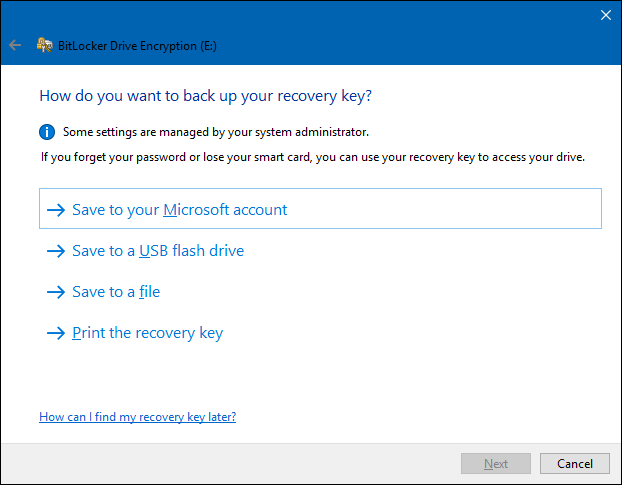
Source? The closest I found was microsoft's key escrow system, but that's hardly a "backdoor" given it's publicly documented, and it's explicitly stated in no uncertain terms when you're setting it up[1]
[1] https://static0.howtogeekimages.com/wordpress/wp-content/upl...
Comment by vel0city 17 hours ago
I'm not 100% certain either way.
Comment by gruez 17 hours ago
Which even microsoft admits is basically a LARP from a security point of view. It's better than nothing, but it's not meant to stand up against serious attacks. Even without the yellowkey exploit, it can be bypassed via interposer attacks on the TPM.
https://learn.microsoft.com/en-us/windows/security/operating...
Comment by aftbit 16 hours ago
Comment by forgotpwd16 16 hours ago
Comment by gazetrac 16 hours ago
Comment by Profazia 3 hours ago
Comment by thenthenthen 8 hours ago
Comment by hparadiz 12 hours ago
I turned an old android into a fingerprint USB and a fido2 in one shot.
The fingerprint USB is actually legit since it's backed by a closed bio metric on device.
Comment by dennysora-main 12 hours ago
Comment by throwaway27448 14 hours ago
Comment by ctkhn 17 hours ago
Comment by pjmlp 17 hours ago
Comment by jqpabc123 16 hours ago
What am I missing here?
Comment by novafunc 15 hours ago
Comment by justsomehnguy 14 hours ago
Comment by jqpabc123 14 hours ago
I have friends who have been locked out of their phone because they put all their trust in the fingerprint reader.
Comment by NetMageSCW 12 hours ago
Comment by mytailorisrich 17 hours ago
Comment by harrysstone0 3 hours ago
Comment by pardeeplogisch 2 hours ago
Comment by pardeeplogisch 2 hours ago
Comment by dpacmittal 17 hours ago
Comment by judge2020 17 hours ago
> The fingerprint only switched the USB connection on; nothing on the card was encrypted.
Comment by solyin 17 hours ago
Comment by judge2020 16 hours ago
Comment by weego 16 hours ago
Comment by swinglock 17 hours ago
Comment by Loughla 17 hours ago
Comment by pdpi 17 hours ago
Comment by Loughla 14 hours ago
I guess it comes down to expectations? You don't expect formal conventions from a website writer, while I absolutely do.
I find it interesting that it was a flag for AI writing for you. That's going to make me consider my voice in certain situations now.
Comment by robertoandred 16 hours ago