Solar power is becoming bigger than nuclear
Posted by geox 3 days ago
Comments
Comment by zhivota 2 days ago
As I understand it, this is very common across much of the developing world now. So the tracking of how much solar energy there is in the world is almost certainly a lower bound on the reality.
Comment by alex_duf 2 days ago
If you're not following her, she's often sharing really interesting stuff.
Comment by ZeroGravitas 2 days ago
https://bsky.app/profile/solarchase.bsky.social/post/3mxjkhs...
Comment by toomuchtodo 2 days ago
Solar Power Finance Without the Jargon2nd Edition https://doi.org/10.1142/q0437 January 2024, Jenny Chase (BloombergNEF, Switzerland)
(no affiliation, I just like the book)
Comment by fallingbananna 2 days ago
If you have your own circuit with solar and battery and devices disconnected from the rest of the grid, then there is nothing to register, right?
Comment by lompad 2 days ago
For balcony panels you only have to do a very small registration, but no large bureaucratic process or getting a permit.
For larger ones you still must get a permit for a very simple reason: even if you don't get your power into the general network, you still affect it by using less, which might cause issues with grid stability.
We have so much power on sunny days now that we can barely deal with it. Which in turn occasionally even causes power prices to go negative - you can get paid for drawing power.
Comment by MakersF 2 days ago
Have you ever wondered how is it possible that the price goes negative? Why would someone pay you to use the energy they produce? Logically, the price shouldn't go below 0 (*) . The reason is that the government gives incentives for each kWh produ ed. So if they pay you 0.10€/kWh, you'll be happy to pay people up to 0.09€/kWh as long as you can keep producing, since your marginal cost is 0. Basically government incentives are producing this situation, paying people to produce electricity nobody wants. It's also the reason why production is far from consumption: the incentives never were designed to push to generate useful electrons, just electrons, even if they cannot be moved to where they are useful. We need to rework how incentives are provided, because this is ending up wasting a ton of public money!
(*) except for power stations were they cannot physically turn it off, but generally they wouldn't be able to produce enough energy to define the marginal price
Comment by flakeoil 2 days ago
By using less oil and less gas we reduce CO2 emmissions, save money and are less dependent on other regions far away.
Comment by netsharc 1 day ago
In a very tiny Canary Island, their battery is many many tonnes of water pumped uphill when they have windpower: https://www.youtube.com/watch?v=RXhAj5BHdfM
Comment by msby 1 day ago
Comment by holgerschurig 1 day ago
That is weird and IMHO totally wrong. And I'm living in Germany. Anyone here can e.g. create an isolated network, without any permission. The local electricity provider etc doesn't care. All they care however that they remove the counter and the main circuit breaker at their end, to really isolate your house from the rest.
Comment by lompad 1 day ago
you have a house, taking power from the grid. Then you want to become more self-sufficient and add solar, but don't want to sell to the grid, just for yourself. If the solar installation and its circuit is not _fully_ separate from the one connected to the grid you have to get a permit even if it's a "Nulleinspeiseanlage".
Yes, technically you could make everything completely separate, then it would be fine. But I haven't seen that in the wild a single time so far.
Comment by gniv 2 days ago
Comment by zarzavat 2 days ago
Comment by leonidasrup 2 days ago
The Germans manage their electric grid very well, the last major electric blackout in Germany was in 2006. (More than 15 million clients of the Union for the Co-ordination of Transmission of Electricity (UCTE) did not have access to electricity for about two hours on this date.)
https://en.wikipedia.org/wiki/2006_European_blackout
On the other hand electric grids in Philippines are quite unreliable and economic losses caused by blackouts are quite high:
" That is a brutal reminder that every blackout doesn’t just kill the lights; it sets the nation’s money, productivity, and economic progress on fire. " https://mb.com.ph/2026/10/26/blackouts-heavy-price-tag-is-ga...
Comment by lompad 2 days ago
Comment by richjdsmith 1 day ago
https://en.wikipedia.org/wiki/Northeast_blackout_of_2003
I had never really considered how stable our grid is until now. I've experienced blackouts in other countries while traveling/living abroad, but Canada has a remarkably well managed grid.
Comment by tharkun__ 1 day ago
Also you may not care for Ontario and Quebec but: https://en.wikipedia.org/wiki/2023_Canada_ice_storm Much more recently.
I can count more years where I've used the generator multiple times a year than years where I did not have to use the generator. Given we don't have automatic whole house failover and I have to actually bring it out, fill it, plug a bunch of things into extension cables we run all over the house etc. we only do it for "major" ones i.e. when it's been out for some time and the outage map shows that "it's not just us". And I'm in a part of our town that usually gets the least amount of power outages and is usually the first to get reconnected as well when it does. And our neighbors that do have automatic failovers are what I count as "actually a power outage". That happens even more often. Like the times when I'm like "OK if this goes one more minute I'm gonna 'fold' and go take out the generator". And then it comes back on after half an hour.
This usually happens around the start and end of winter nowadays meaning during storms and especially sleet/ice storms that coat the lines and trees. I.e. I need to remember to fill up the jerry cans soon actually, thanks for the reminder.
Now, vs. say what is being reported of the Philippines there this is still way more reliable but its nowhere near the reliability of what is cited about Germany.
Comment by gnabgib 1 day ago
Zero blackouts for me (obviously a different part, but for a while in the one referenced by GP), except a transformer explosion (for me - a very real total lack of power for 7 days, but not the city, province, or Canada). A Canada blackout is impossible right now (we have several separate networks with interties, and each individual network has failsafes preventing an outage spreading). Although, a series of cascading bad decisions could work.. I guess.. if you like that sort of thing.
Comment by tharkun__ 1 day ago
The explosions is what we get every single winter. Not necessarily affecting ourselves. But we get "the sky light up" and "loud boom" multiple times every winter. Each time we go like "OK I guess it's starting". Many times it doesn't actually start for us given where we are specifically but I check the outage map and then I see how far away some of those actually are vs. how alight the sky was and how loud it was through closed windows. As in, it seems like it was a street over and it was actually many many kilometers away!
And like I said, big metro area with millions of people. Most of those definitely don't experience this as much as we do here as much of the actual "city" area of that has either buried power lines or when they don't there are no trees nearby (very sad actually). "Out here" in the "boonie but not actual boonies" part of the metro area the power lines do all run above ground and among trees in many parts of the area.
So yeah, while a big 2003 style outage may not be very likely any longer, for my local experience that really doesn't matter a lot in that sense and even in Canada in total, power outages of a half million households plus have happened more recently than your 2003 reference. Not limited to my earlier 2023 example (nicely recent, only 3 years ;) )
2013 ice storm Ontario: over 600,000 customer outages at the storm’s height. https://en.wikipedia.org/wiki/December_2013_North_American_s...
May 2018 windstorm Ontario and Quebec: over 925,000 customers combined https://cdd.publicsafety.gc.ca/dtpg-eng.aspx?cultureCode=en-...
December 2018 windstorm British Columbia: power knocked out to 600,000 households https://news.gov.bc.ca/releases/2019PSSG0119-002228
Halloween storm, 2019 Quebec: about 980,000 Hydro-Québec customers without power at the peak. https://globalnews.ca/news/6112250/quebec-montreal-high-wind...
November 2020 windstorm Ontario: Hydro One reported over 542,000 customers affected. https://cdd.publicsafety.gc.ca/dtpg-eng.aspx?cultureCode=en-...
May 2022 derecho Ontario: about 586,000 Hydro One outages. Quebec: about 550,000 Hydro-Québec customers affected. https://en.wikipedia.org/wiki/May_2022_Canadian_derecho
September 2022, Fiona Nova Scotia: over 415,000 customers - Prince Edward Island: over 82,000 - New Brunswick: 44,329. https://en.wikipedia.org/wiki/Hurricane_Fiona
April 2023 ice storm Quebec: 1,125,000 customers without power at the same time. Ontario: Hydro One reported over 114,000 affected customers. Hydro Ottawa reported 56,000.
https://ottawa.citynews.ca/2023/04/09/more-than-130000-still...
Comment by lompad 2 days ago
In many areas solar panels get turned of by grid operators remotely for many hours on sunny days. In an area in the south I worked in around 50-70% of the produced power of larger installations (>30kwp) is essentially thrown away because the grid simply doesn't have enough capacity.
Comment by zarzavat 2 days ago
If many houses install off-grid solar, it's still not going to have a negative effect on the grid because the change is spread out over time.
It does mean that less generating capacity is needed over the long term, but decision makers can just get that data directly from the grid. I don't see what extra information the permit is adding.
Comment by holgerschurig 1 day ago
And Germany is #4 regarding grid stability (measured in SAIDI) in Europe. There are only some tiny and small countries better than the german grid, and no large industrial country. And, btw, Europe has a WAY higher grid stability than the Americas.
Why is that important? Years ago, I had weekly telcos with a customer in Tucson, Arizona. And more often than not we didn't had one: they had no power over there. So the shabby quality of the public grid influenced in a bad way their economy. Businesses simply couldn't talk and plan during that period. Probably also not produce.
Having a top-notch grid is IMHO a basis for a successful economy.
(And fun thing: the german grid is so good ALSO because of our neighbors. We're all interconnected. In Germany, we don't really have the landscape for massive water pump storage power plants. But when we have excess electricity, the ones in Austria and Switzerland are using "our" power. And we need the power, we get "their" power back. Or France ... in the summer, they now routinely have to power down their nuclear plants due to cooling issues. But in France ... no one notices. We all help each other. In year 53% of the french atomic power was "out" due to climate change and regular maintenance. And it all worked nethertheless. As it should be!)
Comment by nuancebydefault 1 day ago
Comment by gosub100 2 days ago
Comment by leonidasrup 2 days ago
Comment by gosub100 2 days ago
Comment by michaelbuckbee 2 days ago
People putting a couple panels up on their patio or whatever and having it charge one of those cooler sized batteries that they then run a few of their devices off of.
I've been thinking about a similar situation for my shed as I'd realized that the entire system would be cheaper than getting a line trenched to it.
Comment by nsbk 2 days ago
The system is quite smart, it charges the battery up from the grid when electricity is cheap and discharges during peak hours. Legally it’s limited to 800W, but you can set it up to a much higher output.
Comment by tbdenney 2 days ago
Comment by nsbk 1 day ago
The SolarFlow 800 Pro goes for around 500 euros, and good quality solar panels for ~120 each. ~100 for the power meter and ~70 for the brackets to install the panels on. Oh and maybe ~40 for cables.
You can also use the battery as a massive power bank with a 240V outlet on camping trips xD
[0] https://zendure.com/products/solarflow-800-pro [1] https://shellyspain.com/shelly-pro-em-50.html
Comment by w3ll_w3ll_w3ll 2 days ago
The inverter is smart enough to disconnect from your line if you are not consuming energy, so there is no risk of sending the power back to the distribution line.
Comment by tialaramex 2 days ago
I expect what you're talking about is anti-islanding and so it's not interested in what you're consuming locally.
The anti-islanding works by detecting whether it can make a noticeable change to the constant 50Hz (or 60Hz depending on country) AC waveform, if it can that's an artificial waveform made by itself or similar devices in the neighbourhood and so the anti-islanding protection stops delivering power. But if when you try to change the waveform it won't budge, that's because there's say 10GW of much beefier power sources out there keeping it the same shape it always was, so it's OK to generate electricity.
Comment by linsomniac 2 days ago
Comment by nsbk 1 day ago
Just kidding, I know what you mean. I actually started with true balcony solar and evolved into the battery+inverter setup and couldn't be happier
Comment by throwawayffffas 2 days ago
Comment by bluGill 2 days ago
However other regulations are just corruption and increase prices.
Comment by elif 2 days ago
You also need to meet NEC for all the wiring and if you put any on your roof, it will have to be approved by the building inspector.
Lastly, for firefighter safety you also need to have functioning and clearly accessible and labeled emergency shutoff inspected and approved.
To be honest upgrading the meter and applying for net metering was maybe 5% of the red tape hassle for my install.
Comment by xedrac 2 days ago
Comment by elif 1 day ago
To have a battery that truly powers a whole house circuit breaker and not just one flakey ambiguous amperage draw rating collection of power strips you're looking at significantly more. And it's not just for cloudy days. You'd have to size your array for the winter solstice to not be constantly running a deficit out of summer.
Please correct me where I'm wrong with your actual lived experience, but ive yet to encounter much of that, mostly just "I googled this thing and found something claiming to be a thing I think might work"
Comment by xedrac 1 day ago
Comment by elif 16 hours ago
Comment by esperent 2 days ago
My sister got it installed, about €15k worth, of which about a third was covered by grants and she's been selling enough back to the grid that she doesn't pay much bill at all for about 6 months of the year.
Unless she was some kind of off the grid absolutist, why wouldn't she have registered?
Comment by ozim 2 days ago
I remember in past people would make small wind turbines for their own use and would get fined in Europe. Because they expect you to sell the electricity and then buy it back - like you can’t use it directly as far as I remember, without paying taxes and stuff.
Comment by leonidasrup 2 days ago
"Balcony solar power systems are generally permitted up to a capacity of 800 watts, with this limit referring to the maximum inverter output. Consumers must register their systems in the Federal Network Agency's market master data register. This registration is important to maintain an overview of installed solar energy and to ensure compliance with legal requirements."
" In many EU countries, balcony power plants are already permitted with higher power limits. Countries like the Netherlands , France , and Italy allow balcony power plants with a capacity of up to 2000 watts or even more. These countries have recognized that the integration of mini-PV systems plays a crucial role in achieving their climate goals. The Netherlands, in particular, actively promotes balcony power plants through tax breaks and financial incentives.
Another example is Austria , where the power limits are less strict, and systems with up to 800 watts per module are permitted. Consumers can install multiple modules, each with up to 800 watts. The total output of the solar system is therefore not as strictly limited as in Germany. For example, two 800-watt modules could be used, resulting in a potential total output of 1600 watts . In combination with a suitable inverter, more electricity could be used or fed into the grid. Here, too, simplified registration procedures and regional subsidies support the use of solar power. "
https://www.moe-balkonkraftwerk.de/en/blogs/news/balkonkraft...
Comment by rsynnott 2 days ago
Comment by modo_mario 2 days ago
I disagree with it and a lot of other stuff but yeah...
Comment by eitally 2 days ago
Comment by WillAdams 2 days ago
Comment by hunglee2 2 days ago
Comment by pyrale 2 days ago
Good luck with running industries on decentralized energy production. That's how things started during the industrial revolution, and the grid was a net upgrade. Reason for that is building a factory is much cheaper when you don't need to also build the adjoined power plant.
Decentralized production works well with residential or low consumption tertiary sector, but not much else. Even then, a working grid will have better quality of service and economies of scale on equipment. The issue with developing countries is that their grid typically is dysfunctional.
> The outcome is a much more resilient grid energy system.
That claim depends a lot on the threat model you're looking at. If your goal is to still have some energy under coordinated attack, sure. If your goal is to maximmize uptime for critical services, not so much. Backup generators, inverters, etc. typically have a higher rate of failure than a well-performing grid.
Comment by pfdietz 2 days ago
The scale will be set by how large long term storage has to be, which could be as small as 100s of kW. The future grid might be a constellation of loosely connected microgrids. This will do wonders for resilience.
Comment by SecretDreams 2 days ago
Energy input is just one portion of a businesses expenses.. even if this business was fully dark (all robots, since you're not going to get all your HQP to move to Africa), you still would like to have that business somewhat interconnected to the supply chain.
Many businesses won't exist long enough to hit the ROI needed to uproot to move to someplace extra sunny and to pay for the full install of the power required to be fully off grid.
Comment by pfdietz 2 days ago
Comment by gdcbe 2 days ago
At least in Belgium there’s also a lot of unregistered solar panels to the point that the energy regulator is using satellite imagery to catch and find them…
Comment by CalRobert 2 days ago
Comment by 3D30497420 2 days ago
https://www.brussels.be/how-report-solar-panels-brussels
I have no idea how serious these reasons actually are. It seems registration is free, though you do need to have a digital meter, which may incur extra costs. The system is apparently designed to encourage self-usage rather than feeding back to the grid.
I don't really know the benefit of not registering. To register you may need an inspection, which could be a pain and cost some money. But if you've spent a bunch of money on a system... why not do the seemingly small extra steps?
Comment by pyrale 2 days ago
Basically, the grid was built with the assumption that plants produce power, and that households only consume it. That means opening a breaker between the transport grid and the distribution lines should allow to safely work on the consumer-bound side.
That assumption no longer works if consumers energize the network, and while I assume workers have safety guidelines to check the line before starting work, there is still a risk.
Fixing this issue would require new remotely-operated breakers to be installed, which is costly, and it's hard to justify installing them proactively just in case.
Comment by bluGill 2 days ago
Comment by pixl97 2 days ago
Comment by bluGill 2 days ago
Comment by grumbelbart2 2 days ago
No, the fix for this issue is that the inverter of your local solar installation checks if the grid delivers a 50 or 60 Hz waveform, and breaks if it does not. This is pretty much the standard in any installation today, and it's mandatory whether you declare your installation or not.
Side note, there is recently a push to vary the allowed deviation from 50/60 Hz a bit for each installation. The risk is that if all installations stop delivering at, say 50.1 Hz, then if the grid exceeds that value for some reason, there would be a very sudden drop in supply since all solar installations shut off at the same time.
Comment by pyrale 2 days ago
It's hard to apply regulation to people who already decided to skip declaring their setup. If everything was done by the book, the stuff would be declared.
Comment by rsynnott 2 days ago
Comment by cestith 2 days ago
Comment by pjc50 2 days ago
I have been wondering if there is a smart way to make use of "island" solar at home, but not thought of one other than heating assist (pipe tape heater).
Comment by ben_w 2 days ago
- https://www.action.com/de-de/p/3222881/re-load-solarmodul/
- https://www.action.com/de-de/p/3222880/re-load-faltbares-sol...
Despite the low capacity, given what can be done with a phone and a laptop, this is still potentially useful.
Comment by holgerschurig 1 day ago
So for example a high voltage power line is planned to be installed between point A and B. Now, probably some land has to be bought. But maybe not everyone sells land. So maybe land is seized, for the good of all. But ... is it really for the good of alL? The government MUST know beyond a doubt it that line is really worthwhile for the entirety. They need hard planning numbers.
There are numerous scenarios available where a government --- or even private companies --- need dependable statistical numbers to do planning.
And that is e.g. the reason why in Germany businesses have to wire lots of data to a government statistical bureau. We all can then get the relevant statistics out of the 16 state and the one federal offices of statistics. Or (e.g in Germany) the "Bundesnetzagentur" uses it base decisions about the grid on it.
Or private people need to register (cost free, via web, at least in Germany) their balcony solar. Compared to what the businesses have to tell this is almost negligible. It only makes sense due to the sheer number of balcony solar installations.
Comment by CalRobert 1 day ago
Comment by archerx 2 days ago
Comment by holgerschurig 1 day ago
Governments have conflicting goals. You think "raise taxes" is the most important goal. But, believe it or not, some governments -- even conservative ones -- also have goals like "protect the envirnment".
In Germany for example, you are nominally required to register your balcony solar. Online, no fee. So it's easy. But .. there are no fines attached if you don't do it. And they don't ask for any taxes.
They are HAPPY that you do your local electricity power after Putin turned off gas export and it turned out that LPG import is way more costly (due to cooling and pressure, a lot of the stored energy is used for that during the transport/processing on that).
In Germany, there was even a process where the politics told the electrical engineers to not be so anal about electric security to make plug in of these devices into normal sockets a possibility. The VDE only wanted special sockets to be used. The politics said "Nope, too expensive for the normal people".
The idea that legislative and executive is only working AGAINST the people is invalid.
Comment by nkmnz 2 days ago
Comment by jcattle 2 days ago
At 10m the only thing you can reliably detect is large scale deployments. If you want to do better than that you need paid data which is prohibitively expensive at large scales.
Comment by nkmnz 2 days ago
Comment by jcattle 2 days ago
While most developed countries have aerial imaging campaigns on some recurrent schedule (NAIP in the US is on a rolling 3-year cycle), this is usually not the case in developing countries.
Quite a few never had any large scale aerial imaging campaigns and most do not have them on regular schedules.
Comment by nkmnz 2 days ago
Comment by isaachh 2 days ago
Also doable maybe a bit less reliably with high res satellite (30cm res).
Depending on how remote the area the data can be a bit out of date (years even)
Comment by sandworm101 2 days ago
A popular misconception. Solar panels can generate significant power during overcast clouds (~15% of rated capacity). I have seen panels generate power in overcast conditions when they would otherwise lack any direct line to the sun (high latitude, winter, forest/mountains).
Comment by ngruhn 2 days ago
Comment by SideburnsOfDoom 2 days ago
e.g. "Across the Caribbean, people have installed roughly twice as many solar panels as official statistics would suggest. ... China ... has exported far more panels to the Caribbean than have officially been installed."
https://www.yahoo.com/news/science/articles/caribbean-nation...
Comment by nkmnz 2 days ago
Comment by m0llusk 2 days ago
Comment by ErroneousBosh 2 days ago
Comment by pjc50 2 days ago
Comment by ErroneousBosh 1 day ago
Up north of course I've got the space to put my ground mounts wherever the hell I like, and sufficient power from them to run the welder so they can be any shape I like :-D But the weather in the wet and windy west isn't quite so conducive to solar.
Comment by cman1444 2 days ago
Comment by raverbashing 2 days ago
If the power company is going to annoy me (too much) for that, then tough shyt when they need my battery to compensate for peak hours
Comment by cucumber3732842 2 days ago
Ha! They won't even consult you.
What they'll do is they'll fund useful idiot do-gooder advocacy groups and academia and get them to produce a bunch of whining and papers about how the runoff from your panels is bad for some endangered slug or maybe it'll be some supply chain mumbo jumbo about not buying lithium from sources that might fund terrorists or something. In any case, they'll use that as plausible deniability to get some federal rules tweaked and of course your state (because it loves grant money) already has a law saying that municipalities must enforce whatever the fed recommendations are.....blah...blah...blah...several layers of regulatory cause and effect later you will be disallowed from putting up panels without permits which won't be issued unless you bend over and take a bunch of costs that make it a complete non starter.... or unless you connect to the grid.
But don't worry, maybe if your panels and battery are small and useless enough you'll qualify for some tiny homeowner exemption like how you don't need a building permit for a shed so long as it's too small to be useful. Gotta shield the useful idiots from the brunt of the regulatory capture lest they learn how they system works and cease to go to bat for it or starts demanding more than whatever scant shred of a benefit they get out of the whole rotten thing.
Sorry not sorry for being jaded. I work in the sausage factory so I know how it's made.
Comment by HexnMarcusWolfe 2 days ago
Personally i'm waiting for the next iterations of Kesterite cells.
If we can get single cells to crack ~20% efficiency. With a tandem cell architecture, it's going to become the new standard overnight.
Durability of silicon cells or better, but orders of magnitude $ cheaper to produce, and without the need to use toxic agents as in perovskite cells.
We're movin' fast.
For over a decade we were stuck at ~12% efficiency. And in the last 4 years (probably with AI help) we've cracked 15% efficiency
https://interestingengineering.com/energy/chinese-researcher...
Few more years, and with a bit of luck, we'll all be around to see solar panels that cost 1/10th of what they do now.
Comment by ipdashc 2 days ago
I get the impression they're already really damn cheap, to the point that the issues are more so with grid interconnections, land use, and storage
Comment by Maxion 2 days ago
I wonder if as panel costs goes down, will people start to wire their homes again for 48V DC? You could conceivably run your HVAC and fridges at least off of it, this would negate the need for a larger (more costly) inverter.
Comment by greggsy 2 days ago
The only place it makes sense is personal tech and computing, where USB chargers are cheap and ubiquitous, with technology replacement in 2-5 years instead of 5-10 for standard appliances.
Comment by novok 2 days ago
Comment by ErroneousBosh 2 days ago
Comment by speleding 2 days ago
Comment by bluGill 2 days ago
However there are a lot of things that won't work on DC as well. Since very few people are running mains voltage DC labels often will not tell you if it will work. (I've toured ships with mains voltage DC and those outlets are labeled - I assume the crew is trained - or perhaps was since this is just a museum now and I'm not sure if current ships use DC)
Comment by treis 2 days ago
Comment by solyin 2 days ago
Comment by treis 2 days ago
Comment by bluGill 1 day ago
Comment by treis 22 hours ago
Comment by dalyons 1 day ago
Comment by HexnMarcusWolfe 2 days ago
Comment by pyrale 2 days ago
That's true for the solar development project, but such a project typically ignores grid costs.
Comment by anonu 2 days ago
Comment by cowlevel 2 days ago
Comment by Maxion 2 days ago
Comment by atoav 2 days ago
On the usage side for instrumentation, avionics etc. it is usually 28 VDC.
Comment by cestith 2 days ago
Comment by atoav 2 days ago
2. Nearly no equipment uses 120VDC by itself, so you would need specialized DC-DC converters that can deal with the 120VDC input to go down to usual voltages like 48VD, 24VDC or 12VDC
Comment by lstodd 2 days ago
Comment by ErroneousBosh 2 days ago
Most switched-mode power supplies ought to cope with 120V DC. If you look at a circuit diagram the first thing they go through is a bridge rectifier and smoothing cap to provide a 165V (or 340V outside the US!) DC supply for the chopper.
I have some Thinkpad charging bricks I'm prepared to sacrifice for the cause, if you want me to try it.
Comment by Leif24 2 days ago
And that's just dealing with power supplies for electronics (which mostly just want low voltage DC) - if you get into appliances, while almost all will have a power supply that converts to DC, they usually have some circuits that use AC directly (think heating elements, safety critical sensors that use the 60Hz AC waveform as part of their feedback to make sure they haven't locked up, etc). Even appliances that convert the AC input straight to DC (think anything using an inverter to drive a motor or compressor) will often use a voltage doubler circuit to get a DC bus that is ~340V from the 120V AC input (it doubles the peak voltage, which is actually ~170V and not 120V in US) ... The voltage doubler circuit will not infact double a DC input, and the appliance will likely be most unhappy when it's DC bus is a lot lower than it was designed for.
Comment by ErroneousBosh 1 day ago
I see what you're saying but it's a bit theoretical. Nothing in a switcher is run at that tight a tolerance, because in normal operation the load will be highly variable. One of the el-cheapo switching PSUs I have on my bench right now is rated for 90V to 270V, for example, and will run quite happily fully loaded across that full range (and considerably beyond - my variac goes from 0 to about 300V output).
> they usually have some circuits that use AC directly
AC motors won't enjoy it, but heating elements won't be affected.
If you look at the switching power supplies used for network equipment that often actually *does* have ratings for DC operation.
Comment by atoav 1 day ago
I am not saying there isn't anything that can handle this out there, what I am saying is nothing is rated for handling it and this is experimental territory.
Comment by ErroneousBosh 1 day ago
Look at any power supply where you don't want a downstream regulator's decoupling capacitors to have an effect on other regulators.
Comment by pjc50 2 days ago
Comment by bradfa 1 day ago
48V is under the SELV voltage limit, even with some margins.
But historically, some countries have had lower limits. I recall Japan being one of them for a while. I'm not confident that SELV is a harmonized standard worldwide, or at least it wasn't until recently, if it is now.
Comment by 3D30497420 2 days ago
Comment by gosub100 2 days ago
IANAEE, but DC does most of its work with current instead of voltage. So direct shorts are more likely to turn into heating elements (you have to run thicker wire anyway to do the same amount of work). AC can detect and trip faster.
Also, adding/removing loads is more finicky with DC. It affects all the other things on the line much more dramatically than AC.
If I had the time and money to work on this, I would focus on powering heavy appliances with solar and just paying the power co for all the wall wart electronics. Getting a heat pump working with a thermal battery (water tank with heat exchanger), etc. Separate circuit for electric space heaters (with extra consideration for fire safety), and smart thermostat that runs extra heating/cooling beyond what I requested when the sun is shining, to try using the house's thermal storage.
Comment by Thlom 2 days ago
Comment by inamberclad 2 days ago
Comment by HexnMarcusWolfe 2 days ago
Tho' something interesting. Those with large enough arrays can use their excess to produce nitrogen fertilizer via cold plasma.
This would either allow them to store value in that (for sale to farmers / national stockpile) which may give better yields then storing via batteries and selling back to the grid. Or they could use it to grow their own produce making them self reliant and less dependent on supermarket chains and by extension their dependency on fossil fuel use in their distribution networks.
Comment by pixl97 2 days ago
Oh jesus christ, I don't want the average person doing this, nor any unregulated entities doing so. This is how you end up killing a bunch of people.
Comment by ErroneousBosh 2 days ago
It's already getting close to "not really economic" to buy second-hand panels, because people have slightly inflated prices for them, but the way I look at it I get a nice run out to somewhere, have a nice lunch in a cafe, and come back with a couple of kW of panels for about as much as a tank of fuel.
New panels just get cheaper and cheaper and better and better, and you can often find clearance deals on 400W-ish panels for ridiculously low prices.
Comment by syshyk 2 days ago
Comment by micw 2 days ago
I doubt that. Currently the cells itself makes only <50% (maybe <30% meanwhile) of a PV module. So the limit to the bottom is by the glass and frame and cable, not by the cells.
But $/watts can significantly go down with more efficiency.
Comment by LeonM 2 days ago
I've been pricing a PV system recently, and I was surprised at how low the price of panels already is. In most estimates I received the panels itself were less than 20% of the total installation costs. Granted, I am looking at a 3-phase system with plenty of battery capacity. For a more typical household setup with 1-phase and moderate battery capacity that percentage will shift a bit.
In my case the quotes are roughly: 40x430Wp panels (~€4000), 3x (3-phase) inverter/chargers (~€5000), batteries (~€5000), auxiliaries (~€1500), cabling (~€2000), mounting hardware (~€2500), labor (~€5000), planning/permissions (~€1000). So total project price is ~25k, of which the panels are only ~€4000. And that doesn't even count the construction of a utility building to house the batteries and inverters, the EV chargers, etc.
On a side note: I found that battery prices have also dropped significantly already. If you're willing to do some assembly yourself you can get ~15kWh of LiFePO4 for just over €1k.
Also, for those wondering: for my situation the ROI of this setup is expected to be about 5 years. This will be quicker if I get an EV, which I am planning on.
Comment by sandworm101 2 days ago
Comment by TedDoesntTalk 2 days ago
Comment by LeonM 1 day ago
Energy prices are high in my country, and price spikes have become more frequent.
My house is currently heated by natural gas, which costs about €200/month avg plus another €550/year in standing charges. Prices for natural gas is expected to rise. By switching to heat pumps and induction cooktop I can disconnect from the gas distribution grid completely. This will safe about €3k in gas costs annually (against current rates) but obviously increase my electricity usage significantly. So in my country €5k/year in electricity isn't as ridiculous as it sounds.
I'm projecting my electricity consumption to be ~€3.5k a year once I have fully switched to electric heating, so this is where generating my own electricity starts to make sense.
The PV array I'm planning is very much over dimensioned for my use. To make financial sense my PV installation must produce more than I consume over the year. Not only will my electricity bill be effectively €0, I will also be able sell overproduction back to the grid during summer. By using variable rate discharging I can optimize the return. I am projecting that selling overproduction will net about €1k annually.
The rest comes from from dynamic energy tariff trading. The battery will be used as a grid stabiliser, so it'll charge (from the grid) when electricity is cheap/negative and discharge back to the grid when return rate is high. This is projected to net another €500~€1000 annually.
If I add an EV I'll safe about 3k/year in fuel, though my electricity use will obviously go up, I won't have as much overproduction anymore.
In my country PV only really makes sense when it's combined with batteries and connected to the grid with a variable rate contract. The more battery capacity you have the more value/income it can create stabilising the grid. So really the price per kWh of battery capacity is the driving force in the ROI of a PV setup.
Comment by slybot 2 days ago
AFAIK the latest research contradicts to this [1], can you give some links if you have for this?
[1] https://www.sciencedirect.com/science/article/pii/S030626192...
Comment by holgerschurig 1 day ago
And usually (I did not read into detail here) the total cost of energy is never calculated.
In Europe, nuclear power plants usually don't have an insurance. It's the state that pays of the cleanup after an aftermath. So total cost is socialized.
Few countries have final deposits. With current technology, you need to operate them for thousands of years (e.g. guard them, so that no terrorists can get the material for "dirty bombs"). None of these total-cost studies calculates this in.
Many countries don't have their own source of uranium or the fabs to bring it up for usage in power plants. So it happens that by betting on solar, you bet on the goodwill of some external country. Did you know that most nuclear related companies worldwide used to be owned by the russian RosAtom? I have no idea if that is still true now after 5 years of war against Ukraine, so maybe the odd country seized mines or enrichment plants. But RosAtom owned stuff abroad, like Canada or Australia. Finding new ways if some terrorist country like russia suddenly ceases to supply you (like they did with gas) has a very high oppertunity cost. These studies usually don't plan in "second source" economic calculations.
In Germany, the four big electric power companies (e.g. Vattenfall, EON etc) say since decades that they don't want to open new nuclear power plants. Since it is not economically feasible. If the TCO would really be spectacular, then they would say differently. In those places, where they still open nuclear plants, like France, even a single block costs billions. I mean, one block estimated to cost 3 billion euro was costing 27 billion. Do these fabricated studies calculate in this grave error of factor 12? In France, EDF only works because it is state backed. If the TCO would be any good, they would swim in money like the senior Uncle Duck.
Comment by directevolve 1 day ago
Comment by underdeserver 2 days ago
Comment by HexnMarcusWolfe 1 day ago
I said ~20% because that's the minimum required to bring it to commercial market while being competitive. If they go more, great, bonus.
Comment by reportingsjr 2 days ago
Comment by Havoc 3 days ago
Solar is cool but solar that can make it through the night and a couple cloudy days is way cooler
Comment by AnthonyMouse 2 days ago
The fun part is that we're still well before the point when this even matters.
Almost 60% of the US grid is still fossil fuels, with around half of that still happening during the day. Which means you can get down to ~30% fossil fuels without any storage at all because all you do is go from burning fossil fuels during the day and at night to burning fossil fuels only at night.
Comment by chii 2 days ago
only natural gas plants can do this. a coal plant cannot spin up just for the night and turn back off when the sun comes up - it's incredibly inefficient and probably causes more premature wear/tear too.
Comment by Animats 2 days ago
The big issue is what's called "ramp rate" - how fast can output power be increased or decreased? This tends to be around 1% to 3% of capacity per minute. See Figure B-2 in [1], which is a detailed discussion of how to improve your coal-fired power plant's ramp rate.
Natural gas plants have much higher ramp rates, and for batteries, it's under a second. Nuclear plants can be ramped up and down, slowly, but since it's all capital cost, cutting output raises the price of the power.
Comment by Maxion 2 days ago
Batteries are coming, and will solve it, but it will still take time for them to be come cheap enough.
Only once we have ~7 days of storage (~100 GWh of storage) will we be able to get rid of the last fossil plants.
Comment by olegp 1 day ago
Comment by Maxion 1 day ago
Comment by pebbly_bread 2 days ago
How long is the hope those batteries will last? There's surely no way Finland can run off battery power for even one month, much less a whole winter.
edit: perhaps I misunderstood and your comment on batteries was more related to the reliability of wind?
Comment by weberer 2 days ago
Finland's power grid stats are open to the public. You can click the month view to see how the different power sources fluctuate.
https://www.fingrid.fi/en/electricity-market/power-system/
Also fun fact: a lot of solar panels in Finland are mounted vertically to walls rather than rooftops. That's because we're so far north that the sun just hangs around the horizon rather than going directly overhead. You end up catching more sunlight pointing directly south.
Comment by dns_snek 2 days ago
Comment by leonidasrup 2 days ago
"Increased rates of component life consumption due to thermal fatigue, mechanical fatigue and wear caused by differential thermal expansion comprise the bulking of cycling (costs)," according to the International Energy Agency's Coal Industry Advisory Board.
"Every time a power plant is turned on and off, the boiler, steam lines, turbine and auxiliary components go through unavoidably large thermal and pressure stresses," the National Renewable Energy Laboratory (NREL) wrote in a report on cycling costs published in April 2012.
"
https://www.reuters.com/article/business/energy/to-survive-c...
Comment by IX-103 2 days ago
Comment by Ericson2314 2 days ago
Comment by Havoc 2 days ago
Other countries are better positioned. e.g. UK has really spiky wind energy. Right this second more than half the grid is wind. Which is both cool and problematic for managing the grid.
Grid scale cheap storage would dramatic help manage that chaos
Comment by rob74 2 days ago
Comment by Maxion 2 days ago
For Europe to get rid of more fossils without putting the grid at risk we will need more storage.
Comment by Lio 2 days ago
That and low energy density storage located at sea with the turbines.
Comment by pyrale 2 days ago
Comment by Ericson2314 2 days ago
Storage has been making impressive strides, but the cliff here (in storage and transmission, the latter of which we in the US still are sucking at) puts nuclear back in the running.
Comment by AnthonyMouse 1 day ago
Comment by HDThoreaun 2 days ago
Comment by Panzer04 2 days ago
Comment by shagie 2 days ago
https://www.eia.gov/todayinenergy/detail.php?id=45956
If you shut down by day, it can take multiple hours for it to be able to provide full load... and multiple hours for it to shut down cleanly. During this time it is producing power at less than optimal rates and/or using the fossil fuels to keep the wheels spinning and in sync with the grid so that they don't have to go through a phase matching period.
(aside for coal - note that it takes more than 12 hours for a coal plant to get running from a cold start)
Comment by adgjlsfhk1 2 days ago
Wind also helps since wind makes more power at night, as does demand which is dramatically lower at night.
For coal, Great. Making coal economical is excellent. We should have banned it worldwide 20 years ago.
Comment by bijowo1676 2 days ago
Comment by buckle8017 2 days ago
It's also pretty old.
"USA should look into thing it practically invented" good meme
Comment by bijowo1676 20 hours ago
dont you see the problem with USA solving the problem and USA still having a lack of energy storage issue ???
Comment by shagie 18 hours ago
Batteries have a much faster dispatch time than pumped storage. Pumped storage is good for offsetting reduction in other production capacity, and its dispatch time is faster than peaker plants, but its not as fast as a battery.
https://en.wikipedia.org/wiki/Hydroelectric_power_in_the_Uni...
https://www.eia.gov/todayinenergy/detail.php?id=41833
2020 numbers had 22,894 MW of capacity. More storage capacity for power is needed.
The "where are things located" is in the mountains where there's a significant elevation change. Most of the country is too flat to have pumped storage be practical. Installed pumped storage in Michigan (about 2GW of capacity there) does little for the power demands of North Dakota.
And then... there's also building new ones.
Even though FERC has issued licenses for three proposed pumped storage projects since 2014, no new pumped storage projects have come online in the United States since 2012. EIA’s most recent survey of planned power plant additions shows no pumped storage projects under development.
    At 5:12 a.m. on December 14, 2005, the northwest side of the upper reservoir was overtopped when water continued to be pumped from the lower reservoir after the upper was full. This led to the catastrophic failure of a triangular section of the reservoir wall and the release of 1 billion US gallons (3,800,000 m3) of water in 12 minutes.

   ...

   As of 2011, Ameren was reported to have paid a total of close to US$200 million in settlements related to the 2005 breach.
Comment by shagie 2 days ago
There's a good number of 'em: https://en.wikipedia.org/wiki/Category:Pumped-storage_hydroe...
https://www.ferc.gov/media/licensed-pumped-storage-projects-...
You'll see that most of them are in the Appalachian mountains and in the Sierra mountain range.
The one in Missouri is one of the interesting ones that isn't in either.
https://en.wikipedia.org/wiki/Taum_Sauk_Hydroelectric_Power_...
> The Taum Sauk pumped storage plant is a power station in the St. Francois mountain region of Missouri, United States about 90 miles (140 km) south of St. Louis near Lesterville, Missouri, in Reynolds County.
It has a hydraulic head of 860 feet and that represents the challenge - you need to find places in the US where you can get several hundred feet of elevation in a short distance.
Hypothetically, lets build one in Minnesota... Taum Sauk Mountain is the highest point in Missouri. The highest point in Minnesota is Eagle Mountain (in the boundary waters - you can't build there, pretend we can) ... the elevation to the top os 550 feet (about half what Taum Sauk provides) over 3.5 miles (Taum Sauk is just over 1 mile). ( https://maps.app.goo.gl/vHfWarwubaLvsf5z7 )
Much of the US is too flat for it to be useful.
Comment by adrianN 2 days ago
Comment by traceroute66 2 days ago
It might help if the US wasn't so anti off-shore wind at the moment.
Comment by shagie 2 days ago
Comment by HDThoreaun 2 days ago
Comment by pinkgolem 2 days ago
That makes 300B
Eu pricing
Comment by GlibMonkeyDeath 2 days ago
And we can sure find those trillions when we want to: https://defensecommunities.org/2026/04/trump-requests-1-5-tr.... Or https://www.budget.senate.gov/chairman/newsroom/press/extend.... Or...
Comment by adrianN 2 days ago
Comment by GlibMonkeyDeath 2 days ago
Comment by Saline9515 2 days ago
Comment by adrianN 2 days ago
Comment by eptcyka 2 days ago
Comment by shagie 2 days ago
The Iran war that we're currently in is officially at 43B and estimated at 48B. https://iran-cost-ticker.com
Comment by banktops 2 days ago
Comment by traceroute66 2 days ago
And if we subtract all those datacentres crammed with Nvidia GPUs ? ;)
If we're being honest here, the problem with the US is that it has always treated any sort of energy source as being infinite and has always been quite extravagant in its use of energy.
Whether a preponderance for gas-guzzling SUVs or datacentres the story is always the same. The US mentality is there will always be infinite oil in the pump and infinite electrons in the cable.
Comment by jerven 2 days ago
I also think your trillion number is at least double the raw cell cost today.
Comment by loomy7 1 day ago
Comment by fpoling 2 days ago
Comment by thelastgallon 2 days ago
Reserving 20% of that capacity to supply power back to the grid is 5TWh.
EVs can be charged for free during the day, ~20% of solar is lost due to curtailment. Even if a significant percentage (10 - 20%) of the people decide they are going on long drives from Florida to Vancouver and turn off supply-power-to-grid-for-money in the app, its fine, there are plenty of cars. It is the cheapest, most resilient, distributed and self-healing energy ecosystem. Only one problem, it won't make the super billionaires money. Unless it can be packaged in a way to make the super billionaires money, its a no go in US.
This infrastructure buildout costs nothing, people buy new cars all the time (~20M/year), just buy EVs instead. Because people are providing the capital and the storage infrastructure, they should be paid for it.
Comment by HDThoreaun 1 day ago
Comment by AnthonyMouse 16 hours ago
And when you know you're taking a long trip you can still do a full charge without needing to do that the other 99% of the time.
Comment by justincormack 2 days ago
Comment by rr808 2 days ago
Comment by acdha 2 days ago
(That’s the answer for the northeast, too: New England has no shortage of wind all winter long and batteries don’t care where the electricity comes from)
Comment by saltcured 2 days ago
Comment by AnthonyMouse 1 day ago
Suppose that solar generates only during the day and only when it's not cloudy, and it's cloudy e.g. 10% of the time. Then you're using natural gas at night, but those natural gas plants still exist during the day, so you can also use them on the 10% of days that are cloudy and you're still replacing 90% of the daytime demand.
Comment by kulahan 2 days ago
Even if we handwave all the science needed to build batteries big enough to power cities for days, I don't think it's realistic to handwave the science needed to power a city for weeks. We don't even have enough oil for that.
"Power when it is inconvenient" is pretty much the basis for a modern society.
Comment by crote 2 days ago
Heavy clouds and zero wind, for weeks? That's a once-a-century freak event. Just build gas peaker plants if you are worried about it. You could even add carbon capture, but constructing it might emit more than it will ever capture...
Comment by dgudkov 2 days ago
I assume you never tried measuring the output of a solar panel when it's cloudy. It's 10-15% of a sunny day. Closer to not working than working.
Comment by bruce511 2 days ago
On a rainy day that drops closer to 20%.
As an aside - cloudy days avoid a problem I have with shade. In winter, at 3:30pm, the sun goes behind a tree and my production plummets to near zero. If there's cloud cover the sunlight is far more dispersed and there's no "shade".
Comment by andsoitis 2 days ago
And you’re still able to power your entire home? What if the rain lasts for a few days, which is pretty common in many places.
Comment by bruce511 2 days ago
Comment by stephen_g 2 days ago
I did have one rainy day back in the middle of Winter that was 16% but that will end up being literally the worst day of the year.
Comment by tialaramex 2 days ago
It also has relatively wealthy people, living in lots of individual housing units. If you wanted to design a country that's perfect for rooftop solar your imagination might come up with Australia.
That said, Australia ought to be able to run almost everything off solar given how sunny it is, and instead solar is a distant second behind coal for electricity production. So there's plenty of work left to do.
Comment by zdragnar 2 days ago
Comment by PaulDavisThe1st 2 days ago
Comment by kulahan 2 days ago
Our energy grid can't currently handle the ability to charge electric haulers locally at any scale let alone to move an entire city's worth of energy, so the solution is not to 85x the national electric grid all at once.
Comment by ZeroGravitas 2 days ago
But to give them due credit, they believed in this vision and put in the hard work to make sure it became true.
Comment by eldaisfish 2 days ago
If the US decided to divert half of the Pentagon's annual budget to electricity, the US could absolutely build the infrastructure to transport electricity thousands of kilometres.
Comment by acdha 2 days ago
Also, it’s weird to talk about Florida when, say, Arizona and Utah, etc. are right there. Even Wyoming despite being further north has over half of the month sunny in the winter. One thing to remember is that we could power the entire country using solar with a fraction of the land currently used to produce corn for ethanol so we don’t even need to substantially change land use, just stop subsidizing inefficient fuel generation.
Comment by eldaisfish 2 days ago
These usually drop ambient temperatures across Canada and the northern US to below -20 C, and produce generally high winds. This combination of extreme cold, cloud cover, and high winds last for multiple days, often longer than a week.
The wind plus cold means that many wind turbines cannot operate and the cloud cover and shorter days mean that solar is barely generating any energy.
Comment by defrost 2 days ago
That's literally CCP state controlled communism !! More specifically, that's what the Gansu–Zhejiang UHVDC project has as an overhead transmission line length (2,370 km in international units).
* https://www.sciencedirect.com/science/article/pii/S014206152...
* https://www.bbc.com/future/article/20241113-will-chinas-ultr...
Comment by PaulDavisThe1st 2 days ago
Comment by defrost 1 day ago
The GP might be in the group that don't much like that kind of thing.
Comment by hunter-gatherer 2 days ago
Comment by saltcured 1 day ago
And, this gets even worse if you are also replacing baseload plants with solar, since the solar output is more variable than those old plants were, so now you need even more storage capacity to offset those dropouts at the same time you are handling demand peaks.
Sometimes, I think there is some magical thinking going on when people see solar panels work at a house without batteries, and they fail to recognize how much they depend on the grid for stability. If they ran in island mode, they'd quickly understand just how important storage is...
Comment by adrianN 2 days ago
Comment by ZeroGravitas 2 days ago
Anything below 800g of CO2 (which means basically every current grid) means electrifying is a net win. Even the famously coal heavy South African grid is already past that barrier and even if it wasn't all grids are getting cleaner over time.
A grid that has maxed out wind and solar and then used only coal for 2 weeks would be one of the cleanest grids in the world right now, on par with France or Sweden.
Chasing 100% on a grid to satisfy the complaints of people who are concern trolling isn't smart nor necessary. What you need is bulk cheap electricity to allow you to reduce your heating and transport costs and clean your air at the same time.
Comment by adrianN 1 day ago
Comment by fpoling 2 days ago
Comment by adrianN 2 days ago
Comment by fpoling 2 days ago
Comment by adrianN 2 days ago
Comment by leonidasrup 2 days ago
https://biz.liga.net/en/energy/news/germany-to-build-11-gw-i...
In mean time, it looks like coal in Germany will used for longer.
https://www.cleanenergywire.org/news/german-regulator-says-n...
Comment by fpoling 2 days ago
Comment by awesome_dude 2 days ago
A common battery for grid level storage is pumped hydro - that is, use the peak power during the day(s) to push water from the bottom of an elevation to the top, and hold it there - bonus points if it captures water delivered from other solar processes (evaporation -> rain)
Comment by kulahan 2 days ago
Comment by acdha 2 days ago
When talking about cost, it’s important to remember that solar+batteries are already cheaper and, unlike nuclear, happen on much shorter timescales. I’m not opposed to some nuclear plant starts but those guarantee a couple decades of increased pollution before there’s any chance whatsoever for carbon reduction, whereas solar can come online in a year.
Comment by kulahan 1 day ago
You’re right, though, that nuclear is ALSO only a part of the solution. One day, it will be a major and necessary component of our grid, but we need to start tackling this carbon problem harder, and like… yesterday.
Comment by awesome_dude 1 day ago
Comment by toynbee_cunt 2 days ago
Comment by perilunar 2 days ago
That's its function, but that does not make any device that stores energy a 'battery'. An electric battery is specifically a battery of electrochemical cells — Franklin invented the term as analogous to an artillery battery (a collection of guns).
Calling every form of stored energy a 'battery' is just dumbing things down for the masses.
Comment by johnea 2 days ago
The overwhelming majority of generation and storage is best deployed at the point of use.
Grid scale anything, is a massive inefficiency.
The only reason grid and city scale is so prevalent in public discourse is because this is the only electricity the utility is paid for, and they are very actively impeding any other solution.
In the US, there is a very large inventory of flat roof industrial buildings, in the industrial parks that are using huge amounts of electricity. Covering all of those roofs with solar (especially here in the west US) would prevent a tremendous amount of grid scale generation, and implementing storage there would eliminate a large part of the transmission line upgrades the utilities are calling for.
The biggest problem in the US isn't technical, it's the governments desire to primarily support the solutions that are best at serving utility shareholder returns, instead of the technically superior solutions.
Comment by prawn 2 days ago
It's quite common in Australia for commercial and residential.
Comment by footydude 1 day ago
One factor is weight - a lot of low-cost industrial units may well need modifications to the roof to strengthen them to be able to take the additional weight of solar panels.
Certainly where I work (science research facility in the UK) our business has only been able to install roof-top solar on a comparatively small proportion of our total roof space because a large amount of the seemingly viable space would require substantial works to make the roof strong enough for solar.
Comment by acdha 2 days ago
Comment by kulahan 1 day ago
edit: I could see this working well in AUS and USA because we've got lots of space and sun. Might be harder in Europe and northern Asian regions
Comment by missinglugnut 2 days ago
If rooftop solar power were so economically efficient, the manufacturing companies would get far more shareholder money lobbying for rooftop solar than utilities can make lobbying against it. But your conspiracy thinking doesn't account for this.
Heavy machinery uses dramatically more power than the roof space above it can produce. And you can't shut the factory down every time there is a cloud in the sky, so you need a utility hookup that can power the whole factory anyway.
The grid is the technically superior solution. That's why megacorps with capital and lobbying might keep willingly connecting to it.
Comment by IAmBroom 1 day ago
Comment by jillesvangurp 3 days ago
In aggregate, grid operators have a lot of other tools at their disposal via flexible pricing, flexible demand, and automated systems that can adapt to this to e.g. charge cars when there is a surplus of energy, turn on/off water boilers, etc. There's a lot of innovation around this topic in this space. This by the way is as much as making sure generated power doesn't go to waste than it is about ensuring there is enough power. They use batteries to time shift excess power to when they can utilize it.
Interconnected grids means that e.g. an operator in Denmark can import/export to and from the UK, Norway, Germany, etc. On a windy day they'll be exporting wind power. On a sunny day, they might add some solar to that mix. When there's no wind or sun in Denmark, they might pull in Scottish/German wind, Norwegian hydro, Swedish nuclear, etc. Batteries are being deployed all over the place at a pace that is only exceeded by the pace at which solar is being deployed. Whenever there's a surplus energy, batteries get charged up. It's very rare for all of the available generation to disappear all at the same time for long enough to drain all the batteries. And for those times of course fossil generation is still a thing as well, and will be for decades to come. There are a lot of gas based plants throughout Europe. As well as some nuclear plants of course. Singling out the EU market here but it's going to be similar elsewhere.
The point here is that there's no need to pair solar setups with days/weeks/months worth of storage. A few hours goes a long way.
Comment by banktops 1 day ago
Comment by nicoburns 2 days ago
Comment by johnea 2 days ago
A decade or so behind, in the US.
If the US didn't block import of Chinese tech, we could have electrified a decade ago.
The tech available at the current moment, is even more capable of replacing petroleum based electricity.
But our government is banning Chinese tech to serve our outdated industries instead of importing it to serve the population.
As any wise country would do when faced with superior technology, we should import it with the condition of technology exchange. Chinese manufacturers should be training US workers and industrial ownership how to produce cheap, efficient, sodium batteries.
This benefits the populous immediately, and the industries are able to advance into the current century's tech.
Comment by noduerme 2 days ago
If it were a matter of industrial protectionism against a country which was not hostile, not authoritarian, didn't rely on slave labor, etc., then I'd agree with you. Countries have other pressing reasons besides immediate economic advantage to prevent this sort of thing.
To greatly oversimplify: Japan fought against opening their markets, as did China, out of political and social concerns for the stability of their states, far more than economic ones.
Comment by johnea 21 hours ago
The people of the US would still benefit immediately by access to cheap batteries and solar...
Comment by 0xbadcafebee 2 days ago
Doesn't matter though. The big mistake was allowing manufacturing to be exported from the US to begin with. Nearly any advanced technology we use or wish to produce is now dependent on China. They control not only the advanced manufacturing process, but also the refinement of rare earths (we can mine it but not refine it) and have cheaper labor. Not only can't we make tech without them, we can't sell it at competitive prices. Things will soon get worse as robotics and vertical integration makes Chinese products even cheaper and better quality. And we can't compete on robots because China controls that production chain too.
The smart play would be to build up our own green energy sector to gain cost savings, while investing in its manufacturing, so we can eventually compete and support ourselves (which Biden and Obama passed funding for). Trump eliminated all that when he came back, because the oil companies wanted more profits, they literally don't believe climate change is real, and they have no idea how diplomacy works. We could've had cheap battery, wind, and solar manufacturing in the US. Not anymore.
Comment by leonidasrup 2 days ago
1. As a US citizen, you would probably not a get permit necessary for entering the Tibet region.
2. If you could get a permit for Tibet region and go there, you would be followed by police officers dressed in civilian clothing. The locals would be quite hesitant to speak to you.
(Source: been there long ago, seen it). China has many qualities, but freedom is not one of them.
Comment by noduerme 2 days ago
I don't think the poster you're responding to is writing in good faith; they're either an agent of an authoritarian power, or blind to the difference of being one.
People in China can say anything the government approves of, but they can't say "long live freedom and democracy," unless they want to be executed.
Neither, I suspect, will Chinese AI models make any statement in sympathy with personal freedom, democracy, or human rights; it would come at the expense of the people who paid to train those models, and that can't be allowed.
Comment by motionlessveloc 2 days ago
Comment by noduerme 2 days ago
I guess freedom means different things to different people. Do people in China just roll their eyes at that?
And are we perfectly free in America? No. But we can say whatever we want about the government or the corporations, provided we're nonviolent. And we're not commanded how many children we can or can't have, or what religion to practice or not, or forced to show loyalty to a political party.
Plus we can smoke weed, buy guns, vote the bums out every four years, and most importantly make money without having to pay off some party official.
Comment by noduerme 2 days ago
As a child of immigrants from the Soviet Union, and also as someone who knows people still resident in authoritarian dictatorships: This is patently ridiculous. Everything else in your post is a spray of nonsensical policy points and predictions. You led off with the tell. Frankly, it makes everything you say afterward sound like what an authoritarian enemy government would want people in the US to think about their own country.
What you wrote in your first sentence is either (a) wildly misinformed (like, you have no idea what life is like in an authoritarian country with actual slave labor, which is an insult to the people who do currently live there), or (b) intentionally nefarious (like, you work for such a country, in a capacity to minimize the distinction between their system of autocracy and the United States' democracy). If it's (a), study at least a little bit of the history of mass murder in the 20th Century. If (b), well, we live in a free country so you can spew whatever garbage you want. Interestingly, we have not been overtaken by any of the dictatorships that have sprung up in Eurasia over the past hundred years, and I don't think we will be soon.
Comment by 0xbadcafebee 1 day ago
Comment by noduerme 1 day ago
Comment by clarionbell 2 days ago
Europe tried doing that. And our green technology sector promptly collapsed, because it couldn't compete with Chinese undercutting our prices. The only thing left now are wind turbines, but Chinese are making inroads there too. In the meantime, the green transition barely moved a needle when energy shock arrived in 2022 or this year. Rendering rest of our industry, especially chemical industry, uncompetitive.
Comment by WarmWash 2 days ago
Comment by jacquesm 2 days ago
Comment by noduerme 2 days ago
Paranoid is me testing the plates I bought off amazon for lead, and throwing away the bathtub mat which smelled like petroleum waste. I'm fairly convinced that the goal of that ruthless dictatorship is to poison, degrade and infiltrate every single household abroad in every way possible. A fast attack might be to bring as many devices offline as possible, but the slow attack is simply to lower people's intelligence by hardware or software methods (e.g. TikTok, Qwen... or, let's say, not notifying anyone for a few months that a new SARS virus had escaped a lab). Everything that comes out of communist China is warfare, even if it looks like a plush toy.
Comment by andsoitis 2 days ago
It protects American companies who operate in the green energy generation and storage arena from Chinese competition.
Comment by reactordev 2 days ago
Comment by andsoitis 2 days ago
Not only does Chinese competition get blocked, but governments are incentivizing green energy. For instance, just recently it was reported that Tesla’s $10B solar factory could get 35 years of tax breaks in Texas (Oil Capital!!!)
https://electrek.co/2026/10/23/tesla-solar-factory-texas-35-...
Comment by noduerme 2 days ago
Comment by banktops 1 day ago
Comment by Schiendelman 2 days ago
Comment by whatsdowndog 2 days ago
Comment by blitzar 2 days ago
Wont someone think of the big beautiful clean coal companies
Comment by toss1 2 days ago
Access to US markets conditioned on full tech exchange with US battery and automakers would be a fair exchange (and would likely require some temporary support of US automakers so they survive the transition).
Comment by pfdietz 3 days ago
Comment by ben_w 2 days ago
Then again, I'm basing this opinion on a recent-ish video from NightHawkInLight: https://www.youtube.com/watch?v=eq7fR9ISuCw
Comment by pfdietz 2 days ago
The technology I'm most excited about is ultra low capex thermal, as being done by Standard Thermal. Capital cost per unit of energy storage capacity as low as $0.10/kWh(th), so it can work with seasonal storage and just a few tens of charge/discharge cycles over its lifespan.
Standard Thermal has raised $11M and is building in Germany, where they say they can deliver 365/7/24 solar resistive heat (400 C or perhaps 600 C) for half the cost of heat from burning natural gas there.
Comment by cyberax 2 days ago
A regular 18650 cell has about 0.1 square meters of electrode surface. And you have thousands of these cells in a car battery, resulting in literal football fields of electrode area.
Comment by TheCoelacanth 2 days ago
Comment by ben_w 2 days ago
Comment by pfdietz 1 day ago
Comment by rr808 2 days ago
Comment by bryanlarsen 2 days ago
We can get to 95% using just short term storage. I suspect that most jurisdictions will just say "95% is good enough" rather than paying for ridiculously expensive long term storage.
We've got the nat gas capability already; keeping it around for the 5% is quite inexpensive, making the massive investment in long term storage for marginal benefit hard to justify.
OTOH, while the premium for e-fuels seems excessive, if you're only running that nat gas plant 2 days a year that premium is not so scary.
Comment by pfdietz 2 days ago
For covering Dunkelflauten? Yes.
For seasonal storage with a prolonged discharge (so, low power/storage capacity ratio)? I think thermal storage wins there.
Comment by cyberax 2 days ago
E.g. 100 GWh (4 days of 1GW thermal power) with a 100C temperature swing (you can't go down all the way to room temperature) will need around 3.6*10^4 tons of sand. That's a lot.
Honestly, power-to-gas sounds like the only reasonable way for now. In theory, with SOFC (Solid Oxide Fuel Cells) for power generation, it can beat the steam cycle.
Comment by Panzer04 2 days ago
But I have no reference for the cost of setting up such a storage and how it compares to battery or hydro.
Comment by adgjlsfhk1 2 days ago
Comment by pfdietz 2 days ago
Comment by cyberax 2 days ago
Comment by adrianN 2 days ago
Comment by pfdietz 2 days ago
Comment by pfdietz 2 days ago
Comment by cyberax 2 days ago
Comment by pfdietz 2 days ago
So the idea is not practical for storage for an individual home, but could work on the scale of a village or small industrial enterprise. It would allow a solar microgrid to be completely disconnected from the larger grid, even at high latitude (assuming one could get a sufficiently good heat engine to work at that scale; it's a bit small for steam turbines.)
If you look at very large piles of dirt, like large earthen dams, if arranged in a suitable geometry they would have thermal time constants (assuming no fluid flow through them) in the thousands of years.
A computation for you: compute the cost of a given R value per m^2 for various materials. Dirt is very cheap, so even if it's not the best insulator it comes out on top. You need the thing being insulated to be large enough that you can fit the thick dirt layer around it, of course.
Comment by PaulDavisThe1st 2 days ago
Comment by pfdietz 2 days ago
Comment by pfdietz 2 days ago
View another way: if we hook several piles in series, then lukewarm air from a first mostly discharged pile can be directed into later piles for more heating. In the continuous limit this is the concept I described above.
Comment by cyberax 2 days ago
No, because your steam will be at a lower temperature as you draw down the heat, bringing down efficiency.
Comment by adgjlsfhk1 2 days ago
Over the season, your sand drops from ~1000 to ~600 (which is fine since your power needs drop in the spring)
Comment by cyberax 2 days ago
At 1000C steel will react with _water_.
To be clear, I'm not talking about cooling a small crucible but a structure that is at least 20 meters in size.
Comment by pfdietz 2 days ago
Comment by pfdietz 2 days ago
Comment by bryanlarsen 2 days ago
Comment by pfdietz 2 days ago
Comment by bryanlarsen 2 days ago
Those are 2 very different use cases.
Thermal is low rate extraction. It's 1 cycle per year, but the extraction is performed over months so is low rate.
Electricity long term storage is high rate extraction. It's only used a few times a year, but when it is used it needs to cover roughly 100% of the entire grid's needs. I doubt thermal storage is suitable for high rate extraction, but I'd love to be wrong.
Edit: rereading your parent comment you seem to think thermal is suitable for a different use case? Could you elaborate further? When is "prolonged discharge" useful?
Comment by pfdietz 2 days ago
https://www.orcasciences.com/articles/standard-thermal
https://austinvernon.substack.com/p/building-ultra-cheap-ene...
They talk about temperature up to ~600 C, which I believe is limited by the desire to use cheap steal (much hotter and creep becomes a problem). This is also perhaps not coincidentally about the temperature of steam from a coal fired boiler, so one of the eventual goals is to repower retired coal fired power plants with this storage providing the heat instead of coal combustion.
You're right this is not good for something needed "a few times a year" for relatively short periods, for example to cover Dunkelflauten. Combustion of an e-fuel is better for that. But it's well suited to seasonal storage of solar energy, as that would be extracted over months, more or less continuously. The resistive heaters should also be much cheaper per W than electrolyzers.
Comment by bryanlarsen 2 days ago
But what is that useful for? During almost all of those months it would be a lot cheaper to use renewables & short term storage. And it's not fast enough for the few days it's not beaten by something cheaper.
Comment by pfdietz 2 days ago
Put another way: if you oversize the solar to be adequate in winter, you have enormous amounts of surplus solar in summer. So why not store it?
Comment by bryanlarsen 2 days ago
Because 0.10 $/kWh(th) / 0.4 kWh(e)/kWh(th) is expensive.
Comment by pfdietz 2 days ago
Comment by skybrian 2 days ago
Comment by pfdietz 2 days ago
https://www.cleanthinking.de/thermischer-erdspeicher-erdhueg...
Comment by anakaine 2 days ago
It produces enough on cloudy days to still.top the batteries up to full.
I had a day recently where production topped 80kW and was exporting bulk before late afternoon grid production limiting kicked in. That's a lot of juice, and Ive basically not touched the grid in 7 months.
Comment by kleiba2 2 days ago
Comment by losvedir 2 days ago
Comment by jauntywundrkind 3 days ago
Ideally we see people like Form Energies, using iron-air (rust) batteries, for much easier to scale storage. https://www.technologyreview.com/2026/10/06/1145020/2026-cli...
Comment by dieselgate 3 days ago
Comment by rcxdude 3 days ago
LiFePO4 is probably the chemistry best suited to it ATM. Lasts a long time, more stable, pretty cheap, and just a bit less energy density than other lithium ion options. Sodium-ion is looking promising but only just entering the market AFAIK.
Comment by mnw21cam 2 days ago
A lead-acid battery mainly ages by cycle count. If you keep a decent quality battery charged up, and don't regularly discharge it too much, then there are claims they will last ten years. If you discharge them excessively each day, then you'll kill them really quickly.
A LiFePO4 battery has a quoted cycle count. But really what matters is simply elapsed time - the battery will last about ten years if it isn't abused, and you'll be hard-pressed to actually do that many cycles in that ten years. It ages mainly by elapsed time, not cycle count.
I used to argue that for an off-grid solar solution, you should get lead-acid batteries with capacity so that you are normally never discharging below 70%, and that this was still cheaper than getting LiFePO4 batteries with smaller capacity that you would discharge down to 20% each night. The lead-acid would then give you a larger reserve capacity for those instances where the weather is foul for a bit longer than normal and you don't get meaningful charging.
However, since then LiFePO4 batteries have continued to decrease in price, there are new Sodium batteries available now, and I haven't done the calculations again - the best option may have switched over, or it may be so close that it doesn't really matter which one you choose.
Comment by foobarian 2 days ago
Comment by ElevenLathe 2 days ago
Comment by rcxdude 2 days ago
Comment by adgjlsfhk1 2 days ago
Comment by Schiendelman 2 days ago
Comment by sieve 2 days ago
I have a 5 kWp solar plant that produces ~25kWh per day, but it is grid-tied. I considered a hybrid setup with LFP battery back up, but decided to separate the two systems to avoid a single point of failure.
Comment by literalAardvark 3 days ago
LiFePo4 however is excellent and reasonably low cost these days
Comment by adjejmxbdjdn 2 days ago
Fortunately that doesn’t seem like it will be an issue since battery storage costs are also seeing an exponential reduction.
Comment by dominicrose 3 days ago
I guess using electricity to heat during the night could be an issue, but we could also accept to let the temperature drop.
Comment by masklinn 3 days ago
Comment by Maxion 2 days ago
Comment by kulahan 2 days ago
Solar is never gonna be a complete solution. At the end of the day, we could do it more efficiently by just building suns here on earth for the panels, but of course then you've achieved fusion and you're already generating more than solar could ever hope to. We shouldn't hinge our future on half of a technology.
Comment by TheCoelacanth 2 days ago
Comment by kulahan 2 days ago
My larger point is that solar is only ever going to be a piece of the puzzle at best. In space it might be quite nice, but otherwise it's kinda goofy to invest too much in.
Comment by lostlogin 2 days ago
Doesn’t that apply to any power source?
Comment by kulahan 1 day ago
Comment by TheCoelacanth 2 days ago
Comment by kulahan 1 day ago
Comment by TheCoelacanth 1 day ago
Comment by kulahan 20 hours ago
Comment by toynbee_cunt 2 days ago
Comment by Maxion 2 days ago
Comment by jmyeet 2 days ago
Stars don't have this problem because they're very large so there's only so far neutrons can go.
Comment by kulahan 2 days ago
Comment by jmyeet 2 days ago
1. Stars do it. Yes. But stars also have size and gravity, something no nuclear plant will ever have; and
2. "People once said X was impossible" ie the Galileo Gambit. Just because Galileo was mocked for his heliocentric model but was later proven right does not mean everything is possible.
Thing is, I'm not even talking about physics. I'm talking about engineering. Something not only has to be possible but it has to be technically viable and sufficiently cheap. Put it this way: would you pay $60 billion for a 1GW power reactor with a lifespan of 30 years and an annual maintenance cost of $2B? Even if the fuel was completely free the wholesale cost per MWh would be ~$600. Nobody would build that.
Fusion research has been going on for decades and the best we've done thus far is fire a laser for about a second to induce a fusion reaction and also spend billions building magnets to try and contain a turbulent fluid at 100 million degrees, which, again, will do nothing about the neutrons that will destroy that vessel.
The joke is that fusion is always 50 years away and always will be. If you're an optimist it's always 30 years away and always will be.
Comment by kulahan 1 day ago
You should inform nuclear physicists and engineers of your new-to-mankind knowledge.
Did you know we once argued over whether or not to close the patent office because “everything had already been invented”? This isn’t the Galileo concept, it’s recognizing we’ve only been doing global hard science as a species for like 50 years.
Comment by garbagewoman 2 days ago
Comment by kulahan 20 hours ago
Comment by garbagewoman 9 hours ago
Comment by breakyerself 2 days ago
Comment by boringg 2 days ago
I think solar is amazing and we need more of it - but I can't stand this solar and storage go at it alone mentality. It's pretty thickheaded to discount the other forms of energy that we can use and will need.
Comment by rgmerk 2 days ago
There are legit reasons to push back against “solar and batteries everywhere” but I find it hard to credit resilience in a conflict situation as one of them.
Comment by boringg 2 days ago
This isn't a reason not to go with solar+batteries everywhere. This is an observations of the product weak points and why it isn't the only solution in the chain.
Comment by Gigachad 2 days ago
Solar has the advantage that it can be widely distributed on buildings rather than in just a few centralized locations.
Comment by viktorcode 2 days ago
(Diesel power generators also work, but they require constant fuel supply, which can be complicated in a war zone)
Comment by epistasis 2 days ago
https://www.eia.gov/todayinenergy/detail.php?id=67205
But for the most part it will trail solar, because the first chunk of the solar doesn't really need storage. But once there's a healthy percentage of solar, all new solar will have storage or it won't get paid.
Comment by cavoirom 2 days ago
- Solar.
- Wind.
- Nuclear.
- Pumped hydro.
- Battery.
Comment by killingtime74 1 day ago
Comment by jacquesm 2 days ago
Comment by ericd 1 day ago
Comment by leonidasrup 2 days ago
The costs of large number long distance HVDC lines with accompaning invertor stations would be as expensive as a electric generation based on nuclear power.
Comment by jacquesm 2 days ago
Comment by leonidasrup 2 days ago
https://blog.sintef.com/energy/future-hvdc-grids-yes-please-...
Comment by jacquesm 2 days ago
Comment by leonidasrup 2 days ago
Those links and the associated large costs, were not necessary in the past. I would like to note that, the amounts of electricity produced each year in Europe didn't change much for the past 40 years.
https://ourworldindata.org/grapher/electricity-mix?tab=line&...
I understand the low production costs of solar power, but in many discussions the associated costs of upgrading electric grid and building large scale electric energy storage systems are swept under the rug and not assigned to a electric grid dominated by solar power.
Like this BBC article, which compares costs of solar vs. nuclear, when the comparison should be costs of solar+HVDC+storage vs. nuclear.
Comment by jacquesm 2 days ago
Comment by leonidasrup 2 days ago
Comment by JumpCrisscross 2 days ago
Batteries have use in war and power. It will likely scale faster than PV. What we need is the second derivative, so production of the latter can be turbocharged just before battery production is about to break through.
Comment by fpoling 2 days ago
Comment by holgerschurig 1 day ago
This is because people that bring that argument act like every house is it's own electric island. But that's far from the truth. In developed countries the electric grid is HIGHLY interconnected. Look at this beautiful map: https://www.entsoe.eu/data/map/
So, how likely is it that it's cloudy in Bulgaria and Spain and Germany and UK and Hungary and and and ...
(It's only the US that decided to mis-design their grid. Instead of one united, where each one can help the others, they have 4 different grid. That is also one of the reason why the SAIDI --- duration of power interruptions per customer and year --- is so terribly bad).
Also, if you buy your solar cells to work with ambient light, put them into east-west (instead of south) and use an inverter that doesn't use 50W just for itself --- then you can also get power WHEN it it cloudy. Enough to sustain e.g. your router, fridge etc. Not enough to charge an EV.
But... for a day-night-cycle we have local batteries. They got cheap in the last 5 years. I mean, the cheaper ones arrive at 100 €/ kWh.
And finally: no one every proposed that "a single solution is all we need". We don't need just Ford passenger cars. We also need vans. And trucks. And buses.
By limiting your thinking artificially to "How can I oppose a situation where ONLY solar panels provide power" you're doing your own reasoning power no favor. The starting premises is already faulty, almost like a strawman attack (invent some bogus scenario, attack that scenario, hope that others that can't think sharp fail for this bad reasoning).
The fun thing is that people like you post this again and again, in every discussion. Since years. As if you're unable to learn that the world isn't only "one solar island next to another solar island". Why is it so hard to understand that a grid is inherently connected? And that we have a multitude of ways to generate electric power?
Comment by eriktrautman 2 days ago
Comment by d3rockk 2 days ago
Comment by toomuchtodo 3 days ago
- Battery energy storage has grown at an exceptional pace, with global installations increasing more than 20-fold in storage capacity over the past five years. This growth has been driven by falling battery prices, abundant supply and relatively short project lead times. As variable renewable generation expands in many markets, battery storage is becoming an important source of flexibility and resilience for power systems, while also representing a growing commercial opportunity for battery manufacturers.
- However, more than 90% of battery storage applications rely on LFP batteries that are almost exclusively supplied from China, which accounts for almost all global manufacturing capacity and the associated technical expertise. Korean producers are investing to scale up LFP battery production that can offer an alternative, but they face intense competition from established, lower-cost Chinese producers in an oversupplied market.
https://www.iea.org/commentaries/battery-storage-is-scaling-...
- Battery storage now accounts for around 18% of installed dispatchable capacity in Australia, compared with 7% in China, 5% in the United States and 4% in Europe – underlining how rapidly batteries are becoming an important part of the electricity systems in some regions.
https://www.ess-news.com/2026/06/02/global-battery-additions...
Battery storage is right behind the solar adoption curve. Net zero in five years? Probably not. Ten to fifteen years? Almost assured considering rate of change and the overall economics (assuming ~1TW/year of solar PV deployment and enough battery storage to soak up that low carbon generation while also providing grid services to replace thermal generation grid support [voltage, frequency, etc]).
(China is curtailing renewables equal to the annual combined generation of Spain and the Philippines every six months, and India about ~100-120GW/month due to not enough battery storage, for example)
Comment by theoreticalmal 3 days ago
Comment by toomuchtodo 3 days ago
My recommendation would be to see if Ecopower storage and inverters are a good fit for your use case. If you're feeling adventurous, you could build your own battery pack, but I only recommend if you are knowledgeable and confident. This comes with substantial property and life safety risk, only proceed if you know what you're doing and understand the risk (I'll work on my high voltage EV battery packs, but only with a helper nearby holding a 2x4, for example).
Comment by _carbyau_ 2 days ago
Not sure whether other brands could be better but there seem to be various options that would suit. If you are in 120v land you may need to check if there are models to suit.
Its largely modular, inverter sits on top of modular batteries in 8-9kw chunks.
But they are app-infested. IE wants a wifi connection, app on your phone to their servers... etc etc.
I hate it, but the wife likes it. This is a recent thing so I am still working out if there are possible solutions for privacy and control over my own objects.
[0]https://solarbatterysupermarket.com.au/products/sigenergy-ba...
Comment by lostlogin 2 days ago
Their car charger was doing my head in.
I pulled it apart and found an Ethernet plug and it was a complete game changer.
But: the app and their servers remain.
Comment by linsomniac 2 days ago
I'm seeing a lot of comments mis-representing "balcony solar". This is a phrase that specifically means "small-scale solar panels that directly feed the grid". It is NOT about solar cells feeding a "cooler sized battery+inverter".
This is what makes it so attractive; no battery is required. But this is also why it is waiting in the US on legislation (back-feeding the grid). Germany has already passed this legislation. In particular, the equipment needs to be UL3700 certified.
Comment by lwarfield 1 day ago
In an ideal world Balcony Solar shouldn't exist because grid power is cheap and plentiful.
Comment by holgerschurig 1 day ago
In an ideal world no one would bother where power comes from. From "the grid" or "from local". Why should "the grid" get some benefit? Over local production? IMHO such a thinking artificially limits competition.
What should still bother the law makers is the impact "grid power" vs. "local power". E.g. if AI computing centers build gas turbines for local power, but that creates noise and air pollution.
"Balcony solar"'s idea is to get solar into the hand of people without almost no extra cost. By design, you can plug it in into a normal socket. So you don't even need to call an electrician. No new power cable needs to be installed. And the basic idea of this ("make it so simple that even 85 year old Aunt Mary can do it") is IMHO worthwhile.
For a regular solar, you need to check if your roof can withstand the weight and wind forces. You need to install electric lines, circuit breakers etc etc. All of this costs several factors more than the pure voltaic panels.
Comment by bob1029 2 days ago
Synthetic inertia created by inverters can maintain grid frequency, but they cannot handle fault current. Without the ability to ride through disturbances, downstream protection equipment will fail to work correctly. If you hit a semiconductor with 10x its rated load, it needs to shut down immediately or it will be destroyed. The turbine at a nuclear or coal plant can take a serious beating for several cycles before it would be forced to trip offline. The machine is massive enough to absorb any damage without losing its overall functionality.
We need actual synchronous machines spinning with heavy masses. They don't need a carbon-emitting prime mover on the other side. They just need to be connected to the grid. They also need to be placed relatively close to the inverters (same plant/substation) or they won't provide the desired support.
Comment by eigenspace 2 days ago
Tier 1 is flywheels because they have the fastest response, and then response isn't regulated by software but instead is purely mechanical
Tier 2 is batteries, they can be made to respond to current or frequency faults in a response time on the order of miliseconds, and the flywheels give you plenty more time than that to make grid-wide orders for the batteries to respond
Tier 3 is gas peaker plants. The batteries are able to buy enough time that if there's a serious fault that could last multiple hours, you're able to spin up (or down) a gas peaker plant to adjust the grid frequency / current.
Comment by alibarber 2 days ago
Comment by perilunar 2 days ago
I wish someone would pay me to supply inertia. I'm quite good at it too.
Comment by raverbashing 2 days ago
I'd prefer to think someday supercapacitors before the inverters can take that inertial need, but in the meanwhile the spinning heavy thing solution works
Comment by kristjank 2 days ago
Comment by SillyUsername 2 days ago
This was the best bet at the time when it was chosen, but it must be a good case of the sunken cost fallacy by now, given how long it's taken to build, and didn't follow an existing design*
As a risky policy choice, many distributed solar and wind farms with modern sodium-ion batteries would be a safer and more distributed (failure and weather resilient) modern choice.
*If the original design was defective, why are they using it in A and B?
Comment by alex_duf 2 days ago
Putting one clean tech against the other is a waste of time we don't have right now.
Comment by Veedrac 2 days ago
Comment by pjc50 2 days ago
The UK is currently building two long offshore DC-DC connections between north Scotland, where all the wind is, and the south of England, where much of the demand is. This is easier than running another line of pylons on land because fewer people will complain.
Comment by Zigurd 2 days ago
Comment by throw-qqqqq 2 days ago
So IMO we don’t need all the expensive options, when the cheap ones are already viable.
Comment by mschuster91 2 days ago
In the same time frame you can build out enough solar, wind and battery storage that you can supply the same amount of continuous power, have money left over and not need worry about nuclear waste and a hefty teardown bill to the tune of billions of dollars.
Nuclear power is on its way out, all you need it for is deep space, marine military applications (i.e. aircraft carriers and submarines that stay submerged for months at a time) and as a byproduct of reactors used for radiotherapy.
I'm not even sure if it is worth it to keep chasing the fusion dream. Sure, as a foundation research into nuclear physics and chemistry (i.e. creating new elements), or for powering interplanetary space travel, it still makes sense, but by the time nuclear fusion can generate power... renewables will have long since taken over.
Comment by accidc 2 days ago
Additionally, zeroish fuel costs/operational costs, grid connection is optional, capacity to build panels is not controlled technology, raw materials are relatively cheap. So scaling production further or bringing it online is not otherwise constrained.
Nuclear can still can be strategically important as rock solid base load and for grid stability.
In the future, with better understanding and control over nuclear physics, nuclear one day might be as cheap and plentiful as batteries, but for this cycle , solar has essentially ‘won’
Comment by chickenbig 2 days ago
Latency and throughput are not the same thing. 10 years to the first result, and less once the planning and construction process is streamlined.
Comment by mschuster91 2 days ago
You can't streamline your way out of the need to have to build containments capable of surviving a fully laden Airbus A380 crashing into it from 43.000 ft.
I live near a NPP, these buildings are insanely tough and you need a lot of time, a lot of resources and a lot of people to build them - especially the people part is a huge constraint, construction already isn't an attractive career and the demographic bomb is hitting the trades hard.
Comment by chickenbig 1 day ago
Most of the plane is not a problem for 6ft of concrete and a steel liner. Planes are built to just about hold together. The main thing to worry about are the jet engine cores.
Comment by mschuster91 1 day ago
It's still 575 tons of material crashing into the containment at a speed near at or even over the speed of sound. That is a lot of energy to dissipate, on top of that 250 tons of burning jet fuel is a lot of thermal energy that can quickly eat away at steel.
Comment by chickenbig 1 day ago
The NRC report states "with regard to the effects of shock associated with aircraft impact, WEC demonstrated that these shock loadings are less than those resulting from a design basis seismic event"
> burning jet fuel is a lot of thermal energy that can quickly eat away at steel
Hmmmm, it does have to get past the concrete. "for the fire aspect of AIA ... WEC demonstrated that the requirements of 10 CFR 50.150 are met."
Comment by Zigurd 2 days ago
The modularity was supposed to enable offsite construction of modules in a controlled environment and make it more reliable. What happened in real life is that some modules needed rework and that was only discovered after delivery. That massively fucked the schedule.
Comment by chickenbig 1 day ago
But now there is a design, and the Chinese construct CAP1000/CAP1400 on a regular basis.
Comment by mschuster91 1 day ago
Yeah. The Chinese. A country well known for cutting corners ("chinesium steel" has its name for a reason).
I wouldn't trust a Chinese made design. If they do, it's their choice.
Comment by acdha 2 days ago
While all of that’s happening, you’re guaranteed to be producing more carbon emissions before anything can be displaced.
Comment by rsynnott 2 days ago
No, for nuclear plants generally sunk cost is not a fallacy :) Most of the cost for a nuclear plant is upfront, so once you've spent that you may as well use it.
Comment by pjc50 2 days ago
C is not a great idea but like HS2 failing to finish it would also be a disaster.
Comment by SillyUsername 2 days ago
Comment by pjc50 2 days ago
Magnox: un-enriched fuel, designed for weapons, low operating temperature.
AGR: too complicated, can't be refuelled without complete shutdown.
PWR has emerged as the only viable design, and even that is too complicated compared to solar+batteries.
Basically, plumbing is the enemy. Every joint is a potential failure. If what's in the pipe is radioactive or corrosive or explosive (in the case of molten sodium, all three), that's extra bad. So there's tremendous cost of inspections.
Comment by rwmj 2 days ago
Comment by pjc50 2 days ago
Or you go for a gas. But then you're not able to use water as a moderator, so it either has to be a "fast neutron" design (which the few liquid sodium reactors are) or use a graphite moderator (flammable, lifespan issues with neutron cracking).
The unexplored corner is https://en.wikipedia.org/wiki/Gas-cooled_fast_reactor : plumbing is "safe" apart from being incredibly hot, but you still have to deal with fast neutrons smashing up the reactor from the inside on an atomic level.
Comment by metal_am 2 days ago
Comment by speed_spread 2 days ago
CANDU works fine too.
Comment by justincormack 2 days ago
Comment by chickenbig 2 days ago
https://www.onr.org.uk/publications/regulatory-reports/other... is an interesting read; the ONR claims it was not them, and EDF/Framatome claim it was not them either.
The Fingleton Review goes into this and other design changes required by other agencies. https://www.gov.uk/government/news/taskforce-calls-for-radic... .
Sizewell C has an approved design, so the risks are much reduced, and the political/regulatory environment is behind simplification.
Comment by MisterMunchkin 2 days ago
And then you’ll have us buy Russian gas and Iranian oil to save money… and oopsie woopsie looks like we’re dependent on the evil countries again.
Comment by pjc50 2 days ago
Comment by MentalM 2 days ago
First, you for decades pay 5-10 times more for energy to subsidize every single green energy project... and then oopsie woopsie you still buy Russian gas and dependent on the evil coutries.
Comment by belorn 1 day ago
I know multiple people who would have voted for the green party, but decided to not do that because of their investments and political drive towards thermal power plants. The only political alternative to parties pushing for thermal power plants is those that want nuclear power.
Comment by motionlessveloc 2 days ago
Comment by dkdbejwi383 2 days ago
Comment by pebbly_bread 2 days ago
Comment by ErroneousBosh 2 days ago
A modern nuclear power plant using a pebble bed reactor could be the size of a couple of Portakabins, with a third Portakabin to contain the wellies and gardening gloves you'd need to handle the fuel.
Comment by tim333 2 days ago
There was a German one too:
>constructed in 1960, grid connected in 1967 and shut down in 1988. It was a 15 MWe, 46 MWt test reactor used to develop and test a variety of fuels and machinery. ... Over its lifetime the reactor had many accidents, earning it the name "Shipwreck".
Not quite sure what goes wrong but they seem problematic.
Comment by ZeroGravitas 2 days ago
Comment by Nursie 2 days ago
I can only think that the UK must need the reactor products for something defence related, because little else makes sense.
Comment by tialaramex 2 days ago
Obviously as a country with nuclear weapons that's an ingredient.
However Hinkley C's strike price £2012 92.50 is lower than was renegotiated for Drax £2012 109.90. Those are £2012 which means they're inflation adjusted as if you were being paid in the year 2012 not in current pounds. For a real world comparison, AR6 Solar got a strike price of about £2012 50 and that translates into about £75 right now today. Inflation is a hell of a thing.
Drax burns imported trees ("waste wood") so it requires some creative Green accounting to come up with the idea that this is carbon neutral so even if it's not quite as trivially friendly as a solar panel Hinkley is obviously less stupid. Both Hinkley and Drax run happily in the still dark, so to compare solar or wind you need to factor in a lot of storage. Today the government does not fund storage, that's a free market opportunity, so we can interpret the significant discount from Hinkley or Drax to a solar farm as a sign that the market thinks storing enough power is quite expensive actually.
Comment by ZeroGravitas 2 days ago
Apparently the main lesson learned was, don't use a CfD because you'll be contractually bound to your initial bid and be responsible for cost overruns. Instead consumers are paying upfront for construction, with no cap on costs for the next one.
Though of course that's not really a lesson learned. Their CFO knew enough at the time the deal was originally signed to resign over it.
Comment by pm3003 2 days ago
I'm not sure how essential Hinckley Point C would be in this regard (probably not really), but I don't think this is about nuclear fuel.
Comment by gadders 2 days ago
Comment by MichaelNolan 2 days ago
In 2010 Hinkley C was the right choice. But if starting today, that £48 billion could buy you a whole lot of wind, solar, and batteries.
Comment by jayflux 1 day ago
You know it’s not sunny all the time, you don’t need me to tell you that, but it’s not windy all the time either. Batteries are a good investment but they can only hold hours worth of capacity right now not days.
So you have 2 options. Either invest in long term storage, or have enough nuclear around that can kick in when other generators don’t have much, or ideally both, which the UK is doing.
Both Hinkley and Sizewell are the right choice. They’re an upfront cost but once running are cheap.
Comment by gadders 1 day ago
For reference, the Birmingham/West Midlands conurbation is 671 sq km.
Comment by laweijfmvo 3 days ago
Comment by newyankee 2 days ago
Comment by bagacrap 2 days ago
1. Then you need small scale transformers 2. Lots of roofs have shadows on them a lot of the time, like from trees or other nearby buildings 3. Most roofs have to get replaced every 15 years 4. Roof installed solar is fixed in place
I think parking lots, rural empty land and the like are a better starting point that avoids all 4 of these issues.
I have solar on my roof btw.
Comment by viktorcode 2 days ago
Comment by bagacrap 1 day ago
Comment by adrianN 2 days ago
I'm surprised to hear that you need to replace roofs every fifteen years. What are they made of? The roofs I know last decades longer than that.
Comment by bagacrap 1 day ago
And rooftop solar had to be subsidized in the US, so apparently it wasn't attractive enough as an investment on its own. Even now, solar without batteries isn't economically beneficial to individuals, and batteries are ludicrously expensive and require a lot of space.
> I'm surprised to hear that you need to replace roofs every fifteen years.
Asphalt shingles. Of course you can use something else like a metal roof. But the solar panel itself doesn't last that long since efficiency drops and new technology gets so much better. So you're still gonna have a new part of your house that can break whenever it feels like it and needs maintenance every so often. Something I want the government or a utility company to deal with, please.
Comment by Schiendelman 2 days ago
Comment by fishfasell 2 days ago
Comment by rib3ye 2 days ago
In red state language, conservation is being in tune with nature and environmentalism is regulatory capture.
Comment by jmyeet 2 days ago
Oil wells decrease in production over time. It's called the decline rate. For wells in the Permian basin, the average decline rate is about 15%. So a 1000 barrel per day ("bpd") well produces ~850bpd in year 2, ~700bpd in year 3 and ~550bpd in year 4. That means you need to be constantly drilling wells. That's more wealth concentration opportunity.
1MW of solar produces 1MW in years 1 through 20.
Additionally, the fight for control over resources induces demand for weapons. Solar doesn't do that. This is summed up as No one goes to war over a solar panel [1].
Efficiency isn't the goal. Wealth extraction is.
[1]: https://www.theenergymix.com/no-one-goes-to-war-over-a-solar...
Comment by bruce511 2 days ago
I agree with your post, but the above statement is not technically accurate.
Panels do drop in production over time; A very rough rule-of-thumb is around 1% loss per year.
So after 20 years production is at like 80%. (Ymmv)
Of course this isn't really a big deal. The panels themselves are cheap and can be replaced very easily. Equally there is a market for 2nd hand panels as they still produce, and are ideal for places that are not space constrained.
Comment by gniv 2 days ago
Only if the oil price remains high. If the world, um, situation stabilizes we will go back to having a glut of oil and hence low prices. Lower than ever I would guess because of the current massive transition to EVs.
Comment by thelastgallon 2 days ago
Comment by vatsachak 3 days ago
Comment by HPsquared 3 days ago
Comment by jmyeet 2 days ago
Instead we have a captured system where it's cheaper to buy the politics of wealth extraction. Historically speaking this has always led to increasing wealth inequality that is ultimately resolved by war or revolution.
If the ultra-wealthy were smart, they'd declare victory because they've never had it so good and they'd seek to give back a little to placate the populace and stave off that war and revolution. But they don't. Greed has no bounds. So at some points, the guillotines are probably making a comeback. And a lot of people are going to die as climate refugees in the coming decades.
Comment by mindwok 2 days ago
It’s also much more effective to grow support across the spectrum then to have an extremely polarised issue where one side gets power and just overpowers the other. Then you get the insane back and forth tug of war when they get in power and just undo everything you did. It’s pointless.
Comment by smallerize 2 days ago
Comment by api 3 days ago
It goes all the way back to this kind of thing:
https://en.wikipedia.org/wiki/The_Fundamentals
The pamphlet from which we get the term "fundamentalism" was published by an oil industry tycoon.
So the right is incentivized to protect this industry even if it becomes obsolescent and is no longer the most economical or practical way to generate at least much of our energy needs (electricity).
While the right has often sounded pro-nuclear, in practice they tend not to be that enthusiastic about it when they actually get into office. Obama supported the first new nuclear plant in decades.
https://politifact.com/factchecks/2012/mar/02/barack-obama/o...
Comment by bryanlarsen 3 days ago
Comment by MentalM 2 days ago
I think in that case industries that will became most economical or practical way to generate electricity simply will start funding the right.
Comment by nephihaha 2 days ago
The Eastern Bloc in the Cold War was extremely keen on fossil fuels (and nuclear power) and very poor at dealing with pollution. As is the PRC.
In Western Europe, coal miners were the backbone of the far left in places like Germany and the UK including Communist parties. The British Labour Party's vote was traditionally strongest in coal mining areas.
I don't know so much about the US situation, but I am aware that some American coal miners were involved in socialist movements there many decades ago.
Comment by api 2 days ago
Comment by tzs 2 days ago
Climate change:
> By increasing our American energy supply and decreasing the long term demand for oil, we will be well positioned to address the challenge of climate change and continue our longstanding responsibility for stewardship over the environment.
...
> As part of a global climate change strategy, Republicans support technology-driven, market-based solutions that will decrease emissions, reduce excess greenhouse gasses in the atmosphere, increase energy efficiency, mitigate the impact of climate change where it occurs, and maximize any ancillary benefits climate change might offer for the economy.
...
> Because Republicans believe that solutions to the risk of global climate change will be found in the ingenuity of the American people, we propose a Climate Prize for scientists who solve the challenges of climate change. Honoraria of many millions of dollars would be a small price for technological developments that eliminate our need for gas-powered cars or abate atmospheric carbon.
Clean energy:
> Alternate power sources must enter the mainstream. The technology behind solar energy has improved significantly in recent years, and the commercial development of wind power promises major benefits both in costs and in environmental protection. Republicans support these and other alternative energy sources, including geothermal and hydropower, and anticipate technological developments that will increase their economic viability. We therefore advocate a long-term energy tax credit equally applicable to all renewable power sources.
Reducing demand for fossil fuels:
> Conservation does not mean deprivation; it means efficiency and achieving more with less. Most Americans today endeavor to conserve fossil fuels, whether in their cars or in their home heating, but we can do better. We can construct better and smarter buildings, use smarter thermostats and transmission grids, increase recycling, and make energy-efficient consumer purchases. Wireless communications, for example, can increase telecommuting options and cut back on business travel. The Republican goal is to ensure that Americans have more conservation options that will enable them to make the best choices for their families.
...
> We must also produce more vehicles that operate on electricity and natural gas, both to reduce demand for oil and to cut CO2 emissions.
> Given that fully 97 percent of our current transportation vehicles rely on oil, we will aggressively support technological advances to reduce our petroleum dependence. For example, lightweight composites could halve the weight and double the gas mileage of cars and trucks, and together with flex-fuel and electric vehicles, could usher in a renaissance in the American auto industry.
[1] https://www.presidency.ucsb.edu/documents/2008-republican-pa...
Comment by dml2135 2 days ago
Comment by tzs 2 days ago
The argument that the fossil fuel industry historically being a major source of their funding is why they currently oppose renewables is weak because that has been a major continuing source of their funding for many decades.
Hence to explain why the renewable support in the 2008 party platform went away we need to look for an explanation other than simply the fossil fuel industry wanted it.
It still may be due to the fossil fuel industry, but to make that argument one needs to explain why they didn't have enough power before to stop it from going into the platform in 2008 but they did have enough later to get rid of it.
Comment by MisterMower 2 days ago
That baseload capacity comes from natural gas power plants. By building solar and wind you are guaranteeing a market for their products in the future.
Not sure what religious fundamentalism has to do with any of this.
Comment by cucumber3732842 2 days ago
So I think the pivot you're talking about, which I agree with eventually happen, will be offset in at least significant part.
Comment by chickenbig 2 days ago
Good luck storing that energy in batteries through the winter. Having a portion of $50/kWh batteries that cycle once a year results in pretty high energy costs. At some point non-battery storage (e.g. generators running on diesel) take over.
Of course, if people are willing to go totally off-grid then good luck to them.
Comment by verall 1 day ago
Comment by cucumber3732842 2 days ago
I think solar will be cheap enough it'll be more like you need to over-provision the panels and just have storage for a week of cloudy days.
Comment by chickenbig 1 day ago
1 week of storage that is cycled perhaps once or twice a year. 30 year lifetime, say, so 60 cycles in its lifetime. $50/kWh so perhaps $1/kWh for two (presumably cold and dark) weeks a year.
Comment by refulgentis 3 days ago
https://texas2036.org/news-analysis/growth-of-utility-scale-...
tl;dr: https://mlu3fafnp1cd.i.optimole.com/w:778/h:495/q:mauto/f:be...
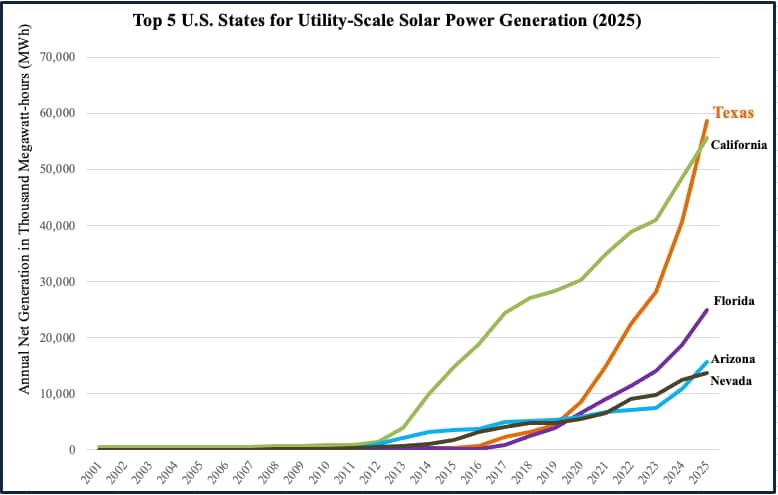
Comment by khalic 3 days ago
Comment by hibikir 3 days ago
So even if a place like the US goes lighter on solar that is reasonable, Places like Spain, Italy or Morocco will go all in just to minimize dependence on a resource a third party can control. It's the ultimate counter to the Hormuz situation. Squeeze access to oil for long enough, and you accelerate the move away from it.
Comment by fleroviumna 3 days ago
Comment by alexk307 2 days ago
The U.S. solar industry installed 43 gigawatts (GW) of new capacity in 2025, remaining the dominant source of new capacity added to the grid for the fifth consecutive year. Solar and energy storage represent 79% of new capacity installed in the first year of the Trump Administration [2].
[1] https://www.chooseenergy.com/solar-energy/solar-energy-produ...
[2] https://tedmag.com/report-u-s-added-43-gw-of-new-solar-capac...
Comment by knowaveragejoe 2 days ago
Comment by dalyons 2 days ago
Comment by bardak 3 days ago
Comment by PyWoody 2 days ago
Comment by triceratops 2 days ago
Comment by xnx 2 days ago
Comment by triceratops 2 days ago
Comment by cheevly 2 days ago
Comment by arbitrary_name 2 days ago
Comment by bergie 2 days ago
Comment by cogman10 2 days ago
For the right to actually embrace solar, you need either big money in solar to start it's own propaganda campaigns or you need big oil to collapse to the point where they can't afford paying propagandists. Right now, they are making record profits so don't count on that anytime soon.
Comment by throwaway030 3 days ago
Comment by EcommerceFlow 2 days ago
Comment by linuxftw 2 days ago
Comment by ks2048 2 days ago
Maybe the voters don't, but the businessmen and politicians definitely do, maybe more so than democrats. Just in different sectors (military).
Comment by crote 2 days ago
Obvious counterpoints: Trump's $700m "clean, beautiful coal" handouts, or Trump's $2B buyback of wind farm leases.
Comment by linuxftw 2 days ago
Comment by triceratops 2 days ago
Comment by bluGill 2 days ago
Comment by dpkirchner 2 days ago
Comment by bluGill 2 days ago
Comment by TheCoelacanth 2 days ago
Comment by linuxftw 1 day ago
Comment by triceratops 1 day ago
The answer is already "no" without regulation. Might as well regulate.
What other options are there? Mind-control?
Comment by dpkirchner 1 day ago
Comment by basch 2 days ago
Comment by JuniperMesos 2 days ago
Comment by basch 2 days ago
>Private industry should be able to profit off the sun and it's disturbing that you think asserting this is a dunk.
It wasn't a "dunk", you added that interpretation yourself.
Comment by carlosjobim 2 days ago
Comment by PaulDavisThe1st 2 days ago
A bit of realism would help here. Yes, there's a left/NIMBY overlap to some degree, but the forces from the non-right camp seeking to limit power development comes from the NIMBY elements, not the left elements.
Comment by carlosjobim 2 days ago
Germany recently finished their complete dismantlement of the nations nuclear power. Another nuclear country Sweden, has shut down seven of their reactors, but are at least rhetorically changing back to supporting nuclear.
Go and talk in real life with people on the left and you'll find many of them are against nuclear power. Go and talk in real life with people on the right and it will be hard for you to find anybody who is against solar power. Because why would you be against solar?
Comment by PaulDavisThe1st 2 days ago
Comment by carlosjobim 1 day ago
Comment by PaulDavisThe1st 1 day ago
Comment by carlosjobim 1 day ago
Comment by PaulDavisThe1st 1 day ago
> The demands to remove power sources come from the left.
Comment by carlosjobim 1 day ago
I also wouldn't have written "remove a power source", since there are movements on the left against several different power sources, including nuclear and coal and maybe more. In the context of this discussion we might however stick to just talking about nuclear and solar.
Comment by bluGill 2 days ago
Comment by carlosjobim 2 days ago
Comment by ZeroGravitas 2 days ago
https://ember-energy.org/data/electricity-data-explorer/?tem...
Solar's global peak month in (northern hemisphere) summer 2024 nearly equaled nuclear, the full calendar year 2025 slightly beat nuclear and now it's possible that the next yearly minimum month coming up this december will match nuclear. That's a lot of change in just 2.5 years.
Also, the graph shows the world needs more wind power as it counter cycles both solar and hydro supply.
Comment by WalterGR 2 days ago
Comment by postepowanieadm 2 days ago
Comment by mhh__ 2 days ago
Comment by WhrRTheBaboons 1 day ago
Currently Solar PV output is incredibly unbalancing but hopefully batteries will offset that in the coming years
Comment by shellwizard 2 days ago
Comment by postepowanieadm 2 days ago
Comment by chickenbig 2 days ago
Put alternatively, better rates for consumers. How should one portion the cost of the electrical system as a whole to different groups of people? If someone seldom draws electricity from the grid, and only when it is likely more expensive how much should they pay? What about the limit where everyone is a prosumer and has this usage pattern?
Comment by postepowanieadm 1 day ago
Comment by rr808 2 days ago
Comment by alex_duf 2 days ago
Comment by 8bitsrule 2 days ago
"Current levelized cost of storage ranges from $150-300 per MWh for established pumped-storage systems, while newer solid-mass gravity systems estimate costs of $200-400 per MWh. These figures are competitive with long-duration storage applications but remain higher than lithium-ion batteries for shorter-duration uses."
https://eureka.patsnap.com/report-gravitational-potential-en...
Comment by cowlevel 2 days ago
Comment by myrmidon 2 days ago
https://gravity-storage.com/technical-concept/
But battery storage is a proven technology now and the cost trends with such bespoke megaprojects are not looking promising, so I'm not holding my breath.
Burning (regenerable) metal fuel in old coal power plants is also an interesting approach:
https://www.sciencedirect.com/science/article/pii/S2666352X2...
Comment by Maxion 2 days ago
Batteries are scheduled to become so cheap that these type of physical storage systems just won't be able to keep up in terms of cost.
Most pumped hydro projects are now put on hold as batteries have been coming down.
Comment by Flere-Imsaho 2 days ago
https://www.elevenenergy.co.uk/#sodium-ion
They are larger than lithium batteries, but potentially cheaper and better performing around temperature extremes.
Comment by chickenbig 2 days ago
Wait, you can schedule price drops?
https://www.nature.com/articles/nenergy2017110 / https://www.cell.com/joule/abstract/S2542-4351(18)30583-X make the battery takeover look like a foregone conclusion, but past performance is no indication of future performance.
Also what about the systems to turn the batteries into something useable? It is telling how cheap lead-acid batteries looked on the first paper's Figure 2, yet overall system costs were vastly higher.
Comment by tim333 2 days ago
Like CATL announced a cost of $19 per kwh. https://electrek.co/2026/07/16/catl-sodium-ion-15000-cycle-g...
which I think is far cheaper than the prices in your links. I think they'll have a job going lower for a while as the raw materials are ~$10.
I think the actual cost to buy one now it more $40-60. The $19 is probably their target in a while.
If you spread $60 over 15000 cycles that's 0.4c per kwh stored and returned which is pretty cheap compared to what I pay for electicity (~$35c).
Comment by chickenbig 1 day ago
Plus battery assembly and installation costs (inverter, grid connection).
> If you spread $60 over 15000 cycles
A 30 year lifetime (11k cycles if charged/discharged once a day). Using a 5% discount rate the cost goes up to 0.78c/kWh for the cells. The cost goes up if it can not cycle once a day, for instance intermittent source of energy or excess capacity. And the cost goes up with all the rest of the equipment involved, and round trip efficiency.
Comment by Animats 2 days ago
Comment by micw 2 days ago
Example: Lifting a 10-metric-ton stone by 36 meters stores just about 1 kilowatt-hour (kWh) of energy. This is roughly equivalent to the capacity of a small power station used for a camping trip.
Comment by leonidasrup 2 days ago
Comment by loomy7 2 days ago
A single cell is about $5 in volume, while 100kg of fill dirt and rock is about $2. At this point new pumped hydro or gravity batteries don’t scale like li-ion does. This tips even more towards normal batteries when you look at sodium or other cheaper but less energy dense batteries.
Comment by robin_reala 2 days ago
Comment by Roark66 2 days ago
But the beauty of solar is that it makes you independent from the grid. China makes the whole system. Cheap, but good quality solar panels. Cheap inverters - these are actually pretty good for the price. And finally cheap LFP batteries.
When amount of solar capacity exceeded half of entire grid, my country has established few silly rules to stop the growth.
For example let's say your house's grid connection is 24kW 3phase. If you want to connect your solar to the grid and feed in power you are limited to 24kW peak solar panels, and.... 24kWh of battery.
This is beyond stupid, but there is more... If your inverter is 10kW or more you have to give the grid operator full control over your system. They then decide when you are sending power to the grid, when you use your battery and when you use the grid. Of course they will make you push to the grid when prices are the lowest and you'll consume from the grid when they are highest.
So many people do what I did. Build off grid systems with ability to swap between the grid and the system.
Such systems do not have to be registered anywhere and I bet they are responsible for huge amount of power use.
For example before I installed solar I wouldn't even think about installing a heat pump for both air con and heating. But having extra power allows me to do it economically.
Comment by bluGill 2 days ago
No we don't. Battery systems can stabilize the grid. You need inverters that are designed for this, but it isn't hard to make an inverter that will set then grid frequency and force it correct. You want most inverters to follow the source, but something needs to set it.
Most rotating steel isn't setting grid frequency either, an induction motor follows the frequency of the grid, and generates power if it is rotating faster than the grid frequency. (this is much more complex, but close enough for a quick comment).
Comment by Roark66 2 days ago
>No we don't. Battery systems can stabilize the grid. You need inverters that are designed for this, but it isn't hard to make an inverter that will set then grid frequency and force it correct.
I know in theory we don't, but in practice there is no such real grid anywhere in the world that would run on large percentage of solar. So it seems we do.
I'm talking about real grid as something that powers at least thousands of households. Not a compound with a dozen buildings.
Take Canary Islands for example. They are an ideal environment to setup a 90% solar and battery grid. They have a great climate and size well suited to this. But they still run thermal plants.
Why? Because no one has successfully showed a largish scale frequency regulation/stabilisation with inverters.
See a writeup about the Texas outage a year or two ago to understand how fragile grids with too large percentage of semiconductor sources are compared with rotating masses.
Comment by mphillips 13 hours ago
This is a regular event outside of the winter months, and has been for some years now. South Australia has a mixture of solar, wind, and gas generation, with some large batteries as storage.
Comment by Stevvo 1 day ago
Comment by Stevvo 1 day ago
Comment by bhouston 3 days ago
I guess this is in part because it only needs amazing factories and not complex deployed and maintained infrastructure that is at risk of blowing up.
Solar seems to fix the mould of a disruptive technology to a T.
Comment by pfdietz 3 days ago
After all, if they could predict the future, why did they design a game rather than get rich in the stock market?
Comment by beanshadow 3 days ago
Comment by bhouston 3 days ago
Comment by pfdietz 3 days ago
Comment by bhouston 3 days ago
https://ourworldindata.org/grapher/installed-solar-pv-capaci...
Comment by pfdietz 3 days ago
https://news.ycombinator.com/item?id=20782346
(Needless to say, I don't have a high opinion of current fusion start ups.)
And fission already had the financial fiasco of the first nuclear build out in the US.
Solar could have been predicted to get really cheap, if one had heroically projected its experience curve into the future. A lot of people chickened out doing that, even Greenpeace.
Comment by bhouston 2 days ago
Comment by pfdietz 2 days ago
Comment by marcosdumay 1 day ago
It got out of the spot for a few decades when everybody started to be on nuclear power, but by the 1980s it was obvious nuclear wouldn't get there.
Comment by sheikhnbake 3 days ago
Comment by rtkwe 3 days ago
[0] Yes pollution from normal everyday fossil fuel power generation causes more damage and deaths in the aggregate but it's a diffuse hard to attribute kind of damage which makes it far less, for lack of a better way to say it, real to people. eg: Did living downwind of that unupgraded coal plant really kill them or is their death because of something else.
Comment by rootusrootus 3 days ago
Comment by rtkwe 2 days ago
Comment by triceratops 2 days ago
Comment by rtkwe 2 days ago
Comment by triceratops 2 days ago
Comment by no-name-here 2 days ago
Comment by cucumber3732842 2 days ago
For industrial sites (including nuclear) there should have to be some sort of containment requirements or insurance/bonds for cleanup but if those can be met I don't see why it should matter any more than a soda bottling plant.
Comment by dalyons 2 days ago
Comment by BobaFloutist 2 days ago
Comment by pfdietz 3 days ago
Comment by jmyeet 2 days ago
To borrow the meme about LISP [1], if nuclear was so good, it would've caught on at any point in the last 80 years. And it hasn't for some good reasons:
- It's too expensive. As an example, Hinkley Point-C in the UK has a super high negotiated rate that only lasts 35 years for a plant that still needs a lifetime of 60 to justify the investment so who knows how expensive the power will be for those last 25 years;
- It takes too long to build, typically ~20 years;
- Fuel processing (to create the fuel rods) creates a lot of harmful waste (eg UF6) and it is not a solved problem;
- Processing of spent fuel is not a solved problem. There's this idea that you just stick it in a barrel and leave it for a thousand years doesn't match the reality. It typically needs active cooling for possibly decades, for a start;
- Failure modes for a single plant dwarf any other alternative. The standard counterpoint is global warming from fossil fuels but that's for the entire fossil fuel ecosystem. The clean up for Fukushima, for example, will likely take over a century and cost over $1 trillion;
- The taxpayer bears the burden for these failures because, in the US for example, the industry self-insurance fund is a couple of orders magnitude too small to cover it;
- Nuclear requires liability limits well below any such failure mode to make it remotely economical (eg the Price-Anderson Act liability limits);
- The ecosystem of building, maintaining, repairing, servicing, monitoring and regulating nuclear power plants as well as all the supply chains (eg transporting and storing fuel) takes a long time to scale up.
I really wish I understood why nuclear has this cult-like following. It's completely irrational.
Comment by MisterMower 2 days ago
We tolerate all kinds of externalities from fossil fuel energy production and environmental degradation due to rare earth mining required to produce solar panels and wind turbines.
Nuclear energy is the only industry required to mitigate all possible externalities, and for that reason it is very expensive.
It’s disingenuous to claim nuclear power is a failure because it’s expensive to build without examining the reasons why that might be.
For proof it can work and is both safe and economical, witness the Chinese currently building 40 new nuclear plants. We could do that here, but choose not to. The only missing ingredient is political will, and resistance from ill-informed people such as yourself.
Comment by jmyeet 2 days ago
I love this argument because it's never qualified. What regulations exactly make nuclear unaffordable? How many of them are safety related? Is safety not necessary?
It's just a hand-wavy argument for nebulous deregulation when all the evidence suggests that no industry is capable of self-regulation.
> ... rare earth mining required to produce solar panels ...
Solar panels don't require rare earths.
> Nuclear energy is the only industry required to mitigate all possible externalities
This is just objectively false. Fuel processing, spent fuel processing and storage and failure modes are absolutely not completely mitigated or even solved problems.
> For proof it can work and is both safe and economical, witness the Chinese currently building 40 new nuclear plants.
Well if 40 power plants are being built, you can't really say that their operational record is that they're "safe and economical" because they have no operational record, right? Now China has other nuclear power plants but you're not arguing with those.
China has several advantages no Western country has:
1. A standardized design so economies of scales with components;
2. State subsidies such as ultra-cheap finance; and
3. If people who manage and oversee such plants skimp on such maintenance they'll likely be executed.
Comment by dpkirchner 2 days ago
Plus, 4. The ability to do long-term planning.
5. An engineering culture instead of a lawfare culture.
There's upsides and downsides to both of these facts, of course.
Comment by MisterMower 1 day ago
Suppose you tell a football player, your overriding priority is not getting hurt. If you get hurt or do anything that might get you hurt, you are out of football for life. Now go out there and win this game.
Those, in a nutshell, are the incentives the nuclear industry in the US faces. Whatever you do, you must never have even the tiniest release of radiation. Safety is the overriding priority. Cost doesn't matter. If there is any wiggle room in your cost structure, you must spend it on making the possibility of a release even smaller.
Meanwhile, we accept major amounts of smog and carbon dioxide emissions from gas power plants, we accept significant environmental degradation due to mining minerals for wind and solar plants, and we tolerate radioactive fly ash from coal power plants beyond the levels we would allow emitted from nuclear power plants.
> Fuel processing, spent fuel processing and storage and failure modes are absolutely not completely mitigated or even solved problems.
The French did solve this problem using a large breeder reactor where they reprocessed nuclear fuel, and the US was on track to build something similar in the 1970's until the Carter administration banned breeder reactors in 1977.
Choosing to not use a breeder reactor means spent nuclear fuel has to just sit there and be guarded while we also have to go and mine and process more nuclear fuel from scratch to run our existing reactors. It's hard to imagine a more idiotic regulatory regime.
> Well if 40 power plants are being built, you can't really say that their operational record is that they're "safe and economical" because they have no operational record
China has 60 existing nuclear power plants that have operated safely and efficiently, and there is no reason to think that these would operate any less effectively. They will likely be even more safe and efficient.
China has a single advantage over the US when it comes to nuclear: they can ignore people like yourself who don't understand how nuclear power works and just build it. The US would be wise to emulate that approach, especially given we do already do this when it comes to flock cameras or AI data centers.
Comment by krior 2 days ago
Is there a plant where the enviromental costs of building and decomissioning a plant and of extracting and enriching the fuel are completely mitigated?
Comment by dpkirchner 2 days ago
I believe it is largely because it is so unviable. If you can shut down any power supply argument with "but muh nuclear" then you can ensure that we keep burning coal and gas forever. And as a bonus, you get to pretend you're the smartest person in the room for having come up with the only good solution.
Comment by kortilla 2 days ago
Because “cost” is not an argument against something that hasn’t been scaled. Nuclear was snuffed in the crib before any repeatable plants could be brought online.
If you looked at the cost of solar in 1995, using it to power anything like a house was a complete joke. It had to fall over an order of magnitude and leave behind a trail of solar company corpses to get to a point where you can break even after 10 years putting them on a house.
Solar and wind need storage to make a complete solution, so when it comes to climate change discussions, you just end up with two “irrational” groups arguing about the optimistic potential things that don’t actually exist at an affordable cost.
Comment by poszlem 3 days ago
Comment by xnorswap 3 days ago
Finally, some much needed progress towards Sagan's apple pie.
Comment by dv_dt 3 days ago
Comment by numpad0 3 days ago
Comment by triceratops 2 days ago
Comment by omnivortex 2 days ago
Comment by maxhille 2 days ago
Comment by bhouston 3 days ago
Comment by aitchnyu 2 days ago
Comment by numpad0 3 days ago
Games like SimCity often only supports ultradense Manhattan style cities and centralized solar plants through distribution networks. That combination doesn't work with solar technology. It should be like "Set up offgrid solar incentives program($1.5B)" buttons that reduces power draw proportionate to numbers of standalone houses that resets when disaster hits the parts of the map it was used on.
Comment by hibikir 3 days ago
Solar seems to be working just fine in Spain, a place where almost nobody lives in a stand alone house, or even a row house. You still put solar in the building, but then you have industrial solar in places wi5 little agricultural value, and wind turbines installed on top of hills. All of this could work just fine in any sim city I remember, as you are just dedicating space to power, which is fine.
Comment by kortilla 2 days ago
Comment by jmyeet 2 days ago
Plus below a certain cost threshold, the risk of damage still means the overall cost is lower.
Comment by hackernud3s 2 days ago
Comment by bergie 2 days ago
Comment by numpad0 2 days ago
The situation is slightly different for rooftop solar installations, which are equally prone to flying debris as concentrated farms but somewhat less likely to be affected by disasters that the house it is on can withstand. But that would be for off-grid purposes and not for the grid, and my original comment that solar generation only works for on-prem off-grid applies.
Comment by bergie 2 days ago
Plan it and it won't be a huge deal.
That said, I'm sure there are spots on this planet where solar isn't the best renewable option. Maybe small-scale wind power would be better where you are? On our boat we have both (and hydro for when we're sailing). Sadly these mechanical generators haven't yet received similar scale effects to their price as solar has.
Comment by cyanydeez 3 days ago
Nuclear's problem, despite it's Champions assertion that it's now safe and properly engineered, is it's still inherently dirty and that dirt follows it through out it's life. It also probably has bloody mines, but every step on the path of using nuclear requires security and safety, and even when it's disposed, it still requires safety and security. It loses because no one trusts anyone along the entire value chain to not cut corners that leads to unsafe practices.
Comment by numpad0 3 days ago
I think there was some ex-French colony government that demanded France disclose details of nuclear waste burial sites for "safety" reasons, which France rejected. Which means it happens. That kind of thing is why nuclear wastes are supposedly and actually so "dangerous" and small private owned generators get "complicated".
Comment by bhouston 3 days ago
Comment by parineum 3 days ago
It's from 2022, so probably outdated.
> According to the US Department of Energy (DOE), about 12% of all silicon metal produced worldwide (also known as “metallurgical-grade silicon” or MGS) is turned into polysilicon for solar panel production. China produces about 70% of the world’s MGS and 77% of the world’s polysilicon. Converting silicon to polysilicon requires very high temperatures, and in China it’s coal that largely fuels these plants. Xinjiang—a region in China of abundant coal and low electricity prices—produces 45% of the world’s polysilicon.
> Reports indicate that some Xinjiang polysilicon plants have employed forced labor of Uyghurs, an intensely persecuted Muslim ethnic minority.
[0] https://blog.ucs.org/charlie-hoffs/mining-raw-materials-for-...
Comment by cyanydeez 2 days ago
Comment by parineum 2 days ago
That doesn't change that you've made a total apples to oranges comparison by using the environmental cost of nuclear fuel to the cost of having a solar panel.
Both produce a finite amount of MWh for their lifetime. Both require mining. How much mining and human rights violations exist per unit of energy produced is the metric you're looking for.
That's complicated though. Easier to pretend like it's zero for one and non-zero for the other.
Comment by chronial 2 days ago
> It needs mines, but those are easily forgotten about once the blood money is washed through a few hands.
This sentence was commenting on solar panels.
Comment by Megranium 3 days ago
Comment by cucumber3732842 2 days ago
Comment by jeffbee 3 days ago
Comment by phtrivier 2 days ago
1. This must be a nightmare to plan the maintenance of a nuclear-heavy grid (as we have in France.) Any nuclear project must be planned 20 years, including just "keeping" what you built 50 years ago. So, assuming they're not stupid and are reading the changes in batteries and PV, anyone working on that knows that, potentially, during the 8th year of a 10-year construction plan, your all plan will have become obsolete.
But, if, for some reason, the evolution is not skyrocketing, and if you _don't_ plan on maintaining / replacing your plans (assuming that "batteries and EV will just solve it"), then you take the risk of, well... not having enough electricity.
So I suppose it's a trade-off between "the risk of have too expensive nuclear capacity", "the risk of loosing face and shutting down a plant construction because it's useless", and "the risk of not having electricity".
I suppose the calculation is that, if you do the first one (as we're doing, as far as I can tell), you end up with sunk cost, but your reactors are there, and you can always find something to do with it...
2. Is there an "Ormouz of solar" scenario ? What would be a SPOF in the solar + battery rollout that could bring the solarpunk world to a halt ? Obviously it's less at risk because, once the PVs and batteries are out of chinese factories, they will produce electricity no matter who rules in Beijing ; but, appart from Xi (who already controls pretty much everything we consume, at this point), is any particular country / corporation gaining leverage if the whole world goes full PV+B ?
Comment by piskov 2 days ago
Is it true? France built more the 40 nuclear reactors in the 80s. I doubt it started “planning” for those in late 50s.
Ain’t designs standardized? Russian Rosatom builds a nuclear plant in 5-7 years
Comment by phtrivier 1 day ago
In short, yes, France was able to build a lot of nuclear in the 80s, but the plans were made in the 70s and, to some extend, reused design and research from the 60s.
Mostly, they benefited from pre-Tchernobyl regulations, and a standardized design that would not be accepted anywhere in the world today if you started from scratch.
After a long hiatus, we sort of managed to build an over engineered post-Fukushima reactor (EPR) in about 20 years, and hopefully learnt lessons so that the next version of the new thing (EPR2) is less of a disaster - but still, you're talking about a decade and a half from presidential ink on paper to electron in the grid if everything goes well - and nuclear is one of those industries where things never go well. Mesmer plan is the exception, not the rule (except if you're Chinese, of course...)
Comment by piskov 1 day ago
Comment by marcosdumay 1 day ago
Yes. At some point somebody will weaponize smart inverters.
It's avoidable if people suddenly decide to not act stupidly. I classify that as unlikely. It's also fixable, just like the oil Hormuz.
Comment by phtrivier 1 day ago
Comment by marcosdumay 1 day ago
Comment by toomuchtodo 3 days ago
https://ourworldindata.org/grapher/solar-pv-prices
The World Crossed a Major Solar Milestone [3TW] - https://news.ycombinator.com/item?id=49151977 - August 2026
Comment by everdrive 3 days ago
Comment by crote 2 days ago
Comment by breakyerself 2 days ago
Comment by ben_w 3 days ago
That's on the small side of things, of course, but we also have PV-covered carports for about the same as a non-PV-covered carport: https://www.kaufland.de/product/512021383/
Comment by bardak 2 days ago
Comment by ben_w 2 days ago
I was considering this earlier in the year, as it happens.
Comment by bardak 2 days ago
Comment by chronial 2 days ago
Comment by dzhiurgis 2 days ago
Comment by dzhiurgis 2 days ago
Comment by ben_w 2 days ago
Comment by wumms 2 days ago
Comment by bergie 2 days ago
They're so cheap that bars in Colombia had panels as their terasse awnings. Cheaper than cloth and makes power.
Comment by bardak 3 days ago
Comment by stetrain 3 days ago
The cost of the panels themselves is becoming one of the cheaper parts of that project.
Comment by serioussecurity 3 days ago
Comment by caymanjim 2 days ago
This article isn't about personal solar installations, in any event.
Comment by xnx 2 days ago
Comment by bluGill 2 days ago
Comment by hdjdnxjzhzhs 2 days ago
Before you get angry, remember what the sun is....
Comment by zahlman 2 days ago
Comment by whatsdowndog 2 days ago
Comment by nromiun 2 days ago
Comment by kortilla 2 days ago
Comment by dyauspitr 3 days ago
Comment by MSFT_Edging 3 days ago
The real money is convincing marks to take the financing for 20+ years.
Comment by dalyons 3 days ago
Comment by rootusrootus 3 days ago
None? Project Solar? The last time I seriously looked at doing rooftop panels, they were significantly cheaper than the door-to-door jerks.
Comment by dalyons 2 days ago
Comment by rootusrootus 2 days ago
Comment by dalyons 2 days ago
There's probably more to the regulatory problem than just the permits i guess.
Comment by rtkwe 3 days ago
There's also other factors like the overall cost being beyond people's willingness to save for when financing is available or the extra value that financed installs can provide the underwriters when they're bundled and sold as a stable income stream like houses were in the mid 00s.
"If it can be done cheaper someone will" is based on a lot of simplifications and assumptions about the market in question.
Comment by lightedman 3 days ago
Untrue, at Sunspark we sold to both individuals and companies. If you can install the stuff yourself, buying it direct from the manufacturer is ungodly cheap (~330w panels at $80 a piece when I worked there almost decade ago.)
Comment by dalyons 2 days ago
Comment by rdtsc 3 days ago
Comment by ghusto 3 days ago
Comment by myphpgothacked 3 days ago
AI can't take my job then.
One indicator is that third world countries can seem to afford it.
Comment by fatbird 3 days ago
The fallacy is that there are infinite market opportunities but a finite supply of entrepeneurs/business/money to exploit them. Therefore, there are an infinite number of market opportunities that will get passed up for one reason or another.
Comment by rconti 3 days ago
Comment by benrutter 3 days ago
One thing that isn't super obvious from the article is that a lot of it is talking about industry solar panels rather than rooftop. The overheads of installation etc get a lot smaller if you're installing a whole bunch at once.
This isn't to say that installing solar panels on your house is a bad idea - they normally pay for themselves after something like 10 years from memory, so are similar to double glazing.
[0] https://www.energy.gov/cmei/systems/overview-trade-and-polic...
Comment by rootusrootus 3 days ago
I would guess this varies by locale, and people usually assume the time value of money to be zero when they make the claim. In much of the US, I think the payback time is more realistically in the 15-20 year range, which means you really only want to install panels when you install a new roof. Otherwise the lifetime of the roof will happen before break even on the panels.
Comment by rdtsc 3 days ago
I am with you, this would be better on a town or regional basis instead of on everyone’s roof. Our houses already have wires going to them and I can’t imagine my particular roof or garage is the best place to put panels and batteries. But I understand it’s a political / administrative issue which may well be not solvable easily in many places.
Comment by sagarm 3 days ago
Comment by KerrAvon 3 days ago
Comment by pfdietz 3 days ago
Comment by blitzar 2 days ago
Comment by toomuchtodo 3 days ago
The biggest cost components are sales and marketing expenses and similar soft costs. Some of this can be driven down if you collectively buy through something like https://solarunitedneighbors.org/
(have installed 100kw+ of residential solar, ama)
Comment by lightedman 3 days ago
Yea, if you go to an installer instead of buying from the OEM and installing yourself. I likely made your panels at SunSpark (We made panels for everyone, Renogy, Juinko Solar, Samsung, etc.) They were sold for $80 at 330w - 4.125 watts per dollar, or a quarter per watt.
Solar isn't expensive - you are.
Comment by toomuchtodo 3 days ago
I am not a commercial system installer, I am a hobbyist enthusiast who helps others install to avoid commercial installers and their costs. Volunteer labor for everything (racking, panels, electrical), volunteer electrician signs off for any AHJ (authority having jurisdiction) requirements.
Most people cannot install the equipment themselves, which leads to the residential costs I mention. Is it expensive? Price is what you pay, value is what you get. If you cannot find someone to install for free, and cannot do it yourself, the price is the price. You can either choose to pay market rate after getting multiple bids, or choose to go without.
US Dept of Energy: Solar Photovoltaic System Cost Benchmarks - https://www.energy.gov/cmei/systems/solar-photovoltaic-syste...
Energy Sage: Solar panel cost in 2026 - https://www.energysage.com/local-data/solar-panel-cost/
(i am also a community outreach volunteer for https://www.gosolarapp.org for automating permitting and remote inspections across the US, which was incubated at NREL prior to being spun out as an independent non profit; this drives down permitting soft costs)
Comment by lightedman 2 days ago
This is highly untrue, until you get to the task mounting on a roof. Barring that, making a solar array system is dead simple. Most anyone can turn a screwdriver or build a frame or connect very distinct connectors together (they just snap together for daisy-chaining solar panels) or insert a power plug into a NEMA receptacle (for balcony solar installs.)
It is the install on the roof itself which most people cannot do (because they lack roofing knowledge.) Every other thing is absolutely DIY by pretty much anyone with hands and eyes.
Comment by toomuchtodo 2 days ago
Literally the most important part is what most people cannot do. If you have the space, sure, ground mount. Most people do not have the space, nor are they going to be confident in putting penetrations in their roof deck to mount racking to hold the panels.
Comment by ramesh31 3 days ago
Comment by stevekemp 2 days ago
I'm looking forward to installing a couple of panels on the roof next year. Having power to charge my phone, or laptop, won't take much capacity, I'm not going to use much power other than that, maybe some music but nothing like cooking/heating, or similar heavyweight usage. (I have a wood stove for heating, and gas/alcohol stoves for cooking, along with on-site water.)
Comment by toomuchtodo 3 days ago
It's the equivalent of a bond investment with potential subsidies at the utility, state, and federal level (solar is no longer subsidized, but batteries still are).
Comment by rootusrootus 3 days ago
So long as the roof itself lasts that long. People who are mid-cycle on their existing roof should not install solar until they get to the next replacement. This is where I am, and why I do not have rooftop solar. I expect to get 15 additional years from my roof, and there's no guarantee I will have hit the break even point by then. Plus, solar installers will not warranty a mid-cycle roof against leaks, so if something goes wrong that quickly eats into your cost savings.
Comment by rcxdude 2 days ago
Comment by toomuchtodo 2 days ago
Comment by BobbyTables2 3 days ago
Comment by toomuchtodo 3 days ago
https://www.energysage.com/news/solar-panels-withstand-hail/
- Every panel sold in the U.S. has to pass an industry-standard hail test, which fires ice balls at multiple points on the panel and requires no visible cracking, delamination, or more than a 5% drop in power output afterward. Companies like UL Solutions, an applied safety science company, test solar panels by dropping a two-inch solid steel sphere from 51 inches onto panels, simulating the impact energy of serious hail. Panels that survive without electrical hazards earn certification for real-world deployment.
- The proof is in the pudding—or in this case, the parking lot. When a severe hailstorm hammered the National Laboratory of the Rockies' (NLR) (formerly National Renewable Energy Laboratory (NREL)) Colorado campus in 2017, just one single panel out of more than 3,000 suffered damage. That's a 99.97% survival rate against Mother Nature.
Comment by Arubis 3 days ago
Comment by benrutter 3 days ago
Comment by nemomarx 3 days ago
Comment by linsomniac 2 days ago
Comment by pjc50 2 days ago
Comment by dyauspitr 2 days ago
Comment by ForHackernews 3 days ago
Comment by izzydata 3 days ago
Comment by dalyons 3 days ago
Comment by Schiendelman 2 days ago
Comment by BobaFloutist 2 days ago
This is really surprising to hear. Are you sure about that?
Comment by tstrimple 2 days ago
Comment by BobaFloutist 1 day ago
Comment by dalyons 2 days ago
Comment by jeffbee 3 days ago
Comment by Qworg 3 days ago
Comment by dataviz1000 3 days ago
Comment by dv_dt 3 days ago
Comment by eppp 3 days ago
Comment by adverbly 3 days ago
On-prem has a problem of distributed labour costs.
On-prem might eventually become cheaper, but my guess is that won't happen any time soon.
For the time being, centralized and at-scale installation is where you can get much, much lower labour per watt costs.
Comment by jillesvangurp 2 days ago
Other places (like the EU and especially the US) have regulatory problems around anything to do with energy. This is mostly about ass coverage resulting in a lot of pressure for certification, related fees, grid operators insisting on a lot of overhead, building codes requiring a lot of faffing about for the business of wiring together what is essentially plug and play stuff, etc.
If you have an off grid shed, providing power to it is cheap and easy because you have none of that. You buy the hardware on amazon or wherever. It arrives, you wire it up. Job done. And if you are smart you might let a qualified electrician do it right for you or at least check your work (so your shed doesn't burn down and nobody dies from electrical shocks). But fundamentally it's not that hard and this stuff is mostly pretty safe and easy to work with. Especially compared to the things people burn down their sheds with traditionally (e.g. generators).
There's a lot of optimization potential here and most of that is completely non technical.
Comment by eppp 3 days ago
Comment by carlosjobim 2 days ago
Comment by bryanlarsen 3 days ago
Comment by dyauspitr 2 days ago
Comment by vicwwaters 15 hours ago
Comment by inSumErgoCogito 3 days ago
Comment by everdrive 3 days ago
[edit]
According to HN you can totally do this and I'm just wrong.
Comment by horsawlarway 3 days ago
Most solar installs work by tying into the existing main breaker of the home.
The cheapest way to do this is to leave the line feeding from the power meter to the main panel untouched. Instead you do anti-islanding detection at the inverters, and when they detect that mains is "down" they automatically cut off to prevent trying to backfeed power to your whole neighborhood during an outage (dangerous, not a good idea).
---
Second issue - there are many appliances that are NOT happy about being turned on and off at random times, and it can significantly impact their lifespan (ex - refrigerators, acs, computers, washers & dryers, etc).
So given the variability of direct solar, you don't want to accidentally destroy your ac unit by having it turn on and off 100 times as random clouds float by.
---
But! If you're willing to install even moderate battery capacity (and LFP is getting quite cheap as well). Then you can absolutely do this. It's just more complicated and more expensive.
You need to wire in a mains relay (~$1,000 depending on the unit) and install some battery capacity to prevent very frequent startup/shutdown, then go through some painful additional signage and labeling requirements (at least in most of the US) and also install some additional shut-down switches on the exterior of the home (ex - to automatically turn the inverters off, and to shutdown the battery system).
Then, yes, you can absolutely stay on solar power while the grid is down. In the same way that people are allowed to run whole-home generators to stay online when the grid is down.
Comment by everdrive 2 days ago
Comment by horsawlarway 2 days ago
Pretty much. I vaguely remember a couple of "off-grid" devices that try to automate this for you (ex - you can set a priority on each breaker, and as supply dips, they get dropped in order of priority).
But functionally speaking, you just need to install a battery. Frankly - Batteries aren't discussed as much as solar, but the big breaking point we're hitting right now isn't just that solar has gotten incredibly, unimaginably cheap.
It's that BOTH batteries AND solar are getting very, very cheap. And the new generation of batteries are also considerably safer than the original lithium batteries.
Lithium Iron Phosphate batteries (LFP) are ~$60/kWh right now. I can buy them commercially in bulk in the US around ~$80 (pretty much all china production - full stop. Historically, I've bought EVE cells, but I'm now seeing direct BYD branded cells as well).
If sodium-ion can hit the same price points (and odds are looking better and better they'll both hit and then plow past as they bulk up production) then my read is that modern power plants are going to be very, very different.
They'll look a lot more like the connection structures we see for trees - a bunch of connected independent installs that can optionally cooperate as needed. Ex https://www.bbc.com/future/article/20260928-a-virtual-power-...
Comment by thelastgallon 2 days ago
Home circuitry, load center need to be redesigned for V2X (vehicle to grid, home, load, etc), plug-in solar and batteries, solar/batteries replacing generators, etc. You seem to have thoughtful ideas about these and it would help to have someone knowledgable articulate how it should be done.
[1]The idea is that they can change the world right now by understanding what they want in their world (clean and free energy) and that they need to ask for those changes because buildings last ~100 years. The lowest hanging fruit is future-proof all construction and have it be ready for incremental changes without needing any labor or permitting work.
Comment by MisterMower 2 days ago
Comment by arbitrary_name 2 days ago
Comment by MisterMower 1 day ago
Imagine I was running a non-profit that teaches middle and high school kids about the human body and the first thing I have them do is to look up their legislator and ask them to pass anti-abortion legislation.
In both situations, kids are being used to promote a political agenda.
It's no different than the parents who bring their kids to protests and make signs for them to hold. Except parents likely explain why they're bringing their kid to a protest. This guy just straight up uses them for his own political goals before even explaining why they're doing it.
You should find that icky.
Comment by thelastgallon 2 days ago
Its kids deciding for themselves about the world they want to live in and what features they want in it. Buildings last ~100 years and most likely they are going to live in a home that was built in the past. If they want modern features or amenities without spending a fortune rebuilding the house, its best to future proof.
Comment by MisterMower 1 day ago
> the first thing I have them do is find out the county building code engineers[1] and ask them to update the code
Based on your other comments, it doesn't appear you're qualified to be teaching kids about this stuff in the first place, given the lack of understanding about basic electrical code.
The real world is full of tradeoffs. If you also told the kids that mandating 240V outlets in garages would increase the cost of new homes by $1,000 they may have a different opinion on the matter, given that those college kids you're teaching probably imagine themselves trying to buy a home in a few years.
Years ago I owned a home built in the 1980's that had a central vacuum system. It was a cool concept but utterly useless. No new homes that I know of have these systems anymore.
Imagine you were born in the 1960's and thought that these things were the future. Think of all the vacuum bags we'll save from the landfill with this technology! Think of all the money people will save on vacuum cleaners!
> If they want modern features or amenities without spending a fortune rebuilding the house, its best to future proof.
The future is uncertain. Ten years from now people may not even want to own cars if autonomous taxis take off. The whole concept of a garage may morph into something unrecognizable to us today. But if you get your way, we'll waste tons of money putting 240V outlets that never get used as intended.
What is the environmental cost of mining and producing literal tons of copper wire and installing it in new homes for outlets that never get used? What is the cost of using skilled electrician labor to install useless outlets instead of having those same electricians working on building a new solar plant?
I encourage you to discuss these tradeoffs. Don't just ride the good vibes of teaching kids how to use political activism to "make the world a better place", without ever actually teaching them how to evaluate if a certain choice actually makes the world a better place.
If people want a 240V outlet in their garage, they are welcome to pay for it. It doesn't need to be mandated. Home builders aren't stupid: they know what their customers want. If they think they can sell that amenity, they'll install it. If they suspect their customers won't use it, they'll omit it and offer them a lower price. That is the most environmentally optimum solution in the first place. Only those homes that intend to use these outlets should get them.
Comment by kissiel 3 days ago
Where I live, on sunny days, the grid goes over 253V (230V nominal +10%), so in order for me to generate anything, my inverter disconnects itself from the grid.
Comment by rootusrootus 3 days ago
[0] It is becoming way more common now, though.
Comment by 1970-01-01 2 days ago
Comment by everdrive 2 days ago
Comment by abfan1127 3 days ago
Comment by __MatrixMan__ 2 days ago
Comment by everdrive 3 days ago
Comment by HPsquared 3 days ago
Comment by Bender 3 days ago
Comment by mabbo 3 days ago
https://en.wikipedia.org/wiki/Shockley%E2%80%93Queisser_limi...
You can get around it with multi-layer, but each layer adds diminishing returns on improvements, while the cost keeps increasing.
The best way to handle places with less solar irradiance is to have more panels. The cost per panel keeps dropping, so the economics keep improving in that way.
Comment by Bender 2 days ago
With more panels my setup will be more of an eye-sore, require more and longer cables, combiner boxes and the setup becomes a bigger project. So I am just being a selfish ass but I had to ask where we are.
Comment by kragen 2 days ago
Comment by Evidlo 2 days ago
Comment by flexagoon 2 days ago
Otherwise, if you just mean financially supporting solar technology, one good way is donating to political action/lobbying groups like Greenlight America or CATF (though that supports clean energy as a whole, not just solar)
Comment by JuniperMesos 2 days ago
Comment by adrianN 2 days ago
Comment by CivBase 2 days ago
Surely economic forces will overcome political ones eventually, right?
Comment by BigTTYGothGF 1 day ago
Like the itanium sales forecast chart, except in reverse.
Comment by vivzkestrel 2 days ago
Comment by manlymuppet 2 days ago
Comment by teravor 2 days ago
would it really be acceptable to have power outages during such events? is it reasonable to have gas plants on standby for just this? if so, you must add them to the cost of solar.
Comment by schnitzelstoat 2 days ago
Comment by Zigurd 2 days ago
Comment by schnitzelstoat 2 days ago
Comment by Zigurd 2 days ago
Nuclear is expensive because of risk, and a lot of that risk is just project risk. Nuclear doesn't get built on time or on budget because project management so often goes sideways. It's not the permits or the protesters.]
Comment by dzonga 2 days ago
what china has done is massive - cheap solar panels & batteries - means a lot of places that never had grid connections suddenly have power 24/7 for cheap. with electric cars / hybrid cars from china - means even transportation is now cheap too. some places even have those electric mopeds too.
nothing beats free energy from the sun.
Comment by jstrebel 2 days ago
Comment by aktenlage 2 days ago
Comment by mentalgear 2 days ago
It may sound absurd, but of all movies the 1990s Naked Gun 2 plot was already about fossil/nuclear conspiracy to withhold liberating, independent clean power from the people. Now we are just add an affordance infliction point that it doesn't make any more sense to not deploy it privately.
(and before the nitpickers nudge in, yes of course ideally it would run on open-source free software. But it's a reach goal, one that you never have with nuclear/fossil)
Comment by amai 2 days ago
Comment by joelthelion 2 days ago
While solar is definitely useful, nuclear is available at all time, during the night, winter, and bad weather. Solar as it is right now (even with a lot of batteries) is not a direct replacement for nuclear energy.
Comment by chickenbig 2 days ago
Sizewell B signed a contract for difference at £70.50/MWh for the next 20 years, which is cheaper than UK offshore and onshore wind in CfD AR7.
https://www.gov.uk/government/news/sizewell-b-power-plant-gi... https://www.gov.uk/government/publications/contracts-for-dif...
Comment by khalic 3 days ago
Comment by recursive 3 days ago
Comment by crote 2 days ago
The main problem with solar and wind is that they can't be dispatched on demand. The power is incredibly cheap, but you are completely at the mercy of the weather.
What is needed is a source of power which can make up for the freak moments where 1) there isn't any sun, and 2) there isn't any wind, and 3) it lasts long enough that batteries can't cover it, and 4) it has to be widespread enough that you can't make up for it with power from half a continent away.
This power source will only need to be used for a few hundred hours per year but it'll need to carry a significant load, so while its per-MWh running costs are basically irrelevant its one-time per-MW construction costs should be fairly low.
This does not at all describe nuclear power, which has incredibly high construction costs, near-zero running costs, and is expected to run 24/7/365 at 100%.
Comment by __MatrixMan__ 2 days ago
Comment by zahlman 2 days ago
I don't follow. Why would they be any less polluting than natural ones?
Comment by tialaramex 2 days ago
In terms of regular old "Oh, no, it's toxic" pollution this part was fine, and the problem in the "natural" hydrocarbons is that they were not actually pure hydrogen and carbon - especially coal. So you just wouldn't do that in the synthetics. It's likely easier to make "pure" synthetics.
In terms of climate, the synthetics would be cycling carbon that already exists. So they'd be neutral. Neutral isn't a solution, but it's at least not making the problem even worse which we are aggressively continuing to do as a species.
Comment by __MatrixMan__ 1 day ago
Comment by zahlman 1 day ago
Comment by defrost 1 day ago
* https://research.csiro.au/carbonlock/geological-properties-o...
* https://www.sciencedirect.com/science/article/pii/S036031992...
Comment by khalic 2 days ago
Comment by __MatrixMan__ 1 day ago
Spring and fall are peak solar collection times, summer and winter are peak energy use times. So collect the carbon in fall, burn it in winter, re-collect it in spring, burn it in summer...
Comment by khalic 3 days ago
Comment by caymanjim 2 days ago
The median reactor in the US produces 1-2GW. Most nuclear installations have multiple reactors, so capacity is a multiple of that. 1GW of solar generation requires literally millions of solar panels and thousands of acres of land, and still needs the transformers and distribution infrastructure. And that doesn't include any storage capability.
This is a contrived example. You're making it sound like solar is power available now. It simply isn't, on any scale like that. If it takes a decade to bring 1GW of solar online and two decades to bring 1GW of nuclear online, it's not as clear-cut.
Nuclear could be done a lot more quickly than it is and still be safe. Not as fast as solar, but it's not like it's an order of magnitude.
Comment by pjc50 2 days ago
By comparison, the country's nuclear programme is targeting 2050, and I suspect that may get overtaken by events. Although it's still required for nuclear weapons. https://en.wikipedia.org/wiki/Nuclear_power_in_Pakistan
> You're making it sound like solar is power available now
It is. It's a thing you can buy from Aliexpress.
Comment by tialaramex 2 days ago
The UK's biggest solar farm, Cleve Hill has 373 MW nameplate capacity but over the last two years the UK brought 10x that much total subsidised grid solar online - not to mention the unsubsidised which is likely many times more because if you're a gambler the subsidy is mitigating a risk you wanted† I don't have blow-by-blow data for unsubsidised schemes because only the subsidy needs to track that.
† The UK uses Contracts for Difference to subsidise these energy projects. In effect these contracts guarantee you a price, your "strike price" when you sign the contract, plus automatic inflation tracking. But for Solar PV that price can be (and for years now has been) lower than wholesale electricity prices you'd keep outright if you were willing to gamble and risk the wholesale price collapsing. Cleve Hill paid about £3.5M to us because their guaranteed price was lower than the wholesale price they received most of the time.
Comment by khalic 2 days ago
Comment by recursive 3 days ago
Comment by boringg 2 days ago
No reason for people to splinter the effort on clean reliable power.
If we only go after solar, wind and storage -- how are we ever going to get to long form space travel and continue to level up our technology for energy? How will we get to fusion?
Comment by garbagewoman 2 days ago
By researching fusion? Imagine how much research you could do with all the money that you didn't waste on building uneconomical nuclear power plants
Comment by pbkompasz 2 days ago
Comment by pingou 2 days ago
Comment by marcosdumay 1 day ago
I'm not sure the "enough batteries" part is a good investment, and the original economics is already not competitive with renewables. But maybe after you add in long term storage and the possibility of black swan risks it can make sense to subsidize a bit of other kinds of power on some regions.
Comment by boringg 2 days ago
Comment by dalyons 2 days ago
Comment by rcxdude 2 days ago
Comment by crote 2 days ago
Comment by recursive 2 days ago
Nope. One of the fundamental premises of money is that it circulates. The only way money could not be re-spent is if the money supply were to decrease.
The total volume of new power generation is going to be mostly determined by how much those capital holders value it. If there's more utility in power this year than last, we may see more new starts in generation projects, regardless of which type of generation those projects are doing.
Comment by boringg 2 days ago
Comment by ryandetzel 2 days ago
Comment by WhompingWindows 2 days ago
Comment by axiologist 2 days ago
Comment by abrookewood 2 days ago
Comment by zeniksi 2 days ago
Comment by eluru 2 days ago
Comment by realusername 3 days ago
Comment by marcosdumay 1 day ago
Comment by hunglee2 2 days ago
Comment by jaffa2 3 days ago
Comment by rcxdude 2 days ago
Comment by esskay 3 days ago
Comment by rsynnott 2 days ago
I mean, the article kind of self-contradicts the idea that it's mature technology. A mature technology would not be halving in cost every couple of years. 15 years ago solar cells cost about $2.50/watt; in 2024 it was about $0.27/watt.
Comment by sampton 1 day ago
Comment by iperov 2 days ago
Comment by lol8675309 2 days ago
Comment by tianji-astrolog 2 days ago
Comment by Asad-SialTV 2 days ago
Comment by p1dda 2 days ago
Comment by fleroviumna 3 days ago
Comment by betamagel 2 days ago
Comment by VeejayRampay 3 days ago
it's a great source of energy mind you, but I kind of wince everytime people are trying to say it's better than nuclear (if you put the dangerosity of the raw material aside of course)
there are excellent storage capacities now, which helps a lot, but nuclear stays unmatched in producing vast amounts of electricity on demand (as long as we're not in a brutal heat wave to be fair)
Comment by lightedman 3 days ago
Solar is the superior form of nuclear energy. You're using a big ass nuclear fusion reactor in the center of our solar system to generate energy, and you harvest that energy by capturing its photonic output.
As far as storing the energy for peak demand/nighttime usage, we've got literally hundreds of methods to do it, from pure mechanical to electrochemical.
Comment by __MatrixMan__ 2 days ago
Centralized energy infra just isn't resilient enough against geopolitical problems to be worth investing in. Something about too much dependency on a thing attracts bad behavior to that thing.
By contrast, ain't nobody wasting a $50k missile on a $5k battery just so they can cut power to one building.
Comment by krior 2 days ago
You cannot switch off a nuclear plant in an instant, that process takes weeks.
Comment by pjc50 2 days ago
Ramping up takes longer, yes, especially from maintenance. But the real factor is that operating cost is constant, almost independent from output, so they want to run the plant at operational 100% as much as possible.
(handy UK status page: https://www.ukgridlive.co.uk/nuclear )
Comment by jeffbee 3 days ago
Comment by roflmaostc 3 days ago
I could also say: Solar is the best energy source (if you put night aside of course).
I mean obviously the main drawback of nuclear fission is the waste and the potential impact of radioactivity.
Comment by pfdietz 3 days ago
If nuclear were just as expensive as it is now but had no waste or radioactivity it would still be struggling.
If it were 10x cheaper but still had the waste and radioactivity it would be going like gangbusters.
Comment by ben_w 2 days ago
Perhaps. While the amortisation of the costs of Chernobyl etc. over the global nuclear fleet are surprisingly low, the local economic impact was high enough that even governments are cautious about the risks.
e.g. the Chernobyl exclusion zone is about the size of Luxembourg, so I'd expect their government to have had… discussions… with the French government about the safety of the nearby reactor in Cattenom: were it to détoner while the wind was blowing the wrong way, Luxembourg may cease to exist.
(Low risk, but existential if it happens. Not everyone's as enthusiastic as powerful people seem to be today about AI).
Comment by triceratops 2 days ago
Comment by psolidgold 2 days ago
Also to clarify, modern Gen III+ reactors have passive safety systems that make leaks/meltdowns virtually impossible [2], and the total volume of high-level waste is tiny, solid, and completely contained in dry casks with little chance of escape - however there are some concerns on the 100+ year timescale, I'll admit.
Also a fun fact, deaths per unit of energy of nuclear compared to solar are nearly identical.[3]
[1]https://world-nuclear.org/information-library/nuclear-fuel-c... [2]https://www.amacad.org/publication/nuclear-reactors-generati... [3]https://ourworldindata.org/safest-sources-of-energy?hl=en-US
Comment by dalyons 3 days ago
Comment by protocolture 2 days ago