No signs of AI payoff outside the tech sector
Posted by the-mitr 3 days ago
Comments
Comment by secabeen 3 days ago
You can see a similar history with electrification. A few industries went quickly, but then it took like a decade of little growth before the true benefits showed up. As an example, take a factory that was built around hyrdo-power like a grain mill. You can't just take an electric motor and drop it in in place of the water wheel. It doesn't fit, the wheel is outside, there isn't room between the mill and the wall, etc. Only when you completely rebuild a new mill building designed around the features and limitations of the electric motor do you see the major benefits.
Same thing here; it will be new factories and new companies that are designed from the ground up around AI and its benefits and limitations that really move the needle.
Comment by Zigurd 3 days ago
Software creation tools have been worked on for decades to keep fallible human coders out of trouble as much as possible. Starting with compilers that enforce or at least encourage coding style humans can understand. Compilers embody formal definitions of language syntax. Lint and other static analysis technologies contribute by identifying problematic patterns in code. Leak detectors identify memory management problems. Profilers identify performance problems.
Few other endeavors have this much tooling that serendipitously happens to help help LLM-based agents be more useful and less error prone.
A lot of discussion around AI is very high-level and abstract. It helps to dig in and identify the characteristics that actually make a domain more or less amenable to being boosted by AI.
Comment by rwyinuse 3 days ago
If you provide best models with all the data and context an average white collar worker has to perform their job, in most cases they will do just fine. But in real world that context is often scattered over multiple systems, or sometimes exists only in people's heads. I believe that's the main bottleneck for adoption now.
Comment by eslaught 3 days ago
Software has high verifiability through compilers, linters, static analysis, leak/memory corruption detection tools, or the very least, running the program to see if it crashes.
Math (as has been making the headlines recently) has high verifiability through automated theorem provers. Notably some of the non-mechanized math results from LLMs have been demonstrated to be wrong (and presumably many more are being checked; these aren't exactly easy to understand proofs).
Game playing (chess, go, Star Craft, etc.) is similarly verifiable: you get your score and you always know how you did in the end (even if not in the moment).
Making assumptions about LLMs in non-veriable domains is making a claim about LLMs that doesn't match their current capabilities. Maybe they'll get there and maybe they won't; I can speculate as well as you can but we're both guessing, so I'm not sure how much value the speculation has.
Comment by david_shi 2 days ago
But we're definitely very early on this trend.
Comment by dwattttt 3 days ago
And LLMs won't take the easy way out (like so many people) and suppress errors, change tests etc, tweak code until warnings go away?
Comment by fuzzzerd 3 days ago
That's not to say it isn't useful, and if youre on top of it you can guide it away from doing that.
Comment by otterley 2 days ago
Comment by dwattttt 2 days ago
AI is changing how the code is written, but I'm not seeing anything at all changing the incentives around testing and verification.
Comment by otterley 2 days ago
Comment by autoexec 3 days ago
Comment by bunderbunder 3 days ago
But most white collar workers I know spend most their time either talking to each other, or thinking real hard about what to say the next time they get together to talk. If that’s generally true then it would suggest that there isn’t much white collar work that LLMs, which are now widely regarded as exceptionally poor communicators, can do particularly well.
Comment by pj_mukh 3 days ago
The bull case (see: long term) is that the “organizing and talking” as long as it’s not something that is essentially human (like caretaking, nursing etc.) will happen between personal agents of sorts with only the deeper judgments being left to the humans opening up even more increases in productivity. This is already happening with PR reviews in a lot of workplaces.
Though I’m guessing most workplaces outside of tech will require total reorganization around this reality, but more likely this way of running will mean newer upstarts challenging incumbents refusing to change as it’s always been.
Comment by euiei 3 days ago
When this stuff implodes it’s gonna be hilarious.
The bankers thought they were really smart in 2008. When people get carried away and take it too far things will fall apart.
Comment by whoanoway 3 days ago
Comment by RussianCow 3 days ago
LLMs can help tremendously with this part, though. Exploration/brainstorming, discovery, data analysis, etc can be made significantly easier with LLMs in most knowledge based fields.
Comment by alfjal 3 days ago
I've seen much time wasted on strange ideas originated by an LLM. It's a lot easier for a human to organically have good ideas than to refute LLM-generated ideas that are a dead end.
Comment by epihelix 2 days ago
All AI is doing here is rapidly identifying the people who have Peter-principled themselves.
> It's a lot easier for a human to organically have good ideas than to refute LLM-generated ideas that are a dead end.
What works better is when you can use an LLM to obtain a negative opinion on your own ideas that you think are good. LLMs aren't great at original thinking, but they're pretty good at finding the flaws in poorly thought-through human ideas.
Comment by bunderbunder 3 days ago
The chatbots kept steering people toward uncreative ideas and overshadowing novel insights that might come from genuine domain expertise. AI generated meeting summaries became a force for miscommunication as they de-emphasized or even outright misrepresented what was really important about the conversation. And people became much worse at proving ideas out before making significant resource commitments thanks to effects that we now describe with terms like AI psychosis.
Comment by arthurcolle 3 days ago
Comment by alfjal 3 days ago
Some companies are releasing code that nobody on the owning team has ever read or reviewed, or has any inkling exists.
Comment by arthurcolle 2 days ago
Comment by tdhz77 2 days ago
Comment by vips7L 2 days ago
Comment by tdhz77 2 days ago
Comment by froggy 2 days ago
Comment by tdhz77 2 days ago
Comment by shermantanktop 2 days ago
Comment by sho 2 days ago
I'm not sure you've quite thought this through. "Holding it wrong" is very, very often the case, especially with technology.
Comment by 4ff4 2 days ago
Comment by euiei 3 days ago
Sigh. Where are the actual smart people here who think deeply? This surface level stuff doesn’t cut it
Comment by giovannibonetti 3 days ago
Comment by bunderbunder 3 days ago
All of it relies on learning and information processing capabilities that LLMs simply do not have. The idea that any of it will automatically emerge from the current architectures simply by adding more parameters is about as sensible as thinking that if you keep counting long enough eventually you’ll get to complex numbers. We’re going to need to invent new technology to fill these gaps, and there is no way of knowing how long those developments will take.
Comment by bluefirebrand 2 days ago
Comment by Aerroon 2 days ago
Comment by spunker540 2 days ago
Comment by triceratops 2 days ago
The god machine can prompt itself. Just go "Write me a prompt to <whatever>. Ask me as many clarifying questions as needed.". It is not a differentiator.
Deep domain knowledge and pattern matching that allows you to quickly verify outputs might be a differentiator. Maybe. But you might end up the bottleneck if you verify everything.
Comment by lokar 3 days ago
Comment by mancerayder 2 days ago
Comment by dzonga 2 days ago
is that true though ? let's think about finance say a simple M&A deal for TV show rights ?
i think us engineers n i'm assuming u r one - we tend to underestimate the complexities in the world specially in worlds governed by 'words'.
Comment by brainwad 1 day ago
Comment by coldtea 3 days ago
Maybe that's just something which made sense when they were necessary to do the not yet automatable informattion processing work, but that only took like 20% of their time, so they added meetings, and useless work to keep them busy.
Comment by ashdksnndck 2 days ago
I want to believe reasons why this won’t work, but it feels like cope. It would be smart to be prepared for the world where knowledge workers get replaced by AI and also prepared for the world where AI is a bubble that pops.
The goalposts on what neural nets can possibly do have already moved past chess, go, protein folding, coding, poker, math, the Turing test…
Comment by 4ff4 2 days ago
lol aka you have zero conviction about what you are saying.
So whats the point of you posting? Zero value add. In fact bordering on negative value.
Comment by ashdksnndck 2 days ago
You want to drive across town. You, only willing to deal in certainties, must decide ahead of time whether you will get in a crash. If you determine won’t get in a crash, you make the drive, pedal to the metal. If you determine you would crash, you stay home.
Me, willing to deal in probabilities, make the drive at the speed I feel reasonable and wear a seatbelt.
Comment by stefan_ 3 days ago
Comment by troupo 3 days ago
A lot of that work entails work with very little margin for error and hallucinations.
Comment by RussianCow 3 days ago
Comment by fwip 3 days ago
BTW the medical professional mistake rate is often reported per-patient, not per-decision. That is, of the dozens of things recorded on each patient's chart, one being wrong counts the same as all of them being wrong. It's an easy way to inflate a negligible error rate into one that scares readers.
Comment by gerdesj 3 days ago
Perhaps the doctor uses some sort of "safe phrase" to ensure the agent doesn't get distracted by conversational theorizing and discussion.
The agent does decide to improve the prescription and does so because that possibility hadn't been considered in testing.
Warfarin (blood thinner) was prescribed for a haemophiliac and they are now no longer a "burden" on the NHS!
Comment by troupo 2 days ago
As we all know, the agents are really good at maintaining long contexts and doing parallel tasks without degradation.
> Perhaps the doctor uses some sort of "safe phrase" to ensure the agent doesn't get distracted by conversational theorizing and discussion.
Yes, there certainly is some magic word that stops an agent from context degradation, and prunes all work to just a useful subset. Sadly, no one knows what it is.
Comment by ChrisMarshallNY 3 days ago
This morning, I was talking to a friend of mine, who is a marketing (not tech) guy, and he was gushing about LLMs.
He loves being able to just dump in a bucket of seemingly unrelated data, and getting actionable BI from it.
I think we're in for a wild ride. Fasten your seat belt, and keep your hands inside the vehicle...
Comment by pjc50 3 days ago
Now, Excel also makes mistakes while trying to get clever - remember the biologists who had to rename several genes to prevent Excel treating them as dates - but it's also a ubiquitous business tool. And you can combine them. But equally Excel hasn't replaced every white collar job.
Comment by jiggawatts 3 days ago
This was a job to manually collate financial reports into aggregated sums to sent up the hierarchy to the next level up.
This is now a trivial BI query and doesn’t require manual processing by humans.
A bigger shift is that now I only see CEOs or at most CxOs with secretaries. Mobile phones and Outlook calendars have largely wiped out that profession.
Comment by tibbar 3 days ago
Comment by SOLAR_FIELDS 3 days ago
Data engineers, on the other hand… way more relevant than ever before
Comment by tibbar 3 days ago
I think this dynamic also requires more data engineers, but I don't personally see the split in demand between those roles that you describe. Data analysts often have business or domain context that data engineers lack.
Perhaps we'll start rolling data analysis work into "operations".
Comment by disgruntledphd2 2 days ago
The implications of custom dashboards for every question are huge, but will require a lot of harness and tool building to realize.
The next decade or do will be all about building tools for different domains.
Comment by jiggawatts 2 days ago
Comment by Marsymars 3 days ago
Depends heavily on the field. Most fields don't use the term "secretary", but e.g. my mid-sized company of several hundred employees has a single executive assistant, vs. my wife works at a law firm where it's pretty close to 1:1 professionals to assistants.
Comment by senordevnyc 2 days ago
Comment by SoftTalker 3 days ago
It also doesn't require AI. Management wants to see how the same measurements change over time. They don't necessarily want the latest AI model's hot take on this month's data. Or maybe they do, but I doubt it's very helpful.
Comment by troupo 3 days ago
Comment by red75prime 3 days ago
Comment by troupo 2 days ago
Comment by red75prime 2 days ago
An LLM with CoT is Turing-complete, so there's no wall to its capabilities. There's no theorems that establish limits of reinforcement learning either. There's no evidence of quantum computations in the brain.
All you have is a strong belief.
Comment by troupo 2 days ago
LLMs do not replicate brain functionality.
> Or the brain itself is magic
The brain itself isn't magic
> An LLM with CoT is Turing-complete,
C++ is Turing complete. Hell, HTML+CSS is Turing complete.
> so there's no wall to its capabilities.
There are multiple well understood and well explained walls and limits to LLM capabilities. And none of those walls, or perceived lack of them, stem from something being Turing complete.
> There's no theorems that establish limits of reinforcement learning either.
There's a very obvious and immediate one: availability and size of training data. And compute. And time.
> There's no evidence of quantum computations in the brain.
What does quantum computation have to do with brains or LLMs?
> All you have is a strong belief.
Says the person who just listed a lot of beliefs in marketing bullshit.
Comment by red75prime 1 day ago
Oh! Do you know how does the brain function? Heck, we don't know in detail how LLMs do their thing. The trivial observation that the brain in not a Turing machine is irrelevant if we are talking about functionality and not computational substrate.
But a Turing machine that implements functionality of a target system is the information-theoretical optimal compression of the data produced by the target system. So it stands to reason that LLMs that need to compress vast amounts of data approximate such a machine.
> C++ is Turing complete. Hell, HTML+CSS is Turing complete.
This is absolutely irrelevant to the question of the limits of LLM training. It's a common surface-level patter matching response, though.
> There's a very obvious and immediate one: availability and size of training data. And compute. And time.
Yeah, practical limitations. And practical results like seven hundred solved math problems show that you need, at least, to stop and think.
> What does quantum computation have to do with brains or LLMs?
If you have to ask that, it means that you haven't dug into all this mess deep enough. Basically, BQP computational complexity class is more powerful than P-class. If the brain employs such computations (although we don't know the appropriate quantum algorithms, so it's just wishful thinking mostly), the corresponding Turing machine is impractically large and slow.
> Says the person who just listed a lot of beliefs in marketing bullshit.
Nah. Learn more.
Comment by leidenfrost 3 days ago
It's like Software, its value is to be a complement and/or an abstraction of existing businesses. All of that sits on the very basics of the essence of civilization, which is how much things we can get off the soil and what how quickly and effective we can transform it.
Not to be anti-tech, but every new advancement, no matter how next-level, has to sell more of the same goods and services people have been using since the dawn of civilization, and those goods and services need to solve the mundane problems people have been getting since millenia.
Comment by bensyverson 3 days ago
Comment by mgaunard 3 days ago
Comment by recursive 3 days ago
Comment by SgtBastard 2 days ago
Comment by mgaunard 2 days ago
The first is what it might say on paper, the second is more honest and reflects the real business value.
Comment by fakedang 2 days ago
There are companies which are involved with building and marketing their own software for the construction industry, but they are also actively involved in the construction process in a consultative capacity. Only then could they even be classified as construction industry companies.
Comment by SgtBastard 1 day ago
I thought you may have been nitpicking previously but you’re just incorrect.
Comment by roenxi 3 days ago
Comment by genghisjahn 3 days ago
I say that because I have Claude review code and then review the review and it will point out all the things it got wrong the first time. And I end up having to review it myself. Don’t get me wrong, I’m burning tokens all day and love the legit productivity gains but I don’t see how this replaces everybody in tech for a while.
Comment by lenkite 3 days ago
Sorry, just don't trust accurate LLM data analysis even from the latest claude model. Have had some embarrassing bloopers over the last year. It is just better to code a deterministic tool to do the data analysis.
Comment by orwin 3 days ago
Don't get me wrong, I still use it, but the more you do, the more I see the obvious limitations.
Comment by techpression 3 days ago
Not saying it can't be done, but my recommendation is still "ask your LLM to make a tool that process the data, do not process it via the LLM itself".
Comment by Zigurd 3 days ago
But those are the kinds of estimates that I can eyeball and be more than 80% certain they are plausible. That won't cut it in a lot of domains.
Comment by ToucanLoucan 3 days ago
* what he perceives to be actionable BI.
Comment by rustystump 3 days ago
We got a new a CNC machine and everyone is carving away marveling at how easily it chips away at metal when the result is a jagged mess.
Comment by ChrisMarshallNY 3 days ago
Comment by malfist 3 days ago
Comment by emp17344 3 days ago
Comment by ChrisMarshallNY 3 days ago
Comment by GolfPopper 3 days ago
Hate marketing BS and wealth extraction? Absolutely.
I see OpenAI, Anthropic, etc (the whole LLM-hype/boom) leaning far more towards being the latter than the former, in which context the dislike makes perfect sense.
Comment by tayo42 3 days ago
Comment by emp17344 3 days ago
Comment by ChrisMarshallNY 3 days ago
Some time ago, I had a discussion here, where I mentioned that the average commute time from the suburban community in which I live, to downtown Manhattan, was generally 90 minutes to two and a half hours.
This was based on purely anecdotal data. That data includes the daily news on the radio and TV, which considers commutes from suburbs, important enough to dedicate significant airtime.
It was attacked, because some organization published some statistics, that said the average suburban commute time was 27 minutes. I was told that I was exaggerating, and being overly negative.
Here's a math word problem:
Harry lives 25 miles, as the crow flies, from his destination. However, the roads make it 40 miles.
Of those roads, 10 miles are suburban side roads that Harry needs to take, to get to the highway. The average speed is 25 MpH.
Once Harry hits the highway, though, the real fun begins. It's stop-and-go traffic (20MpH) for 28 miles. Once he gets to the city, he needs to navigate another 2 miles, through the most God-awful traffic on Earth, to where he needs to drive around for up to a half hour, looking for a parking space.
How does Harry make the drive in 27 minutes?
A fairly significant number of folks just took that ridiculous statistic, and were quite comfortable, calling me a liar, based on it. It was kind of jaw-dropping; considering the types of folks that we have, here.
That sounds a bit more "cultish" than we might be comfortable acknowledging.
> "Lies, damn lies, and statistics."
-Mark Twain
Comment by thwarted 3 days ago
While I don't disagree that we generally get too hung up on data, "It's a problem when the data matches the hypothesis" is an odd blanket interpretation of the scientific method.
Comment by fyredge 2 days ago
Anecdotes are poor because it is highly context dependent. You had to make a long description of Harry to make your point, and yet it has not, to my mind, disproved the statistics, though I would like the source to the stats myself if you could provide it, thanks.
Comment by refactor_master 2 days ago
Think you’re clever because your LLM contacts 100 businesses? Imagine 100000 businesses doing the same thing. You’ve just eradicated human support, because nobody’s going to sit through this BS bot future. Good luck when you get auto-flagged for some reason and there’s not a single human to revert or care.
Comment by paulddraper 3 days ago
Comment by ToucanLoucan 3 days ago
Comment by paulddraper 2 days ago
Randomness generators would fail horribly.
Comment by echelon 3 days ago
Kidding of course. It could be that he's an expert in his domain and can quickly ascertain whether the results are quality. It may also save a lot of time and be the best modern heuristic process.
I certainly will never need to write code anymore, and I can judge the output of these agentic processes. Same thing.
Comment by pinkgolem 3 days ago
Comment by jmalicki 3 days ago
If companies can better understand their customers so they can give me products that better fit my needs, or inform me of products I couldn't have known about otherwise, that's a win for everyone.
Comment by smelendez 3 days ago
And you can introduce people to products they didn’t know existed and now want, as opposed to showing them things they don’t need.
Comment by LPisGood 3 days ago
I’ve always had doubts about the validity of this “actionable BI,” even before it was slop, serving, mostly to serve leadership’s biases and justify their preferred ideas.
If accuracy was never that valuable to begin with then this should not be a problem.
Comment by arcanemachiner 3 days ago
Business intelligence
Comment by invaliduser 3 days ago
So yes, LLM have positive impacts in many business domains, but seeing people happy and enpowered with their home-made little apps, I think it's the best.
Comment by ButlerianJihad 2 days ago
It used to be that someone wanted unfettered Internet access, and they were disgruntled with the company's firewall or proxy policy, and so they brought in a modem, and hooked it up to their desktop PC, and started dialing out on some analog line that the company didn't even know they had. Then it's all fine for 3 years until some malware gets discovered, and then IT discovers who-all had unauthorized lines that weren't being scanned or filtered at the company firewall. Same thing happens with WiFi APs today, of course.
I was working for a company that really offered no in-house software or tools to run. But my new supervisor was asking me to closely track my time. So I signed up for some SaaS that would let me log activities and track my timeslices, so I could show a graph or table later on and see what I was doing. I used it for a few weeks. It was real effective. But what I realized down the line, was that all the notes I was typing into this 3rd-party SaaS, were revealing company confidential information. And ultimately, I felt very uncomfortable about revealing what I was doing, on an unannounced and private project, and without authorization or even notifying my employer's IT department. So I shut it all down, and I had to do it with pen and paper, but that felt secure enough.
So if people are going to feel empowered by vibe coding their own bespoke apps, I hope their IT department comes down like a ton of bricks, and tells them to knock it off. Because it is not worth the tech debt, support costs, and ultimately the massive security problems and infoleaks. If your employer won't give you what you need in these terms, then maybe it's just not important to them in the first place.
Comment by solyin 2 days ago
Comment by theturtletalks 3 days ago
If the original company has distribution, they can likely catch up, but the gap we see between AI-first companies and the companies not utilizing AI will broaden exponentially in the coming years.
Comment by rjbwork 3 days ago
Comment by citizenkeen 3 days ago
Comment by chasd00 2 days ago
It may be a success or maybe not who knows but she did it. I think she has 4 or 5 paying customers.
Comment by kiwicopple 2 days ago
Comment by rienbdj 3 days ago
Comment by mervz 2 days ago
Comment by 123pie123 3 days ago
aaaand let me guess? have they assessed whether this tool needs backups? monitoring? resilience? patching? obviously in 5 years time the author would have left leaving NO documentation on a mission critical 'small' app - likely hosted with a shit ton of other mission critical crap
It's MS Access all over again, my future rates are looking good
seriously it's like going back to the 90's
Comment by ipdashc 2 days ago
Or, hear me out, it's not actually "mission critical" and none of this stuff matters. They made their job easier in a small way, good for them.
> It's MS Access all over again
In that it's a convenient tool that a lot of people find useful?
Comment by rjbwork 3 days ago
Comment by notnaut 3 days ago
Does that software directly utilize ai?
Comment by zkry 3 days ago
Comment by delusional 3 days ago
Or the pretty obvious third possibility: The tech sector is the part selling the LLMs. They're not digging up more gold with their cool shovel technology, they are selling the shovels.
Comment by mmcnl 3 days ago
Comment by ranger_danger 3 days ago
Comment by dboreham 3 days ago
Comment by mmcnl 3 days ago
Comment by ranger_danger 3 days ago
Comment by ikiris 3 days ago
Like... other fields exist, this is incredibly myopic. What is specific to software is it is all language based, and the people making the tools happen to be familiar with it so they know how to train it, but that's about it.
Comment by bryanlarsen 3 days ago
- lots of high quality training data
- automatic verfication/scoring is straightforward
- AI companies are software companies so are better at tuning LLM's for software
- the goal is AGI, where AGI means the AI can improve itself autonomously. Which requires them to be good at software
While LLM's are uniquely good at software today, they'll get better at other fields slowly as attention goes towards training in those fields.
Comment by TranquilMarmot 3 days ago
Comment by bryanlarsen 2 days ago
The question is whether this uniqueness is going to be persistent. I think the uniqueness just makes software first. The alternate theory is that software will stay unique and that other fields won't get to the same level.
Comment by mike_hearn 2 days ago
Comment by rokhayakebe 3 days ago
This seems correct and in fields of knowledge people guard their secre, or it is not easy to extract/document knowledge, or it isn't publicly available.
Comment by dvduval 3 days ago
Comment by 4ff4 2 days ago
lol
Comment by thwarted 3 days ago
And the LLM-based coding agents provide the ultimate scapegoat for those who consider "the LLM wrote this code" to be an acceptable, deflecting response when issues occur.
Comment by mym1990 2 days ago
Comment by kolinko 3 days ago
But I’d say only recently CC became decently usable for nontech people - the auto mode plus finally polished browser integration, plus Opus 5.5. Even I was surprised by how well it all works now out of the box (and how cheap - regular Pro license is decently useful now).
Comment by geraneum 3 days ago
Comment by kolinko 3 days ago
Also I’ve seen and heard of previously nontechnical people that now build oneoff tools for themselves to speed up their work or coordinate the work better. My fav example is a girl - arts major - who was in customer service, and rebuilt a CRM for a 10-person company. As a cherry on top she created the nicest video tutorial of any software I’ve ever seen :)
But in other cases output was nonprogramming in nature. Since CC can access mail, slides and excel and a bunch of other stuff there is a ton that people can ask it to do and not waste time.
Comment by geraneum 3 days ago
I’m curious what does “skyrocketing” output mean for you objectively? How does you measure that?
> arts major - who was in customer service, and rebuilt a CR
If you ask the lady, where are the customer data? How can I have the same CRM on my computer? How can we let the boss follow up on leads (typical CRM stuff) what would she say? Would she need to go back to CC and ask? How does this work in practice?
Comment by mike_hearn 2 days ago
Product management is a thing, you don't have to be particularly technical to do it (although it helps).
Comment by geraneum 2 days ago
Comment by mike_hearn 2 days ago
Comment by jonas21 3 days ago
Comment by dabinat 3 days ago
Comment by ericmcer 3 days ago
why wouldn’t that work for other high trust industries (law, medicine, government, etc.)
Comment by milkshakes 2 days ago
consider where "AI" was just two years ago, pre claude and codex. what do you think the next two years will bring?
Comment by retinaros 3 days ago
Comment by psunavy03 3 days ago
The PPTs and emails are just means to an end. But at least you're able to sound all cool and edgy on the internet.
Comment by galaxyLogic 3 days ago
Comment by retinaros 2 days ago
many jobs do not generate any value at all. your vision of the corporate life looks like one of someone who has never seen what some of the people do in corporations. most of people just spend days producing 0 value or even negative one. in public sector that "most" is likely 80%. why do you need a human to take in your passport renewal demand? why do you need a HR worker to give you the details of a policy? not even saying that most of the people wont even provide you a specific answer to your own case and struggle intellectually to tie it to your specific case and most of the time answer something wrong. happened to me plenty of times in immigration offices in the US or Europe for instance.
in consultancy like the big three a big chunk of the work is useless and about delegating accountability to those big three. they will continue doing that but soon they wont need much humans to produce those reports. AI are already better and it and most of workers there just prompt without even checking sources.
those jobs will be gone. for some of those they were already sent to call centers in india now it will be sent to an LLM.
Comment by dboreham 3 days ago
Comment by kaffekaka 2 days ago
Producing legal documents on the other hand is only part of the process, a lawyer or similar must still apply the produced text in some human driven context.
Comment by AnotherGoodName 3 days ago
AI could probably write decently if every scraped book had all the revisions to create it embedded within or art had every brush stroke documented. As it stands programming is the first to be trained. The rest will take some more time.
Comment by Zigurd 3 days ago
Comment by mike_hearn 2 days ago
Comment by cephi 3 days ago
Comment by thallavajhula 3 days ago
Comment by malfist 3 days ago
Ive been trying to figure out some persistent si joint pain and my chart is full of me passing or failed tests nobody performed, observations nobody made and diagnosis that no doctor confirmed.
Its just so much wrongness, ive tried getting it corrected a few times when it really matters but its just so much wrong crap
Comment by ilaksh 3 days ago
It is relatively easy to create and deploy a transcription model. It's pretty hard to find one that is really accurate and to configure it with a good microphone setup and pair that with a fast but also intelligent LLM to clean things up. If you execute any of that poorly or pick a cheap not very smart model for privacy and or cost saving you could easily end up with nonsense.
Comment by malfist 3 days ago
Comment by FeepingCreature 3 days ago
(They will. It's very well suited to it, once the garbage gets filtered out. It's not like it's a scam as a whole, it's just a field that's very scammy rn.)
Comment by malfist 2 days ago
Comment by dweinus 3 days ago
Comment by queenkjuul 3 days ago
Comment by tdeck 2 days ago
https://www.abc.net.au/news/2026-08-14/ai-medical-scribe-err...
AI transcribed chart said the patient took psychedelics when they never said that.
Comment by trollbridge 3 days ago
Comment by HDThoreaun 3 days ago
Comment by pinkgolem 3 days ago
as is translating text, deepl/google where okaisch, llm's are on another level
Comment by trollbridge 2 days ago
(We use this for inbound phone calls and it’s just not reliable enough yet.)
Comment by pinkgolem 1 day ago
Are you giving the model context? Industries XYZ with special words zyx
In our use case it's better then the human transcript comparison
Comment by sam_lowry_ 1 day ago
Comment by camdenreslink 2 days ago
Comment by pinkgolem 2 days ago
Comment by syshyk 2 days ago
Comment by quickthrowman 2 days ago
I’m not letting them experiment with AI when it comes to my medical care.
Comment by skybrian 3 days ago
Comment by NikolaNovak 3 days ago
Comment by 1718627440 3 days ago
Your chosen example is rather more fitting for the opposite case. Dropping an electric motor is pretty easy, you just attach it to the other side of the axle. But there is really no point in doing that. The sole benefit for that mill, will be that there is the cheap power from the water. It's also the sole reason for the current position of the mill, for the electric motor, you hence need to add long cables first. The size and operation mode of the mill is also not fit at all for the electric age. There is really no point, you are better of just building a new mill in a completely different location.
But you can do that independently of the old mill, since there is hardly any capital to be taken from the old to the new mill, short of maybe the office supply. So you just build a new mill, completely independently. But there is also no reason to decommission the old at the same time, the only reason is to shut it down when is no longer economically viable. But that also might be at a different point in time than building the new mill.
Comment by rustystump 3 days ago
Artists were already starving. The more physical trades are…physical not language so a plumber still plums. Maybe now they ask gemini instead of google tho.
Areas related most to…language are the most impact by large language models? The one that i think is just as impacted is education because it is also almost all language driven.
I see zero sign of any of the new mills coming around. Steel, crops, farming, none of it has changed and what little has is from…the software side or…language.
The SV world really over indexes on how much software can do.
Comment by galaxyLogic 3 days ago
I'm interested in what will happen with factories, why couldn't robots do all the work? Well maybe not ALL the work but most of it.
Comment by Vaushite 3 days ago
Comment by queenkjuul 3 days ago
Comment by ilaksh 3 days ago
Huge progress in spatial understanding with frontier models now building architecture and complex mechanical systems in Blender.
Plumbing is coming within a few years.
Comment by AngryData 3 days ago
Maybe on new builds with fresh material, but that is already the easiest and quickest plumbing task.
Comment by mike_hearn 2 days ago
An entry level largely untrained junior doing pro level work because their AR headset and earpiece tells them exactly what to do next? That's possible today.
Comment by AngryData 2 days ago
Many skilled tradesmen have already left the industry because higher skill levels have little value, and their labor value is just barely above grabbing randos off the street. AI at best is saving a minute of evaluation or google search, but 99.5% of the job is physical work and pain still, not high level problem solving.
Comment by habinero 2 days ago
Comment by ilaksh 2 days ago
Humanoid robotics may progress faster than that because they are building on existing AI. But it will be capable of some plumbing work within a few years.
Comment by habinero 2 days ago
Comment by ilaksh 2 days ago
Comment by skybrian 3 days ago
Comment by autoexec 3 days ago
It took a massive amount of new infrastructure for electricity to benefit people. Lines had to be run, houses and businesses had to be wired, new light fixtures and appliances had to be purchased and installed.
LLMs can currently be accessed and used everywhere instantly by everybody right now and at any moment day or night. Rich and poor alike can take advantage of it. There's nothing holding back anybody. If everybody without electricity could have pulled a small rectangle out of their pocket and pressed a button to instantly have electric lights and power, the positive impact of electrification would have been immediate. This is not even close to a "same thing now" situation.
Comment by scotty79 3 days ago
Exactly.
> There's nothing holding back anybody.
The same thing is holding back AI. Most businesses don't have AI powered appliances. Yet.
The industries that used appliances that can be AI powered, the AI took over in months.
Comment by autoexec 3 days ago
Comment by scotty79 2 days ago
True, but funnily enough those are not workhorses of most businesses outside of AI. Jevons paradox was about that. Introduction of computers into most businesses didn't traslate to immediate performance gains so it's hard to imagine that automating computers will have strong immediate effect.
I think the most powerful way that software is going to benefit businesses outside of IT is creation and maintenance of custom software for every business that's going to be better fit, faster and cheaper than anything IT industry can deliver. Though even those gains are still going to be modest to moderate.
At some point real AI powered appliances might show up, like robots or full stack AI management.
Comment by renegade-otter 3 days ago
It's not true elsewhere. The definition of "is this a good outcome" is pretty nebulous in other areas.
"Is this what the law says?"
Yes, but that's not how the judge will interpret it, etc.
Comment by mike_hearn 2 days ago
Comment by renegade-otter 10 hours ago
Comment by baq 3 days ago
those who did are rather convinced it's over, for juniors at least.
Comment by eqvinox 3 days ago
Comment by charlieyu1 3 days ago
Comment by arctek 3 days ago
Next you will be telling me economists are also liable for mistakes in their predictions or modeling.
Comment by habinero 2 days ago
Comment by 4ff4 2 days ago
Wait till regulators step in.
Comment by msabalau 3 days ago
And it was in 1987 that Nobel laureate economist Robert Solow famously said “You can see the computer age everywhere but in the productivity statistics”
I mean, maybe AI will be faster, because it's especially easy to apply compared to generally applicable technologies. There was the Bank of Korea study showing this spring that did show productivity gains with single proprietors--folks who don't have to reorg employees and processes to do something with more abilty or saved time.
But, generally, I don't know that there was an reason to expect that corporate America generally was going to see an AI payoff so soon.
Comment by Vaushite 3 days ago
Comment by queenkjuul 3 days ago
Comment by Negitivefrags 3 days ago
It's very hard to improve something that you don't understand yourself. All the tiny decisions you make as you create a product are informed by the experience you have.
So it's seems obvious to me that a product created by software engineers would be better at software engineering. A programmer knows what a programmer needs.
To improve another industry successfully, you would really need people from that industry to be involved in a deep level in the design of the product.
Comment by ilaksh 3 days ago
They have a ton of tasks that pop up on my dashboard for all sorts of industries that I know nothing about. I think they are ramping up in non-software areas.
Comment by chrisinnes 3 days ago
Comment by snapplebobapple 2 days ago
Comment by abathologist 2 days ago
Like %40 of the companies in the index are tech or IT. SO how does the supposed flat line across all those tech companies fit your thesis?
Comment by zapataband1 3 days ago
AIs don't just make code they make words, images, and sounds. Hasn't worked in those markets either.
Comment by za_creature 3 days ago
Joke's on them, all intellectual work is modelling to some degree, and can be automated in the exact same way with the exact same mediocre results. How long until someone vibe codes a Lean for structural engineering?
Comment by 1718627440 3 days ago
That's the reason these profession is regulated. Regulation is written in blood.
Comment by strange_quark 2 days ago
Comment by disgruntledphd2 2 days ago
Comment by za_creature 2 days ago
Comment by vips7L 2 days ago
Comment by za_creature 2 days ago
After 8 or so years since GDPR went into effect, its main effects thus far have been annoying cookie banners and assisting corruption (our HoA have cited it as an excuse not to publish various names and contracts relating to maintenance of common property and politicians frequently remember that they have a right to be forgotten whenever there's a scandal nearby).
All the other technically illegal shit happened anyway. I have no reason to believe that the regulators will side with the people and every reason to believe that rules would be something along the lines of "it's too dangerous so you must use a LLM".
Comment by vips7L 2 days ago
Comment by za_creature 2 days ago
We needed something 10 years ago when Cambridge Analytica showed that the consequences of the above are not just limited to the internet.
Google now writes the web standards and TikTok is telling people how to vote. Between the incentives and the fact that politicians don't understand tech, the only thing they'll end up forcing is "hundreds of thousands of untested, unreviewed code for authorized professionals"
What do you do with open source, with the arguments calling software speech?
Comment by za_creature 3 days ago
Comment by 1718627440 3 days ago
Comment by za_creature 2 days ago
Of course, they were written to prevent human errors from otherwise well meaning but possibly clumsy actors. Nobody has a fucking clue what the error envelope of these models actually is, they just use magic words like "apply guard rails" as if there wasn't a whole area of science surrounding error propagation that they couldn't apply because the models themselves are vibe-data-scienced together.
Academia has similar rules to prevent clout farmers and incentivize discovery, though in that case the followers of the machine god have already decided that the human scum must refrain from thinking and instead spend all of their time deciphering the gospel.
Or maybe it was all propaganda, possibly generated by some weird text generator that was recently invented ¯\_(ツ)_/¯
Comment by knollimar 2 days ago
Comment by za_creature 2 days ago
Specifically what exactly is preventing the same pattern of fire competence and force mediocrity to sign off from working in any other area? The risk of catastrophic failure? There's insurance for that, another domain that's a harness around a model (albeit not a large language one, yet).
Comment by knollimar 2 days ago
Yes, but the PE's at engineering firms have the ability to say no and demand redesigns since it's their name on it, unlike programmers.
I frequently see firms design way beyond the bare minimum so that there's no question and it's an easy sign off rather than spending months on a back and forth.
Comment by za_creature 2 days ago
As to your second point, that just means that the training corpus is already designed with a healthy margin of error.
Comment by zapataband1 1 day ago
Comment by electriclove 3 days ago
Comment by platevoltage 3 days ago
Comment by nemomarx 3 days ago
Very possibly on the way but so less uptake than software engineering for sure.
Comment by mike_hearn 2 days ago
Comment by electriclove 3 days ago
Comment by FeepingCreature 3 days ago
Comment by zapataband1 1 day ago
Comment by belZaah 2 days ago
Comment by jeremyjh 3 days ago
Comment by panny 2 days ago
That's the core issue apollo is talking about. Investors have been told, "Buckle up, we're getting rich in 2027." Not "Hey, after 20 years, this will probably be pretty nice, maybe." This is how bubbles pop. Everyone starts to realize they were oversold and they rush to get their money out at the top. LLMs won't go away, but the financial collapse will be devastating.
Comment by redanddead 3 days ago
Comment by mcmcmc 1 day ago
Comment by eek2121 3 days ago
Big Tech wants to make humans the go-between, however, the thinking and problem solving wasn't the problem to begin with. Checking for mistakes, correcting them, and presenting the corrected versions is the hard part. If a human does not go through the steps of solving the problem, they can't effectively analyze or process the output, which will always lead to mistakes. The only way for LLMs to take over any jobs would be if humans were perfectionists and could check every single bit of work without fault (since LLMs will always make some mistakes: a "perfect" LLM isn't possible anymore than a perfect human being is). Humans (especially myself are disaster and mistake prone.
That's why you should not invest now unless you are short term trading, and you should get that bag of popcorn ready. Trillion dollar valuations aren't real. It's a fake number propped up by a bubble. The US is in record debt, and it will be unable to backstop the financial loss...without taxing heavily the very folks that want to be backstopped. Those folks are dimwits and are only focused on making a buck. They are assuming everything will work out, either via investors/revenue/profits or a government bailout.
Bear Stearns had the same attitude.
In 2008 the government had leeway. This time, they do not. Regardless of political party.
Disclaimer: Please note I do not have an investment in any company, not even in a 401k. I am a disabled software engineer (and manager, in some cases) who worked in/with startups with various sectors. I have knowledge about all the financial and investor nonsense that goes into startups and small businesses. As an autistic millennial, who has definitely been around the block with bubbles, I am also interested in tech and finance. I also have a decent amount of knowledge about the damn stock market. I don't and will never claim to be an expert in any of those things, however, I know enough to say that a whole bunch of folks are going to lose a TON of money at some point within the next few months/years (likely before 2030, possibly by 2028), so if you are overexposed to the stock market (pretend it drops to zero, won't happen, however, it will drop, and no stock is safe, this goes for you FIRE folks as well), you should back off your investments to an acceptable level (the most amount of money you'd be fine with losing ALL of).
Sorry for the rant. Have a good night all.
Comment by apercu 3 days ago
hey are amazing tools, but every time I see a task that LLMs helped me complete in 30% less time, I see 5 more tasks that took me 30-50% longer to complete because of errors, lies, mistakes, hallucinations, context limits.
Do not tell me I'm holding it wrong.
Comment by fwlr 3 days ago
It’s weird that this has to be spelled out for so many engineers and economists, but to be very clear: OpenAI et al wants your token spend to go to one-minus-epsilon of what you previously spent on payroll, and wants your productivity to go to one-plus-epsilon of what it previously was. If you want 10x productivity, spend 9.9x more on tokens.
They are in the business of enclosure and rent extraction, and any innovation that comes out of their research and development - regardless of how real an innovation it is - will be completely contained and bent totally towards that business. Any leakage of the innovation that you experience as a productivity boost is literally felt as lost profits by them.
Comment by extraextra 3 days ago
1. If AI would bring great productivity but all that extra value is captured by closed-source model providers, then everyone would switch to open-weights models + bare metal servers, which would non-tech companies to capture most of the value. Your argument that there is great value in the use of AI, but it's all captured by OpenAI and Antrhopic falls flat on it's face here. The market would adapt quickly.
2. OpenAI and Anthropic are still losing money. Your argument is that 100$ of extra value is produced, but the closed-source model providers capture 99.9$ of that because they are "rent extractors". If you're right, and they capture 99.9 of the value created, that's a huge issue because they spend 150$ to create that value. If even after eating the whole (value creation) pie they're still unprofitable, that's the worst news for the AI industry.
Comment by fwlr 2 days ago
Comment by extraextra 2 days ago
I'm trying to be conscious about the situation because (like everyone else here) I've money on the line in the AI sector.
I hope this whole build-out turns out to be positive for our society.
Comment by fwlr 2 days ago
While in general I commend showing generosity and charity to those we disagree with, I don’t think it’s commendable to remain generous past the point where it becomes untenable.
Comment by bagacrap 3 days ago
OpenAi and anthropic hypothetically undercut each other.. each epsilon-ups one another until they get to a point where they're splitting the productivity gains with the other companies. If this doesn't happen, it's called collusion and the SEC initiates action. (Ha!)
Comment by extraextra 2 days ago
If we discuss theoretical scenarios, it's less likely to happen in a scenario where we only discuss about 2 companies in an oligopoly, so the argument isn't as strong.
In a scenario where we have 2 companies AND open-weight models (Chinese, American, French), all of a sudden that process is accelerated. That's basically my first argument in the comment.
Comment by GeoAtreides 2 days ago
Comment by extraextra 2 days ago
The companies discussed in the article are 493 of the biggest companies in US, so if there was value to be extracted from using bare metal + open-weight models, I am sure they would be all over it.
Everyone talks about how sophisticated those large players have become in trimming their AI spend, they're a lot more cost-conscious. Perhaps this narrative might be overblown or there is truth to it. We'll see.
Comment by augment_me 3 days ago
1) If a firm spends $99k on compute to replace a $100k engineer and produces 5x the output, how is that not a 5x increase in aggregate labor productivity?
2) In your aspirin example, why wouldn't a competitor with an identical 1¢ machine sell it for 50¢ or 10¢ to take 100% of your business? You are either making the assumption that 1 company is owning the market and no models are useable beyond that one, or that all of the models that are in the front of the market have a cartel and fix the price, which is not true either looking at API costs.
Comment by fwlr 3 days ago
1) If a firm spends $99k on compute to replace a $100k engineer and produces 5x the output, how is that not a 5x increase in aggregate labor productivity?
(Also, pedantically, compute is not labor - if you 5x output and 0x labor, the labor productivity statistic becomes “what’s the ratio of 5/0 to 1/1?” ie undefined. But that’s not a very interesting point.)
Note closely the “middleman” vibe of this arrangement: the firm does not spend on compute to get output; the firm spends on tokens and then the token-provider spends on compute to get output, and then hands the output back to the firm. Rather than put in x and get back f(x), they put in x and get back e(f(g(x))), where e and g are the middleman’s extractive greed functions.
2) …why wouldn’t a competitor with an identical 1¢ machine sell it for 50¢ or 10¢ to take 100% of your business?
Comment by augment_me 3 days ago
- You have tokens priced differently as evident by for example pricing on for example OpenRouter.
- You don't reach 100$ of Fable/Mythos output by running Deepseek for the same amount of money. How do free open source models fit in here? Do you have to run Nemotron for an infinite amount of steps to reach 1$ of Deepseek compute? If not, then the argument is not valid because the pie should be shrinking.
Comment by bagacrap 3 days ago
> Forms of Collusion Most criminal antitrust prosecutions involve price fixing, bid rigging, or 2 market division or allocation schemes.
Comment by syshyk 2 days ago
...we should be seeing prices of every day goods and services(mainly) come down.
I'll hold onto my hat for now.
Comment by frank_nitti 3 days ago
There is no question about the benefit when things go right; a wary engineer responsibly guiding agents to build orders of magnitude more than was possible before, and always skeptical and critical of the vendor, knowing the vendors’ incentives.
But that’s not the majority, and the people approving absurd token spend are too far out of the weeds to see what’s happening - people burning 6 figures in tokens and still end up with broken systems that keep them over the weekend, but now they hardly understand what they’re troubleshooting (if at all).
This is a dream scenario for the fat-cat vendors, so there is incentive to have CC/Codex write more code, overly-complex designs. When users get upset, they jump to OpenAI to spite Anthropic, or vice versa, but always getting further locked in to the duopoly
Comment by augment_me 3 days ago
Also waste and token spending could very well be a short-term thing. A lot of teams had crazy AWS bills in the mid-2010s on lambda functions and workflows, then it got cut down and optimized.
Comment by nicce 3 days ago
I think they are saying that with 99k pure compute you are able replace 100k engineer with equal output. Or that is the goal of the AI companies. It is worse for them if you get more productivity.
Comment by geraneum 2 days ago
Comment by augment_me 3 days ago
Comment by fwlr 2 days ago
Comment by LPisGood 3 days ago
It sounds like they spent 99k to replace 5 100k engineers, which means they could charge 499k for it.
Comment by augment_me 3 days ago
Comment by SpaceNoodled 3 days ago
Comment by rran 2 days ago
Of course every business wants to capture 99.9% of the value they offer, but competitive forces drive this down to an equilibrium.
Also, as an aside, I've noticed that there's a subset of people on hackernews who use 'weird' to describe any disagreement with their position. It's not 'weird' to have an opposing or different view and removing such language will make conversations on here more pleasant.
Comment by luke5441 3 days ago
Comment by nicce 3 days ago
They are really trying to do that by getting that regulatory capture
Comment by grumbelbart2 2 days ago
Comment by disgruntledphd2 2 days ago
Conversely, DeepSeek are relatively compute starved and produce a usable model (definitely not frontier but 10x cheaper).
Comment by twelvechairs 3 days ago
Comment by le-mark 2 days ago
Comment by kristianp 3 days ago
Comment by fwlr 3 days ago
…plus whatever healthy premium the corporation decides it is owed for so bravely taking on those trillions of dollars of debt, once that too is paid off…
…plus whatever the expectation of return on investment the lenders were persuaded by, once that has also been met…
…only then will we get to see what proportion of the gains these corporations think it fitting to let trickle down. What do you reckon they’ll let us have? 50/50? One in ten?
Comment by cman1444 2 days ago
Comment by vishalontheline 2 days ago
Comment by magic_hamster 2 days ago
Comment by christlab 2 days ago
Comment by ttul 3 days ago
For sake of comparison, consider e-commerce. As a proxy for "impact on the economy", we can use Amazon's revenue. They went public in 1997 and that year had revenue of $148M (just 0.14% of Walmart's revenue that year). By 2000, revenue was $2.76B (1.65% of Walmart). Bricks and mortar didn't start feeling anything until probably 2011, when Amazon crossed 11% of Walmart's revenue. And it wasn't until 2025 that Amazon finally surpassed Walmart.
But, if you worked in tech in the e-commerce business, things were already feeling pretty hot by 2007. And at that point in time, the e-commerce sector was still miniscule compared to traditional retail (~4%). Software is very exciting these days and the most fantastic things are happening. They will eventually percolate out to the rest of the economy. But it will take many years before everyone notices the difference.
Comment by bagacrap 3 days ago
Meanwhile, at least half of the engineers have been pulled off other projects to work on, well, anything that has the veneer of AI attached to it. So we've lost half of the workforce to AI. But sure, the 25% of engineer hours still working on core product have gotten 40% more productive! (Actual coding, 2-3x, but that was never the majority of the work.)
What is the long term steady state here? Not sure if there even is one. But I've always spit balled that my job would be 90% less effort if all humans were good faith actors (no need to worry about privacy and security). Just ditching those two considerations is a 10x multiplier. So conversely, if the bad actors are empowered 10x by these tools, instead of 10% of my job being actual functionality, maybe 1% can be. I need the (promised) 10x boost of ai just to get back to the historical base case.
Perhaps the people seeing massive productivity gains are ones who never bothered with security to begin with (ahem Sony).
Comment by byko3y 2 days ago
The people talking about "increased output" — do you have any proofs for these words? I'm working in IT — I don't see any radical productivity growth. Yes, you can doo hello world 4 times faster now — but even then when you need to polish it the speed of development stabilizes near baseline real quick.
The early 2026 research shows only modest improvement in productivity: https://pubsonline.informs.org/doi/10.1287/mnsc.2025.00535
Comment by RaftPeople 2 days ago
I definitely see effective use of the tools.
The most common examples are non-tech or semi-tech people solving problems with Claude's help (e.g. create a query that provides X data for the auditors) and only requiring a quick review by the tech team as opposed to the tech team having to do all of the work. The pace has increased and the tech team is less of a bottleneck for some things.
Comment by byko3y 1 day ago
However, often time people start talking about something like 100% increase in performance — I just don't see it. Don't get me wrong: I totally enjoy AI making dirty work for me, but it's not something magical.
Comment by ajam1507 2 days ago
The field experiments in this study are a few years old.
Comment by byko3y 2 days ago
Comment by geraneum 3 days ago
What do you mean by output? LoC?
Comment by ttul 1 day ago
So, my measure is not just line of code. It's deployable features. And yes, by that measure, we have gone from zero to "lots" in a very short time.
Comment by throwuxiytayq 3 days ago
But that’s not the point here - even if this is true and it continues, IT is not the entire world economy. I don’t think we’ll see the same productivity gains propagate more widely soon. This will take years. The real world is a ship that’s immensely hard and slow to steer, which is easy to forget when your CI pipeline deploys commits to production in minutes.
Comment by byko3y 2 days ago
Comment by throwuxiytayq 2 days ago
Comment by byko3y 2 days ago
I actually reported one such case: https://github.com/cesanta/elk/issues/75
The kid had no clue LLM just copied implementation from other similar project.
Comment by throwuxiytayq 2 days ago
Comment by byko3y 2 days ago
In case you would say "but LLM-s learn on random source code from the internet" — not anymore, modern LLM-s are trained on highly curated, preprocessed, and some synthetic datasets. As I've said — the copying is indirect.
Comment by throwuxiytayq 2 days ago
These problems looked slightly more difficult than bubble sort to me. Do you suppose these bugs existed in some other software and the agent only translated the fix between repositories? When the agent was debugging the software, were they simply following some tutorial they were trained on? Is this the 1% case? Or are the stochastic parrots regurgitating most probable tokens in approximately the right order to provide an illusion of work being done?
> In case you would say "but LLM-s learn on random source code from the internet"
Of course they don't, it's not 2022 any more.
Comment by byko3y 2 days ago
For debugging LLM-s reproduce fine-tuning datasets made by humans actually doing debugging on some code. And yes, the problems AI found in your code were similar to the problems humans found when writing those datasets.
Comment by throwuxiytayq 2 days ago
No, they're basically the same thing, intrinsically linked and inseparable. Likely represented together in training sets, too. I'm surprised anyone would say that. Are you a programmer?
> For debugging LLM-s reproduce fine-tuning datasets made by humans actually doing debugging on some code.
Not really, they are primarily trained on LLM-generated trajectories from executable training environments.
> And yes, the problems AI found in your code were similar to the problems humans found when writing those datasets.
So they're only similar now? I suppose, in the way that I learned how to solve bugs while learning to program and now I can fix similar ones? I guess we can now agree that LLMs are capable of learning and extrapolating knowledge to new problems?
Comment by byko3y 2 days ago
No, they are not the same, and they require different tools: you cannot write code in gdb or valgrind. Even in IDE-s debug and editing interfaces differ significantly. You can literally separate gdb session from any code editing, do debugging with zero code writing and then relay the findings to someone who will make the changes.
The fact that you personally do both things does not mean everybody and everything does it this way. And certainly LLM-s don't function same way people do.
And no, debugging and code writing are not in same datasets. More to it, debugging and architectural planning is mostly represented in fine-tune datasets (prompt-response, agentic step prediction), while code writing is mostly (like 99%) pre-training data (refined internet scraps and regenerated code).
>Not really, they are primarily trained on LLM-generated trajectories from executable training environments.
Training on purely LLM-generated data is known to give horrible results. Big AI companies already have thousands of debugging sessions at hand — those bring high novelty/variability into the training sets. It is possible to multiple those fully supervised sets via LLM-generated bugs or bugs from github reproduced in a sandbox. With all that said, feeding lots of very similar bugs and solution trajectories does not help much in training — so it's rather "combinations of known human skills tested in a sandbox", not "totally random efforts transformed into datasets of successful debugging outcomes".
>So they're only similar now?
`c = a + b` and `c = a + d` are similar, but the difference is very small — it's about variable rename. It's not a unique code. And I never told LLM has to reproduce 1 Mb of source code byte-to-byte without any change. Just in case some of my words sounds like I told — I did not mean it.
>in the way that I learned how to solve bugs while learning to program and now I can fix similar ones? I guess we can now agree that LLMs are capable of learning and extrapolating knowledge to new problems?
No, LLM does not learn to program same way people do, it generally does not learn things the way humans do. Why would they? The training of a human looks nowhere close to how LLM-s are trained. Even the way people translate similarities is not the same as LLM's: LLM does precise literal swap, human extracts meaning and unfolds the solution into concrete words. Humans chase goals and plan things, LLM-s pattern-match and reproduce superficial shape, treating steps in complete isolation.
Human can try to reproduce actions with zero understanding of the subject — which usually leads to very mediocre results even after lots of effort. Basically, LLM can be seen as a stupid and blindly-diligent office worker x100.
Comment by throwuxiytayq 2 days ago
Yes they are, and no, they don't. Debugging can be done by writing/deleting/modifying code (e.g., write a test and run it, or add log statements, or remove a line and re-run the program, etc.), or by running shell tools (either as single tool calls, which you may to be a one-line program, or with larger compound commands, or entire shell scripts - throwaway or saved to a file), or by writing code that analyzes debugger output and logs, or editing code at runtime with hot reload, or - depending on the runtime - attaching to the running program and running ad-hoc code (REPL-like), and so on. It's literally impossible to enumerate all of the options because it's all mixed in one codey-debuggy-flavored soup. Are you saying you've never seen an agent do this?
It's also fun to write your own debugging tools by the way - just imagine any debugging workflow you think is good, write the tool, give the agent some tips how to use it, and they'll do great. It's so good, you should really try it. This includes debugging tools that are operated by writing code, it totally just works.
> you cannot write code in gdb or valgrind
I'm actually pretty sure these are extensible, and I'd bet quite a lot that an LLM could write that plugin.
> The fact that you personally do both things does not mean everybody and everything does it this way.
I don't, but LLMs certainly do.
> And no, debugging and code writing are not in same datasets. More to it, debugging and architectural planning is mostly represented in fine-tune datasets (prompt-response, agentic step prediction), while code writing is mostly (like 99%) pre-training data (refined internet scraps and regenerated code).
Programming and debugging is self-evidently part of the same training loop. Agents write code, validate it and adjust trajectory. I'm not saying that they don't train agents for debugging-centric tasks specifically, but these certainly often - if not usually - involve programming as well. The same way coding tasks often involve debugging.
> Training on purely LLM-generated data is known to give horrible results.
I don't know what to tell ya, it's how the LLM sausage is made.
> `c = a + b` and `c = a + d` are similar, but the difference is very small — it's about variable rename.
I think you're vastly underestimating the difficulty of real world programming tasks. It's a pretty common mistake, I usually see this in people who are struggling to downplay LLM capabilities, and their strategy is to pretend that everything LLMs are good at was trivially accessible in the training data all along.
> No, LLM does not learn to program same way people do, it generally does not learn things the way humans do.
Obviously, it doesn't. I said "LLMs are capable of learning and extrapolating knowledge to new problems". You can throw a novel problem at an LLM and you'll get a novel solution. This is obvious to anyone who works on interesting problems. You could literally hit CTRL+T and do it right now. It's such an easily and accessibly verifiable fact. What a weird hill to die on, and yet so many corpses there.
Comment by byko3y 1 day ago
We can end with things like "drinking cofee is an essential part of debugging for me". Debugging is an integration work, just like architecture planning, so it's somehow tied to plain english skills, reading docs, running whatever existing commands there are, parsing tools output is very important thing.
Another point on which we should reach an agreement is the definition of debugging, as I suspect you may have your own definition. Fixing compiler error is not debugging. Glancing over source code is not debugging. Debugging is characterized by running a program and comparing the actual outcome with the expected one — implying finding the exact part of the source code responsible for the problem. Meatbags often do not read the full related code, and sometimes are not even experts in that particular programming language, or simply don't own the code and have hard time digging into it.
Countrary, LLM-s excel at bruteforce code sifting and spitting two more 200-lines python scripts each minute. Still, even with AI debugging is not just "read and write code" — it's rather a high level skill with code read-writing being the largest hammer in the belt. Hammer so large AI will write several large scripts rather than use existing simple command.
>It's also fun to write your own debugging tools by the way - just imagine any debugging workflow you think is good, write the tool, give the agent some tips how to use it, and they'll do great. It's so good, you should really try it.
You conflate crutches with features. LLM-s absolutely suck at interactive tools, so they have to compensate with their strongest side: writing-reading code. Not because that's the absolutely most efficient way to debug, but because the economy is shaped differently in the world of AI. Running application manually, manually collecting logs, and then feeding them into AI is not "debugging made by AI" — it's the debugging made by human while AI doing the "code sifting" part of the debugging process.
>> The fact that you personally do both things does not mean everybody and everything does it this way.
>I don't, but LLMs certainly do.
When I look at my agent doing 1000 characters one-line python script for testing/debugging, I do realize there is no way it could be a common code-writing skill, regular python code does not look like this, the skill requires some special understanding of agentic loops, it cannot be from pre-training dataset. And you definitely cannot say that "being able to write code" automatically enabled "being able to debug" — just try any pre-2025 model that is decent at code writing but not trained for modern tools/harness (I'm pretty sure some newer models also lack this ability, but such models are harder to spot). I'm pretty sure everybody here tested pre-2025 models, it's really nothing to argue about.
>Programming and debugging is self-evidently part of the same training loop. Agents write code, validate it and adjust trajectory.
I would suggest you to re-examine some fundamental explanation of how LLM training actually happens, because it seems to me you don't differentiate pre-training and post-training stages (and post-training has lots of flavors in it). Trying to train LLM for agentic coding and debugging before it learns basic code patterns is a huge waste of resources. "Never say never" — if you manage to generate dozens of billions of agentic training sets, you can probably end up doing "coding+debugging pre-training", but so far neither Anthropic nor Google have resources to do that, rather they employ millions of fine-tuning samples. And I heart those companies have lots of money.
It is true that modern LLM-s are trained to do basic chain-of-thoughts/agentic loops at the very begginning of fine-tuning (i.e. after pre-training), but it should be noted that LLM can do implicit chain of thought and code writing BEFORE any fine-tuning. Just the base model can do that, but the format of input and output does not correspond to what humans and harness expect. And that's basically how the chain of thoughts was discovered: researchers asked LLM to solve some task step by step — and it did. Nobody trained LLM to do that, it just reproduced some patterns from pre-training sets. And then researches started training LLM-s to specifically optimize agentic loops.
> I don't know what to tell ya, it's how the LLM sausage is made.
Even small Phi-4 was pre-trained on only 40% synthetic data, despite Phi-1 employing 99%+ synthetic data. Once again, you should split pre-training and post-training.
On modern super-large LLM-s the large corpus of agentic loops for fine-tuning is indeed generated via external expert agentic loops, but it never becomes 100% as the model collapse is real and well known. Just in case the wording "model collapse" is not clear: the model starts using extremely limited set of tools to solve every task, even when much more efficient tools are available. I can see the tendency for model collapse on Grok 4.7 and Sonnet 5.5 I often use, and their engineers definitely partially counteracted this tendency.
>I usually see this in people who are struggling to downplay LLM capabilities, and their strategy is to pretend that everything LLMs are good at was trivially accessible in the training data all along.
I tried feeding non-canonical Tarjan bridge-finding implementation into AI approx year ago, and it went totally crazy: it says the implementation is incorrect, then traces it via supposed counter-example and finds it correct, then tries to give new explanation and once again suggests the implementation is bugged... The fact we put lots of crutches beneath the same pattern-matcher does not make it a completely different mechanism.
Most people never leave their sit during the AI ride so AI drives them through the pre-defined happy path. But once you try to deliberately leave this road, LLM-s often mark the code "wrong/unoptimal/poorly formatted". That's particularly a reason why older agents used to agressively introduce completely unrelated refactoring/formatting changes — because they just did not like how many spaces you've used in your code — and modern LLM-s still suffer from this problem, but their harness and agentic loops usually hide at least part of those meaningless changes.
The phenomena is long-known, LLM-s strongly prefer their own ideomatic code: https://openreview.net/forum?id=4NJBV6Wp0h
>I said "LLMs are capable of learning and extrapolating knowledge to new problems". You can throw a novel problem at an LLM and you'll get a novel solution.
My experience is quite the opposite: I give a novel problem and LLM suggests 10-years old solution using libraries that are long deprecated. My whole life's hobby is about finding rare stuff, and I have very broad experience in this area. I particularly like LLM-s for finding some rare old thing I've never heard about, but in terms of making up something totally novel LLM-s totally sucks. Arguably, an ant is more intelligent when dealing with novel conditions than the most sophisticated modern LLM is.
Comment by jeremyjh 3 days ago
Comment by tdeck 2 days ago
For example, my friend Marco has built like 10 different apps. I've used some of them and they're useful. I think this is an example of something that just wouldn't be happening on this scale without LLMs.
Comment by jeremyjh 2 days ago
Comment by disgruntledphd2 2 days ago
LLMs have made stuff like this much more possible.
Granted, we have an absurd amount of tech debt, but given our deadline that's an acceptable risk.
Note that the reason this works is because we can compare to the external tool, which is a really really good scenario for the current models.
In more greenfield areas they are less useful. Ultimately though, you can't outsource understanding, and that feels like the limiting factor now.
Comment by le-mark 2 days ago
This is becoming common, but we should ask what is it really? The analogy i see with these SME vibe coded apps is the same as the graveyards ie file shares full of forgotten but once useful excel spreadsheets and access forms/dbs. Coding was always part of the problem. This highlights deployment and adoption are also tasks to be performed.
Deployment for who and adoption by who? In an ai future that would be agents. App registries where agents can discover capabilities would seem to be a thing the future would need.
Comment by geraneum 3 days ago
Comment by throwuxiytayq 3 days ago
Comment by geraneum 3 days ago
Comment by throwuxiytayq 2 days ago
I know some people who pay for their own tokens because it lets them do their job in 30 minutes a day, and spend the rest of their time creating a side project. I know several freelancers who didn’t make software before, and now they have custom productivity tools tailored to their jobs. Others work in small teams, where the boss doesn’t need to ask for proof because they’re burning tokens themselves.
Comment by geraneum 2 days ago
Comment by throwuxiytayq 2 days ago
I'm guessing you haven't had the displeasure of working for a boss who doesn't code and has no idea what he's paying you for - lucky you.
> I was questioning the absurd 10x-100x company output, which is relevant to the op.
I'm talking about programmer productivity, not company output. For pure software companies, these may be closely related, but there's many other processes involved with converting code into money. Either way, the 10x+ productivity increase is obvious to everyone I work with.
Comment by geraneum 2 days ago
Comment by throwuxiytayq 2 days ago
Comment by geraneum 2 days ago
Comment by johnnyanmac 2 days ago
Asking the workers why they need to justify the responsibilities they were hired for is a small part of what's pumping this bubble up.
Comment by geraneum 2 days ago
I wish I could be a fly on the wall when that happens.
Comment by jstanley 3 days ago
Comment by tracerbulletx 3 days ago
Comment by password54321 3 days ago
Yeah, it is not going to be slow. Progress compounds, everything is being built on top of fast computers and fast widespread internet connection. You are not at the beginning of the curve like you were in the 20th century when people didn't even know how to use a keyboard and we are already seeing widespread disruption in security.
Comment by tracerbulletx 3 days ago
Comment by password54321 3 days ago
Comment by ForHackernews 3 days ago
Comment by jeremyjh 3 days ago
Comment by password54321 2 days ago
Comment by jeremyjh 2 days ago
So far the only economically valuable activity that AI has really proven itself very capable in is coding - and its for the same reason of economical RLVR. It can do significant tasks completely end-to-end in that domain. It is very helpful in other types of tasks such as data analysis and legal research, but those things are not going to fulfill your expectations for broad economic impact.
There is simply no evidence at all for the broad claims of disruption in 1-2 years.
Comment by ajam1507 2 days ago
Comment by ForHackernews 2 days ago
Comment by benatkin 3 days ago
Comment by ben_w 3 days ago
I expect to be surprised by specific headlines, but I don't expect "software engineer" to be any more common a job opening than "steam locomotive engineer" in 10 years time.
Conversely, I would be very surprised if the robotics startups turn out to have solved general-purpose AI models that work in the real world, both fast enough and cheap enough (currecy or joules) to be significantly labour-displacing in 10 years.
Where I'm about 50-50 on which of "AI does it" or "AI does't do it" is more surprising, is specific physics research from AI. LLMs can do a lot of hard maths, there's lots of open problems in physics due to hard maths questions. So:
Consider the Alcubierre metric. The original is impossible. Can an LLM either design something in the same broad category which is physically instantiable but still useful (e.g. "yes it's sub-light but it manages 0.01c and you weren't getting that otherwise"), or prove this is impossible when limited to matter made from normal electrons, protons, and neutrons?
Comment by emsign 2 days ago
Comment by williamtrask 3 days ago
Note: on an exponential, you can always say this. People will look back on today with the same "aww cute" eyes.
Comment by card_zero 3 days ago
Comment by aDyslecticCrow 3 days ago
Comment by nicoburns 3 days ago
Comment by ambicapter 3 days ago
Comment by loeg 3 days ago
Comment by aDyslecticCrow 3 days ago
Comment by tracerbulletx 3 days ago
Comment by datsci_est_2015 3 days ago
Comment by loeg 2 days ago
Comment by WillAdams 3 days ago
I once participated in a project where we worked up a database-driven typesetting system for a company whose annual publication had a staff of a dozen (3 managers (one of whom mostly did ad sales), 3 full-time compositors, 6 part-time) and when we put in the system they quit paying their expensive annual license for maintenance on the proprietary composition system, and fired two managers and 1 compositor and half the part-timers.
The staff was commensurately larger when they switched to the first electronic composition system they were using from the typesetter and paste-up they initially used.
Comment by jmalicki 3 days ago
That's one of the "everywheres" the author of the statement was talking about, which is the point - you could see every part of the economy seemingly improved, but it did not show up at the macroeconomic measurement level.
It was until the 2000s that computers caused an uptick in measured productivity at the GDP level, though.
Comment by WillAdams 3 days ago
Admittedly part of that is caused by the change in tax laws making it untenable for publishers to maintain a backlist.
Comment by jmalicki 3 days ago
It was not on a level that nudges GDP growth for a long time. The irony is that maybe the productivity didn't increase until book publishing plummeted, since enabling a lack of physical books was a huge productivity win.
This isn't a debate about whether industries improved. When you look at GDP, do you see an uptick in GDP or not?
The original quote was often seen as a paradox. At least one major interpretation of the original quote is that "the computer revolution is so obviously helping the economy, that if it doesn't show up in GDP, is it even a meaningful measurement, and how can we fix that?"
But it is very fitting to discuss that quote - the original article discusses multifactor productivity, the same relevant measurement, and earnings of the S&P 493. There are two ways to interpret it - is AI not increasing productivity, or are we not measuring productivity, and is there "dark matter" somewhere in the economy that is not being properly measured?
Comment by WillAdams 1 day ago
The thing is, increased efficiency doesn't always yield a larger market in the short term.
There are only so many copies of a book listing television stations and demographics for marketing purposes which the market will bear as in this specific instance.
It takes a while for the displaced workers to get retrained and find other jobs which allows them to produce/consume more.
On the flip side, Nintendo hiring a couple hundred folks to make a game such as _Legend of Zelda: Skyward Sword_ suddenly created $50 x 600,000 in value on the day it was released.
Comment by jmalicki 1 day ago
And that's a critique of the original article... that the broader "S&P 493" isn't showing gains might be for the reasons you describe.
Comment by ijustlovemath 3 days ago
Comment by olalonde 3 days ago
Comment by emp17344 3 days ago
Comment by CuriouslyC 3 days ago
Dario explained it very clearly in an older interview. If every model is bigger and more expensive to train, each model can individually be profitable, while the company as a whole still shows a loss at any given point in time. This is why he likes the idea of regulation so much, it'll let them take a breather and recoup.
Comment by clownstrikelol 3 days ago
“We’re profitable as long as you ignore our ever increasing cost of goods sold, we promise it’s not a pyramid scheme” - ~~Charles Ponzi~~ Dario
Comment by FeepingCreature 3 days ago
An industry cannot fail because it's too successful.
edit: Other explanation. The industry has found a moneyprinter. It prints money, and several companies are building them and printing money. However, each one of those companies is cashflow negative, because they're all trying their desperate best to build an even larger moneyprinter. Why? If they don't build it and the next company over does build it, and it works, then company 1 is differentially outcompeted. what's more, the more expensive each moneyprinter is, once a company gets strongly ahead the second company won't get the financing to keep up with that one. ... But it's still moneyprinters. This is not an economic race that ends up with "and thus everyone stopped printing money."
Comment by clownstrikelol 3 days ago
Sure, if you say so.
> There's no (non-doom) scenario where this game does not end with profitable cheap tokens.
I doubt it.
> Wherever it'll stop scaling, it'll be profitable to serve tokens at that scale.
It’s much more likely, imo, that local AI models will completely destroy the entire business model of inference. For any entity that would be spending enough to replace multiple employees (allegedly), the cost of the hardware to do so is completely affordable. This has the major benefit of eliminating per token costs, and practically guaranteeing that some “AI company” can’t steal your company’s secrets.
At an individual person level, this hardware will take much longer to obtain, but it will happen eventually.
> And of course if it doesn't stop scaling, it's the singularity and all this thought of profits is quite secondary.
I still believe, strongly, that LLMs are the wrong path to AGI. There’s trillions of dollars being put into turning LLMs into AGI; however, there has no zero results showing that LLMs are capable of “learning” anything. “Skills” and expanded context windows don’t count. The “model” needs to be able to modify itself, in real time, for that to be possible.
We’re in a local maxima that strongly refuses to accept that it’s a local maxima. (Diminishing returns for the amount of money poured into “training” is beyond obvious to anyone paying attention).
> An industry cannot fail because it's too successful.
Sure it can. The fossil fuel industry is wildly successful.
It’s also boiling the planet alive, but that’s okay, it’s generating shareholder value so everything’s fine.
Edit for your edit:
> edit: Other explanation. The industry has found a moneyprinter. It prints money, and several companies are building them and printing money. However, each one of those companies is cashflow negative, because they're all trying their desperate best to build an even larger moneyprinter. Why? If they don't build it and the next company over does build it, and it works, then company 1 is differentially outcompeted. what's more, the more expensive each moneyprinter is, once a company gets strongly ahead the second company won't get the financing to keep up with that one. ... But it's still moneyprinters. This is not an economic race that ends up with "and thus everyone stopped printing money."
By your own definition it is impossible to achieve profitability without an ever increasing amount of money flowing into it.
There was a business about moving stamps around that needed similar levels of cash infusion to sustain itself. Eventually its bubble popped too.
Comment by FeepingCreature 2 days ago
You're massively underestimating how much cheaper it is to serve models in a datacenter than at home.
> By your own definition it is impossible to achieve profitability without an ever increasing amount of money flowing into it.
No, what? No. This is just a total misreading of what I'm saying. It's extremely easy to achieve profitability. It just requires your business to stop chasing more profitability. The problem is just that then the other businesses who are still chasing more profitability will eat its lunch. It's a market shape that easily supports n-1 bankruptcies but never n bankruptcies.
Comment by phoghed 3 days ago
Sure, if you say so.
Comment by disgruntledphd2 2 days ago
Dario also believes that verifiability is trivial, which I'm much more sceptical of.
Comment by doctorpangloss 3 days ago
Comment by SpaceNoodled 3 days ago
Comment by olalonde 3 days ago
Comment by doctorpangloss 3 days ago
but have you looked up who invented the computer? and who was funding all the first versions of the software we use? it was the US military.
Comment by paulddraper 3 days ago
Comment by za_creature 3 days ago
Comment by KellyCriterion 3 days ago
Comment by ForHackernews 3 days ago
Comment by __m 2 days ago
Comment by ForHackernews 2 days ago
Comment by watwut 3 days ago
Comment by floatingtorch 2 days ago
TFP data is murky at best IMO
Comment by oa335 3 days ago
It took decades for effects of personal computing to show up in aggregate statistics.
See:
https://en.wikipedia.org/wiki/Productivity_paradox and https://dl.acm.org/doi/10.1145/163298.163309
edit: My comment is not exactly right, its more about general computing rather than personal computing
Comment by marcelo-earth 3 days ago
The decade ahead is going to be a very interesting one
Comment by thereader12 3 days ago
Comment by le-mark 2 days ago
> As with previous technologies, an extremely large number of initial cutting-edge investments in IT were counterproductive and over-optimistic.
I think we are definitely seeing this today!
Comment by agumonkey 3 days ago
Comment by msabalau 3 days ago
It's just that in 1987. the computers were generally and for the most part, irrelevant to productivity, just like steam and electricity were a promising gimmick for a long time before.. they weren't.
Looking backwards, it is easy to miss this.
Comment by agumonkey 3 days ago
Comment by oa335 3 days ago
Comment by jerf 3 days ago
The question is really about the fate of the current build out. For those of us who have extensive experience with AI, which is to say, those of us here, because we are probably the only people not only using it day in and day out but potentially using multiple sessions of it all the time, I think it's not so surprising that it isn't necessarily immediately radically transforming every industry everywhere. Even as it has rewritten the minute-by-minute process of doing my job entirely, it hasn't actually changed my job all that much at the higher level and it's hard to assign much more than a 2x or a 2.5x overall improvement to it once I account for all the Amdahl's Law issues that come up from the parts that have not been so amenable to acceleration.
And without unit testing, continuous integration testing, pull request review, the fact that the AI is building code which is itself a highly reviewable artifact rather than just doing whatever directly, and all the many many guard rails we've built up in our industry that happen to be extraordinarily amenable to use by automated systems, I still wouldn't trust AI all that much for a real task. They still bang into those guard rails a lot, and still make what I consider to be deeply suboptimal decisions far too often to take my hands off the wheel. With all the stuff we have in the programming space they are a game changer, but in a field that doesn't have anywhere near that much padding and safety nets I'd be way, way more hesitant.
I want to say it's weird to talk about such things when they are also capable of such amazing math proofs, but at the same time when you consider the numbers tossed around for how much those things have cost, I think you're seeing another space that has guard rails comparable to software engineering. By contrast to the way these AIs are working, when a human solves a comparably hard problem the human tries a few things but from the outside would seem to proceed almost directly to the solution, compared to the staggering amount of blundering about the AIs do before arriving at their solutions. Now, in terms of the final results, yeah, they got there and I won't deny that. I'm just saying that in fields where the acceptance criteria are nowhere near as sharp as math or software, they're operating at a significant disadvantage still.
Comment by mr_toad 3 days ago
Computers and the internet didn’t radically change every industry everywhere. But every industry everywhere uses computers and the internet, and more pertinently, they pay good money for it.
AI doesn’t need to transform the world, it just needs to pay off the sizeable investments in data centers.
Comment by aDyslecticCrow 3 days ago
Cause at the current rate and scope of data center investments; they have to transform the world more than... every other software system we've come up with until this points combined; to justify their cost.
Comment by mr_toad 3 days ago
Comment by disgruntledphd2 2 days ago
And is there enough business or computer demand for all the data centers we're building? I don't think anyone has an answer to that.
Comment by datsci_est_2015 3 days ago
Do they? Compute and internet access are orders of magnitude cheaper than the software that runs on it.
Comment by TheJohnSmith1 10 hours ago
Comment by yoz-y 3 days ago
Comment by paimapi 3 days ago
I don't think that translates well for other fields at all. You can throw an engineer or an MBA-brained exec at a business problem all you want but until they start using the products, they're not going to be effective at guiding its development.
Comment by throw765392 3 days ago
The biggest paradigm shift has been representing models as humans, and I don’t think that’ll fade. I highly expect the AI Model T Ford will be a generalized assistant that actually works. Likely developed by OpenAI or Anthropic. And likely 5 years from now or more.
Comment by kaffekaka 3 days ago
Comment by aDyslecticCrow 3 days ago
Maths i a cool benchmark, but has the similar benefit to software; very easy to verify.
Comment by nico 3 days ago
I wonder if you might be conflating LLM/Agent with AI
Waymo is AI, I personally would happily ride one, or a Zoox. Those are quite real tasks the AIs are performing, people put their lives on the hands of these AIs
A lot of AI models every day work to provide search results, driving directions, image recognition, automatic routing and classification (eg. Fruit packaging companies use vision models to accept/reject fruit for packaging in real time - that’s the fruit we buy at the supermarket and then eat at home), and so many other things
So inadvertently, and without much choice either, you probably already rely and depend on AI on your everyday life
Comment by datsci_est_2015 3 days ago
We’ve been arguing about this for decades. I think the less controversial take is that very specifically LLMs and their agentic harnesses are AI.
Comment by nico 2 days ago
Not sure what you mean. Are you being ignorant or sarcastic?
https://en.wikipedia.org/wiki/List_of_artificial_intelligenc...
A* path finding and SLAP/SLAM (used in video games and robotic systems), BFS/DFS, Alpha-Beta pruning, Simulated annealing, Genetic algorithms/programming....
All of those are considered AI, none of those are LLMs or agentic harnesses (which of course are also AI). Also, most real AI tasks systems currently deployed in the world, don't use LLMs or agentic harnesses, or diffusion models, or image/music/video generation
Comment by bagacrap 3 days ago
I guess this bubble has some room to run!
Comment by gyre007 3 days ago
Comment by sumeno 3 days ago
Comment by christlab 2 days ago
Comment by besterman23 3 days ago
The first requires a fundamental shift in not only how you work but expensive and complex infrastructure changes from the company itself just to make it possible (the first Mac for example would cost about $7000 per person in today’s money and would be outdated in maybe a year or two), an office building of The latter requires asking a subscription service to do a task for you on basically any computer connected to the internet.
Comment by computomatic 3 days ago
Claude subscriptions help, but only if I come in with the expertise to build the entire system around the model and I don’t mind the whole thing grinding to a halt when my session limit is saturated. Anyone selling the system off the shelf is going to be charging API rates. Computers were cheap in comparison.
Comment by besterman23 3 days ago
Perhaps they’re all on the $20/m plan which is useless?
Comment by computomatic 3 days ago
Comment by besterman23 3 days ago
LLMs are great and definitely make you more productive, for some reason 493/500 firms haven’t been able to figure that out even though it’s trivially easy to provide employees with frontier models and it’s also trivially easy to use frontier models.
Which is why I say comparing it to personal computers in 1987 is not an apt comparison. That took redefining physical workspaces, new infrastructure, and new personnel which wasn’t easy to come by. Becoming a company that uses AI is just as easy (if not easier) as using any other SaaS.
Comment by kaffekaka 3 days ago
Comment by kaffekaka 3 days ago
Comment by throw765392 3 days ago
Comment by datsci_est_2015 3 days ago
If it costs 2x-3x the median household income to be an AI maximalist that definitely puts some comments on this forum into context.
Comment by computomatic 2 days ago
The personal hobby version is to get the Claude max plan.
Comment by poody 3 days ago
Comment by torben-friis 3 days ago
The internet age opened a million of possibilities to improve education: improved visual explanations, scalable access to the world's best educators, lowered friction to access students to work with, replayable lessons...
We mostly just kept the old model and placed an addictive device in front of children.
Comment by datsci_est_2015 3 days ago
You mention the addictiveness of the devices, this probably plays a big role in shaping the outcome space.
Comment by ChadNauseam 3 days ago
It's just sad. I sometimes help kids with math, and it's amazing how screwed they are. Like, smart kids with good grades who are totally unable to do basic manipulations with fractions. I mean questions like "write 25% as a fraction". They are getting absolutely nothing from math classes. How could they? Even the best teacher in the world can't pause class for everyone when they realize that one of their students is missing some foundational concepts. That student is just going to get left farther and farther behind, and they will never catch up. It happens to almost every student at some point. They'll get sick for a week or just have their mind on other things, miss some important concept, and then be left behind forever.
I honestly have a hard time imagining how we would possibly make the situation any worse with technology honestly. But if you just took Math Academy and made students use that instead of their math classes, I bet 99% would have better understanding and fluency with math than they do now.
Comment by monk_grilla 1 day ago
> Imagine asking a high-school math teacher to compute i^i. Almost none will be able to.
Mine could. And of those who couldn't they would have leveraged the technology available to them (Google) to find the answer with me, and would be able to make it make sense to me. This is an example of technology bettering my education.
Comment by supaflybanzai 3 days ago
Comment by Zigurd 3 days ago
The idea of an AI tutor that could step-by-step customize an education plan to each student and patiently apply every approach to getting the students to understand each lesson, is such an attractive vision.
Both of my kids chafed under lock step pacing of lessons, even in a school where disruptive or unmotivated students were pretty much nonexistent.
Comment by agumonkey 3 days ago
There's many breadcrumbs like these, of a change in culture globally. 50s social expectations about expression and characters were way deeper. And it gradually fades away as life becomes comfy and entertainment based (80s+) I'd say.
Comment by turzmo 3 days ago
Vs one for Patient Zero, the most popular song today: https://www.sheetmusicplus.com/en/product/patient-zero-24016...
Comment by Maojer 2 days ago
Comment by lapcat 3 days ago
AI certainly seems to be making students much less competent.
Comment by 4b11b4 3 days ago
Comment by aDyslecticCrow 3 days ago
Comment by bemtevi 3 days ago
1. Computers have allowed me to gather more information, access more journals, more results from around the world, but what really seems to matter in learning is just sitting down with a tiny bit of material like one book and REALLY understanding it.
2. Computers make things more distracting because while they make typing up reports, proofs, and assignments more efficient, there's actually just too much information. What really seems to help is having LESS information so there's some space to just think and work things out.
The fact is, what computers do is help you keep up with other people in the field, so they might accelerate progress at the research level, but what they don't do is help you become a rigorous, independent thinker.
Academia in fact has always been an uneasy tension between the two: building capable individuals and getting results and money for progress. Computers help with the latter - they certainly impede the former.
Comment by 1718627440 3 days ago
You still need to calculate calculus yourself long after you could buy books where the result is written in. That supposed "paradoxon" is not even specific to electronic tools. It's just that the point of education has never been to get results, but to exercise in as much as side paths as possible and memorable while following the path to the results. The result mostly get thrown away immediately.
Comment by Zigurd 3 days ago
Comment by mr_toad 3 days ago
It’s terribly ironic that things like calculus, linear algebra and matrix manipulation were being weeded out of the curriculum, right before machine learning took off.
Comment by aDyslecticCrow 3 days ago
If we're talking about the US; then it's simply the very healthy and functional economic inventive of students taking out lifetime loans to pay school tuition for schools that have not actually risen in quality or format in 40 years. The more students; the more money to the school board! Lower those bar riiight down!
Lazy kids these days amiright!
Comment by datsci_est_2015 3 days ago
It’s not even a flyover state thing, if you just look at Wisconsin and Minnesota. It’s uniquely red state. Also Indiana department of transportation is terrible as well.
Comment by autoexec 3 days ago
I suspect that it's a lot less about making children feel better and more about keeping the general population stupid and unable to think critically so that the ruling class can exploit them easier. The children of the ruling class are still given the opportunity to be well educated by private institutions that are overpriced to keep out the poors.
Comment by cpursley 3 days ago
Not everyone on hn is American or part of the Anglosphere.
Comment by dieortin 2 days ago
Comment by doctorpangloss 1 day ago
if someone knew a better way to improve test scores without cheating on them, we'd use it. it's a very hard problem.
on the flip side it is pretty obvious how construction and manufacturing can be automated and what the impact will be. it's so obvious that we already tariff and ban stuff that, from our POV, is automated, like prefab buildings, for solely political reasons.
Comment by tapoxi 3 days ago
Other industries don't, so they have no way of knowing if the AI is bullshitting them outside of manual validation, which makes it more expensive and slower than doing it yourself.
Comment by agumonkey 3 days ago
    - fixing regular computers issues (confusing browser or os behavior)
    - finding more possibilities with your current programs (around 2020 someone once asked me if I knew a way to capitalize a word on a computer, when she realized there was a dedicated shortcut she became ecstatic)
    - having a rubberduck to discuss your daily work dead-ends
    - thus decoupling from team friction as you need to ask less questions to people that might hurt you.
Comment by byko3y 2 days ago
Comment by sick_of_slop 3 days ago
Comment by verdverm 3 days ago
Comment by mr_toad 3 days ago
Back testing, hold-out sets, cross validation.
This has all happened before.
Comment by flowerlad 3 days ago
That hasn’t stopped Tesla. Their self-driving cars work by connecting the car’s controls directly to a neural network.
Comment by aDyslecticCrow 3 days ago
Comment by qwerpy 3 days ago
Don’t know much about how it does in the rain since moving to SoCal but in clear weather it hasn’t come close to hitting anyone yet. Even proactively warned me a few times while I was driving. Maybe I should let it take over in parking lots too :)
Comment by rergaqevrae 3 days ago
Comment by IncreasePosts 3 days ago
Comment by flowerlad 3 days ago
Comment by SonOfKyuss 3 days ago
Comment by mr_toad 3 days ago
Comment by SonOfKyuss 2 days ago
Comment by flowerlad 3 days ago
Comment by flowerlad 3 days ago
Comment by aDyslecticCrow 3 days ago
Comment by EA-3167 3 days ago
Comment by Madmallard 3 days ago
and if they did for your system, then it's so simple that whether or not you used AI doesn't even really matter
Comment by vanviegen 2 days ago
Comment by zapataband1 3 days ago
Comment by 1718627440 3 days ago
Comment by TheAtomic 3 days ago
For a sec I thought he was talking about private equity.
Comment by abroszka33 3 days ago
Comment by disqard 2 days ago
https://www.antipope.org/charlie/blog-static/2018/01/dude-yo...
Comment by Animats 3 days ago
Comment by asdff 3 days ago
No one is actually given the agency in any company to set about and engineer and implement an automated solution that replaces existing business units. They also have to be given slack to fail and iterate. Easiest to just run mcdonalds mostly as you ran it the last quarter lest you rock the boat too much. Rinse and repeat and people still bag fries today, and the deep fryer remains probably the most dangerous part of the kitchen.
Comment by Animats 2 days ago
Whether general purpose robots will change this is interesting. It looks like they're going to cost about as much as a car. (There are at least 18 makers of humanoid robots. The hardware situation looks good.) That's cheaper than humans. There are already companies that set up industrial robots and charge for them by the working hour, with all maintenance and setup included.
Comment by asdff 7 hours ago
Comment by creativeSlumber 3 days ago
There's probably a good reason for this. Demos usually just show the happy case, whereas in practice you have to deal with all the nasty edge cases of reality.
Comment by impizulu 3 days ago
I don't have much experience in robotics but I've heard that machine vision models have absolutely been changing the industry. And I imagine they are also using AI to write a lot of software too. But not my area, just what I've heard / been reading.
Comment by Animats 3 days ago
How much of that is automation of "bullshit jobs"?
Comment by impizulu 3 days ago
We have replaced external tools with in-house tools written by largely AI. These are not one-prompt tools made in a day. We have built our own analytics stack which non-technical coworkers use everyday - they are not interested in "bullshit", they need real, accurate data and visualisations. And we had a cross-over period where our internal tooling was compared to our (now legacy) 3rd party analytics tools. It was done properly.
At least where I work, I don't think there is much automation of "bullshit jobs" - people don't typically just waste time chasing fairy tales (for the most part). But for things like report generation or tracing issues or generating presentations or infographics, there is certainly a much higher volume of these things getting pushed around which may or may not actually achieve anything, or be at all correct. So I reckon a large chunk of these would fall under into the "bullshit" bucket.
Because everyone can produce so much more "stuff" with AI assistance / automations, a good portion does end up spewed straight out of the slop factory. How much / what proportion kind of differs person-to-person tbh.
Comment by bigstrat2003 3 days ago
Comment by bagacrap 2 days ago
Comment by osigurdson 3 days ago
The problem isn't that "AI doesn't understand..." this or that, as concluded by the article though. Its more a lack of creativity and incorrect reasoning about what AI can and cannot do. For one, whole role replacement is pure fiction and likely will never happen with LLMs. I expect most businesses will look very different in the next 10 years due to AI and it will not be smooth as the needed creativity will mostly happen in startups (and perhaps companies that can truly operate like startups) and diffuse out from there. I'd expect a lot of churn in the S&P493 and even the M7 most likely.
Comment by bagacrap 3 days ago
Comment by trzy 3 days ago
Comment by so-gala-massey 3 days ago
Comment by bagacrap 3 days ago
Comment by cmiles8 3 days ago
2027 is going to be very interesting. Buckle up.
Comment by jmyeet 3 days ago
We are functionally in a recession. The only way this isn't true is because of AI investment [1]. Additionally, GDP itself is flawed because it is propped up by housing, specifically imputed rent [2]. Another ticking time bomb is the $4T private equity backlog [3].
The real product of AI of labor displacement and wage suppression.
So while this article sees profits flat outside of the Mag 7, it should really be in decline to being flat is actually an improvement (IMHO).
We're not producing anything anymore. All we're doing is driving up revenues on inelastic demand on things like food, housing, electricity and health care. That's all PE is. And that's all our economy does now.
I really think people are underestimating just how close to breaking point our society is.
[1]: https://uhero.hawaii.edu/would-we-be-in-a-recession-without-...
[2]: https://www.taxresearch.org.uk/Blog/2023/02/14/10-or-gdp-is-...
Comment by zmmmmm 3 days ago
Comment by bagacrap 2 days ago
Comment by sfRattan 3 days ago
Simple organizations too, and sometimes especially so. The amount of unrealized productivity many small business stand to gain just by adopting simple automations that computers have been able to perform for decades may be as large as (or larger than) the productivity gains ML model and agent adoption enables. And that adoption may just be enabling someone who never wanted to learn Excel macros or regular expressions to command an agent to go do those things which have been possible yet unrealized in a particular small business for decades.
The problem has largely been (and remains) humans set in their ways, of the sort who stopped reading books or seeking any new knowledge whatsoever the moment their mandated or socially expected schooling was complete. Incurious midwits are definitionally the bulk of any workforce, and getting them to change any process is like pulling teeth whether they're working in a small business or a megacorporation. Change often doesn't come until the midwit on some particular throne retires, quits, or is laid off.
Comment by WillAdams 3 days ago
The thing is, the failure rate was quite high --- often only 15 (sometimes fewer) lines were returned, and after a while, Microsoft imposed a limit on uploading more files, even though I was deleting the conversations immediately and quitting CoPilot and re-starting (long sessions seemed to have a progressively worse failure rate).
Since then, access to CoPilot has been removed and we're waiting on a test program to finish. Kind of curious how many tokens this was using up (and if there's a model which could be run locally which would work well and quickly enough).
Comment by galaxyLogic 3 days ago
It did save me a lot time to use AI, especially should next time since I now know which AI app can handle it. So, there was a bit of overhead before I found the AI-app and prompt that would do it.
I have another friend who works for SAP as a project manager. She said she hates the fact that management wants them to use AI for everything, giving them a bonus if they do. But one reason I think their employer insists on that is that when you try to use it for real tasks you discover what works and what doesn't. Gradually we should be getting better at it.
Currently there is still a penalty caused by
1. AI not being able to do a specific task
2. Users not knowing which AI-app can do the job and
3. How to prompt the AI to get it done.
Writing the prompt is what users must do, and writing a prompt that works is a skill they must learn for every task you want AI do for you. Therefore progres is is happening but incrementally.
Comment by tokioyoyo 3 days ago
Comment by verdverm 3 days ago
Comment by WillAdams 3 days ago
I couldn't find an OCR system which was:
- free/affordable
- able to cope with arbitrary check sizes/hand-written checks and my occasional need to arrange multiple invoices in a stack with the check rotate 90 degrees so that all the numbers are visible
- which would capture the data from a scan in such a way that it could be easily used to rename the file
If you know of a system which is flexible enough to do this which is essentially free, let me know.
Comment by verdverm 3 days ago
I did see a talk recently of fine-tuning a small LLM specifically for receipt transcription: https://www.youtube.com/watch?v=vDyxCHl-p8s
https://github.com/fw-ai/cookbook/tree/main/training/case-st...
HF has OCR LLM based models too, eg: https://huggingface.co/baidu/Unlimited-OCR
Comment by youre-wrong3 3 days ago
Comment by jgilias 3 days ago
Comment by ezekiel68 3 days ago
"A new scientific truth does not triumph by convincing its opponents and making them see the light, but rather because its opponents eventually die, and a new generation grows up that is familiar with it."
Admirers of this idea shortened it to, "Science progresses one funeral at a time."
Comment by jgilias 3 days ago
Comment by jonatron 3 days ago
Comment by wincy 3 days ago
Comment by geraneum 3 days ago
Comment by ManuelKiessling 3 days ago
Comment by mrdw 1 day ago
In marketplaces margin/ROI of goods are distributed like(just for example):
Top 1% goods (P01) - ROI 1000%+
Top 5% goods - ROI 300%+
Top 10% goods - ROI 100%+
Top 20% goods - ROI 50%+
And so on. So such automation helps me to find that Top 1% first
Comment by jeffybefffy519 3 days ago
Comment by bentt 2 days ago
We have no idea where this will take us but it’s like measuring the effects of COVID in 2020. The immediate outcomes (temporary unemployment, massive stimulus) created long waves that we are still encountering (inflation, global instability).
Comment by specialp 3 days ago
At the start of this all, execs were clamoring for "AI" and at that time the models were superficially impressive but fell short. Now I think they are all underestimating the amount of improvement in the last year. There's loads of work that can be automated
Comment by tomrod 3 days ago
Comment by neuronexmachina 3 days ago
>You can see the computer age everywhere but in the productivity statistics. Robert Solow (1987)
Comment by Fanmade 2 days ago
Comment by realusername 3 days ago
Comment by XIII-2 1 day ago
Thus far AI has been great at extracting value from every area its introduced in, but terrible at actually generating value.
Comment by byko3y 2 days ago
I'm pretty sure most of the growth comes from companies laying off useless COVID-epoch engineers. If you lose the dead weight, you climb up without ever gaining more profit. And IT companies hired the most during COVID — the rollback is logical and it has nothing to deal with AI.
But this theory is harder to grasp than the sweet "growth is coming soon". Personally, I don't see any signs of long-term recovery after 2022, the US gov. debt growth is unsustainable, and the global market falls apart i.e. GDP growth while real markets collapsing will just collapse the currency.
Comment by dzonga 3 days ago
for 'A.I' to work for the rest of industry outside of software - you need high touch customization.
Comment by drivebyhooting 3 days ago
No Signs of Tech Payoff Outside the Tech Sector. Manufacturing, basic science, education, etc languished while Big Tech reaped record profits and achieved stock heights for the last 15 years.
Comment by repeekad 3 days ago
Comment by drivebyhooting 3 days ago
There are too many confounders.
Comment by to11mtm 3 days ago
Even last week I had a case where, I was reviewing code that I know the dev was vibe coding, and honestly was good up to that review.
Buuuuuut, for the stuff I reviewed that day, there was some base-class inheritance use that was so ugly that my initial teams message to the dev was along the lines of 'What crack was Copilot smoking on that one'.
Turns out, they had asked some other random-ish questions in the chat they were doing their actual work in, and those questions more or less polluted the context.
Sure, I was able to guide them for how to not do that in future (i.e. keep unrelated questions around the work in question to a separate chat, etc.) but this was also a dev that is normally both very good, but also overworked semi-related to the general 'AI will save us on dev costs thing'.
I can't help but ask whether, for the even less-technical people that are told 'yeah you lost two colleagues but here is Copilot/Claude/etc' and they don't even get enough advice to have it actually increase productivity versus chasing down gremlins in the actual work.
Comment by theteapot 3 days ago
Comment by ericlamb89 3 days ago
Comment by luckylion 3 days ago
I don't follow.
Comment by drivebyhooting 3 days ago
Doubtlessly Chinese manufacturing benefited tremendously from those advancements. But my point is the headline whinging about AI in America would also apply to Tech in America.
Comment by bagacrap 2 days ago
Comment by bigbuppo 3 days ago
Comment by spawrks 3 days ago
Comment by mamaluigie 1 day ago
I dont see having a morgan freeman AI voice saying announcements and me asking it for how to fix my machines being much better than what already exists in my industry...
Comment by morelandjs 2 days ago
If you want to see if AI is paying off, look at new startups that build AI-native versus those that don't, controlling for the type of industry/product. This is a difficult causal inference comparison to make, but it's the one that I find most meaningful and interesting.
Comment by kaffekaka 2 days ago
Comment by trentnix 3 days ago
I'm seeing non-engineers use AI to send more emails, have more meetings, create more documents, and create more dashboards. So much of the busy work that happens in corporate environments was never that valuable in the first place. A firehose of busy work doesn't move any needles that matter.
Comment by nicce 3 days ago
Comment by kaffekaka 3 days ago
Comment by n4r9 3 days ago
Comment by trentnix 3 days ago
Copilot schedules the meeting, takes notes during the meeting, chirps at you via teams during the meeting, provides a summary in Teams after the meeting parroting what you just heard, and then asks if you want it to schedule a follow-up. It's so helpful![/sarc]
Comment by serf 3 days ago
this is literally the textbook historical process across every industry ever.
Comment by cs702 3 days ago
Lots of theories seeking to explain this reality, but that's all they are: theories. Maybe some will be proven right. Maybe all will be proven wrong.
As of right now, the economic reality lags far behind the hype. But down the road... I wouldn't place a bet either way.
Comment by daniel3303 9 hours ago
Comment by taormina 3 days ago
Comment by dingaling911 3 days ago
People are, on average, too stupid to make good use of AI to the point where you can actually gain massive productivity.
The pointy haired bosses are going to do their usual approach: force people to work more, claim success, move on.
Comment by einpoklum 3 days ago
Comment by dingaling911 3 days ago
Comment by zapataband1 3 days ago
Comment by 0xbadcafebee 3 days ago
What's embarrassing is how many people are clueless about where AI is going. The tech sector is one giant echo chamber, so it thinks whatever it makes will be a miracle cure. Everyone outside the echo chamber has no idea what it is/how it works, so they're just hoping it's the miracle cure the echo chamber keeps saying it is.
In reality, AI is just a minor improvement in productivity that doesn't solve hard problems. It does what we could already do before, a little faster & cheaper, without determinism/trust. It's a bigger, faster truck, but somebody still has to drive it, find a place to park it, spend more on gas, etc. It may be able to "think", but it won't replace humans until it can accept liability.
Comment by blobbers 3 days ago
Robots still seem far off. Its just like war, air superiority might make the war winnable but its the boots on the ground that are needed to actually take the territory.
Comment by adjejmxbdjdn 2 days ago
1. Even before AI, the U.S. economy was growing because of a handful of tech companies. The rest of the companies were collapsing.
2. If revenue per worker is stagnant despite AI investment, we don’t know what the revenue per worker would be without AI investment.
3. There’s no reason to believe AI should improve revenue. AI doesn’t just make companies more efficient. It makes their customers more capable of replacing their products. This continues all the way down to the individual. I might have thought about buying a calories tracking app in the past, but now, I can just use one of my AI Chat apps to do that for me.
AI might be reducing overall demand for services and therefore naturally contracting the exchange based economic system.
Comment by bagacrap 2 days ago
5 year chart doesn't look like collapse to me
Comment by danans 3 days ago
All of this is true, but the reality is that LLM agents free up time for people to make judgement by taking care of the grunt work, which means each person can do more. That increased efficiency can mean higher revenues in growth industries and higher profits (through reduced labor force) in stable or declining industries.
Comment by 638d127673 2 days ago
Maybe it takes a while to show up on the S&P 493's bottom line, but our token spend has had one of the best ROI as far as I'm concerned.
Comment by kaffekaka 2 days ago
Comment by cuttothechase 3 days ago
The only issue is that the benefits would be more enmeshed with other gains in other industries.,
Heck, even in Software Development, the real benefits are not with mass labor elimination resulting in cost savings but with increasing available throughput. Technology if used to the fullest potential should be able to expand the proverbial pie., which is where the gains are!
That is not to say people won't try to save cost by eliminating labor due to AI., which is super shortsighted and misses the forest for the trees, but the overarching goal should be to increase the quality and quantity of deliverables, as demanded by the market.
Comment by sailfast 3 days ago
Maybe? But aren’t they the Mag 7 for a reason? Don’t they control a substantial part of GDP? Don’t they have a significant impact on the global economy that the s&p 493 may not - especially with large scale adoption of these tools.
Not saying that this means AI spending at current rates will be profitable or not crash - but only that there may only be 7-10 big companies at the end of all of this and the S&P 493 will be irrelevant (it’s one potential scenario in my book at any rate)
Comment by bagacrap 2 days ago
Comment by sailfast 2 days ago
Comment by bagacrap 2 days ago
And they have guns?
Comment by sailfast 1 day ago
Also I no longer assume any of these agencies will enforce their charters if the executive is sufficiently captured by companies as to allow mergers. For evidence I’d just gesture around at the latest batch of mergers.
Comment by toomuchtodo 3 days ago
Only 13% of companies see real returns from AI, survey finds - https://news.ycombinator.com/item?id=50207881 - October 2026
Comment by FrustratedMonky 3 days ago
is this 13% of leprechauns become elves?
Comment by stefangordon 2 days ago
Comment by d3edd 2 days ago
He wasnt wrong actually.
Most people just watch and observe. As we see on Tikky Tokky and Instagram.
Comment by pratchett 2 days ago
Comment by CPLX 2 days ago
Comment by dolebirchwood 3 days ago
Comment by DebtDeflation 3 days ago
Right now, the most effective use case for AI is coding agents. Software development is a profit center for the tech sector, so it's not surprising that they're seeing big gains. In Corporate America, software development is part of IT which is a cost center, and the software landscape is 30+ years of bandaid-ed legacy systems, maintained by offshore contractors who submitted the lowest cost bid, so attempts to gain productivity via AI have not been as successful.
Where Corporate America has seen gains from AI in my experience is with customer support chatbots, but the customer service function overall in Corporate America is an unmitigated disaster, so the gains are hard to measure.
Beyond these two use cases, most people in Corporate America are just using ChatGPT to create slop and copy/pasting it wherever, and then goofing off in their newly freed spare time.
We need to see new AI use cases in Operations, Finance, Marketing, etc. that can handle business processes end to end before the productivity gains start showing up in the financials.
Comment by tsoukase 2 days ago
Comment by abathologist 2 days ago
Comment by mbil 3 days ago
Yes there are technical solutions to such problems; I'm sure there's probably a startup to make phone calls that's hooked into your company's knowledgebase, multi-LLM workflows for document review, etc. But non-tech companies aren't adopting those. Tech companies came for the software generation and stayed for the general knowledge worker productivity. Since 2023 they made the investments to procure services, change culture, and generally re-tool. Software companies are also uniquely positioned to deal with the limitations of AI in-house, like by building custom glue components to link systems, building controls to mitigate risk, etc.
So basically the tech sector leverages AI more than other sectors. At a company level, non-tech has less investment, less training, less integration of AI with business processes. At an individual level this looks like workers having fewer tools, not knowing how to use the tools they do have, not knowing even what the tools' capabilities are, and incorporating them into their work only superficially if at all.
Someone asked me for help using AI at their job (which is tech adjacent). They were trying to create a process document using ChatGPT. Their selected model was GPT Luna Light (!), and they were copying and pasting data between ChatGPT and SharePoint. There _was_ a SharePoint integration but it lacked write access. The model was not aligning the doc images. Their prompts were not specific. It was a bad experience. Their conclusion was that AI was stupid and not worth the trouble.
So even though the non-tech sector can't take advantage of AI to the same degree that the tech sector can, they're utilizing it even less than they could be.
Comment by teekert 3 days ago
Comment by dwheeler 3 days ago
It's too early and we are probably not measuring the right things.
Comment by networkOne 3 days ago
Comment by bigstrat2003 3 days ago
Comment by amelius 3 days ago
Comment by h317 3 days ago
Comment by iambateman 3 days ago
Comment by limit2 3 days ago
I do.
I worked as an installer for an ISP in 1995. Yes, it did exist. I remember the excitement of small business owners for getting it. No one needed explanation that instantly sending editable files over email is a game changer for many small firms. Previously you could either fax which was not editable or you needed to courier which was expensive and while overnight was possible it was even more expensive and still much slower than just email.
So yes, it created positive value the very moment you would open Eudora or Pegasus and press Send.
It didn't require hundreds of billions of capex. It required someone to set up shop with a PC, a serial card and a couple modems.
Comment by cheevly 1 day ago
Comment by enraged_camel 2 days ago
>> It didn't require hundreds of billions of capex. It required someone to set up shop with a PC, a serial card and a couple modems.
This is a bad faith comparison. Those small business owners who gained access to the internet benefited from decades of research by military and research institutions, as well as massive amounts of infrastructure spending by telcos. That spending really started to pick up near the end of 1995. Between 1996 and 2001, North America collectively spent $1 trillion on the Internet buildout.
Comment by trilogic 3 days ago
Comment by thatguy00 3 days ago
Comment by trilogic 3 days ago
Comment by thatguy00 3 days ago
Comment by necovek 3 days ago
Comment by mekael 3 days ago
Comment by customguy 3 days ago
seriously though: nothing will stop the sky from being blue, anytime soon. How I know this? Because we don't constantly talk about how the sky will always be blue. If you got the goods, you don't need the sales pitch.
Comment by nearlyepic 3 days ago
Comment by trilogic 3 days ago
Comment by robotpepi 3 days ago
That you don't know. Nobody knows what AI is going to be capable of in 2 years. It could continue improving, or not. There's no strong evidence in any direction. You're just ignoring what doesn't fit your narrative.
Comment by nearlyepic 3 days ago
when you say "Many will fall for the road to be paved", you are saying your idea is more important than human fucking lives. this is a recurring theme in every fascist regime throughout human history.
Comment by TFNA 3 days ago
Of course there have been regimes throughout human history that were unfree, even brutal, but no need to apply a term so linked to specific early twentieth century developments.
Comment by nearlyepic 3 days ago
Comment by roosterIllusi0n 2 days ago
They don't have the people. That is why all the big players keep using financing nonsense to buy everyone up. Killing competition is all the monopolists have left.
Comment by xbmcuser 2 days ago
Comment by OrvalWintermute 3 days ago
Suggest Apollo is not doing a good job of measuring improvements since these are soft costs and harder to measure. But, instead of saying that, they are just repeating a low IQ take.
Comment by solyin 3 days ago
Comment by kolinko 3 days ago
Also, it’s been just 9 months of modern claude code, and for many companies less than 6 months since first employees outside of IT got access to Claude Code. What do they expect?
Comment by einpoklum 3 days ago
I wonder if the argument cannot be made that it has delivered little payoff in tech as well - in terms of actual stable revenue vis-a-vis the immense capital investments, the deep loans, the circular commitments etc.
Comment by pixel_popping 2 days ago
That's just a false statement.
Comment by az226 2 days ago
Also adoption is less pervasive.
But wait a few years and you will see a big payoff.
Comment by motohagiography 2 days ago
All that’s left is offence surveillance logistics and insurance for a breakaway civilization.
Comment by wonderwonder 2 days ago
Comment by her0d0tus 2 days ago
Comment by nunez 2 days ago
a) So many startups are reselling AI, and
b) Many startups are VC-funded, and with VC investing significant amounts of capital into the space, forced collusion is definitely a possibility
Comment by heohk 2 days ago
Comment by dweinus 3 days ago
Comment by deadbabe 3 days ago
Comment by the_arun 2 days ago
Comment by dgellow 2 days ago
Comment by stbenjam 3 days ago
Comment by lurquer 2 days ago
(1998 version of the story)
Comment by yieldcrv 3 days ago
1. every business unit and department was neglecting a best practice due to lack of investment in their organization. it has always been that way for decades and always will be that way because it isn't economically viable for it to be any other way. the workflow automations and agents we create act as digital workers that either do that neglected part, or let the rest of the organization do that neglected part.
2. the whole company always starts the year off with a bunch of goals, and by Q3 most of them are cancelled. now less of them are cancelled.
both factors mean that anyone just looking at "worker productivity" or "did we save money" is going to get the answer of no. everything is costing you the same, or the AI itself is costing you more. whatever contract I'm working under is definitely going to cost you more, if you don't cancel all those enterprise SaaS seats we told you to cancel.
I see a path to savings, but I don't think that's necessarily the metric to focus on. you need to look at the whole corporate structure, why are you still doing certain things, because those pressures will just make the org do more things because nobody is empowered to say "wait, maybe this is dumb"
Comment by paxy 3 days ago
Comment by asdff 3 days ago
Businesses end up buying into all these services because thats just what is done. It's keeping up with the joneses. It isn't clear that they really lead to more sales revenue and improved bottom line. Even taking on orders using the system doesn't imply that; your customers might have just been shunted through a different ordering system instead.
And that is with an actual tangible service being offered. What does AI offer a restaurant? Outside code gen it's basically fancy google. What are they going to do, prompt it 'how can I make more money'? That would probably offer the same utility as just searching the internet on similar keywords relevant to your small business. Not really a value add that isn't there.
Comment by yalogin 2 days ago
Comment by bagacrap 2 days ago
Comment by mbesto 3 days ago
1. Profit margins from the mag 7 are on an upward trend starting in 2020. This is pretty consistent with the insane topline growth had by covid and the most recent layoffs occurring over the last 6 years. To unilaterally attribute this to AI implementation is lazy.
2. Most non-tech firms are only implementing AI just now because we finally have better enterprise tooling required. We won't see the effects for another 12-24 months at least.
3. As a former management consultant, this might be the worst use of a stacked bar chart I've ever seen: https://www.apollo.com/content/dam/apolloaem/images/daily-sp...
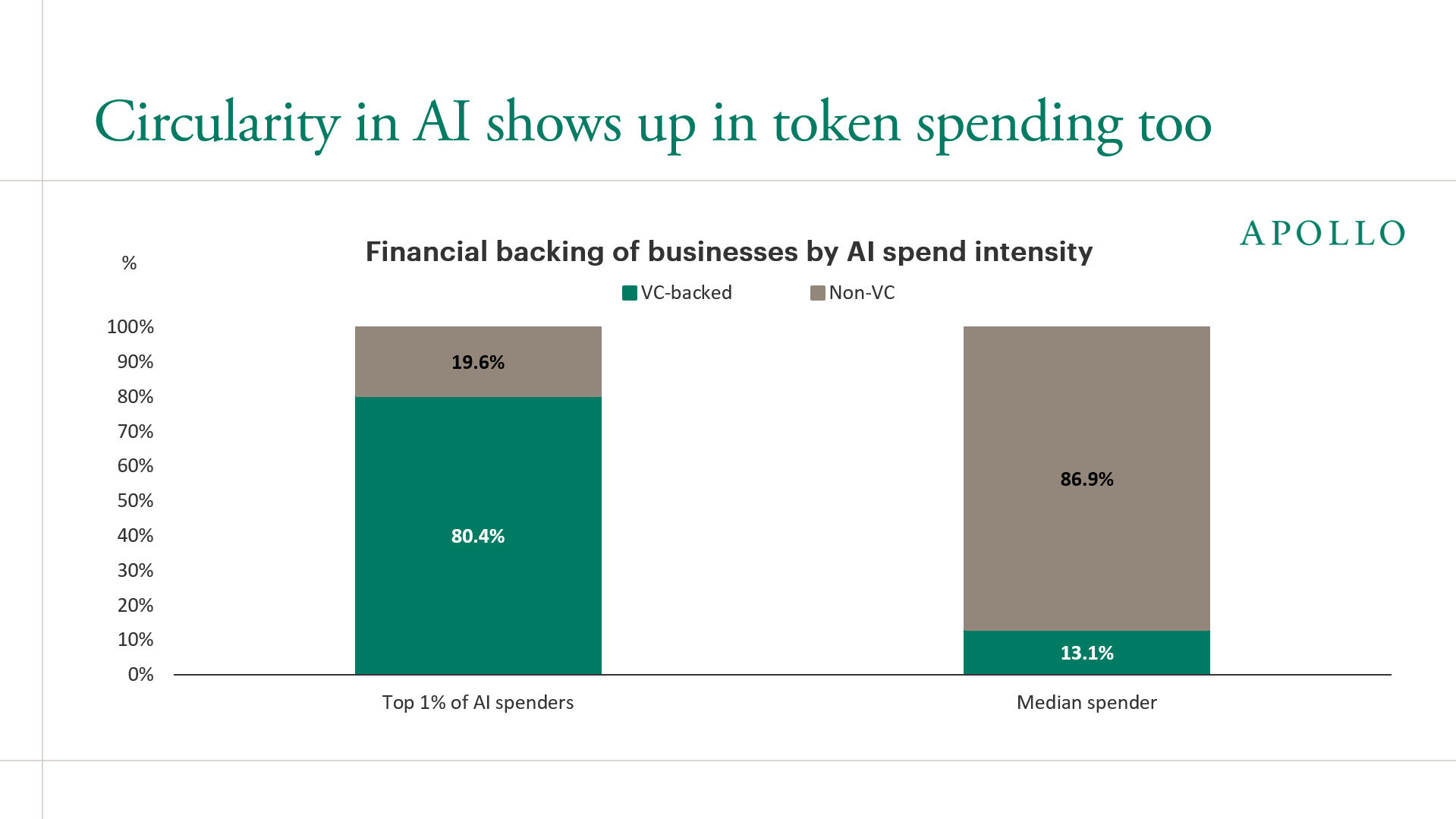
4. I don't know how you actually isolate AI productivity gains on a macro level. It seems pretty much impossible.
This whole thing is laughable.
Comment by wewewedxfgdf 3 days ago
Comment by keel-control 3 days ago
Comment by sweetdingoes 1 day ago
Comment by kazinator 2 days ago
Comment by harry8 3 days ago
Not so much in accounting, which is a much easier problem.
Software devs eagerly trained their replacement.
Comment by JoeAltmaier 3 days ago
Comment by datas 3 days ago
Comment by davedx 3 days ago
Comment by mlindner 3 days ago
Comment by sehw 3 days ago
Comment by thomasjeff1 3 days ago
Comment by Luker88 3 days ago
"Tech sector" is supposed to be much bigger than just 7 companies, no matter how big those 7 are.
This looks to me more like just a huge centralization of wealth.
Comment by rglover 3 days ago
It should be of zero surprise that the rush into AI has yielded limited results (if we're honest, both in and outside of tech)—you won't get a bunch of artists or creative thinkers out of a pliant, ironically agentic labor force. That's why most people say "it doesn't work": it's because they lack the skills and knowledge to use it properly (but corporations want to delude themselves into thinking they have a genie in a lamp).
Comment by j45 3 days ago
Comment by aelsi 3 days ago
Comment by 1vuio0pswjnm7 1 day ago
1792952284 | AI delivers 'zero financial payoff' to most companies, Apollo economist says | https://techcrunch.com/2026/10/25/ai-delivers-zero-financial... | https://news.ycombinator.com/item?id=50234408 | 1 comment
1792968546 | Apollo says AI has delivered 'zero financial payoff' outside the tech industry | https://www.businessinsider.com/apollo-ai-zero-financial-pay... | https://news.ycombinator.com/item?id=50236828 | 47 comments
Comment by w10-1 2 days ago
AI in medicine has become pervasive, resulting in less time spent fighting IT or staying up-to-date and more time with patients; no one need be fired because you can always do better work.
It's the opposite of enshittification: quality has gotten better without any visible economic difference.
Comment by pokstad 3 days ago
This reminds me of the book The Redemption of Time. An alien society incapable of lying has no other way to understand deception than to study an actual human mind. The different ways that we are capable of thinking can be so hard to capture in an artificial system.
Comment by WheelsAtLarge 3 days ago
AI productivity gains are coming make no mistake about it. My guess is that we'll see them within the next 5 years.
Comment by johanneskanybal 3 days ago
I would expect new disruptors to eat the lunch of the old, but that's slow.
Comment by archagon 3 days ago
The industrial revolution produced physical goods at scale, which eventually gave regular people access to things they could not have before.
AI produces intellectual labor at scale. Regular people do not need mass-produced content in their lives: there's already too much music, too much TV, too much software that only seems to get worse year after year.
Who needs mass-produced intellectual labor? The owning class. This is the only population segment that stands to benefit from this revolution. It's the reason every tech CEO is trying to shove AI down everyone's throats. It's the reason they're resting their feet on the table while everyone below them is starting to panic about the future of their careers.
I don't believe we will see compounding acceleration of anything other than spam and enshittification in this AI-laden world. This is not technology for building futures we can barely dream of: it's a gold-plated gift to the oligarchy and a fuck-you to everyone else.
Comment by trvz 3 days ago
This may well remain a "true communism/socialism has never been tried" situation.
Comment by AbstractH24 3 days ago
The other is that there is so much more value to be extracted before this bubble burst.
Not sure which I believe, objectively. Subjectively, inside of tech, it certainly feels like the former.
Comment by addozhang 2 days ago
Comment by Zambyte 3 days ago
AI labs are focusing on automating and accelerating AI research, because that will accelerate AI development in other fields. Claims that non-tech topics are harder to train for are wildly over stated in this thread. Labs are focused on beating each other to RSI, and training on tasks that do not support that are a lost opportunity cost.
Comment by m0llusk 3 days ago
Comment by blurbleblurble 3 days ago
Comment by lukasm 3 days ago
Comment by TheJohnSmith1 9 hours ago
Obviously a useless anecdote, but my internet consumption is far lower than it's ever been in my adult life.
Comment by necovek 3 days ago
Internet has allowed a new type of businesses to appear and prosper. Some old-style businesses got the hang of it, some did not (look at all the newspaper businesses trying to figure out how to stay funded without falling under oligarch's rule).
Comment by baby 3 days ago
Comment by kaffekaka 2 days ago
Comment by ckx 2 days ago
Comment by zzzeek 3 days ago
Comment by ethical 3 days ago
Comment by binarysolo 2 days ago
Comment by ath3nd 3 days ago
Comment by ethanhood_okroh 3 days ago
Comment by siddhant_d777 2 days ago
Comment by ronen-fidenceai 2 days ago
Comment by Glasses82 3 days ago
Comment by Glasses82 3 days ago
Comment by ihsw 3 days ago
Comment by angrymouse90 3 days ago
Comment by emsign 2 days ago
Comment by bob1029 3 days ago
There have been wins with the customer facing side of the business, but the development team seems to be the biggest problem right now despite the direct & obvious applicability of these tools. I know they aren't a special unicorn edge case because I was very rapidly solving their issues before they stopped handing me things that revealed the lethargy.
Within the sector where these tools definitely work, the biggest barrier to effective adoption is figuring out a way to undermine the various ideological high grounds. I have found the most effective argument to untangle this knot to be something approximating:
Challenge:
"Why should I adopt or help to implement technology that might eventually replace my job?"
Response:
"Because refusing to won't protect your job. It puts everyone's job at risk."
It doesn't matter if you protect your job (not using AI) if the entire company goes to the bottom of the ocean as a consequence. The neat thing about this is that your job is part of the set known as "The Company" and if that ceases to exist, so does your job. Good luck suing a dissolved entity for unemployment or whatever. There is enough competition in most markets to punish anyone who thinks they can win on virtue alone.
Comment by anonymousDan 3 days ago
Comment by bluefirebrand 3 days ago
Is there even any actual basis to walk this back at all anymore? It kinda seems like its a done deal and this is the outcome.
Comment by decidu0us9034 3 days ago
Comment by bayarearefugee 3 days ago
The vast majority of entire companies are going to the bottom of the ocean regardless of what individual contributors do.
Once you can replace nearly every job at a company, the company doesn't need to exist. Companies are just collections of experts, if AI replaces all the experts then it replaces the whole company.
So I've adopted the accelerationist mindset of: yes, this is absolutely going to replace my job, but it is going to replace everyone else's job too so fuck it I'll use it and we'll all go down to the bottom of the ocean together.
Comment by SkyeCA 3 days ago
What a grim outlook.
Comment by haunter 3 days ago
Comment by briHass 3 days ago
The incredible improvements have only been over the last 9 months or so. Business, especially disrupting entire job functions, takes much longer than that. As is typical with this type of change, it'll be slow until a tipping point, then FOMO will hit.
Comment by asadotzler 3 days ago
Comment by marginalia_nu 3 days ago
Why would you spend dollars on tokens today if you expect the same tokens will get you something vastly superior in a few months, or that they'll do the same job for nickels on the dollar? Do you just hate having money or what is the problem?
Comment by krapp 3 days ago
Comment by kaffekaka 3 days ago
Comment by meindnoch 3 days ago
Comment by IshKebab 3 days ago
It'll probably be a couple of years before most companies even realise it's an option.
Comment by tempest_ 3 days ago
Most developers don't work building low level high performance scalable systems for a large tech firms, they are making CRUD back-ends for phone apps.
This section of the industry is definitely contracting. Even more obvious is the dev tooling part of it. Dev tooling companies are disappearing or being "bought" all over the place because what might have been a product before is now an hour or two with someone with CC.
Comment by to11mtm 3 days ago
Yeah, 100%. Even for relatively complex scenarios (i.e. over-engineered for purpose) as long as the engineer can prompt coherently and tweak it's a big increase in productivity, at least for those people.
The gap is in things like contract houses where you might see better code on code review from the people submitting but if you actually use the tools, you know that the hours billed are even more inflated than they might have been before.
Comment by Barrin92 3 days ago
the mythical man month lesson holds for CRUD apps as well. I'd be careful to equate churning out lines of code with the health of a piece of software down the road, even a relatively straight forward one.
Keep in mind in any real world software what matters is maintenance of a system, not just how many features you can add, regardless of human or machine generated code, some badly glued together codebase that's rapidly growing is going to haunt you.
Which is also why replacing sound dev tooling and with a magical prompt genie is incredibly irresponsible and short-sighted. You could cheaply produce code by outsourcing it years ago.
Comment by stonogo 3 days ago
Comment by lisplist 3 days ago
Comment by IshKebab 3 days ago
How long have people been warning about global warming? Do you still think it isn't real?
Comment by bigstrat2003 3 days ago
It does not. But it does mean they are bad at predictions and you shouldn't give their latest prediction much credence.
Comment by IshKebab 2 days ago
Six months before the start of WW2 would your rather be "we're not at war, don't panic" or "peace is over, stockpile food"?
Comment by repeekad 3 days ago
> before most companies even realize it's an option Couldn't be further from the truth
Comment by bigstrat2003 3 days ago
Comment by IshKebab 2 days ago
The third is definitely not as good as the commercial version, but it also doesn't cost $100k/seat/year.
Unfortunately work paid for the tokens so I can't share them, but I've seen it with my own eyes. It really works now. The code is not slop (and I am a perfectionist; it's not just that I have low standards).
It doesn't work with pre-Astra models for sure though.
Comment by asadotzler 3 days ago
If you moved the goal posts any farther, they'd have traveled around the world and would be sitting at your back right now.