Show HN: What if the speed of light was 5 km/h?
Posted by dmitrybrant 2 days ago
I've always wanted to make a visualization where the speed of light was scaled down to human speeds, so that we could intuit relativistic effects with everyday objects. Here is the first version of it!
Comments
Comment by adamkurkiewicz 2 days ago
Many issues with the MIT game were discussed here:
https://physics.stackexchange.com/questions/43695/how-realis...
While the thread lists multiple issues, the issue that I found was with modeling temporal aspects of relativistic doppler (I also reported it on the github repo of the "slower speed of light" project, but that doesn't appear to be maintained):
https://github.com/MITGameLab/OpenRelativity/issues/17
In this game, it looks like the temporal component of the Doppler effect is modelled correctly.
Comment by dmitrybrant 1 day ago
Comment by dotancohen 1 day ago
Very reminiscent of the Casimir effect experiments.
Comment by santiagobasulto 2 days ago
How i got there:
The closest major galaxy to the Milky Way is Andromeda, and is 2.5 million! light-years away. And this is the CLOSEST galaxy, the universe is extremely big.
Of course that as you get closer to C, the traveling object will experience time dilation (relative to observer), so the time passed will be less. At 99.999% C, the traveler would take ~11,000 years to arrive to Andromeda.
So again, even at 99.999% C, 11K years seems like a LONG time to reach even the closest galaxy.
My reasoning was: the speed of light is pretty damn slow.
But then I realized: no, it's not the speed of light that is slow, is my frame of reference.
For us humans, 11,000 years seems like A LONG time, but for the universe is not that long.
The universe's age is estimated to be 13.8 billion years. 11,000 years is 0.0000007971 of the age of the universe.
An average human lives 70 years, 0.0000007971 of that lifespan is approximately ~0.4 hours, or 29 minutes, so it's not that bad.
So yeah, frame of reference matters.
Comment by Terr_ 2 days ago
If you can somehow accelerate/decelerate at a constant human-acceptable 1G, time dilation means almost anywhere is reachable in a human-lifetime.
That coincidence(?) could easily become false if we are accustomed to lower accelerations or lesser lifespans.
Comment by andruby 1 day ago
At 1G constant acceleration reaching Andromeda would take ~15 years, or ~29 years if we also need to decelerate at the same 1G rate to not just whoosh by.
The furthest known galaxy is MoM-z14, which would take ~47 years to reach.
But unlike Andromeda, MoM-z14 is accelerating away from us, or more precisely, the space between us and MoM-z14 is expanding. It's "receding" at 726,000 km/s (= 2.4 times the speed of light). And still accelerating. Because of these, even the magical constant 1G accelerating spaceship can never reach it, not even in 1 Billion years.
Comment by asnelt 1 day ago
Comment by ahazred8ta 1 day ago

http://www.zitterbug.net/future/future815.html
What If Light Was Really Slow? https://www.youtube.com/watch?v=ge_j31Yx_yk -- https://duckduckgo.com/?q=slower+speed+of+light&ia=videos&ia...
Comment by thwarted 2 days ago
The Overview Effekt: Time Dilation Visualized
Comment by no_multitudes 1 day ago
Well, you also need clarketech heat dissipation and collision deflection technology, if you want to get there without vaporizing.
Comment by Sohcahtoa82 1 day ago
Colliding with a single 0.3 mg grain of salt at 20% of the speed of light creates an impact with 560 MJ of energy, equivalent to 130 kg of TNT, over 8 times the nuclear bomb dropped on Hiroshima.
Even a tiny speck of dust, half a microgram, is equivalent to a hand grenade when hit at 20% the speed of light.
You wouldn't be able to even escape the solar system before your shields were devoured. If you accelerated at 1G constantly, you'd be going 3.5% of the speed of light by the time you reached Pluto's orbit. Space dust particles are already hitting you like nuclear bombs at that speed.
Comment by dotancohen 1 day ago
Comment by hebelehubele 1 day ago
Comment by Terr_ 1 day ago
While I did read The Expanse, when I think of that class of dangers, what pops to my mind is an old short story Neutron Star (1966) [0]. A financially desperate pilot is hired to discover what killed some researchers while leaving the indestructible starship hull intact... and the thrusters off.
[0] https://en.wikipedia.org/wiki/Neutron_Star_(short_story)
Comment by xelxebar 1 day ago
Comment by dotancohen 1 day ago
> failsafe timers and dead-man switches when testing new things.
Comment by zem 1 day ago
Comment by sinuhe69 2 days ago
Comment by jtbayly 1 day ago
Comment by stouset 1 day ago
To an outside observer, the trip might have taken you millions or billions of years while to you it was only ten or twenty.
It’s helpful to think about the limit. To light, which travels at the speed of light, it arrives at your retina the exact moment it was created in the core of the sun. From our perspective, it took almost a million years (about a million years to make it from the core to the convective region, then another few minutes to travel from there to Earth).
Comment by jtbayly 1 day ago
So presumably this means 11k years from an earth point of view? But the traveler would still be alive and a very short time would have passed for him?
Comment by stouset 1 day ago
At 1g of constant acceleration you can reach Andromeda in just under 15 years of experienced time. An observer on Earth will perceive you as having taken a hair over 2,500,000 years to get there. You can get there arbitrarily quickly; at 10g it would take a 1 year 9 months. But an external observer on either planet will see you taking closer and closer to 2,500,000 years to make it the full distance.
Comment by jtbayly 21 hours ago
Comment by petersumskas 16 hours ago
Whereas a constant 1g acceleration would far exceed that fraction and thus shorten the time significantly.
Comment by digitalsushi 1 day ago
Comment by hnlmorg 2 days ago
Professor Farnsworth: That's why scientists increased the speed of light in 2208.
Comment by sh0gg0the 2 days ago
Comment by shagie 2 days ago
https://thinkzone.wlonk.com/SS/SolarSystemModel.php?scale=10... lets you make scale model calculations (useful if you're building one). The default model scale has the speed of light at 67.06 mi/h (107.9 km/h). This puts Earth out at 14.16 miles and Alpha Centauri at 2,581,000 miles away.
I personally like the "Sun is 5 inches" scale because that puts the speed of light at 323.1 ft/h (10x garden snail speed) which is 1.46 miles/day... because that puts Alpha Centauri at 2,354 miles away... which is a conceivable distance.
If you go to a scale of the sun being 500 inches (about 110000000) and the speed of light is 6 mph, Alpha Centauri is 234,600 miles away - the distance to the moon. It also lists the scale distance to the center of the Milky Way 1,327,000,000 miles) and Andromeda (137,400,000,000 miles) which are in the unconceivable range.
Comment by petersumskas 15 hours ago
This discussion has made me wonder what it would look like to have a different scale where the distances are based on the “speed limit” (which is mostly 100km/hr)…so that earth, for example, would be 8min from the Sun. Neptune or Pluto would be 4 - 7 hours away.
It would still fit in Australia but be significantly larger.
Comment by sh0gg0the 1 day ago
Edit: I now watched the animation. It's exactly the same as the YT video. Speed of light is very, very slow.
Comment by buf 2 days ago
Comment by irjustin 2 days ago
Comment by cluckindan 2 days ago
Comment by RHSman2 2 days ago
Comment by cluckindan 20 hours ago
Comment by nayuki 1 day ago
Roman lowercase c is the metric prefix centi-. Roman uppercase C is the metric unit coulomb.
Italic uppercase C has various uses such as: a variable denoting capacitance in electrical engineering; an undetermined constant of integration in calculus.
Comment by Tepix 1 day ago
The speed of light is high. It's just that the universe has expanded into an unimaginably large area by now.
Comment by NetOpWibby 2 days ago
Comment by atlimar 2 days ago
if we add more 9s, is it possible to reduce that number to within a human lifespan?
Comment by marcyb5st 2 days ago
If you accelerate at 1g constantly for 1y you travel 0.5 light years. You do that for 10.5 years and you reach the center of the milky way. You do that for another 4 (~14 total) years and you are in the Andromeda galaxy, and you do that for another 10 years (~24 years total) and you reach what today is considered the edge of the observable universe.
By the time you get there you are basically traveling at a rounding error from C.
Comment by ExoticPearTree 2 days ago
Can't we accelerate past 1G constantly? Or do we expend so much energy doing it that we can't realistically do it with today's technology?
Comment by TheOtherHobbes 2 days ago
Magic warp bubble tech is the bare minimum, and we're nowhere close to inventing that.
Comment by myrmidon 2 days ago
Chemical rockets are currently the only thing that allow sustaining such accelerations briefly for human-size payloads, but the low exhaust velocity and exponential reaction mass requirement make sustaining it for days/months/years completely impossible.
You'd have to supply the energy externally (i.e. some sort of beam propulsion), but getting any significant fraction of g out of such a system (with human-sized payloads) seems unlikely within the next centuries, especially as the distance increases.
Comment by consp 2 days ago
Or some form of ram scope, plenty of H everywhere, but those also have the issue of you collecting things while going at relativistic speeds.
Comment by 21asdffdsa12 2 days ago
Comment by wallst07 2 days ago
Comment by 40four 2 days ago
Comment by Enginerrrd 1 day ago
Comment by jdjfbfbdbfnf 2 days ago
Comment by mjmas 2 days ago
Comment by lostlogin 2 days ago
Increasing the acceleration a little bit more than that (eg to 1%) would make a difference.
Comment by rrr_oh_man 2 days ago
Wouldn't that be only a few months on a decades-long journey at 1.01G vs 1G??
Comment by lostlogin 1 day ago
If the acceleration was too great but survivable, what happens? I can’t imagine my back, knees or ankles would like it.
Comment by SideburnsOfDoom 1 day ago
It's hard to accelerate at or beyond 1G for very long with current technology. Roughly speaking, the rocket runs out of fuel soon. Packing more fuel makes the rocket heavier, meaning diminishing returns when using the fuel. The mass required grows exponentially. See "The tyranny of the rocket equation"
Comment by devld 2 days ago
But that would be pretty pointless without taking the time to decelerate :)
Comment by librasteve 2 days ago
Comment by rrr_oh_man 2 days ago
People always say that about speed of light stuff, but I don’t get it. Do you have any more examples of counterintuitive math?
Because what you’re describing is basically the equivalent to compound interest in finance. (e.g. investing $100 at 10% interest over 10 years results in $260)
Comment by MathMonkeyMan 2 days ago
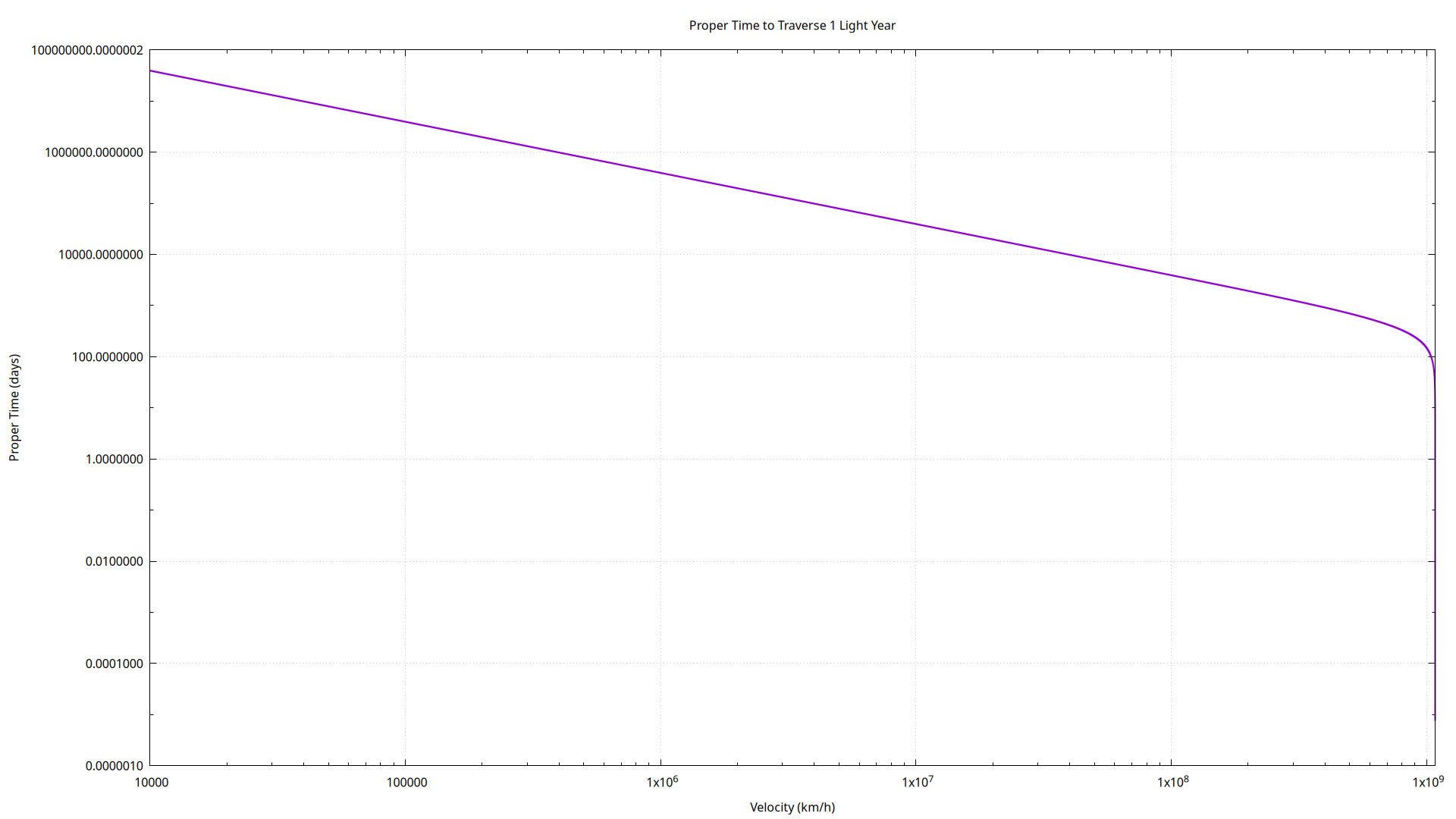
- [pic](https://home.davidgoffredo.com/hackernews/proper-time-one-li...)

- [plot](https://home.davidgoffredo.com/hackernews/proper-time-one-li...)
Comment by rrr_oh_man 2 days ago
Comment by MathMonkeyMan 2 days ago
Comment by rrr_oh_man 2 days ago
Comment by chungy 2 days ago
Comment by rrr_oh_man 1 day ago
I'm not saying that I couldn't fire up Cloudflare Warp, but I think it's a legit issue for average users [0]?
Comment by MathMonkeyMan 1 day ago
Or I could go back to IPv4 with dynamic DNS, but that would mean changing domain registrars.
Comment by numpad0 1 day ago
Comment by tcfhgj 1 day ago
Comment by tcfhgj 2 days ago
Comment by Sohcahtoa82 1 day ago
Comment by onraglanroad 1 day ago
Comment by MathMonkeyMan 1 day ago
    david@carbon12:~ $ dig +short AAAA home.davidgoffredo.com
    2603:7000:5101:de1c::cafe:babe
Comment by numpad0 1 day ago
Comment by lightedman 1 day ago
Comment by jeanlucas 2 days ago
Comment by rrr_oh_man 2 days ago
              1,000 seconds =          ~0.01 days (~17 min)
          1,000,000 seconds =         ~11.57 days (~12 days)
      1,000,000,000 seconds =     ~11,574.07 days (~32 years)
  1,000,000,000,000 seconds = ~11,574,074.07 days (~32k years)
Maybe it's just our human calendar/time unit rollercoaster (60*60*24*30*12) that's playing tricks on us here.
Comment by jeanlucas 2 days ago
But it isn't intuitive, you're not used to numbers that big or that grow that fast.
Few things go from a million to a billion, especially when related to time.
Comment by mathgeek 2 days ago
Comment by saberience 2 days ago
I find it frustrating that people seem to think that someone going from 1M to 1B is somehow different to other numerical operations. It's not. It's 1000 times bigger, it's not a huge deal.
Comment by jeanlucas 2 days ago
Somehow people are interpreting this as some kind of math trick.
It's not a trick, our brains are not wire to deal with numbers growing quickly, but we do understand the math.
Comment by RHSman2 2 days ago
Comment by lightedman 1 day ago
Comment by marcyb5st 2 days ago
Comment by alex_duf 2 days ago
Comment by andsoitis 1 day ago
Yes. At 99.99999999% of c it would take 35 years from the perspective of the traveler. However, an observer on earth will still see it taking 2.5m years.
Comment by futureshock 2 days ago
Comment by ndsipa_pomu 2 days ago
Comment by santiagobasulto 2 days ago
At 99.999% of C, the Lorentz factor is ~223.6.
It grows pretty quickly as you add more 9s to the fraction. Every two additional 9s multiply the Lorentz factor by ~10.
So at 0.99999999999 c, it'd be ~223,607x.
2.5M years / 223,607 is: ~11 years
Of course this is all highly theoretical.
Comment by desterothx 2 days ago
Comment by santiagobasulto 1 day ago
Comment by ryeights 2 days ago
Comment by davidoduk 1 day ago
Comment by yellowapple 1 day ago
Comment by fwip 1 day ago
Comment by mr_mitm 2 days ago
You think those time periods are large because you see a lot of numbers in the units you chose, or because it is much larger than your lifespan. But in the grand scheme a galaxy is nothing but a spec of dust, 10k years a blink of an eye.
There is no other natural velocity that I'm aware of that we could compare it to, but we can say that the speed of light is the fastest there is, so how can it be slow?
Comment by cheschire 2 days ago
Comment by _Microft 2 days ago
Comment by DoneWithAllThat 1 day ago
Comment by IAmBroom 1 day ago
Along your trip you will see stars turn red, sometimes flashing white and blinking out, but sometimes just fading away.
Your civilization will without a doubt go extinct.
If you are exceedingly lucky, you may see other civilizations of other species arise... but you'd need very high energy receivers in front of you, or deep infrared receivers behind, and of course be staring at the right place to see the signs.
You may eventually begin to notice the revolving motion of galaxies. After that, if you continue, you'll see galaxies collide. By then your planet will have been dead for longer than it was a planet when you left it.
Comment by stackedinserter 1 day ago
Maybe it's the answer to Fermi paradox: aliens are all around, we're just too fast for them to communicate.
Comment by BobaFloutist 1 day ago
Comment by greysphere 2 days ago
I've never quite wrapped my head around this and was hoping to get some insight from this simulation. But afaict, I'm not seeing this effect (press W for a bit, the A for a bit and it's not obvious I'm at a different orientation - if I look down at the ground the gridlines are still axial).
I don't know if I'm misinterpreting the math, or the simulation, or maybe the simulation is doing something to 'correct' for this behavior so things are more natural, or something else. Does anyone have any insight?
Comment by zogomoox 2 days ago
Comment by unexpectedtrap 2 days ago
In the sources I see that the acceleration is applied simply by utilizing a velocity‐addition formula (see https://github.com/dbrant/relativity/blob/fcc20fb18381959ac2...), so no Wigner rotation appears. I guess all the fancy stuff related to how time passes in an accelerating frame (like https://en.wikipedia.org/wiki/Twin_paradox#Difference_in_ela...) is also wrong in this simulation because of that.
You can however observe a mathematically equivalent effect in hyperbolic games, e.g., in Hyperbolica. Hyperbolica even has a quest about rotating a chest by moving it along the axes. On the hyperbolic plane it’s of course not about acceleration but about a winding number you’re doing around some point, but it’s still fun.
Comment by rootusrootus 2 days ago
Comment by jbaber 2 days ago
https://www.reddit.com/r/educationalgifs/comments/qq5cw7/coo...
Comment by HDBaseT 2 days ago
We cannot play competitive multiplayer games globally, without 300ms ping. I dream of a world playing Black Ops 2 on a original PS3 in 2026 getting into a lobby because latency is low.
Comment by dinfinity 2 days ago
This is of course assuming instant activation, a direct connection and no additional latency from network hardware.
Comment by apothegm 2 days ago
Comment by dinfinity 2 days ago
The point is to quickly and accessibly convey an intuitive understanding of the propagation speed of information in biological circuits vs. the max speed of information in our universe (to our current knowledge at least) and in our technology.
Comment by rwoerz 2 days ago
Comment by zelphirkalt 2 days ago
Comment by fahrvrgnugen 2 days ago
300ms feels extremely optimistic coming from my perspective of someone living on an island in SE Asia
Comment by jmaw 2 days ago
Comment by 93po 1 day ago
Comment by tiborsaas 1 day ago
Comment by skhr0680 2 days ago
https://wondernetwork.com/pings/Auckland
Your real world latency is going to be worse.
Comment by esikich 2 days ago
Comment by somenameforme 2 days ago
If we ever reach the technology to enable relativistic starships (basically able to accelerate at 1g or so for years at a time), then the universe is going to get seriously weird. Not only for us, but also for people in the distant future who will regularly have ancient relics from the past traveling into their time, when they will likely scarcely resemble us, and going 'Hello fellow... humans?' That'd be some next level archaeology opportunities though.
It'll also be socially odd as the elite and powerful travel off into the future seeking immortality, unable to ever return, at least so far as we currently understand.
Comment by IAmBroom 1 day ago
You cannot. The speed of light limits you, even as you approach it, by changing distance itself.
There is no absolute distance between two points; all astronomical distances are calculated in a non-relativistic framework. This is perfectly acceptable, since we all live in that framework relative to each other, and even if we were talking to multi-generational "friends" on Alpha Centauri, it would still hold true for both sides (to within an imperceptible error).
This is why it is sometimes suggested that photons don't "travel" at all; because they move at c, every spot they go to is the same spot to them. A divide-by-zero non-error.
Comment by somenameforme 1 day ago
This is also why it's 100% possible for a human to travel to Alpha Centauri, or even the edge of the known universe all within a single human lifetime, from his own perspective. Of course for an at rest observer, billions of years would have passed, but for him - mere decades.
Comment by HPsquared 2 days ago
Comment by altmanaltman 2 days ago
Comment by brontosaurusrex 2 days ago
Comment by timoth3y 2 days ago
This is more of a simulation of what if light was perceived as 5mph for you and kept the same for everyone else.
It is cool though.
Comment by somenameforme 2 days ago
Comment by evanb 2 days ago
Comment by IAmBroom 1 day ago
Comment by lightedman 1 day ago
Comment by tristanj 2 days ago
There is also a helpful FAQ which explains all the strange things happening, such as length contraction, time dilation, and color shifting: https://testtubegames.com/srel101.html
My favorite levels are #18 (which demonstrates time dilation), #26 (which demonstrates space warping), and #42 (which demonstrates retarded time https://en.wikipedia.org/wiki/Retarded_time ). All the levels are unlocked and you can skip to any level.
Comment by shagie 2 days ago
> A Slower Speed of Light is a first-person game prototype in which players navigate a 3D space while picking up orbs that reduce the speed of light in increments. Custom-built, open-source relativistic graphics code allows the speed of light in the game to approach the player’s own maximum walking speed. Visual effects of special relativity gradually become apparent to the player, increasing the challenge of gameplay. These effects, rendered in realtime to vertex accuracy, include the Doppler effect (red- and blue-shifting of visible light, and the shifting of infrared and ultraviolet light into the visible spectrum); the searchlight effect (increased brightness in the direction of travel); time dilation (differences in the perceived passage of time from the player and the outside world); Lorentz transformation (warping of space at near-light speeds); and the runtime effect (the ability to see objects as they were in the past, due to the travel time of light). Players can choose to share their mastery and experience of the game through Twitter. A Slower Speed of Light combines accessible gameplay and a fantasy setting with theoretical and computational physics research to deliver an engaging and pedagogically rich experience.
Comment by koolala 2 days ago
Comment by Norlo 7 hours ago
I’m curious how you’re handling the visual distinction between time dilation/length contraction and the actual light-travel-time effects an observer would see. That seems like it could get surprisingly unintuitive once the scaled-down speed of light gets close to the objects’ velocities.
Comment by Driftbench 3 hours ago
Comment by dramm 2 days ago
Comment by gryfft 2 days ago
Comment by kshmir 2 days ago
Comment by tomjakubowski 2 days ago
Comment by dang 2 days ago
A Slower Speed of Light (2012) - https://news.ycombinator.com/item?id=40332586 - May 2024 (59 comments)
What if we could reduce the speed of light - https://news.ycombinator.com/item?id=26309517 - March 2021 (1 comment)
A Slower Speed of Light (2012) - https://news.ycombinator.com/item?id=17169262 - May 2018 (15 comments)
A Slower Speed of Light - https://news.ycombinator.com/item?id=4731749 - Nov 2012 (105 comments)
"A Slower Speed of Light" Game Trailer - MIT Game Lab - https://news.ycombinator.com/item?id=4714779 - Oct 2012 (1 comment)
Comment by TZubiri 2 days ago
I feel like a rule of vibecoding would be that you shouldn't do it for the core of a product, the quality is just not there yet. Even if it is, your core contribution should be what LLMs would train on, rather than being their output.
Comment by hn993302 2 days ago
Comment by Tostino 2 days ago
Comment by chamomeal 2 days ago
Comment by k310 11 hours ago
5 km/hr = 4.56 ft/sec. so lightning is seen 1157 seconds or 19 minutes per mile. as opposed to the usual zero.
Sound travels 1100 ft/sec and is heard the usual 5 seconds per mile after the strike, but 19 minutes before the flash. Per mile of distance away.
Comment by IvyMike 2 days ago
https://www.goodreads.com/en/book/show/1382560.Redshift_Rend...
Comment by jcul 2 days ago
Comment by pavel_lishin 2 days ago
Comment by nielsbot 2 days ago
Comment by zrail 2 days ago
Comment by yreg 2 days ago
Comment by aequitas 2 days ago
Also one of my favorites is discworld scientist experimenting with ftl communication through succession by “modulating” a king above a pit of sharks an measuring his son at the other end of the world for “kingness”
Comment by pmontra 2 days ago
Comment by lysium 2 days ago
Comment by pmontra 1 day ago
Comment by teamonkey 2 days ago
The cars seem to twist towards me as they approach and away from me as they recede, but from my initial stationary position, which is below the roof of the lowest car, I feel that I shouldn’t ever be able to see light from the top surface of a car’s roof?
If I toggle ‘L’ off then indeed, I can’t see the top of any of those cars. But I feel that even with it on, and in the absence of gravitational lensing, I feel the path of light from that top surface would always be blocked?
Comment by Sopel 2 days ago
Comment by tliltocatl 2 days ago
Comment by sakjur 2 days ago
Comment by tliltocatl 1 day ago
Comment by d34dman 2 days ago
Comment by aquafox 2 days ago
Comment by the-mitr 2 days ago
Comment by aaronbrethorst 2 days ago
Comment by er4hn 2 days ago
Comment by divyekapoor 2 days ago
Comment by walrus01 2 days ago
Basically imagine like if you wanted to walk in a straight line between two points at both ends of a empty, long, narrow rectangular warehouse, and instead of walking in a straight line from A to B, you bounced off each wall at an angle (like a pool ball ricocheting off the bumpers) to get from one end to the other. Making your cumulative distance travelled on foot much greater.
Comment by vlyan 2 days ago
I know there are many other mundane technologies that can be described in sci-fi-ish way, but for some reason I'm particularly amazed by fiber transmitters being compact and cheap enough to be used in mass-produced killer drones.
Comment by walrus01 2 days ago
When I say data rates are way below 1 Gbps, it's because commonly you've got two things going on, a UART serial bridge from operator to flight controller board (same idea as what is implemented in RF with ExpressLRS, TBS Crossfire or similar), this is at most a Mbps or two. Then a possible live video feed over IP which will be easily under 50 Mbps.
The only thing a little bit out of the ordinary about them is that they're often bidirectional single strand optics with the prism built in, and tx/rx on different wavelengths (like 1550 and 1570, or 1550 and 1610, or whatever). Basically same thing that somebody lighting a very low cost metro dark fiber circuit might do to use only 1 strand for a gigabit or 10 Gbps link.
Comment by sampullman 2 days ago
Comment by tliltocatl 2 days ago
Comment by walrus01 2 days ago
There's more advanced ones that take video input from a MIPI digital video interface or native HDMI input.
Not just because latency but also because of cost, size, weight, power.
Comment by taneq 2 days ago
Comment by walrus01 2 days ago
If you google image search "refraction fiber optics" you'll get some decent pictorial examples of what I meant by photons bouncing off the interior walls of a 9/125 SM fiber optic strand billions/trillions of times on its path, I guess I was trying to write an extremely simplified explanation of refraction in something like a typical SMF-28e / G.652.D fiber.
Comment by rootusrootus 2 days ago
At the risk of exposing how little I remember from physics, doesn't light in a single mode fiber not bounce? (right about now I'm thinking that it's probably not great to think of photons bouncing because this is quantum level stuff, right? light is a wave, etc. gosh it's been a long time since I tried to really know any of this...)
Comment by walrus01 2 days ago
https://www.aflhyperscale.com/articles/how-do-fiber-optics-w...
Comment by nearbuy 2 days ago
Comment by bananaflag 2 days ago
Comment by Vishal_Max 2 days ago
Just a thought experiment for you guys: imagine a bacteria that survives inside humans. It doesn't even know what a human is. For the bacteria, its entire world is simply the environment in which it lives. It doesn't know that we are living beings actively trying to maintain ourselves and survive.
Now, suppose a harmful bacteria enters our body, makes us sick, and we take medicine that kills all of them. From the bacteria's perspective, it could look like a natural disaster or some unexplained event in which they all suddenly get wiped out. They have no idea that a living being called a human actively tried to eliminate them using something called medicine, which was engineered specifically to kill them.
Similarly, what if our world, or nature itself, is part of some higher-level entity that we simply exist within? What if the reason for our deaths, natural calamities, and other events is something completely beyond our perception? Whatever we do, we may never be able to understand what is actually happening at that level, just as bacteria may never be able to understand that humans exist.
One thing that could potentially support this idea is self-regulation. We see self-regulating systems throughout nature, and these patterns seem to repeat at different scales. We ourselves are self-regulating organisms, and nature also has countless cycles and mechanisms that regulate themselves.
Maybe these patterns continue at scales we cannot perceive. We can observe certain things at the scale of humans, but we still don't fully understand what happens at the nano scale or on the scale of the universe. Perhaps there are higher levels of organization and self-regulation that we simply don't have the ability to perceive yet.
Comment by lolakutty 2 days ago
https://www.youtube.com/watch?v=OKnpPCQyUec
But let me tell you another possibility. What if there is no nature, but just our perception of it.
Yea, tree falling in the forest and all that...stated more explicitly..
Comment by Vishal_Max 2 days ago
Comment by barrenko 2 days ago
Comment by gigisfndr 2 days ago
Gitanjali GulveSehgal @gigi_sehgal Jun 22 Replying to @fermatslibrary Contrarian Takes: 1. We live in a “box” governed by the compute we are capable of. Perhaps the rockets are out there in a form we cannot observe. ( borrowing from Quantum Ruliad ). E.g What do bacteria think of us? Do we “exist” for them? Are we infrastructure or entities to them? Do they think we do not exist? We cannot see Neutrinos streaming thru our bodies but atleast we managed to figure out that they existed. Who knows what else exists that our senses and technology cannot perceive or reverse engineer existence of? 2. Perhaps they have remote observation capability, 3. Perhaps its a simulation we are in a space alien overlord’s lab 4. Perhaps the Men in Black wiped our memory each time we see them 5. What were those drones flying over DC? 6. Perhaps they are already here
Comment by gwbas1c 2 days ago
Is this a bug or am I just really confused?
Comment by zamadatix 2 days ago
E.g. when you accelerate ("W") the angle the light rays from in front of you appear to be coming changes, making them look farther away. If you let go of "W" you should keep your current velocity and see you are indeed still moving forward, just in a world more pronouncedly warped by the effects of relativity.
Comment by Tepix 1 day ago
Comment by inshard 2 days ago
Comment by vogje01 23 hours ago
Comment by teekert 2 days ago
Edit, maybe it's because the speed shift is so coarse I cross past 0 km/h from back to forwards and reverse too fast...
Other than this, very very nice. Love this kind of thing for developing intuiting outside the normal range in which we experience the laws of Physics. Well done.
Comment by classified 2 days ago
That's exactly what would happen ins space.
Comment by teekert 2 days ago
Comment by classified 2 days ago
Comment by mjdv 2 days ago
Comment by domhudson 1 day ago
I also recommend a banner that says it doesn't work on mobile as it was quite confusing to me as to whether it was working or not.
Comment by eyeundersand 2 days ago
Comment by nvalis 2 days ago
Comment by zamadatix 2 days ago
Comment by Ajedi32 2 days ago
Comment by ama4efaria 2 days ago
Comment by jawilson2 2 days ago
Comment by bell-cot 2 days ago
More realistically - the atmosphere would not be gaseous (everybody dies), the sun would be a black hole larger than the earth's orbit (everybody dies), and quite a few other problems.
Comment by throwawaysoxjje 2 days ago
Comment by moring 2 days ago
It's yet another xkcd-level apocalypse.
Comment by bell-cot 2 days ago
(But What If he's sworn it to secrecy?;)
Comment by koolala 2 days ago
Comment by Crowberry 2 days ago
Comment by TZubiri 2 days ago
As such I wouldn't base my understanding on the subject on this as-is. Which is a shame as, if it was actually hand coded I might actually use this to learn relativity, something which would otherwise be out of my reach.
A note on source code, I think committing the actual javascript code and such is a mistake at the level of committing compiled binaries to a repo. It's more useful, correct and genuine to upload the prompts used, which are the source code that generates the target code, and upon which the author and others can study and modify the program.
That said, as an idea, it reminds me of Kay's dynabook example ( https://dl.acm.org/doi/10.1145/800193.1971922 ) :
"Here look." Her fingers started to fly on the DynaBook's keyboard, altering the program she had·written several weeks before .. You justact as though the ship is pointed towards the sun and add speed!· As she spoke her ship started to fall, but not towards the sun. Oh no!..·"
If we want to move closer to that ideal, of interactive education, I don't think we can just apply the old forms and use the LLM to aid one in being the allmighty program-creator, the LLM needs to be placed at the service of the user. I can't help but seeing the usage of LLMs to generate code as misplacing this power. It's as if a new powerful metal were discovered and smiths can only think about making hammers and foundries and casts with that metal, considering it too valuable to actually use it for the products being smithed.
Comment by gigisfndr 2 days ago
Comment by aadyachinubhai 2 days ago
Comment by trelane 2 days ago
Comment by janandonly 2 days ago
To stop a 'blight' in the universe, some natural laws have to be changed wherever it starts to spread, is the story premise if memory serves me.
Comment by chantepierre 2 days ago
Comment by messe 2 days ago
Comment by seanmcdirmid 2 days ago
The Forever War series changes the speed of light at the end to mess with the mortals, not to prevent any calamity however.
Comment by dragonfax 2 days ago
Comment by Kranar 2 days ago
Having said that... this is mostly a slogan and makes for good Youtube videos, but it falls apart the moment you subject it to even the most basic scrutiny. For one... it doesn't make sense to talk about a speed through time since speed is literally a measure of change with respect to time, so a change in time with respect to time doesn't make any sense.
But as a slogan, it captures the idea that motion through space and the rate of your own clock are tightly linked together.
Comment by pixl97 2 days ago
Only if you're talking about other people's clocks and not your own. Your own clock is one second per second, but someone else's may be slower or faster relative.
Comment by bilekas 2 days ago
Comment by qurren 2 days ago
You can say the age of the universe is 14 billion years, but that's in our reference frame.
In another reference frame it may be a different number.
Comment by bilekas 2 days ago
Comment by GPerson 1 day ago
People working at AI labs like yourself should figure out how to stop destroying science so there are still people who know enough to call you out when you spread misconceptions.
Comment by qurren 1 day ago
> preferred
While these are meaningful conventions, they are being measured with respect to that rest frame.
The local group moves at some few hundred km/s velocity relative to the CMB, so the age of the universe in our reference frame will be slightly shorter than that preferred frame. Call it ~10^-7 shorter but still ever so slightly shorter. That was my point.
Comment by Kranar 2 days ago
So then you say take someone else's clock and compare it to your own clock, but that is still just a pure number. A speed is not a number, it has units like meters per second. A ratio of two clocks has no units at all, the units cancel. Whatever number you get, 3 or 9, it's just a factor by which two clocks disagree. You can absolutely interpret this ratio as a rate, but that doesn't make it a speed.
And a speed is exactly what the slogan needs, because the diagram/geometry it's using involves a right angled triangle where on one side of the triangle is your speed through space, and on the other side of the triangle is your speed through time, and the hypotenuse of the triangle is fixed at c (since every object travels through spacetime at this fixed speed).
For that to mean anything both sides have to be the same kind of quantity. You can't put meters per second on one side and a bare number on the other and call it a triangle. Nor can you patch it by multiplying the ratio by c to give it units, because the thing you get then grows as you speed up instead of shrinking. Either it has the right units and the wrong behavior, or the right behavior and no units at all. There's no version of this geometry that produces a consistent picture.
Comment by eggn00dles 2 days ago
Comment by nephihaha 2 days ago
Comment by rx_tx 2 days ago
Comment by nico_bresson 2 days ago
Comment by perlgeek 2 days ago
When c is approximately 10^7 times lower, so is the wavelength (if we keep the frequency the same), so now-visible light would have wavelengths far shorter than an atom or a molecule, and probably couldn't be easily detected by biological means.
You could say: sure, maybe we'll just see light at lower frequency. Maybe that's true, but the energy of a single photon is E = hf, where h is the Planck constant. So if we assume much lower-frequency photons, they have much lower energy, and thus become harder to detect.
Lots of other things could be different, like chemistry, heat conduction etc.
At a height of roughly 1.8, at c = 5km/h, light would take 0.1 seconds to travel from head to toe. Nerve signals are much slower than c, so human bodies likely wouldn't exist as we know them.
The list of potential implications to consider is fascinating, endless and maybe even a bit overwhelming :-)
Comment by nomilk 2 days ago
EDIT: ah, by setting 'Speed of light' parameter to 40km/hr I find it a bit more intuitive
Comment by bouncycastle 2 days ago
Comment by samplatt 2 days ago
Forward means light is hitting your eyes faster, making it look like the distance the light had to cross is condensed, meaning it looks further away.
Moving backwards slights the light hitting your eyes, to the point where you're moving away from the light, so everything goes black.
Comment by iceman_w 2 days ago
Comment by buttercraft 2 days ago
Comment by pfdietz 2 days ago
Comment by mark_something 2 days ago
Comment by pfdietz 1 day ago
Comment by fuzzfactor 2 days ago
Comment by mec31 2 days ago
Comment by MPSimmons 2 days ago
Comment by hodder 2 days ago
In physics, "we" use the raisin bread analogy where when you bake the bread, the raisins are all getting uniformly distant from each other with no central point of expansion and no obvious sign of pulling in any specific direction such as would be the case for a gravitational effect.
Comment by ahazred8ta 1 day ago
Comment by amelius 2 days ago
Comment by jagged-chisel 2 days ago
Comment by jjgreen 2 days ago
Comment by TheOtherHobbes 2 days ago
Whether or not the speeds at which things happen in physics, chemistry, etc are somehow absolute, or somehow inherently relative to c, and would speed up and slow down if c changed, is an interesting question.
Comment by linzhangrun 2 days ago
Comment by jve 2 days ago
Comment by fennec-posix 2 days ago
Comment by wging 2 days ago
Comment by vunderba 2 days ago
Some of the details in the paper are super cool. Since the game pulls "c" down to near walking speed, you receive photons at different rates depending on their direction relative to your motion (relativistic aberration / searchlight effect) resulting in neat visual shifts.
I don't usually download games, but I might have to make an exception just to try it out.
Comment by zkmon 2 days ago
Light doesn't "travel". It's just an exchange of entangled photons creating the concept of time duration and distance.
Comment by adamtulinius 2 days ago
Comment by zkmon 2 days ago
Comment by swiftcoder 2 days ago
Comment by nekusar 2 days ago
Electronics wouldnt work at all.
Comment by scotty79 2 days ago
Comment by thesparks 2 days ago
Comment by BSTRhino 2 days ago
Comment by ShinyLeftPad 2 days ago
Comment by somenameforme 2 days ago
Comment by Ajedi32 2 days ago
Comment by realmanrealmanu 2 days ago
Checks repo.
Contributors: @dbrant dbrantDmitry Brant @claude claudeClaude
I’m tired boss
Comment by baalimago 2 days ago
I got confused by the premise. To the fully blind person, the speed of light does not matter. He'll hit the object 5 meters away from him regardless if he sees it or not (as will everyone else, but it'll look weird).
Comment by throwaway893257 2 days ago
Comment by emmelaich 2 days ago
Comment by joelthelion 2 days ago
Comment by mark_something 2 days ago
Comment by shevy-java 2 days ago
Comment by dares2573 2 days ago
Comment by bilsbie 2 days ago
Comment by teiferer 2 days ago
Comment by skulk 2 days ago
Comment by johnkozak 1 day ago
Comment by aghilmort 2 days ago
Comment by krttherealest 22 hours ago
Comment by Aeolun 2 days ago
Comment by sim04ful 2 days ago
Comment by initramfs 2 days ago
Comment by ligarota 2 days ago
Website loads in few ms
Nahh it's not
Comment by jrflowers 2 days ago
Comment by Unified-Mentor 2 days ago