Chinese chipmaker shares surge 470%

Posted by pingou 8 hours ago

Counter174Comment158OpenOriginal

Comments

Comment by fooker 7 hours ago

Prediction - we are going to figure out SOTA AI performance without requiring 1TB of memory within a year or so.

Of course CXMT, Micron, and family will still be profitable, but maybe not 'surge 470% from IPO' profitable.

Comment by xyzsparetimexyz 6 hours ago

How would we do that? There's no historic precedent for that. Its fundamentally an information theory thing: what's the max amount of intelligence you can get out of 1 KB/MB/GB? There has to be a limit and I'm not convinced that it's far off.

Comment by esterna 6 hours ago

Once I start a conversation about Postgres query plans, maybe 95% of the knowledge will be almost certainly not needed, and for an inference provider there will be many more concurrent queries with reasonably large overlap. Maybe future architectures will be able to take advantage of this so not all parameters are needed in memory for almost all instances.

If we are talking about all knowledge, then I agree that the compression ratio is very impressive already.

Comment by NaiveBayesian 5 hours ago

Mixture of Experts is already used by pretty much all modern LLMs to address exactly this phenomenon.

Hopefully, future models can be trained to be even more aware of external knowledge, accessible through web search / RAG / whatever it will be then, and might not need to internalize much knowledge at all.

Comment by bbatha 3 hours ago

> future models can be trained to be even more aware of external knowledge

Then you need longer contexts, which is proving to a much more stubborn problem than general knowledge compression.

Comment by xscott 5 hours ago

All the terms are squishy, but being sloppy about it, I think there's intelligence that needs to be in the model, and knowledge that could live in a database. Right now, models are memorizing a lot of stuff they don't need to. We know how to index lots of information on (comparatively slow) SSDs or across a network.

See Karpathy's "Cognitive Core" idea. (I don't have a good link)

Comment by t-3 2 hours ago

I was recently skimming through some 20-30 old books about Information Retrieval (https://en.wikipedia.org/wiki/Information_retrieval), and it was immediately quite striking to me that LLMs are the culmination of the integration and development of many ideas in IR that were impractical or theoretical back then. Decoupling the database from the search interface would make the relationship between modern AI and IR even clearer.

Comment by anon373839 5 hours ago

So far, frontier capability keeps getting shrunk to fit consumer level hardware. The lag time being over a year, though, precludes this from being called SOTA by the time it arrives.

There must be a limit, I agree, but there have been no signs of approaching it yet. The most recent cohort of small models have shown the biggest leap in capability so far.

Comment by londons_explore 6 hours ago

It doesn't matter. However much intelligence you can squeeze into 1 GB, people will always want more.

Standard Def TV was plenty for 50 years. But when more was on offer, everyone went for it, and now you can't even buy a 480p TV.

Comment by CamelCaseName 6 hours ago

Your example contradicts you.

2K, 4K, and 8K+ TVs have been around forever, and although 4K has become the norm, it's widely accepted that there isn't much benefit for most people above 1080p

Comment by brianwawok 5 hours ago

Depends on distance and size, there is a lovely chart. My projector at 10 feet away is night and day difference at 4k. Mathematically 8k should look identical, so I haven’t spent the money to try it to confirm.

The 1080p thing is true in the age of 40” TVs but not so much now, think Costco has a 95” TV if not 100”.

Comment by phatfish 2 hours ago

I can definitely tell the difference between 1080 and 4k on my 55inch at around the recommended viewing distance. Less so on a 42 inch. A 4k image will look good even on a projector, as you say.

Personally I think 4k (with HDR) is good enough for consumer use, so agree with the parent theoretically just not quantitatively.

It did take around 20 years from DVD to 4k Bluray though.

Comment by HelloMcFly 4 hours ago

> it's widely accepted that there isn't much benefit for most people above 1080p

Is it? By whom? For larger TVs, closer distance, or a combination of the two, there absolutely is value from 4k. https://i.rtings.com/images/optimal-viewing-distance-televis...
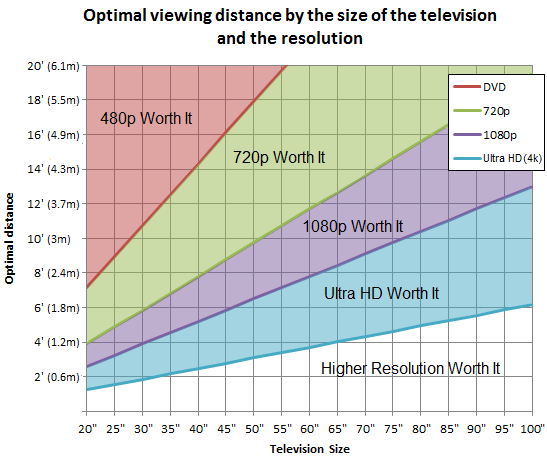
Though I'm unlikely to ever upgrade from 1440p on my computer, personally.

Comment by t-3 2 hours ago

Talking about resolution is pointless without mentioning screen size and display tech. PPI is better, but doesn't always work well comparing between technologies.

Comment by StilesCrisis 5 hours ago

It depends on TV size. If you've ever experienced Netflix on a 75" TV, 1080p content looks mediocre on it. So really it's better expressed as "there isn't much benefit for most TV sizes."

Comment by broeng 4 hours ago

I wont quite argue, that 1080p is always enough on a 75", but your example is more a Netflix problem; their compression results in hideous quality, and it's not really representative of what 1080p could be.

Comment by StilesCrisis 4 hours ago

Granted, maybe Netflix wasn't the best example, but I was just trying to be succinct.

Comment by oblio 6 hours ago

Yeah, but that's based on a hard limits, the physics of the eye. The example was poorly chosen.

Comment by t-sauer 6 hours ago

Your example also counters your point: A lot of people do not care about 4k, and even less do care about 8k or above. We reached a point where most people are completely happy with the quality they get.

Comment by lelanthran 5 hours ago

> Your example also counters your point: A lot of people do not care about 4k, and even less do care about 8k or above. We reached a point where most people are completely happy with the quality they get.

And when (not if) we get to the 4k (or 8k) equivalent of LLMs, they'll just be baked into hardware and we'll have near instant responses while running locally.

There is no future where OpenAI, Anthropic, etc survive with their current business model; at some point we will hit a point where training a new model is done only every 5 years or so, and in that scenario we aren't going to be running models of pricey server GPUs with latencies measured in seconds and full responses measured in minutes.

We'll be running locally with sub-millisecond latencies and responses measured in milliseconds. There is no way for any big company to compete with the current business plan of selling inference or subscriptions.

Comment by seb1204 4 hours ago

I dare say many are watching on handheld devices and not big screens. At least a sizeable percentage I would say. My guess.

Comment by phoghed 5 hours ago

Likely constrained by the fact people are mostly watching low bitrate Netflix streams.

Comment by sureglymop 6 hours ago

Don't forget that it's only an assumption that scaling more results in better models. There may be a ceiling to that. If that is hit and the best performing possible model can run in little VRAM, your argument here doesn't hold anymore.

In a way it is actually the same thing that makes us accept AI as working in the first place. It only needs to be good enough for human perception. The same is probably true for compute.

Comment by oblio 5 hours ago

I'd argue we've already hit the ceiling. Can you truly tell the different between SOTA models from 9 months ago and those from today? There are some improvements but they're mostly marginal.

Plus there is a chance the actual scaling that matters is beyond our reach. Think instead of TB models, PB or ZB models. We don't even have that kind of information. Humanity in its entire history hasn't generated 1ZB of information.

Comment by xyzsparetimexyz 3 hours ago

> Can you truly tell the different between SOTA models from 9 months ago and those from today

On a task that corresponds to the benchmarks, yes absolutely.

Comment by flohofwoe 4 hours ago

FWIW I still play PC games on 1080p (also has the nice side effect that I don't need to buy an overpriced highend GPU, nor use upscaling hacks like DLSS which trash image quality).

Comment by lelanthran 5 hours ago

> Standard Def TV was plenty for 50 years. But when more was on offer, everyone went for it, and now you can't even buy a 480p TV.

And yet when we hit 4k, that's were people just stopped buying higher res. 8K is still useful, but only when the screen is so large that it doesn't fit in the room :-/

Comment by bogdan 5 hours ago

There's barely any media in 8k. There's so many ppi you can squeeze before your eye can't tell the difference anymore.

Comment by odyssey7 5 hours ago

Historical precedent: Quickselect, or any other discovery of a surprising algorithmic speed-up.

LLMs haven’t been on the scene for very long. There’s still lots of room for efficiency discoveries. Plus, I keep hearing quantum is going to be a big deal in the next few years.

Comment by _glass 5 hours ago

Super interesting, when Quantum computing would enable really large models, or much larger contexts. But QRAM is even more behind than pure fault-tolerant gates.

Comment by EarthMephit 5 hours ago

I haven't tried it, but colibri is meant to allow running GLM 5.2 the 744B model in 32GB by using prefetches and streaming from fast SSDs.

https://github.com/JustVugg/colibri

Comment by kcb 3 hours ago

Terrible performance on $20,000 worth of GPUs.

Comment by 2 hours ago

Comment by fooker 3 hours ago

I'm claiming that the max amount of intelligence you get out of a 100GB model is unlikely to be that much lower than what you can get out of a 1TB model.

Comment by xyzsparetimexyz 57 minutes ago

That depends on whether you can separate intelligence from memorization. I think we can agree that theres more than 1 TB of memorizable information in the world, even when highly compressed.

Comment by fooker 45 minutes ago

Sure, agreed.

The question then is, how much memorization is really needed for intelligence if you can query structured information?

Comment by yieldcrv 6 hours ago

It’s not just about small models, that’s only one part of evolution

Some groups are baking models into silicone, Deepmind has an example, it gets 18,000 tokens/sec on Llama 3.1, not sure about parameter size

Comment by fooker 3 hours ago

> Some groups are baking models into silicone

While some other groups are baking silicone into models :)

Comment by intrasight 6 hours ago

I think this is the future - at least it will be for on-device models. Apple, for instance, will "bake silicon" once a year for their current model, and use that chip in all their devices.

Comment by lelanthran 5 hours ago

> How would we do that? There's no historic precedent for that. Its fundamentally an information theory thing: what's the max amount of intelligence you can get out of 1 KB/MB/GB? There has to be a limit and I'm not convinced that it's far off.

Sure, it might be very near using the current approach, but... it might also be might be very far off because we are using the wrong approach.

I mean, look at the max amount of intelligence you can get out of a human brain powered by two bananas...

Comment by leoc 5 hours ago

Though even if there are big further breakthroughs to be made here, they won’t necessarily be made soon, and if they aren’t made in the next ~10 years then they won’t really affect the outcome of chip investments made now or in the immediate future.

Comment by petesergeant 5 hours ago

> How would we do that? There's no historic precedent for that. Its fundamentally an information theory thing

Maybe? Human science history is absolutely littered with examples of things that were “constrained” by a fundamental law … until they weren’t, because we’d misunderstood or misapplied the law.

Comment by bebe8393jrir 4 hours ago

Just replicate dogs brain. It is the ultimate state of art (far smarter than people). But you need a few kb of memory to replicate resoning skills.

Dogs are very smart!

Comment by raincole 6 hours ago

And by the time the models that require 1TB memory will be better.

It's like people saying mobile chips are going to be better than PC chips... until they realize PC can be made of mobile chips too if that comes true.

Comment by fooker 3 hours ago

No, it's like saying a chip that consumes 500W is going to be better than a chip that consumes 200W.

This used to be true for the first several decades of microprocessors, and stopped being true in the early 2000s.

Comment by ImprobableTruth 6 hours ago

The fundamental issue is that for these systems bigger is essentially always better (if affordable). So if we can squash something like Kimi K3 down to run on a 'normal' system, that just incentivizes devs to increase the model size until once again we're at the limit of what can be run.

Comment by leoc 4 hours ago

I think the chipmakers are pretty securely set up here, the usual cyclical issues aside. Between the stubborn resistance of the data to being compressed without significant loss, and to a lesser extent the ability to do more with more memory (we’re surely at diminishing returns for LLMs already, but diminishing doesn’t mean zero) it seems like a fairly safe guess (I am not an expert on anything) that for the next decade at least you’ll still want at least 128-256GiB of video RAM to have a comfortably “SOTA-enough” experience. Then the other side of the rectangle comes from putting that VRAM in every consumer and office-worker device. Selling everything at a big premium to a few efficiency-obsessed SaaS providers is what you do when you’re temporarily supply-constrained. Sidelining the SaaS middlemen and selling to gloriously inefficient consumers who will leave their laptops closed for most of the day is the dream. This is probably not unrelated to the fact that the country which is currently making a big strategic push into memory manufacturing is also championing open models.

Comment by Dibby053 6 hours ago

What do you base this prediction on? It seems very unlikely, unless by SOTA you mean the current SOTA.

Comment by oblio 5 hours ago

> What do you base this prediction on?

Their posterior. Or worse, their interest in going to the moon (HODL style, not Artemis style).

Comment by petra 2 hours ago

And besides llm's memory requirements:

-HBM has a lot of room to grow(bandwidth/power/density). And an HBM memory takes 3x the amount of wafers of regular DRAM.

-HBM + better DRAM designs could increase random memory access speed by alot. I've seen research talking about 7x.

At what point it makes sense that half of consumer GPUs and most of the server GPU/CPUs start using HBM?

Comment by tornikeo 5 hours ago

SoTA AI will move well past 1TB+ memory requirements in 1 year or so.

Also, you will be able to play with much more competent models locally. They will still feel like children compared to the adults living in the SoTA region.

Comment by clbrmbr 6 hours ago

Are you thinking of fundamental architectural changes (like the Transformer)? Or incremental (like MoE or GQA)? Are there specific neolabs or techs you are following that lead you to this prediction?

Indeed it seems quite possible we are one architecture breakthrough away from existing chip stock driving us all the way to ASI.

Nobody has done AFAIK the information theory to prove it’s not possible.

Comment by whazor 6 hours ago

Yeah, you can directly print the SOTA AI model on the chip. I also believe this can be done on older process nodes. The most important factor would be speed. How fast can you go from new model to new chip?

Comment by empath75 54 minutes ago

You can get _better_ that SOTA AI performance by burning the weights directly to silicon, the problem is you're locked into that model

Comment by dist-epoch 6 hours ago

Even if we do, we are going to need a lot of RAM for the billions of agents running everywhere.

Comment by hahahaa 5 hours ago

"we" being China?

Comment by greenavocado 6 hours ago

NOPE. The opposite will happen. CXMT will flood the market thus making 1 TB models affordable.

Comment by yieldcrv 6 hours ago

that would be perfect timing

Hyperscalers are screwed, data center mania couldn’t even be completed during this massive spending spree, all while the people seemingly sitting on the sidelines are working on getting these things baked into the OS and chipsets in a way consumers wouldn’t notice

Comment by lardosaurusrex 1 hour ago

[dead]

Comment by jonkoops 7 hours ago

EU chip industry: best I can do is eat glue in the corner.

Comment by jdiez17 6 hours ago

EU chip industry: best I can do is supply chips that are in 99% of industrial equipment and vehicles. Also supply the only machines in the world that enable leading edge lithography processes.

Comment by bgnn 5 hours ago

No comment on the second part, but the first part is wrong. EU doesn't have a moat in process technology anymore (since 2010s). They have a bunch of legacy fabs, like 350, 180 and 130 nm but Taiwan, US, and China (and others like Israel, or Singapore) have these too. EU is severely lacking behind chip design, production and packaging capabilities for industrial, automotive, and space kind of niche applications since the heavy divestment from semiconductors after 2008 financial crisis and 2015 Euro crisis.

On top of this, once European giants like NXP (formerly Philips semiconductors), Infineon (formerly Siemens semiconductors), and ST are actively reducing their footprint in Europe and moving to India or SE Asia.

In short: No, EU has no future in those markets as designer or producer of chips.

Comment by dachworker 4 hours ago

This is actually at the core of our (EU) problem. Instead of thinking, "here is this new technology, how can we build new markets/products out of it", our industry leaders always think, "here is this new technology, how can we apply it to our existing industries".

You can see it a lot in AI, right now. AI4industry is not where the gains are right now. We should be competing on training foundational models. Once the foundational models from US/China are strong enough, they will do AI4industry and we wouldn't have any edge on them anyway because their tech is more vertically integrated and they have better insight in how AI works under the hood.

Comment by larksimian 4 hours ago

There's no moat to AI models so it doesn't really matter who develops it first. If AGI happens none of it matters since it won't be controlled anyway. If there's an exponential wall then everyone will be at it within 12 months of the first person hitting it and then it's better not to have spent the cash pioneering the path.

The long-term idea that the we have to compete claim is based on is like AGI and it's gonna really care what Elon tells it to do. This is a dumb idea regardless of how it fails.

AI models are seeming the ultimate in fungible commodities at this point, why spend on R&D?

Comment by altern8 6 hours ago

EU: we should create a law regulating the viscosity of the glue being eaten

Comment by modo_mario 6 hours ago

EU: Perhaps we should also spend a few billion on attracting american glue manufacturers so they open a factory and a half here so we can catch up in this chip making business.

Comment by shimman 2 hours ago

EU: Our people generally live longer and happier lives plus our countries are some of the safest on Earth. Better throw that all away and follow the Americans into hell so our elites can make slightly more money!

Comment by dadoum 6 hours ago

CXMT uses old Qimonda patents (even though Qimonda's tech is now outdated), and the former CEO of Qimonda is currently building a fab for an FeRAM-based alternative to DRAM in Magdeburg. It's a gamble as FeRAM still suffers from a more limited lifetime than conventional DRAM at this moment but I think there are still somewhat interesting developments happening in Europe.

Comment by mrtksn 5 hours ago

To be fair, all high end chips are made in Asia with EU tooling. US happens to be the place where the managers are and the trade is facilitated. There has been some good progress to push Asia make cips in USA with EU machines however IIRC significant part of the chain is still in Asia and chips made in USA are shipped to Asia for further processing.

Edit: changed China with Asia to distance the comment from Taiwan-China based politics.

Comment by wasfgwp 3 hours ago

> US happens to be the place where the managers

And you know.. the actual design for plenty of these chips. By that definition Apple is also an Asian company..

> with EU tooling

That is only a (vital) part of the supply chain, there are plenty of other components.

Comment by mrtksn 3 hours ago

IMHO the moral of the story is that no one particular makes the chips, humanity does it collectively.

Comment by norman784 4 hours ago

AFAIK the high end chips are made in Taiwan, that's not the same. Also there was an export control, so ASML couldn't sell the latest equipment to China.

Comment by mrtksn 4 hours ago

Officially, according to USA, Taiwan is China but this is pedantic. Let's call it Asia instead of going into China-Taiwan politics

Comment by zer00eyz 4 hours ago

> To be fair, all high end chips are made in China with EU tooling.

Did you mean Taiwan? Because depending on who you ask that is, or is not china.

The Chinese have been cut off from EU tooling for a while now. And their attempts to build out their own lithography setups have been a failure. Their 7nm process is, by all measures, not delivering the yields that one would need to make it really successful.

Comment by mrtksn 4 hours ago

No I don't mean anything related to politics of China-Taiwan. I have no interest in that.

Comment by pmxi 2 hours ago

Clearly you do, given you expressly maintain that China includes Taiwan (an uncommon opinion)?

Comment by mrtksn 2 hours ago

You know what, it's not something I know anything about but it seems like the "Taiwan is not part of China" folks are annoying and I haven't met the opposite kind so I guess I lean towards Taiwan is part of China now, giving the benefit of doubt to the other side of the flag war.

Comment by b3orn 7 hours ago

EU chip industry: best I can do is power electronics.

Comment by nimchimpsky 6 hours ago

EU Chip industry : ASML, 2nd to only nvidia, 0.5T mkt cap

Comment by eckelhesten 6 hours ago

They sell the shovels, we need someone actually digging for gold.

Comment by Tade0 5 hours ago

Shovels have always been the better out of the two investments.

There were rumours about China grabbing hold of one of ASML's machines, but with no additional information on this it's safe to assume they're still hammering out 7nm chips using DUV at piss poor yields.

Comment by amluto 1 hour ago

I see no reason to think that CXMT’s yields are poor. Or, for that matter, that Huawei’s yields are a problem.

Comment by wasfgwp 3 hours ago

Except in China’s case where they eventually figured out how to make shovels themselves in plenty of other industries (and likely at some point in the future chip fabrication as well)

Comment by Foobar8568 6 hours ago

STMicroelectronics cries in a corner.

Comment by Steve16384 5 hours ago

HN continues its transmogrification in X.

Comment by Tade0 5 hours ago

Don't make me tap the sign that says "ASML".

Difference between Europe and the others is that it doesn't brag nearly as much.

Comment by dmix 5 hours ago

Even the EU thought the “EU Chips Act” was a failure which is why they are trying to re-invent it after spending billions https://www.theguardian.com/business/2025/apr/28/eu-microchi...

I don’t think the goal there was to sit around praising past accomplishments. You always have to keep building.

Comment by wasfgwp 4 hours ago

And that’s about it..

In relative terms there is no innovation happening outside of that and some other smaller companies providing highly specialized components that are a part of the supply chain.

There isn’t just much if anything to brag about. ASML is great but it’s effectively a monopoly (for the time being) due to a large extent some correct historical choices.

Comment by jonkoops 4 hours ago

ASML doesn't make chips.

Comment by tigershark 3 hours ago

Nobody makes state of the art chips without ASML

Comment by amluto 1 hour ago

If you believe Huawei’s marketing, they are doing quite well on their Ascend series with DUV.

CXMT is making truly impressive inroads on what is currently a very Large addressable market using DUV.

Comment by jonkoops 2 hours ago

ASML doesn't make state-of-the-art machines without Cymer. What is your point?

Comment by 5 hours ago

Comment by WhyNotHugo 3 hours ago

You're forgetting about ASML, which is European and makes the actual machines to produce a huge portion of the world's high-end chips.

Comment by Ampersander 6 hours ago

EU bourgeoisie invests in US tech

Comment by lelanthran 5 hours ago

> EU chip industry: best I can do is eat glue in the corner.

Aren't they the only ones able to supply the chip-making machines?

Comment by wasfgwp 3 hours ago

Based on the empirical evidence we have ASML succeeded in spite of the EU not because of it (so “they” is bot exactly fair). There is not much EU has going on besides that when it comes to growth and innovation.

It’s a bit like Novo Nordisk, they had a huge win and then just focused on making as much money while it lasted while more innovative companies ate up their market.

Comment by yearesadpeople 5 hours ago

Oh Jon

Comment by vitalyan8184 6 hours ago

[flagged]

Comment by cloudie78 5 hours ago

EU: More windmills!

Comment by glimshe 7 hours ago

I have nothing to say about this company's long term potential, but I'm curious to know whether this will become an enormous "tik stok" like SK Hynix became in South Korea. I've watched a short documentary about the investment mania in SK and it's really scary.

Comment by samrus 7 hours ago

If the chinese government feels its critical to china's success then it will be backed like alibaba and wechat and others were

Comment by thenthenthen 3 hours ago

Jackie Ma of Alibaba was basically exiled for some time because he got cocky (and too powerful/rich?).

Comment by overfeed 12 minutes ago

While hyping upcoming products from his conglomerate, he talked shit about the government (regulatory authority, more specifically), and he got hit.

Comment by Hasz 2 hours ago

the company, sure. The stock or people who own in, less clear.

Comment by _trampeltier 7 hours ago

Tesla is kind the same. Everybody bought it, because it went up so much, less because of the product. I guess every AI would do the same.

Comment by rokkamokka 7 hours ago

I wonder what the effects of TSLA dropping to reasonable levels (a drop of about 90%) would look like.

Comment by Schlagbohrer 6 hours ago

Morgan Stanley said that SpaceX's space activities are only worth $8 per share...

Comment by fragmede 6 hours ago

Morgan Stanley's target price for SPCX in their report is $300, with $8 being the space component, and the $292 being everything else, like what actually gets put into space. The Morgan Stanley report doesn't say SPCX is worth $8/share. Just wanted to be clear and not have a conversation based on vague implications.

Comment by rapsey 6 hours ago

Most people here seem to have a serious misunderstanding of what a stock price means. It reflects investor expectations. Not current revenue.

Comment by addozhang 3 hours ago

South Korea has opened its financial doors to the outside world, and since SK Hynix is a publicly traded company, that's allowed capital to flow in and take control of the company.

Comment by chii 6 hours ago

> the investment mania in SK and it's really scary.

i mean, it shouldn't be scary, because their failure is their own, and i doubt there would be collateral damage outside of those high risk investors.

It's scary for _them_, but it's an interesting case study for an outsider.

Comment by thephyber 5 hours ago

There's a lot of speculation in your comment.

I lived through the crash of 1989, the Dot Com crash in 2000, the GFC of 2008, and whatever the crash and WSB speculation in 2020 were called. None of them had a tiny blast radius like you suggest.

Comment by fwip 4 hours ago

If 30% of adults in your country suddenly lose, say, half their wealth from a stock market crash, it's going to affect everyone in the country - not just the investors.

To use an example, the Great Depression wasn't sunshine and roses even for the people who kept all their money under the mattress. Their job was just as likely to go out of business.

Comment by blitzar 6 hours ago

If the golden stick of memory sitting on Trumps desk has its intended effect - and the US allow Apple to buy memory from CXMT then another 500% surge might happen.

Comment by amluto 56 minutes ago

The reverse might be worse for the US in the long run.

Right now, the US leads China in compute-heavy R&D because the US has access to more compute, and that compute has two components that China has limited ability to produce domestically: the GPUs themselves and the DRAM. A decent fraction of the balance of the plant is already produced in China.

If the US refuses to buy Chinese tech, then we may find ourselves paying more for compute than Chinese labs (DRAM first, but Huawei really really wants to catch up with the combined forces of TSMC, Nvidia and AMD) and falling behind on access to compute at acceptable prices.

If I were setting US policy, I would be trying to get the US-friendly companies to increase production and trying to encourage domestic production so that the US-friendly world can stay ahead. Getting held back by a DRAM cartel that wants to juice profits at the expense of output is not good for the US.

Comment by overfeed 3 minutes ago

> If I were setting US policy, I would be trying to get the US-friendly companies to increase production and trying to encourage domestic production so that the US-friendly world can stay ahead.

That's what the CHIPS Act was supposed to do, but it got neutered for partisan political reasons. The CHIP Act was already about a decade too late. US policy is inconsistent across administrations, and the beneficial moves usually made very late in the game, around the time second- and third-order effects of the bad decisions become unbearable.

Comment by levanlevi 7 hours ago

is it retail or hype driven - that's the question

Comment by feverzsj 7 hours ago

It's driven by the supreme leader's grand plan, like everything else there.

Comment by VulgarExigency 6 hours ago

Seems to be working out better than leaving it up to the market

Comment by pingou 6 hours ago

Why does the US stock market keep having record years while the population doesn't seem to benefit, whereas the opposite is happening in China? Isn't that a failure of US capitalism?

Comment by thephyber 4 hours ago

What do you mean why?

This memory stock popping on IPO has nothing to do with how well/bad capitalism provides in the USA. This is entirely about Chinese investors speculating on this company's ability to grow and undercut some Samsung, SK Hynix, Micron. Nobody knows on IPO day if a company will grow into the expectations of the investors.

And China's population mostly invested in Evergrande real estate, not stocks. Lots of workers in the US are at least invested in the stock market via their 401k/IRA, but the same isn't true of Chinese workers.

Also worth reiterating that most US stocks aren't doing great. The top 10 by market cap keep dragging the indexes into growth, but success is heavily biased towards the monster caps.

Comment by pingou 2 hours ago

In the US, shareholders get rich while regular people get left behind. In China, shareholders returns seem quite bad, and standards of living seem to actually improve. Granted, China started from a much lower point, which makes rapid growth a lot easier.

Comment by bawana 5 hours ago

The population in china is falling off a cliff....low birth rates, collapsing property prices (the main vehicle for personal investment), slowing ecconomy.

Comment by xboxnolifes 1 hour ago

China's population has dropped a few million over the last 5 years, but over the last 20 years they have still gained 100 million people.

Comment by Tade0 5 hours ago

Is the latter part actually true in this decade or just "face"?

Comment by VulgarExigency 5 hours ago

It's not a failure, that's just how capitalism works.

Comment by expedition32 2 hours ago

You're supposed to redistribute the money to the poor. That's what FDR did and was later copied by European socialists.

Comment by xboxnolifes 58 minutes ago

If the poor were worth having money, the market would distribute money to them (Obligatory /s specifically for the HN audience).

Comment by VulgarExigency 1 hour ago

That sounds like government intervention to me.

Comment by levanlevi 3 hours ago

imo, every form of country order has a tipping point from where it starts deteriorating at record speed - cannot tell exactly what comes after ultimate capitalism but I think it's hitting peak points

Comment by wasfgwp 3 hours ago

Except the CCP seems perfectly fine with with allowing (semi) private companies to compete and innovate freely and it has worked out quite well for them..

Comment by cluckindan 7 hours ago

Let’s see them ship some chip first

Comment by blitzar 6 hours ago

> 8% to 9% of the worldwide DRAM market share in 2025

how much more do they need to ship to satisfy you?

Comment by kubb 6 hours ago

10x

Comment by blitzar 5 hours ago

Seems fair ... if they can capture (and ship) 90% of the global supply of memory they will be permitted to have a market cap of 0.1x Nvidia.

Comment by feverzsj 7 hours ago

The price is similar, as they all rely on same upstream suppliers. The quality is kinda meh.

Comment by wasfgwp 3 hours ago

Currently price has little relation to manufacturing cost, though

Comment by grumbelbart2 6 hours ago

They don't have access to EUV machines from ASML though.

Comment by adrian_b 5 hours ago

What they have is good enough for competitive DDR5 DIMMs.

In China they already make integrated circuits with a finer pitch than at TSMC or Intel before the transition to EUV.

This is achieved by multiple exposures, which increase the fabrication cost, but with the current prices they still have very healthy profits.

Comment by feverzsj 6 hours ago

EUV is only required for highend ram like HBM3E, HBM4.

Comment by kmjmbk 4 hours ago

they seem to be doing fine regardless.

Comment by cubefox 6 hours ago

> Once an affordable component used to build devices, memory prices have more than doubled in recent months - and are still rising.

Is this accurate? It looks like they are no longer rising, at least for DDR5 memory:

https://de.pcpartpicker.com/trends/price/memory/

Most of the price increase did occur in Q4 2025 and most prices are fairly stable since then. Maybe this is different for LPDDR, GDDR, or HBM, but I would like to see evidence for that.

Comment by Tepix 6 hours ago

Look at DDR5-6000, it clearly is rising again since June.

Comment by cubefox 3 hours ago

Still looks like a weak trend compared to the explosive price hike at the end of 2026.

Comment by shevy-java 7 hours ago

The more interesting question is: why does the rest of the world not increase their production prowess? I am aware of most of the reasons, but I am getting tired of the "China is better than the rest of the world". It is more that China did a lot of things that the others either failed to do or no longer wanted to do. Case in point is Germany: from "our cars are best" to "hey, chinese cars are now better" (or, cheaper, for a comparative quality). This constant complaining is so strange. Would that energy not be better spent to try to become better?

Comment by thephyber 3 hours ago

The short answer is VW doesn't have the ability to compete with China's best EV car company on EV price, factory automation, or raw input (labor, electricity, metals) economies of scale. The complaining is to get politicians / regulators to prevent the Chinese EVs from being imported into their domestic markets.

Chinese structural advantages: monetary policy, lower cost of living, better infrastructure (electrical and transportation are all new within the last 20 years), lower cost of {concrete, factory machinery, metals, electrical} due to economies of scale.

Chinese EV manufacturers advantages: they don't sell ICE cars, so they don't have any legacy customers, factories to retool, or brand migration issues. And they mostly stole their technology from hiring Tesla factory workers to moonlight for them and share the design, technology, tooling, and RE the Tesla finished product.

Major Western legacy car company disadvantages: Ford, Toyota, Volkswagen, etc... all have significant reasons why they can't or won't make the super risky attempt to go all-EV. They all have $10s of billions in debt they are still paying off for their current capital improvements. Those debts assume they contribute selling ICE because EVs last longer so they would sell fewer units per year. It's simply less risk to avoid making any EVs and pay politicians to protect their businesses than to try to compete with 10 year old Chinese phone-companies-turned-EV companies. On top of that, the worldwide demand for EVs is only about the volume of the single most popular model of Toyota. They would have to go into massive debt on a giant risk that consumers will want more EVs (and that the EVs they design/build will sell better than the current ICE cars they have meticulously crafted for 50-100 years).

Comment by brabel 6 hours ago

50 years ago you could ask the same question about Europe, the USA and Japan: why are they so much more productive than everyone else?

So others did spend energy on becoming better and now you see a different picture when you look at the world.

Comment by raizer88 6 hours ago

Because the capitalist west doesn't have strategic view, beside maybe on the defense sector. Everything else must produce profits next quarter not in the next 3 years.

Comment by Schlagbohrer 6 hours ago

It's this. Wall Street won't allow american companies to make long term decisions and long term planning that cost money in the short term, because they want all that money immediately now. Like, right now now. If an executive promised they could deliver big profits in 5 years by spending the next two investing their profits, Wall Street would fire them and put in someone who will happily spend all the profit (plus debt) to do stock buybacks and dividend disbursals.

Comment by Mainan_Tagonist 5 hours ago

The stock market works that way, it's true.

But what about SpaceX, Blue Origin... there are also counter examples that show it is possible for investors to wait out the big profits.

Comment by fwip 3 hours ago

I don't believe either of those two companies have ever been profitable. (I'm sure Musk has some accounting tricks to make it look that way, though.)

Comment by yuraoak 3 hours ago

those are not run by Wall Street. they are run by 2 billionaires who care about something other than near-term profit (legacy, ambition, etc).

Comment by shimman 2 hours ago

Both those companies only can exist because of massive amounts of corporate welfare. What exactly are you trying to argue here? That the government should give private capital more of the people's money while the country suffers from lack of healthcare, childcare, education, and housing?

What's the point of this? Honestly?

Comment by expedition32 2 hours ago

America is the greatest country on earth because someone owns 50 billion dollars.

Comment by bildung 6 hours ago

It's even worse, the entire ideology is that industrial policy can't, by definition, be better than what the market would decide without interference. So every kind of actual strategic decision making (i.e. investing a few hundred billions in the industries of importance for the next decade(s), or at least in the infrastructure supporting it) would actually make matters worse. That is essentially what neoliberalism is all about.

This is core reason why the German industry became so irrelevant in the last 2 decades: The rail infrastructure became pseudo privatized and now is in shambles (IIRC only about 60% of trains arrive on time). The PV industry was axed by the conservatives about 15 years ago and now is completely dominated by China. Even now, as the other EU countries demand strategic investments - and again the German conservatives say this ought to happen without any new debt. "We can only spend what we have", to quote Merz. Imagine China saying this about chip production, or even Sam Altman about compute hardware...

Comment by mosura 6 hours ago

It is because in the west we suffer from self inflicted obstacles that make it impossible to get out of our own way. The Chinese gov must think they are playing on easy mode.

Comment by mschuster91 6 hours ago

> Would that energy not be better spent to try to become better?

The problem is, shareholders have bled Western companies dry in the chase for returns on investments. There is no money left in the companies to retool them to be competitive with China.

Meanwhile, the CCP just pours dollars into their companies.

Unfortunately, there is no punishment in Western societies if you run a company into the ground as long as you pay your debts on the way out.

Comment by mapt 5 hours ago

The rest of the world is chasing models of investment in procurement of goods and services that get stuck on neoliberal capitalist antipatterns where every action demands a short-term profit motive. These are now very large-scale, highly-complex-supplychain manufacturing projects, and you cannot remain competitive if you are just Putting Faith In The Market to solve your problems. There's too much planning and sustained, structured goal-orientation required for investors or for the sort of contract-bid, public-private actions Western politicals are used to engaging with.

Comment by dist-epoch 6 hours ago

It takes 2 years in EU to get approval to build a shed. Imagine how long it takes to get approvals for a chip factory which uses a lot of water and very toxic chemicals.

UK has been trying to get approvals for a new runway at Heathrow airport for over 20 years !!! now.

Comment by HighGoldstein 5 hours ago

The EU isn't monolithic, you could probably do this fairly easily in someplace like Poland where there isn't a bureaucratic hell and a large supply of skilled workers and engineers. But of course, Poland and co. are the "lessers" in Europe where you outsource for cheaper labor, a prestigious thing like a cutting-edge chip fab would need to be built somewhere like Germany or the Netherlands, and so it never shall exist.

Comment by skocznymroczny 5 hours ago

Mostly self-inflicted wounds in form of climate pledges, climate taxes and such. Because of the goal to achieve zero emissions goal and climate neutrality, we abandoned cheap energy sources such as coal and pushed our heavy industries out of Europe to China. We still need those products, so we import them from China while wondering why European industrial segment isn't growing. Even in the clean energy sector, most solar panels come from China.