Show HN: Physically accurate black hole you can put in your room
Posted by aplavin 4 days ago
We have a black hole at home — with actual relativistic physics, live in your browser.
I'm Sasha (Alexander) Plavin, an astrophysicist at Harvard's Black Hole Initiative studying quasars and black hole environments. I work with raytracing/radiative transfer simulations professionally, and wanted to make one anyone can play with — so I built this app.
Put the black hole onto your screen (any browser), or directly into your room with AR or VR (requires WebXR, for example Chrome on Android, or any VR headset). When looking around, pay attention to unintuitive relativistic effects: rays bending around the black hole, and special relativistic "Doppler boosting" changing brightness depending on the viewing angle — zoom out to see the fast jet where the latter effect is especially pronounced. Faint markers show where other viewers are standing right now.
Alternatively, put the black hole in front of your camera and watch it lens your actual surroundings. Light winds around the hole, so you see both what's in front of you and what's behind you at once (when the device and browser allow both camera feeds). The closer to the black hole, the stronger the bending — and the longer the light-travel delay: wave at it and watch the changes propagate inward. (unfortunately, WebXR restrictions make AR passthrough and the camera feed mutually exclusive)
No signup, basic features work on every device, no data uploaded — the camera feed never leaves your device. Source code: https://github.com/aplavin/blackhole.plav.in.
Enjoy having a black hole in your room, or use it for education/outreach — any questions, feedback, or suggestions are welcome!
Comments
Comment by Waterluvian 15 hours ago
Comment by quijoteuniv 11 hours ago
Comment by hmokiguess 4 hours ago
Comment by 20k 13 hours ago
I wouldn't mind at all if it didn't say that this was a *physically accurate* black hole specifically, but this now falls under misleading science communication in a way that often gets hand waved away as if it doesn't matter, so we've got to clear some things up!
1. The accretion disk shouldn't be red, people just expect it because it looks cool. Black hole accretion disks are near universally hot enough to be blue. Interstellar did this too, and tried to handwave it away very unconvincingly
2. This is a non/low (?) spin black hole, which isn't super duper realistic
3. It ignores the position of the camera (which affects the lorentz shifting)
4. The doppler shifting isn't terribly accurate
5. It doesn't model the accretion disk temperature distribution or colour with any kind of accuracy. Usually you model accretion disks as a blackbody radiator, shift it by the doppler, and to display this convolve this against the human eye response (LMS), go to XYZ, then RGB, do a physical tonemapping step, before an sRGB conversion. This instead does none of that - no step of this is done with any physical accuracy. Its not even illustratively correct as we'll get into
6. The actual radiative transfer is very simplified compared to what you'd use for realsies, and isn't based on any real numbers, with very simplified equations. The opacity and emissivity of the disk is arbitrary, as is the size, and it does not correctly incorporate brightness or extinction, eg here https://github.com/aplavin/blackhole.plav.in/blob/2f004bfeca... is super simplified
7. The wrong equation is used for the doppler calculation. They use the I^3 variant, whereas the data you get out of a disk sample is *radiant flux* which is actually F_obs = F_emit / (z+1)^4. This is a very common mistake in image processing, which means that the doppler shift and observer brightness isn't correct. Surface brightness over here https://github.com/aplavin/blackhole.plav.in/blob/2f004bfeca... is *not* a spectral radiance but instead a radiant flux
Stuff like the brightness -> colouring conversion is particularly inaccurate. Eg if you check out the source:
https://github.com/aplavin/blackhole.plav.in/blob/2f004bfeca...
It maps the pseudo brightness completely arbitrarily to colour. The resulting colour/brightness here then doesn't correspond to anything remotely physical. It also performs a *linear* mapping of a linear quantity (brightness) to sRGB (which is a nonlinear process!!), which means that it doesn't even retain any of the underlying physical characteristics of the brightness simulation, which itself is quite inaccurate. Its vibes all the way down
This is all fine if you're doing visualisation, but this isn't an accurate simulation. I wish this was just called a visualisation of a black hole, but its being communicated as if this is super hard science with credentials and all
Comment by KaiserPro 9 hours ago
I thought "oooh this is interesting I wonder how they are going to do physically accurate on an end device" Recalling how the original particle sim was something like 100TB, took 2 weeks to generate and seemed to write in a way that killed disks. but that was >10 years ago, so what clever stuff has been done to model it locally.
Its been a long time since I've looked at black holes, but what I'm not understanding is why the stars surrounding the black hole are just points, and more over why the lines are straight to the centre of the hole. from memory the way light enters the hole appears non-linear and changes on view point.
Comment by vee-kay 8 hours ago
Peak HN, right here!
Comment by reactordev 5 hours ago
Comment by gattr 8 hours ago
Comment by JadeNB 1 hour ago
Comment by aplavin 13 hours ago
I consider the colormap choice to be completely arbitrary though, without affecting accuracy. Basically, it represents intensity at a given frequency, the image like one would get from a telescope. It wasn't intended as a faithful optical color representation! And really, in my (admittedly biased) view of a radio astronomer, I tend to assume frequencies invisible to the human eye anyway.
Comment by 20k 12 hours ago
Its titled a "physically accurate black hole"! Please don't do this, if its intentionally not physically accurate and heavily simplified! The general public on here don't know better, and it takes someone else with years of experience simulating black holes to dig through your code to show what you've simplified. There's like a few hundred people who have the right experience worldwide to know that you've got some of your equations incorrect
The issue is when you're communicating doppler, if you want to correctly show the change in doppler, you can't make the intensity or colour mapping arbitrary
There's two ways to communicate accurately an example linear change in emissive power:
1. Use a perceptual brightness system, so that a linear change in power represents a linear perceptual change in perceived brightness. This accurately communicates to a viewer the underlying shift in power emission, if you want to show off how a radio telescope perceives a black hole for example
2. Use an emitted power <-> sRGB mapping (with tonemapping), so that a linear change in power is perceived as if it were a physical light getting brighter. This is more "what would this look like to a person?"
At the moment the change in your image brightness doesn't correspond to anything, which means that its not really communicating any science, and it doesn't correspond to doppler. Which is fine if its just illustrative and that's clear, but again vanishingly few people will know this is a visualisation not a physically accurate render
Comment by fwip 4 hours ago
Comment by john_strinlai 4 hours ago
i think an "astrophysicist at Harvard's Black Hole Initiative studying quasars and black hole environments" who "work[s] with raytracing/radiative transfer simulations professionally"probably has a decent understanding of what's going on...
Comment by fwip 3 hours ago
Comment by john_strinlai 3 hours ago
20k's comments open up conversation and engage with the content. yours is just boring, encourages no conversation, and is basically a copy/paste of thousands of other worthless comments. the only thing your comment accomplishes is making hn a worse place.
Comment by aplavin 12 hours ago
It also doesn't exert the gravity an actually accurate black hole should :) And also, even on a phone with two cameras, they only cover a part of sphere – while a real black hole would bend light coming from all 4pi directions. Some simplification is generally required ("the map is not the territory") and I don't see "simplified" as being opposite to "accurate".
Colormap choice: it can be a useful mode to show proper linear power -> linear perceived brightness mapping – true! But that's only one of many possible choices, and scales like logarithmic are very common in scientific images.
Comment by 20k 12 hours ago
Are black hole accretion disks generally red in real astrophysical cases?
They're most accurately represented as being blue. Red is fine for visualisations because it looks cool (which is fine!), but blue is the physically accurate colour. Visualisations claiming to be accurate like this presenting red black holes is becoming an increasingly large science communication problem
The way that the colour and brightness are mapped together is also not correlated correctly, and some of the equations just aren't right. The doppler isn't correct at all here, partly because its simulated incorrectly (with the camera problems), and partly because the mapping done at the end doesn't correlate to any reasonable brightness
Stuff like this: Its not accurate at all. It isn't simplified, its just wrong - which is totally fine for a visualisation, if that's the intent. But:
>scales like logarithmic are very common in scientific images.
Sure. What scale are you using for the doppler brightness here? Because as far as I can tell, its a piecewise mapping of the form ~pow(x, 2.2), after being run through a non smooth function `afmhot` - a function which doesn't have a linear brightness response. So the brightness in this image doesn't really correspond to anything related to doppler or brightness, and the colour also doesn't correspond to anything involving colour (or the doppler). The entire image's look is basically accidental
Here's a specific comment from the event horizon telescope talking about exactly this problem with specifically the afmhot transform being used, because its important for visualisation:
https://github.com/achael/eht-imaging/issues/85
Which shows some of the problems here
Comment by stackghost 15 minutes ago
Is it accurate to model a cow as a sphere?
Comment by EugeneOZ 11 hours ago
You’ve already done great work here. That said, the feedback seems to come from someone who spent considerable time analyzing your work. Even if only a few of the suggestions are ultimately valuable, that’s still a meaningful contribution and worth considering.
Comment by aplavin 4 hours ago
Comment by 7bit 6 hours ago
Comment by 20k 3 hours ago
Comment by aplavin 2 hours ago
Comment by andrecarini 2 hours ago
Comment by 7bit 44 minutes ago
Comment by 7bit 2 hours ago
The only criticism is to call that accurate, when it's simplified. OP ist defending the use of accurate with dumb arguments. The fix would simply be to not claim "accurate" and continue to provide a probably great visualisation (idk, haven't looked at it)
Comment by radicality 1 hour ago
Comment by yoaviram 10 hours ago
Comment by aplavin 3 hours ago
Also note that the visual difference for the camera warp is really marginal between rotating vs non-rotating black holes.
Comment by gilrain 5 hours ago
You agree that it isn’t “physically accurate”, then… but seem to argue that you shouldn’t be called out for the false title?
It’s fair enough to be called clickbait when you really did score extra clicks with a slick falsehood, surely?
Comment by aplavin 3 hours ago
The only difference here is that I don't show a colorbar with explicit color-number mapping, for simplicity sake.
Comment by agos 2 hours ago
Comment by aplavin 27 minutes ago
Then you are up for a big surprise if you browse through modern published papers :)
Comment by biorach 8 hours ago
Comment by 20k 2 hours ago
That's 100% fine if you present it as a visualisation with limitations and I absolutely love people making fun side projects like this and presenting them. I built a whole tutorial series on doing this, because I think people getting stuck into the field is absolutely great, and more power to everyone who wants to write anything no matter how accurate it is
Its the fact that this is being presented and stated as if its a physically accurate sim made by someone with experience in the field so it must be spot on, when in reality its little better than an artists impression of a black hole, that bothers me. Its science miscommunication. Coming away from this, you might think:
1. Black hole accretion disks are red
2. Black holes do not warp the background around them, only the accretion disk
3. You might get notions about the intensity distribution of the doppler shift, or the way that cameras work near black holes etc
None of which is particularly correct, and there's a lot more wrong with it too
Comment by gilrain 5 hours ago
If correcting misinformation is “harsh”, reality is fucked.
Comment by reactordev 5 hours ago
Comment by KinetiNode 52 minutes ago
Comment by imp0cat 9 hours ago
Love, Death & Robots: Black hole used red for the disc, too.
Comment by mazurnification 7 hours ago
Comment by 20k 2 hours ago
https://20k.github.io/assets/kerraccrete.PNG
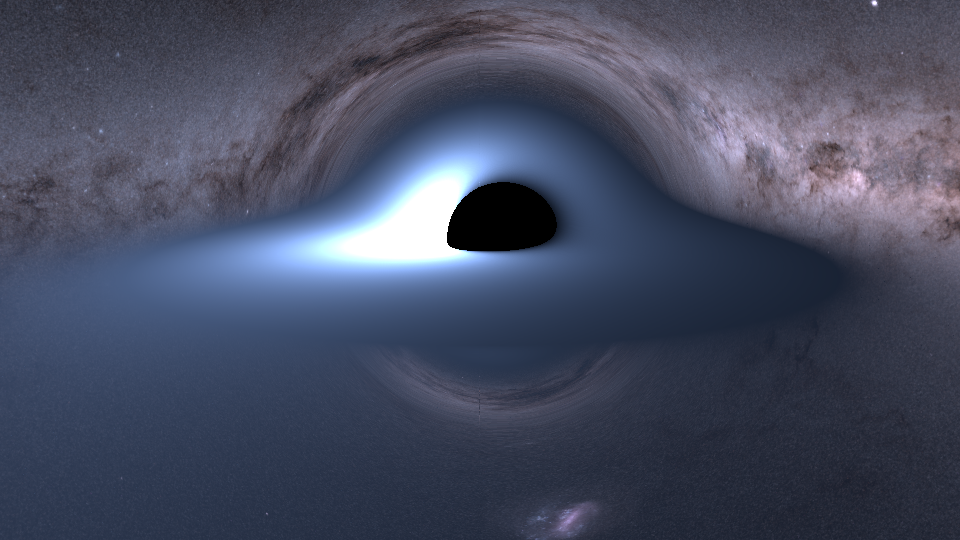
This is a colour and relative brightness accurate example of a hot accretion disk. The size, emissivity and absorption are set to arbitrary parameters, but this is human-eye-colour accurate with correct doppler and radiative transfer for a spinning black hole. Its as correct as I can make a specific model, for what a human would see standing next to a black hole taking into account the limitations of the human visual system
You can get a red accretion disk like this:
https://i.postimg.cc/pV8VWKhw/verycold.png
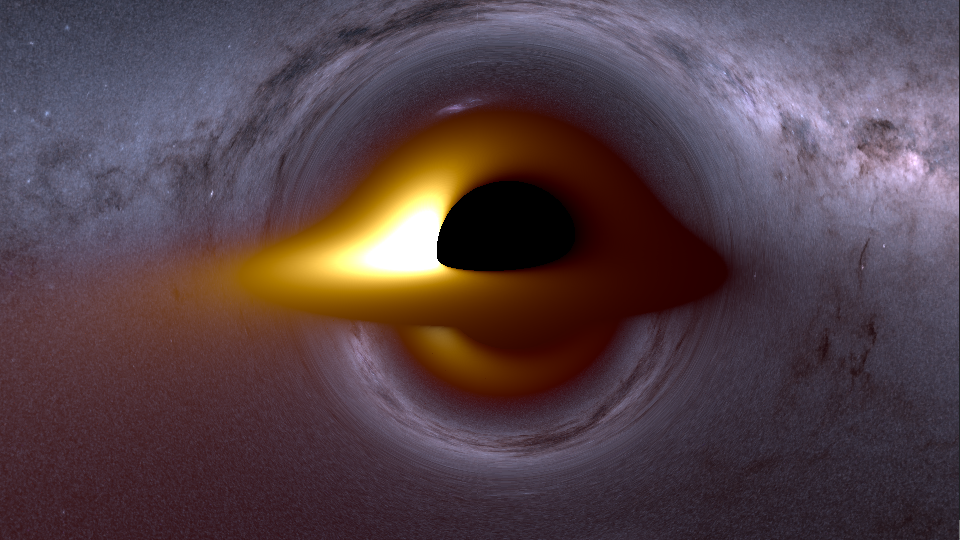
But it requires the disk to be extremely cold, which is physically pretty suspect
One interesting feature is that the temperature and brightness scale differently, so that its actually hard to observe the colour shift, as the brightness changes much faster than the colour. So its not something you ever really see to the human eye
That said these don't do accretion disk within the ISCO, which is a major limitation
Comment by aplavin 3 hours ago
Comment by FrustratedMonky 5 hours ago
He probably knows. It's in a browser, there are probably some trade-offs. Calm down.
Comment by gilrain 5 hours ago
Comment by folkrav 3 hours ago
Comment by FrustratedMonky 5 hours ago
Comment by 20k 2 hours ago
Comment by toddm 3 hours ago
Comment by dluan 14 hours ago
Yeah, that was the day I learned I have a deep, crippling phobia of large objects. And Melanoheliophobia, which is fear of black holes. The only other time I've felt that way was snorkeling once near a giant 3 story tall bait ball of swirling fish, which was so disorienting and panic inducing that I vomited.
Comment by BLKNSLVR 14 hours ago
I was nervous beforehand, but once I was in (and had accepted the inevitability of my own death) it was surprisingly calm / calming floating around and having these frickin' aquatic alien species just going about their dailies around me. I went close to the massive grouper just to get the scale right (not that I can really remember, it was 26 years ago). I even looked through the perspex so I could see the non-human-safe sharks in the tank next door.
After the (awesome) experience, I went and looked at the grouper from the outside (one of those underground big perspex viewing rooms) and I was back to being awed / scared by its size, and somewhat refusing to believe that I'd been in there with it. The memory of it is scarier to me than what I remember feeling when actually doing it. It's weird.
Comment by ViscountPenguin 13 hours ago
EDIT: Apparently not licensed, just completely unrelated.
Comment by lmpdev 12 hours ago
No Orcas, good rehab program, seal exhibit is good (no true seals), Polar bears are a bit sad though
I did the seal diving experience which was great - mostly disabled California sea lions and NZ Fur seals (which do well in captivity)
Comment by watutalkinbout 12 hours ago
Comment by matheusmoreira 11 hours ago
Comment by hnlmorg 10 hours ago
Supernova and asteroids were always scarier to me because they’re potentially planet-ending scenarios. Whereas a black hole is benign as long as you don’t move into its orbit at too acute an angle.
Comment by LeoPanthera 11 hours ago
Comment by MaxikCZ 10 hours ago
Comment by matheusmoreira 11 hours ago
Comment by antonvs 11 hours ago
Many black holes have a bright accretion disk outside their event horizon, so visibility for those is not an issue.
But it’s certainly possible to have maximally scary black holes that have no accretion disk and are small enough so as not to cause significant lensing. You could fly your spaceship straight into one of those without even realizing, until you start turning to spaghetti.
Comment by matheusmoreira 11 hours ago
> it’s certainly possible to have maximally scary black holes that have no accretion disk and are small enough so as not to cause significant lensing
Now that's a proper cosmic horror.
Comment by taneq 9 hours ago
Comment by chamomeal 14 hours ago
Strongly recommend Outer Wilds. Falling into the black hole the first time was one of my most scared moments in gaming. I was totally panicking lol
Comment by khedoros1 12 hours ago
And getting close to the upper atmosphere of Giant's Deep for the first time, staring, thinking about the atmospheres of real-world gas giants, knowing that I need to take the plunge.
That game exposed some phobias that I'd only been vaguely aware of before.
Comment by sph 8 hours ago
I recommend the game Exo One then.
It's a surreal game of flying a spaceship around in the atmosphere of a gas giant. While beautiful to look at, I know enough that flying around in a gas giant is so terrifying a prospect I never managed to complete the demo of the game. "Oh, how do you falling through pitch black clouds with winds in the 3000+ km/h where it's raining literal diamonds until you reach a lake of supercritical fluid at extreme pressures?" You don't even have to go very far, there's 4 of these in our solar system alone.
Comment by yuye 4 hours ago
The Outer Wilds is one of the greatest gaming experiences of all time. I would love to forget all about that game to just experience it again from scratch.
Comment by SapporoChris 10 hours ago
Side effects may include overwhelming hate for Walt Disney Productions.
Comment by aplavin 14 hours ago
Comment by wffurr 5 hours ago
Comment by GavinMcG 13 hours ago
Tangential, but this being a nearly word-for-word translation of “black hole fear” made me realize how odd it is that we insist on latinizing these things.
Comment by cwnyth 11 hours ago
Comment by ButlerianJihad 9 hours ago
https://en.wikipedia.org/wiki/Chris_Cornell#Personal_life
The modern Greek terms for "black hole" are:
μαύρη τρύπα or μελανή οπή
https://el.wikipedia.org/wiki/%CE%9C%CE%B1%CF%8D%CF%81%CE%B7...
helio- cannot mean "star" in a generic way but invariably refers to our own Sun. If referring to some other star, then we use aster-.
Comment by antonvs 11 hours ago
Comment by TeMPOraL 10 hours ago
Comment by brador 11 hours ago
Comment by stavros 10 hours ago
Comment by brador 6 hours ago
Comment by stavros 6 hours ago
Comment by ButlerianJihad 6 hours ago
Comment by kortilla 11 hours ago
Comment by somenameforme 12 hours ago
Comment by antonvs 11 hours ago
Comment by somenameforme 10 hours ago
For example many food dishes we have retain basic naming conventions, yet have well understood meaning. In the US a customer ordering spaghetti is likely to be quite unhappy if they get a cream sauce, even though the order itself is literally just the name of the noodle.
Comment by TeMPOraL 10 hours ago
Comment by antonvs 7 hours ago
Why would you expect that? It seems the opposite of what we see in practice. Colloquial language typically makes no concessions to technical usage.
Your example works against your own position. “Spaghetti” is an Italian word, much like the Greek portmanteau that started this discussion. The idea that it implies a particular sauce is purely regional, as you noted by saying “In the US”. (I had to ask an LLM what you might mean - apparently you would expect tomato sauce.) Ironically, that would not be expected in Italy.
So here we have a word taken from another language, which has a local connotation which depends on a shared context. As with all language, one has to learn that context. It doesn’t matter that much what the words are. If the word had been “thinnoodle” instead, that’s what you would have learned and been familiar with. (“Noodle” comes from German and entered English about 65 years before spaghetti, apparently.)
Comment by somenameforme 3 hours ago
And these are in domains that people will certainly come into contact with in their life, like healthcare, so it's not like just nitpicking over e.g. pure math's preference for having people's names attached to various mathematical constructs as opposed to something even vaguely descriptive. Very few people will ever interact with pure math in 'normal' life, so it's largely inconsequential.
I mean just imagine we were going to do things over, and in starting to name medical conditions somebody said, 'Hey I have an idea - instead of naming everything in an obvious way let's name everything using some obscure language almost nobody understands.' Nobody would really be on board with that, but we ultimately ended up in that exact scenario.
Comment by efilife 4 hours ago
Comment by taneq 9 hours ago
Comment by sph 8 hours ago
Thank you for mentioning this. I am an avid space nerd. One day I decided to try Space Engine, and one of the first thing I did was get warped to a black hole. Seeing a literal hole in space time appear in front of my screen was one of the most terrifying things I've experienced. I Alt-F4'd, and never opened that application again.
It's like every single atom, nay, every single subatomic carrier of information in my body was telling me to stay the hell away from that.
Comment by pea 4 hours ago
Comment by aplavin 14 hours ago
I wonder if some tricks, adjustments are feasible, to minimize the effects of these phobias? I see these visualizations as a pathway to make understanding such a complicated, unintuitive object more accessible – and would be great to make it even more accessible, if it makes sense... Happy to chat more, brainstorm some solutions.
Comment by dluan 9 hours ago
Comment by efilife 4 hours ago

It has always scared me and I believe it's for the exact same reason. It's possible it invokes no feelings on you if you haven't seen it in context (in the game it's from) so I'd like to test this
Comment by efilife 14 hours ago
Comment by dluan 9 hours ago
Comment by ButlerianJihad 11 hours ago
Okay, so this appears to be a neologism that may not be found outside of science fiction dialogue. But I can appreciate the humorous derivation here.
Wiktionary defines this as an "irrational fear" which is in-line with other irrational fears known as phobia. So, is it possible to have a rational or healthy fear of black holes? Is it rational to be unafraid of them?
I am unafraid of personally meeting the Flying Spaghetti Monster whilst not wearing a colander on my head, and I am not irrationally afraid that Azeroth will be invaded by Kardashians. I am not afraid that a dragon will bite my head off.
It seems rationally to be respectfully "fearful" of the capabilities and awesome astrophysical properties of black holes, but it would be irrational to be afraid that I could fall into one, or be personally harmed in any way by one. If someone begins "seeing" black holes at the end of their suburban cul-de-sac, then probably get some professional help.
Comment by qwertywert_ 13 hours ago
Comment by recursivecaveat 12 hours ago
Comment by dluan 9 hours ago
Comment by ButlerianJihad 6 hours ago
Oh, here we go: your sense of scale pertains to volume, not mass. The entire point of a black hole is that its enormous mass is concentrated in the smallest size possible. A golf ball-sized black hole would be a realistic conjecture.
Comment by taneq 9 hours ago
Comment by csmoak 14 hours ago
Or could the brightness shown be a result of it being Kerr vs Schwarzschild?
Comment by 20k 11 hours ago
Comment by aplavin 5 hours ago
Comment by 20k 3 hours ago
1. The relative brightness of different parts of the image
2. The colouring
3. The general relativistic effects of a black hole, other than the most basic disk warping effect
4. The relative colouring or brightness change from doppler
When you make a post about a physically accurate rendering, people usually expect it to be a decent representation of the underlying object in *some* capacity
There are of course constraints in terms of what the human eye can see and what we can portray - eg wanting to present alternative radio frequencies, highlighting different aspects of a black hole etc, which is why we make *specific* brightness and colouring map choices. That isn't a justification for making *arbitrary* choices in brightness and colouring map choices, because otherwise you could do sin(brightness * 1000) and call it physically accurate. In fact any output is an arbitrary colourmapping of a physically accurate black hole rasterisation under this definition, including a pure white square
Colour mapping and scale absolutely is very very much not an arbitrary choice, I linked elsewhere the event horizon telescope talking about this specific issue. People go to great lengths to put the work in to make physically accurate renderings, to convey accurately what you're looking at. I'm surprised to see you say that its considered arbitrary for renderings
There's a lot of room for doing visualisations to show off a specific element of a black hole, but the output here is near completely free of any physically accurate content. This is one of the more basic simulations I've seen - and that's before getting into the fact that it contains coding errors
Comment by aplavin 28 minutes ago
I'll assume this is a good faith question, hope it was intended like one. I view strong light bending as the key distinguishing property of a black hole, and something we are fairly certain about. This is reproduced accurately in all modes, up to the fundamental technical constraints of the browser environment. Gravitational redshift is another one, and it's also reflected.
Things like the precise matter configuration in the disk (and correspondingly its radial brightness profile) are much less well known, and are less fundamental for black holes as objects. This part is represented in a simplified way – thin disk, with a reasonable-shape analytic function defining radial emissivity distribution.
As for colormapping: I follow the by-far-dominant approach in scientific literature, where color mapping choice is completely unrelated to physical accuracy of the plotted observations or simulations. Having a preference for different color schemes is a matter of taste; suggesting a linear intensity->pixel mapping is a reasonable feature request, but far from a bug or inaccuracy.
Comment by aplavin 13 hours ago
Kerr vs Schwarzschild (static vs rotating black holes) is a much smaller effect visually – that's why it is so hard for us to measure black hole spins (= how fast they are rotating) observationally, even with the Event Horizon Telescope.
Comment by csmoak 13 hours ago
Very cool demo! Thanks for sharing!
(For reference, my experience rendering black holes is recreating Luminet's rendering from the late 70s: https://www.ioccc.org/2025/cesmoak/index.html )
Comment by aplavin 13 hours ago
Fortran punchcard style to render black holes?! That's really going full circle to the origins, I really enjoyed reading about Luminet's work some time ago.
Comment by csmoak 13 hours ago
Yep, I had fun learning a lot about punchcards, Fortran, and the math behind black holes. I suspect I'm doing something similar to you in my Fortran implementation, raymarching along the null geodesic to come up with my final image: https://imgur.com/a/czysDls
Also, I have to point out the "going full circle" pun, intended or not.
Comment by aplavin 13 hours ago
Comment by csmoak 12 hours ago
Comment by aplavin 3 hours ago
- See a jet at redshift z ~ 6? There are thousands more!
- See that well-aligned blazar jets are among strongest gamma ray (or neutrino) sources? Gamma rays/neutrinos are preferentially emitted along the jet direction, otherwise we'd seen thousands more equally strong sources.
Comment by arianvanp 10 hours ago
I just get a flat floating image of a black hole. Am i holding it wrong?
Comment by aplavin 4 hours ago
Comment by viciousvoxel 10 hours ago
Comment by tantalor 3 hours ago
Apparently it is not working correctly on my device, so it would be nice to see the intended effect.
Comment by aplavin 3 hours ago
Interestingly, Firefox seems to be better for the camera mode – for me, Chrome only gives one camera feed at a time, while Firefox allows both front & rear cameras.
And AR + camera warping don't work together, unfortunately – browser API limitations.
Comment by tantalor 3 hours ago
This looks the same as on my device.
I was expecting some distortion or bending of the background?
Comment by aplavin 3 hours ago
So, you either choose AR and see the simulated emission from around the black hole, properly warped/boosted – but the camera feed remains flat, the browser itself does the overlaying.
Or, alternatively, choose the camera mode, and see the warping of your camera feed.
Not both at once!
Comment by runtime_lens 11 hours ago
Comment by guardiandev 2 hours ago
Comment by nomilk 13 hours ago
Comment by nnevatie 7 hours ago
The lines in the demo look upscaled and aliased for some reason.
Comment by ninjahawk1 14 hours ago
Me: zooms in
Comment by hahahaa 15 hours ago
Comment by dmd 15 hours ago
Comment by hahahaa 15 hours ago
Comment by forsalebypwner 14 hours ago
Comment by boothby 15 hours ago
Comment by addaon 15 hours ago
Comment by gregsadetsky 14 hours ago
https://www.youtube.com/watch?v=C7JQ7Rpwn2k&t=1401s (the whole video is incredible, but this timestamp is the magical bit)
Comment by pezezin 14 hours ago
IMU are very useful to known your orientation though. Even an inaccurate IMU is useful to provide an initial estimate to feed vision-based algorithms.
Comment by hahahaa 5 hours ago
Comment by aplavin 14 hours ago
Comment by pal9000i 6 hours ago
Comment by aizk 15 hours ago
Comment by aplavin 13 hours ago
I work in the Event Horizon Telescope, studying jets accelerated by black holes, and immediate black hole surroundings as well. I do ray tracing / radiative transfer simulations, and this app is an adaptation of those simulations – with the primary focus on being physically accurate under reasonable assumptions.
And totally, I enjoyed listening to Kip Thorne's lectures and talking to him, he gives them in a very approachable style while remaining honest!
Comment by KinetiNode 55 minutes ago
Comment by lmf4lol 6 hours ago
Comment by kamaal 8 hours ago
Forgive my ignorance.
But what would it take to put a fist sized black hole in your room.
Comment by hrnnnnnn 8 hours ago
[1] https://www.omnicalculator.com/physics/schwarzschild-radius
Comment by kamaal 8 hours ago
Obviously that's not possible by today's physics.
But lets say it was possible, by placing it some where space, how would one make it ?
Comment by JsonDemWitOster 7 hours ago
Imagine my disappointment at finding out that I'm gonna need about 10^47 chonky house cats to make a 1cm blackhole! Where could I find that!
Comment by hrnnnnnn 6 hours ago
Comment by ck2 4 hours ago
(black hole that in theory can be made from concentrating photons from lasers)
Comment by steve1977 4 hours ago
Comment by aplavin 4 hours ago
Comment by picafrost 7 hours ago
There are a few neat black hole shaders[1][2] on Shadertoy as well.
Comment by rgovostes 12 hours ago
Comment by aplavin 12 hours ago
I think the earliest of these black-hole-camera renderings is https://dominic-chang.com/bhi-filter/ though (also linked in readme) – a direct inspiration for the camera mode in my app!
Comment by api 15 hours ago
Comment by antonvs 11 hours ago
Comment by drivingmenuts 11 hours ago
Two black holes at once?!?!?? Yeah, I'm crazy like that.
Comment by JsonDemWitOster 7 hours ago
---
Reminds me of my favorite Spongebob Squarepants gag. Spongebob and Patrick Starfish were tasked to paint the house of Mr. Krabs, Spongebob's exacting boss at the Krusty Krab. Because of course this is a cartoon, they have to paint with all the furniture and bric-a-bracs still in the room. They are just somehow expected to paint around stuff.
Because Patrick is dumb as a starfish (go figure) they end up with a big paint bubble threatening to burst and cover _everything_ with a layer of paint.
Spongebob (panicked): Eeeek! Patrick what can be worse than one big paint bubble in Mr. Krabs' living room?
Patrick: laughs oooh I know...
He proceeds to blow another big paint bubble
Patrick: two big paint bubbles!
Comment by charcircuit 14 hours ago
Comment by aplavin 14 hours ago
Black holes don't really "suck in" light. Whatever falls onto the black hole itself gets deleted, of course – but otherwise, it bends light rays towards its center. That's why the app shows distortion + black circle in the in middle in the camera mode.
Comment by charcircuit 12 hours ago
Comment by aplavin 12 hours ago
Comment by defrost 12 hours ago
I grew up with micro black holes being a possibility, with conjectures such as primordial black hole evaporating down to Planck dimension stability, etc.
Comment by ButlerianJihad 12 hours ago
Comment by wayknow 8 hours ago
Comment by VoodooJuJu 6 hours ago