Replies to comments on my "LLMs are eroding my career" post
Posted by omblivion 5 days ago
Comments
Comment by genezeta 5 days ago
If I had to highlight the one thing all those conversations had in common it would be precisely this:
I thought that having this knowledge would set me apart
Comment by lwhi 5 days ago
People who _can_ see the wood for the trees, and are able to understand multiple (sometimes conflicting) requirements and work out a way through that solves the problems that arise, for all involved parties.
An understanding of domain, the ability to communicate effectively and a mind that can think laterally, will all be vital.
Comment by lelanthran 4 days ago
In the future, those who succeed will be the owners of capital.
Comment by oompydoompy74 4 days ago
Comment by Ferret7446 3 days ago
Comment by lelanthran 4 days ago
Yeah, but we were talking about only success, not winning.
In the past and the present, you could succeed purely on a combination of skill, talent and labour. This approach looks like it will not work much longer.
Comment by lwhi 4 days ago
We exchange our knowledge, time, and skill for money. If this exchange is no longer viable — because similar value can be accessed via LLM agents — we'll have no way of making money.
I do think some (non-billionaire) people will survive the transition, but the question then becomes: what happens to everyone else?
Comment by contingencies 4 days ago
No. In the future, those who succeed will be the children of the owners of capital.
See The Economist, February 2025: https://archive.is/PCoWl
Comment by archagon 4 days ago
Comment by jerkstate 4 days ago
Comment by Fargren 4 days ago
You can also inherit talent, but "the descendants of those worthy are worthy" is a belief humanity spilled a lot of blood to get away from.
Comment by _doctor_love 4 days ago
Same as it ever was…
Comment by lwhi 4 days ago
Comment by fasterik 4 days ago
Comment by marcosdumay 4 days ago
Something happened in the 80s, and it wasn't "the dawn of a new technology". It happened specifically in the US, and was done by their government.
Comment by judahmeek 4 days ago
Comment by zdragnar 4 days ago
Comment by marcosdumay 4 days ago
Comment by SR2Z 4 days ago
Comment by selicos 4 days ago
Comment by Matl 4 days ago
Comment by Calavar 4 days ago
Comment by littlexsparkee 2 days ago
Comment by skybrian 4 days ago
Comment by awesomeMilou 4 days ago
When billionaires say "think about the trillions of people that will benefit from AI" and some notion of living in a post scarcity world, they are talking about _their_ descendants, not yours.
Comment by SR2Z 4 days ago
Nobody wants to be king of the ashes. The future is going to be the same as now, just with a little less menial work.
Comment by dag100 2 days ago
Themselves. The economy is a big cycle where money changes hands to drive production i.e. things getting made. AI will simultaneously greatly increase production (especially once humanoid robots are as dexterous as humans) and make the humans whose jobs it will do economically irrelevant.
So the rich will buy and sell very nice things to each other while the rest of us get left out in the cold because we simply cannot compete with the robots. And because they will capture and control all resources (either by law or by force) we won't be able to create a functioning parallel economy either.
Comment by SR2Z 2 days ago
Here's another framing for you: at this point _there are no longer rich and poor people_. There are fewer people, but we knew that was going to happen as a consequence of declining birthrates. The elderly are taken care of despite an otherwise unsustainable dependency ratio, because robots can manage the actual business of survival. In that world everyone is a member of the nobility by the virtue of being _human_. There are a few holdouts - mostly religious nuts and other cults - but by and large everyone who is willing to accept the machine's gifts has their every material need catered to.
There is no world where legions of filthy rich AI barons lord it over the technologically illiterate peasants, though. How could there be, when literally anyone can plop down $20 and get access to a frontier model? When open weight models trail _at most_ a year behind the closed ones and compute continues to proliferate?
One of the few things we have figured out about AI is that productivity gains are mostly captured by the people using the tools, not the person paying for the model. In other words, using an LLM is a skill and there is still no substitute for the human driving it.
Comment by dag100 2 days ago
For now. And that too at a massively discounted rate to drive adoption.
> When open weight models trail _at most_ a year behind the closed ones and compute continues to proliferate?
Open-weight models require computing power to run. Consumer hardware prices are rising because of AI build-out, so much so that companies that used to serve ordinary consumer markets are switching to serve only datacenters. Megacompute does indeed continue to proliferate.
> One of the few things we have figured out about AI is that productivity gains are mostly captured by the people using the tools, not the person paying for the model. In other words, using an LLM is a skill and there is still no substitute for the human driving it.
Will this be the case in 20 years? Agentic workflows have come as far as they have in about two years of existence. Do you really need the problem between chair and keyboard will be needed after another 10? And do you really think that in 20 years time that we will all be paid to prompt increasingly advanced and independent LLMs?
> everyone who is willing to accept the machine's gifts has their every material need catered to
The way automation is going, knowledge work will be automated first before any physical production processes are. A lot of people will lose their livelihoods before goods in particular become "the machine's gifts". What do you think happens then? Will the capital owners who have captured this reduction in costs reduce prices proportionally? Or will they keep the gains for themselves? Do you think governments around the world will tax the upper class to the point of being able to give everyone their current livelihoods through government benefits?
You are pretty much just describing some sort of fantasy automated communism. Not to mention, in your world, gatekeeping the machines would instantly become the most profitable venture possible.
Comment by SR2Z 2 days ago
Yes, it would! That's why frontier labs don't open-source their models :)
The point is that the technology is already too democratized for anyone to hold onto it. Google had chatbot LLMs in 2019 and tried to keep them under wraps, how many years did that buy them?
> Do you really need the problem between chair and keyboard will be needed after another 10? And do you really think that in 20 years time that we will all be paid to prompt increasingly advanced and independent LLMs?
I think that things are going to get so much cheaper that we'll still be paid more than enough.
> The way automation is going, knowledge work will be automated first before any physical production processes are.
So far, LLMs are great and all, but they only really "fill in the blanks." That's a fundamental limitation of the entire concept of modelling in general; you cannot generalize to out-of-distribution inputs. The bottleneck is going to end up being human beings no matter which way you slice it. Because the bottleneck will be people, more and more of them will be hired, even though each individual is incredibly productive. This is also called Jevon's paradox, when making a resource less expensive leads to overall market growing.
> You are pretty much just describing some sort of fantasy automated communism.
If you went back a thousand years ago and told someone carrying a bucket full of water that one day pipes would run across the civilized world and water would literally be free basically everywhere, they might react the same way. If VLA-driven robots start reducing manufacturing prices, is it so unreasonable to slowly expect more and more things to go that direction?
Comment by dag100 1 day ago
They were hardly the only ones in the space. OpenAI has been around since 2015. GPT-3 was released in 2020 and ChatGPT in 2022. Not to mention, I wouldn't call something produced by a handful of megacorporations worldwide particularly democratized. In fact, Google's transparency is what allowed it to be democratized, because it published its findings about transformers publicly.
> So far, LLMs are great and all, but they only really "fill in the blanks." That's a fundamental limitation of the entire concept of modelling in general; you cannot generalize to out-of-distribution inputs. The bottleneck is going to end up being human beings no matter which way you slice it.
This is a laughably naïve take especially when LLMs have a) been trained on quite literally all the data the world can provide and b) are being trained more and more using reinforcement learning techniques - which don't rely on data at all and instead on producing emergent behaviour from a set of ground rules. With every new release their agentic capabilities improve and they become more independent, requiring only the impetus to get going.
> This is also called the Jevons paradox, when making a resource less expensive leads to overall market growing.
Oh yes, there will definitely be more software. That is guaranteed. What is not guaranteed is how many humans will be involved in making it. Just as more coal is being mined than ever but fewer people are involved in it. Efficiencies in coal mining aren't what made the average coal miner's working conditions or income better, regulations are.
> If you went back a thousand years ago and told someone carrying a bucket full of water that one day pipes would run across the civilized world and water would literally be free basically everywhere
If you told a Roman this, they would not be as surprised as you would think as aqueducts already existed back then. They would be more surprised that the common man had the ability to vote in most countries. I doubt it will stay that way with improvements in AI, at least not without a great reduction in population.
Comment by skybrian 4 days ago
Comment by dag100 4 days ago
Comment by skybrian 4 days ago
Comment by dag100 2 days ago
The Industrial Revolution indeed did not completely eliminate the need for a human workforce. The AI Revolution will.
Comment by csomar 4 days ago
Comment by lwhi 4 days ago
Comment by RugnirViking 4 days ago
Comment by lwhi 4 days ago
The results will hopefully be a lot more tangible.
Comment by RugnirViking 4 days ago
Comment by lwhi 4 days ago
I suppose, my best guess is that a team will be reduced to one or two people; the those that are left will be judged solely on outcomes.
Two (human) brains are always useful; the benefit of a human in these scenarios is that we can be accountable, and that we have a very real incentive to do well and not be fired. The LLM obviously doesn't care in that regard!
Comment by pirates 4 days ago
Comment by csomar 4 days ago
Comment by Tanjreeve 4 days ago
Comment by lofaszvanitt 2 days ago
Comment by dang 2 days ago
If you wouldn't mind reviewing https://news.ycombinator.com/newsguidelines.html and taking the intended spirit of the site more to heart, we'd be grateful.
Comment by lofaszvanitt 1 day ago
Comment by dist-epoch 4 days ago
"Oh, we'll just ship production to China, and do the design and marketing in US, this is where the real value is anyway, China will never be able to do design and marketing as well as we do".
Literally same thing:
"Oh, we'll just let LLMs code, and we'll just do Taste. LLMs will never be able to do Taste"
Comment by pmg101 4 days ago
Except China is just humans in a different location so it shouldn't be surprising they can do things humans in the US can do.
LLMs are a totally distinct type of thing. It's possible they'll be able to do Taste but it's also quite possible they'll never be able to.
Comment by wetpaws 4 days ago
Comment by RugnirViking 5 days ago
I think perhaps the problem is instead "I thought that having this knowledge would set me apart, forever, without me having to learn anything else"
Comment by esikich 5 days ago
Comment by RugnirViking 4 days ago
If your argument is that the customer themselves could use an AI or whatever to learn plumbing, that was always an option (libraries, google, youtube). They pay you so they don't have to worry about flooding their house (or at least have someone else to blame).
They might be able to "one shot" simple fixes that you might previously have assigned to an apprentice, but believe me, AIs are not about to start doing complex things for the layman that actually required seniors previously in either programming or plumbing, because very few of those things were just "type better into a computer". (build trust, speak confidently, know what doesn't work, take responsibility, test without breaking systems, communicate and work together with other professionals, have opinions)
Comment by ufocia 4 days ago
Comment by RugnirViking 4 days ago
it's oft debated, but I do fall on the side of "you should still know maths even in the age of the calculator/matlab/llms". I have found productive employment, and indeed tickets to speak to the big boys in their gilded palaces many times because graphs and charts are their favorite toys and knowing maths got me there. They have always been able to make things with excel, with matlab etc. Often they actually can make charts themselves, but they don't care to become experts in what data is important and what isn't.
The LLM isn't yet good enough to tell you what data matters. People act like LLMs are magical gods that do everything, but it is but another tool. It has limitations, just as it has strengths. It is not ultimately convincing, it is not infallible, and experts will keep finding edge cases all the damn time. Anyone working with them every day knows this, and you need to know it too.
Comment by ValentineC 4 days ago
I'm not sure I can trust any single AI, or even multiple AI models, to not hallucinate overconfidence in certain real world domains.
Comment by smcg 4 days ago
Comment by altmanaltman 4 days ago
I could theoretically learn everything about plumbing but would still rather call a professional for the peace of mind that it was done "correctly" and it the process goes wrong, I would have an instant fix instead of trying to go back and educating myself on plumbing more.
Could you consider that as part of knowledge? Yeah and also no. Because the knowledge can be copied and put into a LLM but legally a LLM cannot sign off on things like NDAs or take accountability like a human has to in these roles.
Comment by RugnirViking 4 days ago
We can argue about imagined future progress, but I don't see that getting much better, given that the literature doesn't often do that, and how often experts in one scenario end up being poorly suited given another set of facts.
Comment by yankee_dodge 4 days ago
Forever? That seems over-optimistic for all occupations in all eras.
For the rest of my working career? This really hasn't been true in a long time either, especially in software, where technology changes on the order of years.
For the duration of my mortgage? The fondest hope, but pretty much like the above.
For the next 10 years? Here is the big change. Even for fields like medicine, where knowledge really did set you apart. The AI can adapt faster. AI is inside the human OODA loop.
Comment by OJFord 4 days ago
As long as we can adapt, move on to the next knowledge-needed area, we'll hopefully be alright.
(I think there are many analogies here to things people have always said about undergraduate study – e.g. it's about teaching you to learn, not teaching you the specific things you're taught, to be remembered and applied forever.)
Comment by sifar 4 days ago
Comment by lukan 5 days ago
Not producing holy code in the academic best language.
Comment by catmanjan 5 days ago
Comment by lukan 4 days ago
Comment by kamaal 4 days ago
The whole leetcode movement was designed to sell this idea that knowing a solution that can be looked up in a matter of minutes on the internet some how puts you astronomically ahead of those who don't. Strangely enough go look at that site itself and thousands submit working solutions to those problems.
Knowing a solution discovered by somebody the first time, is no test of capacity or ability to get work done. It would probably matter if you discovered solution to a novel problem by yourself. How does knowing the end result of a long process by other people decide your ability to do anything at all?
During interviews I have seen companies go to absurd lengths to justify these tests. Including asking candidates to imagine they might not have internet and might need to know these solutions.
The only skill that really matters in our line of work is today most popularly known as high agency lifestyle. And delivery skills largely depend on ownership. In my decades of experience with software work, not knowing a thing isn't even a correlating factor in getting things done.
Comment by TimTheTinker 4 days ago
But there are other dimensions as well that differentiate people and determine their value to business, like the ability to be handed problems no one else can solve and stick with them through sheer stubbornness until solutions begin to emerge.
Comment by nlawalker 4 days ago
Comment by matheusmoreira 4 days ago
Anomie is at an all time high. It feels like the world's unreadable right now. No idea what to do.
Comment by AndrewKemendo 4 days ago
they don’t want to be forced to reinvent themselves every five years because the world is changing faster than it ever has
While I understand where people are coming from to an extent that’s just never been my lifestyle and so when I see people looking for some kind of long-term stability I just kind of baffled at what makes them think that that was ever possible.
It’s like the propaganda from the American 1950s nuclear family idealism really got locked in in a way that people believe that there was a real thing
And while it was certainly true that American baby boomers got to ride the economic pax Americana that happened from 1949 to today, that period is over
While it is still possible for you to have a career your career is most likely going to change every 5 to 10 years now and that’s just a fact of the society that we have built
we did not build society intentionally
It was built via attrition and the current leaders are the ones who are fully committed to monetary based global domination
Comment by Npovview 4 days ago
Why do we always assume environments and other agents will always remain static.
Comment by AndrewKemendo 4 days ago
All the people I know who have a bunch of kids are planning a century ahead
Comment by kristjank 4 days ago
It seems to me that knowledge doesn't always imply competence, but the lack of knowledge often very well explains incompetence. And, since the LLM is replacing the competence part without imprinting any knowledge on the one that wields it, it generates a lot of competent imbeciles that pass interviews and appear as though they not only do things, but know things as well. And once you reach that critical mass, sheeeeesh
Comment by dag100 2 days ago
From your example, perhaps you mean "competence does not imply knowledge" or more accurately in fact "lack of competence implies lack of knowledge" i.e. !competence -> !knowledge, in that competence && !knowledge is common but !competence && knowledge is rare.
Comment by kristjank 2 days ago
Comment by ryanackley 5 days ago
* The curve of AI improvement will continue at the current pace
* AI companies will have the capital continue to expand infrastructure
* there will be some kind of functioning economy if all knowledge workers are replaced
There are strong headwinds to all three of these.
Hey it may come to pass but it’s very speculative at this point. I see a lot of tech people simply overlaying the progress curve of previous tech booms which is reductive.
Comment by onlyrealcuzzo 4 days ago
Frontier AI is already good enough to be very useful for engineering. It's too costly for many places where it could be useful today.
The cost for the same quality of output is going to drop at least 10x over the next 18-24 months.
And likely again in the following 18-24 months.
At the same time, the cost per watt is going to down ~25%, and at the same time speed will increase (also valuable since time is money).
Comment by coffeefirst 4 days ago
How do you know that?
In 2026 the prices have been spiking. It now costs orders of magnitude more than it did in November.
Comment by Ukv 4 days ago
April of last year you'd get 1431 ELO[0] from o3-2025-04-16 for $8.00 per million output tokens. April of this year you can get 1436 ELO from deepseek-v4-flash for $0.2 per million output tokens.
[0]: https://huggingface.co/spaces/lmarena-ai/arena-leaderboard
Comment by saxenaabhi 4 days ago
I can't use last year's SOTA model when my competitors can use the current SOTA model.
This is also baked in the eye watering valuations of model companies.
Comment by margalabargala 4 days ago
Lots of people can. Tools don't need to be top of the line to be useful. Snap-on may exist, but they don't put Harbor Freight out of business.
Advanced IDEs exist but complex projects were still built in vim.
The more capable the budget models get, the lower the marginal gains from using the frontier models, even if the frontier models always stay 6 months ahead.
Comment by onlyrealcuzzo 4 days ago
You can use open source models of equivalent or better capabilities for ~90% less cost...
If you kick and scream hard enough, you can always find a data point to make sure you're correct.
No one is saying that the Opus model last year costs 90% less now than it does this year.
That's not how it works.
There are better, more efficient models with equivalent capabilities that are 90% cheaper (see DeepSeek v4 Pro).
Comment by rzmmm 4 days ago
Comment by Ukv 4 days ago
Comment by Denzel 3 days ago
Comment by Ukv 3 days ago
Comment by Denzel 3 days ago
Even that $1/Mtok provided by Together AI is heavily subsidized by more than $1B in VC money.
This makes it unclear how the true cost curve is progressing. It’s not possible to confidently comment one way or another on the rate that cost is coming down when the entire industry is so heavily subsidized.
Comment by Ukv 3 days ago
Can you link this? I'm unable to find them offering deepseek-v4-flash. I think you could even host the pro model for a bit under $1/Mtok. You can get ~1000TPS out of the box on a B300 that you can rent for ~$3/hr, so around $0.83/Mtok.
Regardless - Alibaba, DeepSeek, NovitaAI, AtlasCloud, Cloudflare, DeepInfra, SiliconFlow, GMICloud, Morph, Baidu, Parasail, DigitalOcean, AkashML, StreamLake and likely others all seem to be offering it under $0.3 per million output tokens[0].
> This makes it unclear how the true cost curve is progressing
For no actual improvement in efficiency to be presented as a 10X yearly improvement since 2018, we'd need to currently be getting 100000000X more intensive models than we should be for what we're paying (a $1/Mtok model actually costs $100000000/Mtok). Presenting, say, a 9X actual yearly improvement as a 10X yearly improvement seems feasible, but for much beyond that I think the exponential just compounds too fast to reasonably fake.
[0]: https://openrouter.ai/deepseek/deepseek-v4-flash#pricing
Comment by onlyrealcuzzo 4 days ago
Historic trends, every 18 months, performance for the same level of quality has gone down 90%.
See: https://www.reddit.com/r/LocalLLaMA/comments/1gpr2p4/llms_co...
And Chart 13 here: https://www.rdworldonline.com/ais-great-compression-20-chart...
And here: https://epoch.ai/data-insights/llm-inference-price-trends
The technology already exists now on the algorithmic front for the next 10x drop between everyone adopting DeepSeek's MLA, MoE (mostly already done), Medusa (a better version of Google's speculative decoding), Kimi's Attn Residuals, and Mimo's Sliding Window Attn, and (possibly) Microsoft's 1.58b (this may be a nothing burger).
Historically, algorithmic gains are only ~30% of the pie, but there's enough out there to get to 10x, with just what's available already. The other ~70% of the pie is better training data (often synthetic) and distilling frontier knowledge. There's no sign we are tapped out on that front.
> In 2026 the prices have been spiking.
That's not for the SAME level of output...
Comment by Der_Einzige 4 days ago
Speculative decoding usually only improves decode and sometimes actually harm prefill and for agentic coding prefill matters more.
You’re right about the rest but I need to set the record straight on these details.
Comment by senordevnyc 4 days ago
Really? Care to do the math for me? Just curious about exactly how many orders of magnitude it's gone up.
Comment by alfalfasprout 4 days ago
It's hardly an inevitability though (nothing is... and analogues to the industrial revolution are iffy at best, we haven't ever had an attempted replacement for intelligence itself before).
Society is doing this at an unprecedented cost and it's clear a large portion of the population is uneasy with it. Whether society in the US, Europe, and Asia will continue to allow such investment at the expense of everything else remains to be seen.
Comment by ryanackley 3 days ago
Their ROI is paradoxical. If they succeed in disrupting knowledge work. Who will be around to use or buy their product?
Comment by DonsDiscountGas 4 days ago
Comment by cloche 4 days ago
Comment by somebodythere 4 days ago
Comment by vrighter 4 days ago
Comment by saltcured 3 days ago
Just like people trying to time the market with "technical analysis". It is extremely easy to find whatever pattern you are looking for. A lot harder to accurately distinguish predictive power from fantasy.
Comment by hodgehog11 4 days ago
Regarding AI companies having capital to expand infrastructure; this is largely irrelevant. The cat is out of the bag, and you can already make serious gains by finetuning to local problems on a desktop machine. There is enough hardware out there to run these things en masse; it's more a question of power. Regardless, this stuff will always keep progressing, regardless of who is doing it.
Regarding the economy, it may be largely irrelevant if we, the people, don't do something very soon. The wheel keeps spinning as long as there are productive workers; it's just that those workers are being replaced by machines. The last year has increasingly demonstrated that you don't need normal people to buy your stuff to remain afloat. You can just keep selling amongst your rich friends while the masses starve, as long as _something_ is still producing what the wealthy want, and enough systems are in place to protect them.
Comment by ryanackley 2 days ago
Sure, if you have a desktop with 175GB of unified memory, you can run deepseek 4 locally. Not completely out of reach but pretty close for almost everyone. There are smaller models but we’re talking about state of the art stuff that can reliably be used to do serious work right?
Also, even in a mad max style dystopian future, the elite need the working class to enjoy their luxuries. There is a long supply chain of experts and workers to build a yacht for example. It’s kind of ridiculous to imagine robots and AI replacing that entire supply chain. It would be extremely fragile. While conceivable, it’s also an unrealistic extrapolation grounded in sci fi instead of reality
Comment by hodgehog11 21 hours ago
I don't see facts in any of these arguments, that's really the point. Doomerism isn't particularly productive, but I'm tired of the complacency and the suggestions that everything will sort itself out. There is a chance it won't.
> we’re talking about state of the art stuff that can reliably be used to do serious work right
The enormous data centers are needed to train new models and deliver to hundreds of thousands of people. For us plebs, yes, the biggest models are out of reach. But a medium-sized business can readily buy the hardware needed to run the state-of-the-art locally if they have the weights. Inference is not so bad. That will be even more true in the future. So it's crazy to me to suggest that AI would just go away everywhere because it is too expensive. The problem is that the current arms race is wasteful and cares not for profitability.
> elite need the working class to enjoy their luxuries
I think this is an extremely critical misconception, and it's sending the world into an increasingly bad place. They really don't, and the assumptions that underpin this statement breaks down when the elite own all the critical assets. If you need proof of this, look at how the working class is being increasingly priced out of almost all luxuries right now. That's the norm. Almost all of human history has been that way. The formula could get a lot worse if there is even the remotest chance that robots or AI can take the place of the workers that might desperately be fighting for the scraps of the wealthy.
> It would be extremely fragile
Actually I think the current state of affairs is fragile. Could you explain this?
> grounded in sci fi instead of reality
More history than sci fi, but a fair criticism. Still, I don't believe there are any "factual" refutations of my concerns, and that should be worrying.
Comment by ryanackley 4 hours ago
Huh? What luxuries? Us plebes can't fly business class? We can't buy that expensive handbag? A better argument would be they can't afford to buy a family home in a lot of markets but this has to do with generational wealth and a housing shortage in many parts of the USA.
> More history than sci fi, but a fair criticism. Still, I don't believe there are any "factual" refutations of my concerns, and that should be worrying.
It's economics. There is a tipping point where automation is self-undermining for capitalism. If nobody has a job, demand collapses. i.e. nobody buys the mountain of goods the robots and AI are producing.
If the economy collapses, many wealthy people would no longer be wealthy. Who is maintaining the robots that are doing everything? Other robots? Now we're getting into sci-fi territory.
Even during the industrial revolution, jobs moved from the farm to the factories. There was not a total replacement for human labor like you seem to be suggesting will happen.
Comment by hyperpape 5 days ago
I guess this is trivially true if you say "maximalism" (hell, the maximalists think it will speed up as the AI becomes a super-AI-researcher), but as long as the rate of change is positive and not miniscule, it's hard to predict what 2035 looks like in software development.
These things are very hard to quantify, but making the progress that happened from Jan 2025-December 2025 repeat twice in 10 years would be enough for me to say I couldn't predict the day-to-day of a software engineer in 2035.
Comment by stavarotti 4 days ago
> Work that introduces new methods, highly creative ideas, or solutions that have not been used or experienced before. More generally, an approach that introduces an innovative strategy to solve a complex problem.
Something that I've been thinking about for the past year or so is coming to grips with the fact that the vast majority (anecdote) of software engineering work is not novel (and maybe that's okay). Few opportunities lend themselves to doing truly novel work. Other than infrastructure work and highly specialized software, pause and ask yourself when you last encountered software were you said "how the hell did they do that?" or "damn, that's nice" (for me, the most recent was Ghostty). I think much of the angst that people have when they fear for their job is coming to the realization that LLMs can do most of the "standard" work that a lot of highly compensated individuals currently do. We've built livelihoods around this and the threat of that coming to an end is genuinely frightening.
Comment by thunky 4 days ago
Amd do it better in most cases imo. Which is also hard to come to terms with, because there is a good bit of elitism/entitlement going around. The idea that a SWE is working at a higher level, which is beyond the reach of mere mortals, so therefore the high compensation is justified. Meanwhile everyone is, for the most part, doing some slight variation of the same thing as you suggested.
After starting out working minimum wage jobs I've always thought that the work gets easier and easier from there. Compensation and hard work are negativity correlated.
Comment by manoji 4 days ago
Comment by casey2 4 days ago
Comment by rfgplk 4 days ago
Correction, essentially 0% of software is novel. Git wasn't novel. Chromium wasn't novel. Linux wasn't novel. Even C when it came out wasn't novel. Likewise Unix. They're all permutations of either prior knowledge, or evolutions of already existing concepts. They only might _appear_ novel to people who lack the depth to see what technology really is. Effectively applied physics (which has been solved for... over a few centuries at this point?) which itself is applied mathematics. There is novely to be found in physics and math themselves, but it's far out of scope of practical engineering.
Comment by hackingonempty 4 days ago
Like every month for the past 5 years? The progress in machine learning is dizzying. It is astonishing what can be done now with text, images, audio, video, code, etc...
If you don't study it, however, you have no idea how it works or how to do it yourself.
oblig. xkcd https://xkcd.com/1425/
Comment by jmpman 4 days ago
Comment by scotty79 5 days ago
We became for AI what our clients were for us. Some hate it, some love it.
To feel safe in life our clients needed to have an actual business. Now when we are the clients of our AI we are scared, because now we need to have an actual viable business. Economic machine that works. Because the old model of just selling our time and effort to a client no longer works, when we are the clients.
Comment by lellow 4 days ago
Comment by omblivion 5 days ago
Comment by avaer 5 days ago
AI is really good at making things that look like they work.
This is a steelman of your argument.
Comment by onraglanroad 4 days ago
Comment by sarchertech 4 days ago
Comment by jason_oster 4 days ago
They did. Now it's all JSX or htmx or some other favored template or DSL monstrosity. Most people do not write HTML or CSS, and haven't in decades. You're spot on.
This says nothing about quality, however. Quality of HTML/CSS is purely subjective. A website's presentation layer cannot meet any technical standard metric for quality in engineering or manufacturing such as durability, reliability, efficiency, or safety.
Comment by sarchertech 4 days ago
Comment by jason_oster 3 days ago
Comment by sarchertech 3 days ago
SPAs didn’t go mainstream until almost 10 years after 2006. And even at their height they never represented the majority of all websites.
But also most SPAs aren’t any less HTML by hand than using PHP templates are.
Comment by jason_oster 2 days ago
And if you needed to manipulate strings to generate HTML, you'd be doing so with some kind of template mechanism, like string concatenation or substring substitutions. John Resig, author of jQuery, wrote Secrets of the JavaScript Ninja in 2008 [1], offering a small templating engine that does exactly that. The first commit in the Underscore library credits this book for their `template` method [2].
I think your chronology is skewed or confused. "SPAs" have been brewing in some form since the mid-2000's, when people stopped writing plain old HTML and CSS. Everything was jQuery UI widgets and AJAX, Prototype and Underscore templates. HTML died a very long time ago.
[1]: https://blog.codinghorror.com/secrets-of-the-javascript-ninj...
[2]: https://github.com/jashkenas/underscore/commit/02ede85b539a8...
Comment by sarchertech 2 days ago
The ability to do SPAs existed, but the vast majority of people weren’t building them. The time period you’re talking about was peak rails erb templates. Which is definitely “writing html by hand”.
I knew plenty of people who were getting paid to convert psd mockups into HTML/CSS around that time. There was a whole industry around hand written psd to HTML, which was eventually mostly outsourced to India.
In 2008 I made most of my money making static brochure sites for small/mid-sized businesses. Most small businesses around that time had something similar. It was very easy back then to browse most of the web with JavaScript disabled.
Comment by jason_oster 1 day ago
I - being old as dirt - was also around for it. Circa 2002 or 2003, we were writing CMSs in PHP which were already well beyond the simplistic concept of rendering HTML tables from database columns. Smarty templates were pretty common back then. It's hard to treat these templates as "writing HTML by hand" because the templates are a higher level of abstraction.
Rails was quite popular, but I never got into it. I went from PHP to Python (avoiding Django) and then to nodeJS. At the time, the MVC architecture was making a comeback, but the mapping of HTML/CSS/JS was never 1:1 with it. Small fragments of HTML and CSS where always littering the JS or PHP/Python. The clean separation was never fully realized. For this reason, JSX was seen as a real win.
The reason I chose to focus specifically on "templates and DSLs" in my original comment is because once the level of abstraction is raised to the point where HTML becomes a compilation target, it is no longer HTML by definition. The browser cannot render the template or DSL without the preprocessor (XSLT is about as close as that ever got). This is especially true with client-side templates. For example, using pre-made widgets like jQuery date pickers is so far removed from writing HTML that a reasonable conclusion is that jQuery developers do not know HTML or JavaScript as a matter of course [1]. But yeah, this was all burgeoning in the early/mid 2000's, and really kicked into full throttle with jQuery.
> It was very easy back then to browse most of the web with JavaScript disabled.
It was easier, but not fool-proof. Client-side rendering wasn't in full swing, but Java Applets, Shockwave, and Flash certainly were in the years leading up to it.
[1]: https://www.quora.com/Why-are-there-people-who-know-jQuery-b...
Comment by ldng 4 days ago
But where are Frontpage and Dreamweaver now ?
Comment by jason_oster 4 days ago
Comment by Younes86 4 days ago
it's look like clean and polished but its full of mess, and duplicate code, no conventions..
we're generating code faster but at what price. but the real and deep project intelligence still a bottleneck.
Comment by red75prime 4 days ago
Parallels to the industrial revolution are apparent. And this is disturbing.
Comment by graemep 5 days ago
Until they go wrong because they are not good inside.
Comment by an0malous 4 days ago
We’re in some weird stage of capitalism where everything is a grift and nobody really cares anymore.
Comment by vinyl7 4 days ago
I've felt this way for a long time now. There's no substance to anything anymore. The US economy feels like a more advanced Nigerian scam, where very few things that the US makes provides anything of actual value and substance. Americans just can't afford quality anymore. We decided we'd like to have significant amounts of garbage rather than fewer quality things. This change was likely due to revving the economy toward quarterly profit goals and GDP growth over everything else. Theoretically, prioritizing investments should have "trickled down" where companies could have more capital to invest in workers, R&Dand quality...but instead it all just got soaked up into executive pay and the stock market.
Comment by graemep 4 days ago
Comment by Chu4eeno 4 days ago
Once you start noticing private companies (like some restaurant chains) manage to both treat their employees better and serve their customers better than the publicly traded ones, it seems like a very consistent trend.
Having pursuit of endless growth to appease otherwise uninvolved shareholders might not be the best way to do "capitalism".
Comment by graemep 4 days ago
Comment by soraminazuki 4 days ago
Comment by bigstrat2003 4 days ago
How good something is inside is directly responsible for how well it works. Your customers might not care about the former, but they will care when your cuts to the former impact the latter (and they always do impact it, in the end).
Comment by archagon 4 days ago
For the most part, people don’t need a thousand new features; the investment class does. Nobody gets mad at Craigslist.
Comment by mschuster91 4 days ago
The problem is... what can we practically do? When the village fish monger 200 years ago sold shoddy fish, you could go to him, give him a few whacks with his fish, and even if the fish monger didn't improve the quality of the fish he sold in response, you at least got some kind of feeling you got justice.
Nowadays? For most of the world, those responsible for the bad software aren't in the same village any more, for 95% of the world's population the USA is on an entirely different continent. Can't do anything to hold anyone accountable, with the exception of cancelling a 5$/month subscription LOL and yelling at some poor Filipino or Indian callcenter grunt. If you're among the lucky 5% that lives in the US, sure, you can file lawsuits if the problem is egregious enough, but that's expensive and consumer protection has been gutted. And doing a copy of a plumber's brother event? Might give you people treating you like jesus-come-to-earth but in the end you'll still face capital punishment for it, if you don't get taken out by the private security of the uber rich before you can even raise your gun.
Whatever the eventual solution to the problem you raise will end up being, it is certain it will not be pretty... bottled up rage is not good for any society.
Comment by jazz9k 5 days ago
I looked at some examples and couldn't tell the difference.
Comment by foobarbecue 5 days ago
I'm thinking of this awful slop "art" I saw on Wayfair yesterday. As a surfer, it's hilarious. That's not how you stand on a board. It's not even a board. And the wave is terrible-- nobody wants to surf shorebreak like that! https://www.wayfair.com/decor-pillows/pdp/design-art-4-hawai...
I guess it could be a useful signal-- if you meet someone and they have it up in their home, you know they don't surf.
More generally, I think anything AI produces that's dense with factual details is inherently trash.
Comment by pc86 5 days ago
There is a visceral hate in the artistic community toward AI that doesn't really make sense to me tbh.
Comment by daveshistory 4 days ago
But pretty soon after that it's "Why am I paying a transcriptionist $3/minute when I can just have the machine auto-transcribe it and then my admin assistant can just scan it for mistakes."
Even if there still IS a quality difference between great writers and AI product, "good enough" is good enough for most customers, especially if you have to pay professional rates to get better.
Comment by rfgplk 4 days ago
Comment by daveshistory 2 days ago
Grandkid's sports club had an AI-made song about the group at Christmas. It was "good enough" for that. Did they steal the job of a local band? Well, in the sense that the club would have had to commission a song. But in reality, the club wouldn't have paid money for that.
They won't pay money to commission Anthropic (or in that case I assume something like Suno) to make the song in the future either. They just won't pay the money at all. A lot of "valuable" human work will be replaced, but it won't be profitable for the companies. I bet more stuff is being transcribed now than ever before -- but not much money is being made on it.
Comment by watwut 4 days ago
Really? Have you seen how the CEOs marketed it and talked about people in that community? Artists hate it, because they listened to what AI community and leadership were openly saying.
The weirdest thing on this all is how people find the hate puzzling considering initial rhetoric coming from the industry itself. And current rhetoric for that matter.
Comment by bluefirebrand 4 days ago
"Why do you guys hate AI so much? All I did was tell you it's so great that it makes your skills worthless and how glad I am that I won't need people like you around in the future to make art and designs. What's wrong with that?"
Comment by watwut 4 days ago
It is just ... we insulted those people, told them they are worthless, when they want to talk about things they like doing we tell them they should use AI and then we act all puzzled they hate us. How could that happen.
And you can see it again and again.
Comment by bluefirebrand 4 days ago
There's a large amount of voices, both online and off, that are sneering. Between crabs in a bucket happy that software devs are being clawed down, and people happy thinking they no longer need us
I'm worn down by a cacophony of voices telling me I'm no longer wanted or needed. I'm very tired.
Comment by matheusmoreira 4 days ago
We're all facing very hard times ahead of us, but I would be lying if I said it wasn't at least a little cathartic to watch this unfold. Programmers, too, were just as arrogant until only a few years ago. As were doctors, lawyers... The list goes on. How the mighty have fallen.
Now we just gotta allow AIs to replace all these lavishly compensated CEOs too. Now that'd be epic.
Comment by Planktonne 4 days ago
A lot of people are looking at AI now and seeing that its proponents sound like cartoon villains. That sends a message.
Comment by matheusmoreira 3 days ago
The only crime here would be stopping the AI onslaught just short of replacing the really powerful people. Let it happen.
Comment by Planktonne 3 days ago
Comment by vrganj 5 days ago
Mass unemployment equals riots equals an end to the status quo.
Comment by DoctorOetker 4 days ago
Comment by pc86 5 days ago
Comment by vrganj 5 days ago
I take it you haven't been listening to what the guys at the AI labs have been saying?
Plus that's what the whole article is about. I'm not sure how you could've missed that?
Comment by pc86 5 days ago
Comment by philipwhiuk 4 days ago
Comment by vrganj 4 days ago
> Take copywriting. It was a profession that took years to master and paid well. This changed slowly as more professionals joined the market, even after the demand spike driven by ecommerce and adtech. Now, LLMs have destroyed the job for the vast majority of professionals.
Comment by queenkjuul 4 days ago
Comment by rfgplk 4 days ago
Even if code typing goes away, a new breed of engineering will take it's place.
Comment by jason_oster 4 days ago
Comment by peterspath 4 days ago
Comment by DoctorOetker 4 days ago
Comment by danieltanfh95 5 days ago
No, it does not. There is no ceiling for complexity.
Comment by lelanthran 4 days ago
> No, it does not. There is no ceiling for complexity.
There's an upper limit on everything. Maybe there's no ceiling on incidental complexity for s/ware development, but there sure as shit a ceiling on the essential complexity.
Comment by naveen99 4 days ago
No ceiling.
Comment by dspillett 4 days ago
There are perhaps limits to useful complexity.
There are certainly limits to complexity people are willing to pay for. So if you are looking to make a living in development the fact that anyone will soon be able to do the basics and customise it for themselves is going to be a problem for you. Not directly, but because you'll be competing for fewer and fewer more interesting jobs that pay less and less over time (as development increasingly becomes a commodity task like waiting tables and stacking shelves), with the rest of us (maybe not me, I've already been unhappy in tech for years as remote work isn't good for my mental health, so I might bail early and beat the rush for those cushy table waiting jobs!).
Comment by rfgplk 4 days ago
Comment by dspillett 2 days ago
No, I'm assuming that the level of practical complexity has a much lower bound than people seem to be trying to service, and that while that bound will grow with time it doesn't grow at the rate the available “solutions” do.
Comment by steveBK123 4 days ago
Comment by star-glider 4 days ago
Comment by red75prime 5 days ago
Comment by GeoAtreides 4 days ago
Comment by rafaelmn 5 days ago
Comment by Schiendelman 4 days ago
Comment by therealdrag0 4 days ago
Comment by vanuatu 4 days ago
with abstractions and complexity there's essentially infinite demand for software
Comment by therealdrag0 4 days ago
Comment by vanuatu 4 days ago
Comment by rowbin 5 days ago
Comment by jameshart 5 days ago
Comment by pixel_popping 5 days ago
It's quite hard to predict what will happen, but in a few years, I bet the unemployment rate of tech workers will be really high, we can just look at how many jobs are currently already replaceable but the owner of it is just lagging in the implementation of automation, it's probably already the large majority of tech jobs.
Comment by rglullis 5 days ago
Comment by DonsDiscountGas 4 days ago
Comment by lelanthran 5 days ago
It's never been declared saturated, with one exception in the six months following the dot-com crash.
I've been in the industry since the mid-90s. I have not seen automation with the potential to automate away everything for the average office worker.
Comment by leoncos 5 days ago
LLM will have an extremely large context window and extremely high communication bandwidth in the future. Therefore, even more complex large-scale software will emerge.
Comment by queenkjuul 4 days ago
Extremely formal syntax, limited ambiguity, simple verifiable testing procedures, and colossal well-documented training sets.
I don't yet buy that the successes of coding agents will apply nearly as well to other professions. "Correct more often than not when asked a random accounting question" really isn't any indication to me that they'll get there.
Comment by ekjhgkejhgk 3 days ago
This isn't the case in most areas. For example in Law, where everythign is text, you can RL so that an LLM produces an argument which a human would believe to be more reasonable, but you can't get a really fast loop of: make an argument, test it in front of a judge, refine the argument until you win the case.
Comment by grebc 5 days ago
Comment by pc86 5 days ago
Comment by grebc 4 days ago
Tools/improvements have rarely been negative in such a massive way except rare instances, and even then society moved on and past those tools to bigger & better things.
How many people today seriously consider agriculture as a career prospect but almost all humans who lived in the last 2000 years worked as peasant labor on a farm. We are thriving in comparison to that period of time.
Comment by red75prime 4 days ago
Comment by grebc 4 days ago
Comment by red75prime 4 days ago
Comment by grebc 4 days ago
Comment by therealdrag0 4 days ago
Comment by grebc 4 days ago
5 years ago absolutely everyone was talking about how blockchains & ledgers were going to solve all the problems of the world, and executives needed blockchain & ledgers in their products. Now, no one cares.
Not saying that happens in this case, but don’t believe the hype so easy. Even job losses in the context of a radically different policies by the current administration doesn’t get a second thought, nor does the fact we’re no longer in a low interest rate environment.
Comment by therealdrag0 4 days ago
I only know one person who works on crypto projects, and no one who uses crypto for purchases. Yet everyone I know in engineering and non-engineers use AI for work and personal tasks. This is a different ballgame.
It could be the innovation curve stops here and we only have to adapt to Claude 4 level AI. I’m sure there will be headwinds like with driverless cars. But it’s very reasonable to guess where this is going.
Comment by grebc 4 days ago
It’s easy in retrospect to be say “sure, we were sceptical of crypto”. It certainly was not easy then to voice that, nor is it easy now to be sceptical of AI - without being labelled a Luddite or just negative.
Money is a huge factor in all this, people love to discuss the current in thing and what’s more in than some tech that’s IPO’ing? Investors were making stupid money with crypto. Investors again are about to make stupid money with AI.
Comment by therealdrag0 3 days ago
Investors make money off AI subscriptions for WORK. Thats a huge difference.
Comment by grebc 2 days ago
The revenue produced is laughable. If you think it’s the revenue and not the equity that matters, you need to do some serious homework.
Comment by therealdrag0 2 days ago
Comment by raincole 4 days ago
You: you're saying "it's different this time."
I don't know. It looks like AI really rots people's brains. As if that they just shut down their minds when they see an anything AI-related. Imagine if this article were about anything else, like:
Article: the stock bubble is going to burst because...
Comment: your argument boils down to "the stock bubble is going to burst."
It'd be so stupid. But somehow when it comes to AI this kind of weird comment is tolerated even celebrated.
Comment by grebc 4 days ago
Comment by draw_down 5 days ago
Comment by contrast 5 days ago
The argument boils down to: this is exactly the same as other times. And provides multiple examples.
Comment by watwut 4 days ago
Comment by noodletheworld 4 days ago
Comment by keybored 4 days ago
> > So blog with single post hyping LLMs. Oh and the domain name "human-in-the-loop". Call me suspicious.
> If after reading what I just said in the reply above you still think I'm an "AI shill" or "lab shill", there's nothing I can do for you.
Yes there isn’t. Because they look indistinguishable.
Replacement Inevitability with a human face, along with all the human concern; “I am part of it and it scares me.”
> Yeah, that's what I'm doing right now. I'm one of the engineers who's constantly committing to improve our agentic tooling, I use different models to do adversarial code reviews, I keep a toolbelt of skills and prompts, etc. I have effectively become the so-called "AI-native engineer" (gosh, I hate that term).
Some CEO gloating about replacing all-knowledge-work gets skepticism, eye-rolls and resentment. Someone in the trenches having human feelings about it generates both sympathetic and ecocentric fear.
---
And maybe autor intent does not matter? The original submission was massively “popular”. It served its purpose.
Comment by watwut 4 days ago
Literally today I got like 4 AI ads literally mocking "old people still using excel", trying shame and insecure people into some AI whatever product.
This is literally the first technology that is trying to scare and mock me into using it. All it actually does is that I am growing to hate it, honestly along with tech industry itself. Which I used to like.
Comment by recitedropper 4 days ago
Comment by keybored 2 days ago
But AI now, harruph. Definitely making it all much worse, and while gloating about it too.
Comment by keybored 1 day ago
I meant addiction. ;)
Comment by mexicocitinluez 4 days ago
This entire section is backwards to me.
The current state of a lot of different domains I've been in is that they tend to center around 2-3 major, generic products that all get retrofitted to fit those smaller/medium-sized businesses. Now that the economics have shifted, it makes sense for those businesses to bring on software devs to build software tailored to their problem specifically.
And you can't compare copyrighting. It's a totally different field, with different goals and different time tables.
Comment by Havoc 4 days ago
Programmers may fall first but other knowledge work won’t be far behind.
Comment by matheusmoreira 4 days ago
Comment by ufocia 4 days ago
"Usually" is the keyword. Until it becomes "always" (counterintuitive for heuristic systems) or "almost always" some human experts will (/may?) be needed to babysit.
P.S. "_are_ usually right" since they are "LLMs". Methinks running the response through an LLM could've made it more "right".
Comment by daveshistory 4 days ago
"These AIs are usually right about things I don't know anything about" sounds like the textbook example of risky thinking though.
Comment by Delk 4 days ago
Comment by hootz 3 days ago
I'm in a similar situation right now. I might get a job offer for a 60% pay raise, however that means leaving a company with conservative views on AI to join an "agent-first" AI focused one.
Comment by 6510 4 days ago
The problem looks something like (not a real example): Type Z hours maximum A per day, B per week, C per month, D per year. E more hours than A is allowed every F weeks but no more than G per month and H per year. More than B is allowed... etc Minimum rest hours I per day, J per week, K per two weeks, L per month. More is allowed every 7.5 days unless it is full moon and maximum hours per day were exceeded at least 3 times in the last 82 days except from solar eclipses or if the Kings is married 12.5 years or if the employee gave birth in the last 472 hours.
My employer has software to make the schedules. It cant tell where shifting around shifts is possible but you can try do it and it will tell you why it isn't possible.
I was hoping to calculate if multiple shifts can be shifted around to facilitate someones day off. Sometimes it just cant be made to work but if people are willing and there is a hole you end up doing it anyway. (I've done a triple shift once because the coworker wanted to bring his wife to the hospital.) Employees earn undocumented days off... and then you end up with multiple schedules, the real one and the official one. Possibly extra copies depending on who knows what is really going on. This cant be the way...
Better just have modern laws that make sense in code.
Comment by teleforce 3 days ago
Personally, I'd really appreciate it if the original OP article author can respond to my comment in the previous post [1].
Comment by waffletower 4 days ago
In my position, our team is clearly displaying "increased demand due to increased efficiency". I admit our position may be situational -- but my anecdote seems more substantive and speculative than "I disagree" from my vantage at least.
Comment by incomingpain 4 days ago
In the 1990s when crypto went to court. It was determined that really anything coming from AI is protected speech. Very few exceptions, AI cant export a few things.
So you're never seeing AI go away, which means you need to transition/adapt.
Comment by insane_dreamer 4 days ago
This is the key insight, and one that I find myself repeating to people over and over. Yeah, you'll still need a HITL for some tasks. But because it only takes 1 person to do 10 people's work, that's a 90% workforce reduction, essentially killing off entire professions.
So "find the next thing" will work for the lucky 10%.
And given the $T of investment including all datacenter and energy to run them (we collectively decided to forget about climate change because AI so shiny), the only way to get the desired ROI is to decimate as many professions as possible.
A couple of days ago talked to a parent of one of my kids teammates and it turns out he's an illustrator who has been able to support his family for the past 10 years on his considerable skill. And all of a sudden, AI has taken it away, not gradually, but almost overnight. No one wants to pay for illustrators because midjourney is "good enough". What is that person supposed to do now? It's not like he can find another company to work for, or move to a city where there are "jobs", it's the end of a career that he spend a couple of decades honing his skills for. It was sobering. Yeah, he could sell his own art on Etsy or something, but there's a limited market -- it's not like people are going to buy 10x works of art on Etsy than before. So essentially, that entire profession is on life support. And lest someone say "use the AI tools yourself, become the prompt engineer", they're missing the point that the marketing person who was hiring illustrators no longer wants to do so because they can just prompt-design it themselves and no one cares about quality anymore anyway.
Comment by alfalfasprout 4 days ago
The practice of writing code, or programming, in recent years has really fallen into two buckets:
The vast majority of folks are given a task, they write code to complete that task, and the task completion then counts towards some objective (eg; a new feature, product or fixing a bug). Perjoratively, they've been known as "ticket takers".
A much smaller group have instead worked in the other direction-- identifying where improvements can be made to a product, piece of infrastructure, or pain point and transformed that into tasks that can then be solved via code.
How much of a role you play in that strategy and formulation has been the real differentiator. Not so much what you know. While these are correlated, they're very different.
At a high level, it's been the difference between "developer" and "engineer" but the reality is the titles have become somewhat meaningless in recent years where many "engineers" are just doing the same CRUD tasks over and over.
The reason this matters is that at some point, you can only abstract so far... the requirements for what to build have to come from somewhere. At the most extreme case, there's only the CEO and a company that's nothing but AI agents. In the least extreme case (today) each line worker could manage 1 or more LLMs/agents.
It's not entirely clear to me or frankly a large portion of those in the industry that we're suddenly on pace for one outcome vs another. But I do think that software isn't particularly unique here other than it was an initial starting point for LLMs to deliver value. All white collar work is at risk including CEOs.
And if that happens it would be outlandish to think a utopia emerges... the opposite is far more likely.
Comment by philipwhiuk 4 days ago
This is just silly. It's fairly clear that the current design (by which I mean the entire concept of the deep neural network) has its limits and that they just aren't that good. We're seeing lots of other AI and software engineering brought to bear, but there's nothing 'inevitable' that means this is close.
"at some point" is so vague as to be irrelevant. Fusion might be the dominant source of electricity "at some point". Equally, AI knowing good principles could be 30 years away.
Don't assume that hard intellectual challenges are solvable on faith. Look at what's currently possible.
AI has always been a field where https://imgs.xkcd.com/comics/tasks.png applies heavily.
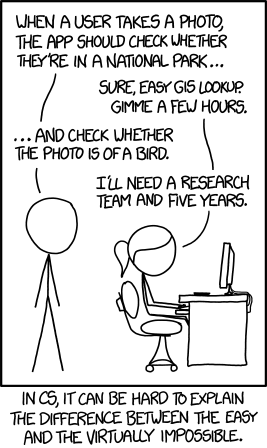
Comment by Ukv 4 days ago
Maybe, but people have been saying deep learning is about to hit a wall since 2012, and many reasonable-sounding "machines fundamentally can't do X" have since fallen.
Feels like we're standing on a roof with floodwater up to our ankles - maybe it stops rising now, but we didn't foresee it getting anywhere near this high in the first place.
I do agree that progress will probably be more slow/gradual than others seem to predict, no "hard takeoff", but even being decades away is still relevant to someone starting a career in software development.
Comment by pixel_popping 5 days ago
I feel that OP has reach that point because he went out of the basic tooling like Claude Code (at least in its default state) and embrace multi-model, automatic reviewing, fuse, loops and so-on, when it's done right, well, failure rate to solve issues is <1%, this is exactly why you arrive to that kind of depressing thoughts afterward and it's spot-on.
Many people will disagree because they are still at the vibe coding stage, not "as much as I can prompt will be automatically done stage". Claude Code imo is deliberately not implementing the best ways for users to work, they have recently implemented Workflows but that's almost a year late, many companies are doing this since always and that's just part of basic tooling nowadays.
People talk about models and benchmarks score while genuinely I'm baffled because they seem to ignore that that same benchmark can reach 99% by levering tooling intelligently, we don't really need better models (at least for coding), we just need adoption of proper methods. The day developers will discover that they are already able to solve 300 issues in a single day with ZERO supervision in complex Rust codebases, I'm sure they'll change their mind.
Our bottleneck in our team is currently just having the mental bandwidth to type as much as possible, it's kinda sad, it is becoming all absurd.
If you are still watching the output of the model for coding tasks, I bet you haven't challenged your own methodologies, yet.
Comment by sixtram 5 days ago
Comment by pixel_popping 5 days ago
Comment by canadiantim 5 days ago
Comment by thunspa 4 days ago
Comment by alex1sa 4 days ago
Comment by Altern4tiveAcc 4 days ago
Wouldn't that be true for humans as well? If you have documentation explaining a rule and you read it, you may not need to reach out to coworkers.
Otherwise I think the author's concerns are 100% valid.
Comment by ekjhgkejhgk 4 days ago
This is a particularly ignorant thing to say.
Comment by tedtimbrell 4 days ago
Comment by philipwhiuk 4 days ago
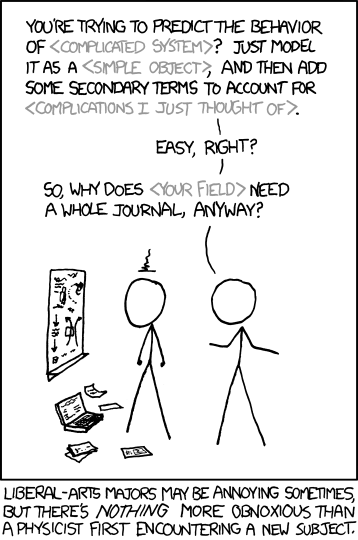
(Also, both might be out of reach of the current AI architectures)
Comment by ekjhgkejhgk 4 days ago
Comment by sam_lowry_ 4 days ago
TLDR: there will be less programmers and they will be better on average.
Comment by an0malous 4 days ago
Comment by sam_lowry_ 4 days ago
Comment by alexpandey 4 days ago
Comment by iyeyerjdsd 4 days ago
Comment by SadErn 4 days ago
Comment by vrganj 5 days ago
Comment by pu_pe 4 days ago
Note that I am not shitting on the idea of option 1 at all, in fact personally I would very much like to see it succeed. I just think this is more of a global issue than a local one.
Comment by keybored 4 days ago
> Note that I am not shitting on the idea of option 1 at all, in fact personally I would very much like to see it succeed. I just think this is more of a global issue than a local one.
That’s why socialists argue for international revolution.
Comment by jappgar 5 days ago
That's why they're obsessed (to the point of psychosis) with "mastering" the new technique.
That's why they're all building a "harness".
What they don't realize is that the ironworker still ends up in chains.
Comment by polotics 4 days ago
The AI-enhanced become more and more AI-integrated and internally AI-fused and they don't even realize they eventually are not humans at all.
The non-AI underclass just hasn't got enough access to resources to survive long term and dies out with a whimper.
Comment by dnc 4 days ago
- the Cul-de-Sac: AI progress flattens as scaling data and compute, RL and algorithmic improvements hit diminishing returns.
- democratization: LLMs decentralize, mirroring the shift from mainframes to personal computers.
- AI creates new jobs and thus new dependencies for the capitalist class
- Any combination of the above.
Comment by red75prime 4 days ago
As every communist, you forget about economics of such a system. How would you prevent concentration of capital in this system? Planned economy? Planned by whom?
Comment by petesergeant 5 days ago
Clearly you feel you've made yours, so what are you doing differently now to what you did before?
Comment by dist-epoch 4 days ago
The capitalist class doesn't control Capital, Capital controls the capitalist class.
Comment by jappgar 5 days ago
It tastes bad, and poisons you slowly.
Some (less) food is produced on farms and kitchens.
It tastes good, and keeps you healthy.
I don't really care who/what wrote the code. I don't even really care about the code at all. What I care about is the end product.
The problem is not "code quality" the problem is that billionaire sociopaths have removed human judgement (and human morality) from the dev loop. This started long before AI.
Coders are hyperfocused on style and missing the substance. We are entering a world where rich bastards can produce evil software without any checks whatsoever.
At least when humans were required to write the code, they had to find and retain unscrupulous humans. Now they're completely unfettered, and we're soon going to learn the precise shape of the digital prisons they're constructing.
Comment by noodletheworld 5 days ago
> They will come for finance, biology, law, marketing, all knowledge work. That's their stated goal and they're already teasing it with "ChatGPT for Health" and similar launches. They're working on "harnesses" for other fields, it's just a matter of time before we have "Claude Finance Analyst" or something.
…
> Beg to disagree. The models will learn good engineering principles at some point.
…
> Stop and think, don't try to predict the future using (bad) past examples.
Don't try to prediction the future based on the past.
Also, here is my doomsday prediction.
Thats kind of ironic.
Heres a more thoughtful take: everything is an s curve.
Things start out fast, then they slow down.
It happens in learning, in tech, in literally everything.
The question (unanswered) is where we are in that curve.
Will they get better? Yes.
A lot better? A bit better? /shrug