Texas grid flags risks as data centers, crypto sites fail voltage tests
Posted by 1vuio0pswjnm7 2 days ago
Comments
Comment by threwrfaway 2 days ago
The loads are slowing down the generators that are burning a well metered amount of fuel to stay at 60Hz. This is a delicate balance since the phase angle must also be spot on.
If a generator and the local line disagree on f, phase or V, you have a short circuit.
If you lose a large amount of load, your generator will spin up with the excess fuel until the control system re-establishes the right amount of fuel.
But now your generators are out of sync! No worry, for small disturbances the dissipative losses sync everything up like syncros on a manual transmission.
But the disturance cant be too big!
Rotating machines are big and heavy, so the first line of defense is their inertia. But this is a finite (and precious) resource.
Contrary to belief, renewables, or generally speaking DC, makes things this stability problem worse. They generate large amounts of power while providing no inertia.
You'd think it isn't a big deal since the DC-AC converter can just synthesize whatever is needed. Heck just keep it rigid at 60 Hz with no phase change.
Well the later doesn't work - the rest of the grid is no longer at that phase and frequency so you got yourself a short.
Furthermore, the DC-AC converter, despite their manufacturers' promise, has no good way to establish what f and phase it should be at during a disturbance (and these magic codes are closed source, believe it or not)
Anywho, a large enough loss of load causes the grid to enters into unstable oscillations, causing protective relays to trip causing a zipper effect where the grid goes down.
Now restart will take a few days depending on the energy mix (fastest for hydro heavy)
Long story short - this is not a trivial problem, and the data-centers can't be allowed to just dump load willy nilly.
EDIT: made it clear that the grid killing disturbance is not caused by renewables; not exclusively anyway. Everyone has to play nice or the grid goes down.
Comment by jillesvangurp 2 days ago
The nice thing with data centers is that they are somewhat flexible. It's not a constant load. Data center operators can choose to reduce load. And if properly engineered, they could do so automatically based on signals from the grid.
The issue with outdated grids is that it relies on technology (spinning mass) that's at this point a century old. Which makes it brittle against outages like you describe. The solution is not more spinning mass but batteries and renewables to take the place of that spinning mass. A battery can respond to oscillations in milliseconds. If you then add flexible load that can spin up/down based on the amount of available power, you gain a lot of stability.
Comment by alexey-salmin 2 days ago
Why the spinning mass technology being "century old" (more like "millennia old" but anyways) is a problem somehow? The Newton's First Law didn't change much in the time that has passed.
Anyone who tried to "respond to oscillations in milliseconds" knows how hard that problem is because the force you apply is integrated twice before it takes effect. Try stabilizing a swing by pushing it's forward when it's behind the equilibrium point and pushing it backward when it's ahead of it. Now imagine a grid of swings connected by rubber bands and a distributed system of independent actors responding to oscillations. There are much more ways in which this system can diverge rather then converge.
Time may prove me wrong, but the arguments like "spinning mass is old therefore should be replaced" certainly won't.
Comment by jillesvangurp 2 days ago
No, but technology has moved on quite a bit. Heavy fly wheels are no longer the state of the art here.
A few tens of GW of battery capacity (i.e. a few dozen nuclear plants worth of capacity) that can switch on/off in milliseconds can do a lot for grid stability. That's part of the reason why grid operators are rolling out so much batteries. It's not necessarily about supplying energy for a very long time but about smoothing out peaks and dips in energy supply and demand and responding more or less in real time to that.
This stuff is basically being rolled out at industrial scale in a lot of places. Australia, China, etc. pretty much run increasingly on mostly renewables. This is no longer as speculative as it would have been ten years ago.
Yes, there are engineering challenges with rolling that stuff out in a lot of places. And even more policy and regulation challenges. Actually that is, by far, the #1 challenge in places like the US and Europe. Grid operators are simply structured and incentivized wrong to deal with this stuff efficiently. Texas is actually not doing too bad relative to e.g. California. But they clearly have some challenges still.
Comment by cogman10 2 days ago
I think this is a misunderstanding of the problem.
Now, don't get me wrong, I believe flywheels are no longer involved but at one point they were for batteries and solar. Not to store energy, but rather to form the output voltage and to give the correct "inertia" of the waveform to maintain a correct phase with the grid. Prior, both batteries and solar were frequency followers. They'd look at the previous peaks and valleys to determine what their output voltage (or resistance) should be. If the input voltage fell too far, both solar and batteries would cut off to avoid damaging equipment on the grid. This is part of why the winter storm killed the texas grid (to my understanding) the voltage dipped too low which ultimately caused renewables to shut off completely to avoid damaging the grid. That all was somewhat of a cascading disaster.
Flywheels have been used as an inertia source to allow for both solar and batteries to act more like a hydro or fossil fuel generator. That's the grid forming technology. I believe (can someone verify?) that there are now all digital versions of this. But it's delicate software. Getting it wrong can do really bad things like destroying other generators or breaking expensive fuses.
Comment by SR2Z 2 days ago
It's an expensive part to be sure, but not so expensive that a plant couldn't keep a few spares.
Comment by TheJoeMan 2 days ago
Perhaps a bad analogy, but it seems these battery systems attempt to stabilize by "pushing", whereas spinning mass can also work through "dragging" the phase. So eventually, you will have just a few rotating masses setting the freq and phase, with more and more systems tracking that and pushing, which seems like a recipe for chaotic equilibrium.
Comment by jillesvangurp 1 day ago
The rest is just economics. We might suck at making batteries. But we suck even more at making new gas/coal plants or fueling those cost effectively.
Anyway, this stuff is being deployed by the hundreds of gwh per year now. Much of it in China but some non trivial amounts in places like Texas and California as well. As a result, the grid is actually getting more stable, not less stable.
Comment by nutjob2 1 day ago
This is comically wrong. You're just making things up. Australia is at the forefront of this new tech due to necessity and some good luck. Scroll to the bottom of this article and have a look at the graph. It shows Australia has 5 times the grid forming battery infrastructure deployed or under construction than China or the US, or pretty much any other country. It is very much SOTA, needed for a grid that is a rapidly changing mix of rooftop solar, hydro, coal, gas and wind spread over a country the size of the continental US. Rotating masses are not going to cut it.
https://arena.gov.au/blog/australias-grid-forming-battery-re...
Comment by joquarky 1 day ago
Nuclear has this little problem getting in the way of switching on/off quickly:
Comment by expedition32 2 days ago
In America that seems to be the dying small town whose only economic value is cheap land.
Comment by jillesvangurp 1 day ago
That varies per region but this is a sector that is now about 2x the level of investment for fossil fuel related infrastructure. A lot of which is increasingly looking like the ROI might never happen.
Comment by joquarky 1 day ago
In the US, this is moot if that time period is more than 3 months.
Comment by biorach 2 days ago
Comment by peterus 2 days ago
https://iten.ieee-ies.org/journal-featured-article/2025/grid...
Comment by namibj 2 days ago
Though if you want to do a smoothing action on real power flux you'll have to colocate battery capacity with the converter. Which to be clear is fairly cheap to do as long as you get compensated for the substantial frequency stabilization capacity this represents. I'm talking like 15~120 minutes at converter nominal AC power of battery capacity.
The first 10~20% of reactive power are almost free from the converter electronics, btw....
Comment by nutjob2 1 day ago
Comment by Retric 2 days ago
In the end a renewable heavy grid can be extremely resilient due to all the batteries, but smart battery systems need to be incentivize or mandated because ‘dumb’ batteries are cheaper.
Comment by gblargg 2 days ago
Comment by flopbob 2 days ago
Comment by cogman10 2 days ago
In the Tacoma example, the input frequency continued to add onto the bridges motion which ultimately caused it to destroy itself. In an electric grid, a misaligned phase can cause excessive spikes (imagine 480V when you expect 240V) or the generators to ultimately burn themselves out because 2 generators are fighting with each other, one trying to raise the voltage while another is trying to decrease the voltage. The really tricky thing is that load (particularly inductive or capacitive loads) look almost exactly like an unaligned generator.
Comment by gblargg 1 day ago
Comment by altairprime 2 days ago
Comment by WarmWash 2 days ago
Communication that detects the release and travels as close as possible to the speed of the natural signal in the rope, and is robust enough to recover without losing stability if the other team grabs the rope again while your "let go" signal is mid-flight.
One way to dampen this is to put a really strong guy on each side, with instructions to never let go of the rope. These are the flywheels of the grid.
Comment by ksec 2 days ago
Comment by bryanlarsen 2 days ago
Proof by example: https://spectrum.ieee.org/grid-scale-battery-scotland
As the article says, this is difficult and adds significantly to the cost. But it is very possible.
(It also adds significantly to the cost of spinning mass generators too. Delivering 250% of nominal current in a short circuit situation requires beefing up a lot of components).
There are many others.
Comment by namibj 2 days ago
And alirack style datacenters have large 3-phase converters between the grid and some 240 (nowadays often 350) V DC bus, with the battery banks directly (with just fuses and sometimes a little bit of balancing/nudging power (think 10% of battery power rating)) on the bus, and then the servers also directly consuming from that bus.
The large converters on the battery bus thus allow synthetically smoothing load transients to the grid using the batteries to smooth that power draw. This has just minor additional wear on the batteries and a small power efficiency impact from hitting through the batteries, both of which are easily paid by anything market-rate of providing that grid service. Because they already need the power electronics and batteries anyways, unlike a utility battery farm that at best can argue day/night load shifting of solar production as the reason for the electronics and batteries to exist.
In that same spirit it's also effective to put batteries on the DC bus (between MPPT and inverters) of large solar farms, because they need the electronics anyways and it's actually reducing the required inverter&transformer capacity of the solar farm by peak-shaving.
Comment by TOMDM 2 days ago
Comment by manarth 2 days ago
However, if a DC detects that the _grid_ is wobbly (voltage or frequency deviations) the DC will disconnect without warning, and switch to its batteries and generators.
The grid complains because it's suddenly lost hundreds of MW of load. For the DC to have isolation capability, it would need a load-sink which can consume roughly the same power as the DC in normal operation, and can take in that load at a moment's notice.
It's a hard problem to solve, and probably better managed at grid-level than DC-level.
Comment by thelastgallon 2 days ago
Thats why always have all the EVs be connected all the time (except the 20 mins they drive). EVs can provide demand as a service and take excess power whenever its available (instead of solar curtailment), and also provide an immediate source of load when events like this happen. Its a shame US is anti EV, it has the best systems at scale that can be leveraged to transform the entire energy ecosystem.
Comment by TOMDM 2 days ago
Comment by WarmWash 2 days ago
Comment by trogdor 2 days ago
Comment by manarth 1 day ago
Comment by cucumber3732842 2 days ago
Liquid rheostat. A big one.
Comment by jampekka 2 days ago
Is there such belief? My feel is that anybody to whom electrical grid stability has even crossed their minds know this.
Comment by somewhereoutth 2 days ago
Comment by wyldfire 2 days ago
During winter storm Uri, they did a duty cycle where we only had power available for ~6-12 hours at a time on the days it was available. This was apparently to avoid that very problem.
So far as I know, the obvious mitigations like winterizing NG generation and/or peering with neighbor grids have not been performed.
Comment by LadyCailin 2 days ago
Comment by otterley 2 days ago
Comment by tenthirtyam 2 days ago
The problem in my mind is that, as it stands, the signal that everyone has to latch on to is itself affected by load and by different generators latching on with different time constants in a complicated feedback loop. Would having a single authoritative source be an improvement? Would that be a way to eliminate the need for inertia?
*I suppose the "target" phase would probably be based primarily on the output from the biggest inertial systems and take into account their ability to adjust phase and frequency.
Comment by nutjob2 2 days ago
Comment by hippich 2 days ago
Comment by analog31 2 days ago
I'm not great with analogies, but imagine a train with two locomotives, and each one is set to run at a different speed. There will probably be a lot of screeching of wheels etc. To make multiple locomotives work on a single train requires engineering them to be synchronized with one another.
Comment by mitthrowaway2 2 days ago
Comment by digitalsushi 2 days ago
Comment by chaz6 2 days ago
Comment by threwrfaway 2 days ago
New house with 200 A panel an assumed 30% utilization rate? $3600.
New data center with 80% utilization rates at 100MW? $80 million dollars.
New 10 GW data center? That'll be $8 billion.
It's outrageous that I'm paying an extra fee to export energy to a neighboring state to power a datacenter.
Comment by Aurornis 2 days ago
Large projects will have a large load interconnection tariff that’s supposed to shoulder the costs of upgrading the infrastructure to support these new projects.
Data center discussions are weird right now because people assume these things don’t exist and propose them as solutions. They already exist.
The problem in the article is something different: The sites they’re talking about are designed to disconnect from the grid and use backup power when the voltage drops, which can be a problem because now there’s too much energy being supplied to the grid and not enough load to absorb it.
Comment by AdamJacobMuller 2 days ago
When voltage is dropping (or phase is falling out of alignment) don't you want to shed load to stabilize? The issue seems to be more that too much load could shed too quickly causing wild oscillations in grid conditions from an undervolt to an overvolt. Seems like the correct, and not terribly complicated, solution to this is to have a process whereby the grid operator can request large customers to shed load and move to backup power temporarily.
That seems like such a reasonable suggestion that I would be shocked if such a thing does not already exist and is simply just not reactive enough and too manual.
Comment by HWR_14 2 days ago
Comment by askvictor 2 days ago
Comment by soulofmischief 2 days ago
As things industrialize further, a state's net compute flow might become a topic of campaign promises. We may later find correlations between states' access to quality compute and the educational/financial outcome of younger generations.
To be sure, my leverage and inertia with a $200/mo ChatGPT Pro subscription is already a lot higher than it is without. We're not talking about just chatbots anymore, modern agentic models represent a quantifiable increase in individual agency. Whether or not the job market implodes, I am able to make progress on things even while asleep or busy with something else. This kind of agentic capital has never been available to the working class before at scale.
States like Texas, with their independent grid, might find themselves in a favorable position in such a balkanization event, but past events have proved that ERCOT is not ready to operate a statewide power grid. I was in Texas during the '21 cold snap and it was brutal. I was using my gas stove for heat. If resources for compute suddenly became constrained, and compute was deemed a matter of security and economic survival, it would be a cutthroat environment for operators of Texas' existing 400+ data centers.
Comment by threwrfaway 2 days ago
In fact, I don't live near Texas. My state is having me finance a power line that will increase demand for our electricity.
Comment by mindslight 2 days ago
Reframing what you're saying, that would be a connection fee that worked out to just under 12 cents per kWh used for the first year, which seems both somewhat reasonable but also probably not going to move the needle much on the large deployments?
Comment by threwrfaway 2 days ago
Note, In proposing a one time fee, on the capacity to generate power, not the energy.
Comment by mindslight 2 days ago
And yes, I got the one time fee aspect. My point is that if you're basing this off of expected utilization (rather than say the size of the service regardless of how much energy is used), and that expected utilization is roughly correct, then that one time fee can be thought of as amortized cost per unit energy over a specified amount of time. And that cost isn't even that high if amortized over a year.
Comment by selfhoster1312 2 days ago
Comment by sph 2 days ago
Comment by burnt-resistor 2 days ago
Comment by selfhoster1312 2 days ago
Now it's much easier for wealthy elites to not pay taxes at all, as outlined in the past year with the Zucman tax debates (which elites opposed for daring to propose a 2% floor tax rate for those who don't pay 2%), and lately with the ministry of Finance Amélie de Montchalin lying to the members of parliament about the existence of a note produced by her own ministry showing that over 13000 millionaires pay effectively 0% income tax.
Comment by phil21 2 days ago
I don’t find anything outrageous whatsoever about building out transmission to strengthen regional interconnections. Lord knows we are decades behind the curve on this. If AI datacenters are what finally lets us maybe start to get a tiny bit ahead of the game I’m all for it. When the bubble pops there will finally be a bit of pressure off, and perhaps we can get back to a tiny bit of overbuilt capacity to cover for exceptional events again. And more reasonable projects maybe won’t be sitting in a decade long interconnection queue.
At some point we get to all collectively pay for our parents lack of investment in energy infrastructure. We have been living off our (great?) grandparents investments into the future and wide scale deindustrialization of the economy since I’ve been alive. At some point you run out of inertia.
Could always move to Texas if you hate the idea of your state ever possibly spending a dollar that benefits someone across the border. They islanded their grid pretty much precisely due to this attitude.
Watching the PJM and MISO interconnections over the past decade or so has been illuminating. It’s been a very slow moving disaster in the making that nearly no one is paying attention to.
As for your proposed solution I doubt anyone - including the datacenter operators - would argue since that is largely what tends to happen as it is. Just change utilization factor to capacity factor and sounds good to me!
Comment by bob1029 2 days ago
As a retail electricity customer, I vastly prefer whatever is going on in their operational context.
I live 10 miles from the "border" between ERCOT and MISO and I've got a lot of experience with both, particularly in disaster scenarios. ERCOT is a total shitshow when it comes to the edges. The fuel mix in MISO is pretty terrible for the environment, but it is also unbelievably reliable. The Mississippi River is not to be underestimated in its logistical impacts. The price of natural gas drives the daily fuel mix proportions, but it doesn't affect the available base capacity and its financial status (fully amortized for over a generation). If natural gas gets expensive in ercot and the wind isn't blowing, there isn't anything else to give. MISO has 2-3x the coal and nuclear capacity that ERCOT does.
Comment by burnt-resistor 2 days ago
Make the DCs themselves pay to play nice to work with the grid: BESS FFR/M-FFR, for generation capacity, and for transmission upgrades.
Right now, they're using privatized-deregulated communism to privatize the profits and socialize the costs. Everyone else shouldn't pay for these goddamn DCs.
Comment by bob1029 2 days ago
If a gigawatt class DC suddenly needs to take its sensitive IT loads off grid, it could be designed with load banks on site to stand in for the IT load. These would be exceptional use only, so the specific cooling technology (obviously we want to boil water) is not much of an ecological concern. A gigawatt will vaporize ~100 gallons of water per second. How long until the grid can adapt? Five minutes? That's not exactly a heroic amount of water for these projects.
Comment by burnt-resistor 2 days ago
Yes, but that's not what's happening. These giant loads are suddenly going offline and are making it the transmission and generation networks' problem. The DCs aren't going to pay for it when they can socialize the costs and problems onto others.
The most obvious answer is these big loads need FFR and M-FFR BESS (battery) capacity near them or on-site to decouple and absorb these huge transient load swings into something the grid can handle. ERCOT should set additional rules that large load customers must use load smoothing rather than simply dumping load at auto-reclosers/auto-cutouts. Not doing so forces the entire grid to be at risk of low inertia transient over-generation.
Comment by ProllyInfamous 2 days ago
Because the Texian grid-operator (ERCOT) is predominantly isolated from the Eastern & Western US grids [†], serving mostly-just Texans – this is to avoid US Federal regulations, by being an only-intrastate entity (technically, which is: the worst kind of "correct" [∑]). This is a socially-engineered "problem".
This means their needs for maintaining grid inertia (which frequency is a measure-er of) are more difficult, as Texas cannot just purchase any substantial/meaningful electricity – everything must be generated in-house.
Worse, the lack of Federal regulations means ERCOT/Texas can create their own rules/regulations/markets for the management of electrical infrastructure. Texas chose to make (IMHO) the most-purely crony-capitalistic market [for buy/sell of MWhours] in worldwide existance – which leads to decannual winterstorm Disasters (totaling hundreds of BBillion$ in damages / hundreds dead). The losses from wasted silicon-ingot depositions (alone) are staggering $,,,.00 – just another cost of doing business within Texas's jurisdiction [ß].
After 2021's storm, some "free market" customers were left with a week of billing costing more than the year's remainder!.
Abbott will just blame the windmills and not a cost-incentive fee-structure which does not incentivize cold-weather preventative maintainance. In fact, it does the opposite (since electricity can 25X price-increase). "Tell me the incentive and I'll tell you the outcome."
[∑] having grown up and been schooled primarily in Texas, I think the best review I ever agreed with was: "The [L]one Star State" – Texceptionalism will kill us all
[†] small DC-DC grid-ties (altogether a low, single-digit percentage of ERCOT's overall capacity) exist with both grids, as well as another smaller with Mexico
[ß] which is why most hospitals/datacenters have their own diesel/LNG generators, on-site – in Texas these have even less regulations because: "temporary" see (e.g.): Tesla's multiple Texas facilities' backupsystems – enormous point-source pollutors
----
If you want a good breakdown of the 2021 Texas storm's decimation of ERCOT/Texas/electricity, look for the great logs reddit /u/redditmudder did (in realtime) as this disaster was unfolding. I cannot remember exactly how low the frequency got... but I think we were closer to EU [50hz] than US [60hz] – as grid operators REAPED profits* from their failing infrastructure driving electricity orders-of-magnitude higher. This is all public information; it wasn't "windmills."
Comment by ilaksh 2 days ago
I am a huge proponent of AI actually, but very suspicious that "financiers" are suddenly creating what amounts to an energy tax by finding legal ways to sneak extra fees or rates into our electricity bills to cover build out and commercial usage costs.
But as far as smoothing out demand, my (admittedly a layperson) theory is that we need to force them to adapt more solar and wind and at the same time more facilities for handling the variable production from that. Such as more large batteries and a shift to large scale long term storage of renewable fuel like hydrogen or other fuels produced directly from renewable sources.
If you have a large production and storage of renewable fuel, then maybe you can build that in such a way that it can handle significant input variations that could include excess grid power.
Comment by phil21 2 days ago
What matters is peak capacity. Using the grid as a free battery for when your intermittent sources of energy go away against your fairly constant loads only makes the grid weaker overall. The best part of these huge predictable load centers is utilization factor.
Storage of some sort would probably help some, but overall the best type of load for a grid is predictable constant usage. Bonus points if it can reasonably be part of a load shedding/demand response program.
Comment by DoctorOetker 2 days ago
The ground level vs tropopause temperature difference is not perfectly stable but largely maintained throughout day and night cycles, it is effectively base load, no nuclear required! We could generate energy while helping the planet cool.
Best to place these in seas, at least 1 structure length away from coastline, not in the middle of densely populated area. Salty sea water can be frozen (purifying it because ions get pushed into the brine) for desalination, brought to conventional thermal power plants, melted on their cold sides producing potable water while improving the thermodynamic efficiency of the thermal power plant (more electric energy per unit of fuel / rod spent).
Comment by jeffbee 2 days ago
Comment by bryanlarsen 2 days ago
California's wholesale electricity prices are the lowest in the nation, half of what Texas' are.
But California's retail electricity prices are the second highest in the nation.
https://cleantechnica.com/2026/05/30/california-lowest-whole...
Comment by baldeagle 2 days ago
https://www.electricchoice.com/historical-electricity-pricin...
Comment by jeffbee 2 days ago
Comment by baldeagle 2 days ago
Please support your assertion that Texas energy costs decreased in that time period.
Comment by jeffbee 2 days ago
Comment by baldeagle 1 day ago
[{"series_id":"ELEC.PRICE.TX-RES.M","name":"ELEC.PRICE.TX-RES.M, monthly","units":"cents per kilowatt-hour","f":"M","description":"Electricity sales to ultimate customer by state and sector (number of customers, average price, revenue, and megawatthours of sales). \n Sources: Forms EIA-826, EIA-861, EIA-861M","copyright":"None","source":"EIA, U.S. Energy Information Administration","start":"202603","end":"200101","data":[["202603",16.39],["202602",15.41],["202601",15.69],["202512",15.87],["202511",16.04],["202510",16.1],["202509",15.83],["202508",15.46],["202507",15.36],["202506",15.26],["202505",15.53],["202504",15.52],["202503",15.28],["202502",14.88],["202501",14.67],["202412",15.36],["202411",15.68],["202410",15.67],["202409",15.06],["202408",14.88],["202407",14.7],["202406",14.55],["202405",14.83],["202404",15.13],["202403",15.02],["202402",14.48],["202401",14.35],["202312",14.64],["202311",14.79],["202310",14.89],["202309",14.68],["202308",14.17],["202307",13.95],["202306",14.35],["202305",14.65],["202304",14.36],["202303",14.61],["202302",14.72],["202301",14.36],["202212",14.49],["202211",15.01],["202210",14.94],["202209",14.75],["202208",14.12],["202207",13.71],["202206",13.49],["202205",13.34],["202204",13.29],["202203",13.01],["202202",12.48],["202201",12.45],["202112",12.56],["202111",12.78],["202110",12.54],["202109",12.26],["202108",11.94],["202107",11.73],["202106",12.04],["202105",12.09],["202104",12.08],["202103",11.7],["202102",12.69],["202101",11.35],["202012",11.59],["202011",11.93],["202010",11.85],["202009",11.77],["202008",11.5],["202007",11.59],["202006",11.76],["202005",11.79],["202004",12.04],["202003",11.81],["202002",11.72],["202001",11.46],["201912",11.71],["201911",11.99],["201910",11.81],["201909",11.81],["201908",11.76],["201907",11.71],["201906",11.8],["201905",12.01],["201904",12],["201903",11.6],["201902",11.6],["201901",11.44],["201812",11],["201811",11.6],["201810",11.5],["201809",11.39],["201808",11.27],["201807",11.09],["201806",11.2],["201805",11.36],["201804",11.39],["201803",11.35],["201802",10.87],["201801",10.63],["201712",10.89],["201711",11.23],["201710",11.09],["201709",11.12],["201708",10.95],["201707",10.87],["201706",11.03],["201705",11.05],["201704",11.09],["201703",11.12],["201702",11.16],["201701",10.74],["201612",10.85],["201611",11.1],["201610",11.02],["201609",11.11],["201608",10.91],["201607",10.83],["201606",10.95],["201605",11.1],["201604",11.26],["201603",11.19],["201602",10.99],["201601",10.88],["201512",11.19],["201511",11.38],["201510",11.35],["201509",11.51],["201508",11.43],["201507",11.5],["201506",11.78],["201505",12.04],["201504",12.1],["201503",11.56],["201502",11.62],["201501",11.49],["201412",11.81],["201411",11.98],["201410",12.07],["201409",12.03],["201408",12.05],["201407",12.05],["201406",12.17],["201405",11.93],["201404",12.06],["201403",11.75],["201402",11.25],["201401",11.22],["201312",11.27],["201311",11.67],["201310",11.68],["201309",11.36],["201308",11.45],["201307",11.41],["201306",11.44],["201305",11.57],["201304",11.43],["201303",11.03],["201302",11.05],["201301",10.84],["201212",10.99],["201211",11.11],["201210",11.16],["201209",11.11],["201208",10.96],["201207",10.87],["201206",10.97],["201205",10.84],["201204",11.02],["201203",11.01],["201202",11.05],["201201",10.77],["201112",10.89],["201111",11.19],["201110",11.23],["201109",11.16],["201108",11.15],["201107",11.16],["201106",11.25],["201105",11.27],["201104",11.16],["201103",11.13],["201102",10.65],["201101",10.7],["201012",11.25],["201011",11.32],["201010",11.62],["201009",11.58],["201008",11.7],["201007",11.71],["201006",11.85],["201005",11.94],["201004",12.12],["201003",11.51],["201002",11.34],["201001",11.21],["200912",11.52],["200911",12.08],["200910",11.97],["200909",12.05],["200908",12.15],["200907",12.38],["200906",12.66],["200905",12.84],["200904",12.88],["200903",12.93],["200902",12.84],["200901",12.6],["200812",13.08],["200811",13.28],["200810",13.53],["200809",13.51],["200808",13.84],["200807",14.06],["200806",13.43],["200805",12.94],["200804",12.53],["200803",11.97],["200802",11.35],["200801",11.65],["200712",11.75],["200711",12.03],["200710",12.42],["200709",12.44],["200708",12.4],["200707",12.51],["200706",12.73],["200705",12.62],["200704",12.56],["200703",12.46],["200702",11.97],["200701",12.08],["200612",11.91],["200611",12.52],["200610",13.18],["200609",13.25],["200608",13.35],["200607",13.31],["200606",13.41],["200605",12.98],["200604",12.72],["200603",12.42],["200602",12.12],["200601",11.91],["200512",11.42],["200511",11.5],["200510",11.6],["200509",11.66],["200508",11.47],["200507",11.29],["200506",11.21],["200505",10.72],["200504",10.15],["200503",10.05],["200502",9.5],["200501",9.15],["200412",9.24],["200411",9.37],["200410",9.57],["200409",10.32],["200408",10.71],["200407",10.48],["200406",10.44],["200405",9.76],["200404",9.39],["200403",8.93],["200402",8.55],["200401",8.61],["200312",8.38],["200311",8.59],["200310",8.93],["200309",9.52],["200308",9.89],["200307",9.97],["200306",10.07],["200305",9.35],["200304",9.03],["200303",9.02],["200302",8.11],["200301",7.71],["200212",8.07],["200211",7.44],["200210",7.51],["200209",8.04],["200208",8.07],["200207",8.49],["200206",8.5],["200205",8.15],["200204",7.98],["200203",7.79],["200202",7.98],["200201",8.11],["200112",8.23],["200111",8.4],["200110",9.11],["200109",9.27],["200108",9.53],["200107",9.55],["200106",9.63],["200105",8.91],["200104",8.52],["200103",8.39],["200102",8.02],["200101",7.68]]}]
Comment by doctorwho42 2 days ago
Comment by jeffbee 2 days ago
Comment by ZeroGravitas 2 days ago
Texas also lead in absolute amounts of wind, gas and coal. They have a lot of generation.
Comment by jeffbee 2 days ago
Comment by doctorwho42 2 days ago
Comment by AnthonyMouse 2 days ago
Comment by burnt-resistor 2 days ago
What's missing is sufficient FFR and M-FFR BESS (battery) capacity to smooth out these sudden disconnects. There's only about 20 GW of BESS generation capacity total in the system now, and ERCOT needs at least 3x more. Placing large FFR and M-FFR near these giga DCs is what it will take to absorb transient overproduction transients from hurting generators or tripping the grid. This is something DCs should pay for rather than upending how the grid works for problems they cause.
Comment by tumetab1 2 days ago
I have no idea of what entails but this seems more a quality of service issue (provided by the grid) and less about the consumers using the grid.
Comment by josefritzishere 2 days ago
Comment by gblargg 2 days ago
Comment by Rapzid 2 days ago
Also the little sound bite about peak demand, Texas has enormous capacity during the summer as well; far, far exceeding demand. It makes total sense to be testing and connecting multi-GW consumers during these months.
Comment by brycewray 2 days ago
Texan here. Actually, it depends on how hot our summer weather gets and, thus, how much A/C use is in play. When we get into a not-unusual run of multiple 100-degree (F.) days in a row, the available capacity often drops to the point where ERCOT begins issuing alerts about things like suggested times of day when running certain appliances might not be wise. Having lived through the nightmare of the February '21 winter storm outages, I keep the ERCOT dashboard[0] as a bookmark and check it at least once, every day of the year.
Comment by onionisafruit 2 days ago
Comment by threwrfaway 2 days ago
The utility will force you to put equipment to correct for power factor (massive capacitor bank), resistive load, etc.
The utility also charges commercial users for apparent power (includes reactive power, or that sloshes around setting up a steady state), as opposed to just real power charged to residential users.
EDIT: in case your wondering, yes resistor loads is just glorified bunch of short circuits and a fan.
Comment by onionisafruit 2 days ago
Comment by tikkabhuna 2 days ago
Comment by defrost 2 days ago
Comment by threwrfaway 2 days ago
Like a black out.
What really hurts is are all the rotating machines, especially the one-phase ones (fridge, AC, blower). Those have transients that last several cycles and are electrical shorts until the back emf is setup.
Utilities will try to roll the power back on in sections to avoid instability, starting with hospitals and those near hydro plants.
But you can help put by turning off your stuff during the blackout and when the light come back on walking around the house to turn them back on.
Comment by applied_heat 2 days ago
Comment by threwrfaway 2 days ago
Comment by erincandescent 2 days ago
The problem is with facility-level grid-responsive safety mechanisms. If the grid sags a bit and several DCs ~simultaneously disconnect, you have a problem. If the DCs going offline causes further instability that causes other facilities to disconnect or grid protection breakers to open, you have a cascading chain reaction
Comment by negative_zero 2 days ago
"ERCOT said it is reviewing the test failures and drawing up plans to protect the grid from disruptions."
Why are they even allowed to connect? / Why are they not kicked off? / Why aren't they being forced to add their own grid inertia?
Comment by klysm 2 days ago
Of course, there are some downsides to this approach, but overall I think it’s a superior. Just look at renewable and battery penetration compared to other ISOs.
Comment by Schiendelman 2 days ago
It's up to ERCOT to figure their own mess out. They will. Nobody else really has to care about it.
Comment by onionisafruit 2 days ago
Comment by jeffbee 2 days ago
Comment by drak0n1c 2 days ago
Comment by weird-eye-issue 2 days ago
Comment by jeffbee 2 days ago
Comment by weird-eye-issue 2 days ago
Comment by jeffbee 2 days ago
Comment by weird-eye-issue 2 days ago
Comment by zephen 2 days ago
Keeping the data center up is completely different from keeping the grid up.
Not only are the batteries too small; they're also on the wrong side of the disconnect.
Comment by threwrfaway 2 days ago
Comment by forgetfreeman 2 days ago
Comment by MBCook 2 days ago
I really don’t want to incentivize private power plants that aren’t on grid. Or just running tons of industrial sized generators instead.
If we’re going to allow enough of this stuff to be built that it can destabilize things why not require they behave and don’t stop off like that? Some sort of organized draw down?
And if they don’t? Mandatory cutoff for X amount of time. Weeks/months.
Comment by toomuchtodo 2 days ago
https://www.datacenterdynamics.com/en/news/google-confirms-1...
https://www.datacenterdynamics.com/en/news/google-announces-...
Comment by dpark 2 days ago
Elon definitely got the “you can just do things” memo.
Comment by toomuchtodo 2 days ago
It is not politically easy, but it is logistically straightforward.
Comment by AnthonyMouse 2 days ago
If you pass a nuance-free emphatic rule that says no fossil fuel generators, does that include the backup generators at a hospital? If it does and then the hospital loses power, that's not just a political problem, that's a "people will die" problem. But if it doesn't then you're going to turn around and find that Elon Musk's data center is hosting some hospital's IT system and then running the generators (that happen to also power the rest of the entire facility) to keep it online. Time will pass before this loophole can be detected, more time until new rules can be promulgated, and then they'll find a different loophole and the process begins again.
That process tends to make people frustrated and then they want to abandon the rule of law. Stop having rules that say what you can't do and just have rules that say you can't do anything and then selectively prosecute the people you don't like. The modern system has been evolving to work more like that, but that's how you enable people like Trump. Making the system work like that is a disaster.
What you need to do is find a better way to solve the problem in general, like a carbon tax, rather than trying to play whack a mole with overly-specific rules until there is such a thicket of them that you're really playing "show me the man and I'll show you the crime" -- or setting things up for someone else to.
Comment by Dylan16807 2 days ago
Comment by MBCook 2 days ago
Comment by rickydroll 2 days ago
Comment by doodlebugging 2 days ago
If you ever visited the town and hit the restaurants during the summer you get a nice taste of the lake bottom when it flips. Pretty nasty yet few restaurants use water filtration to deliver fresh-tasting tea and water to their customers.
That's OT though.
The county will have a special meeting on data centers this Tuesday, June 9 where they are seeking public input. I expect that there will be plenty of people and hope they have time to give people an opportunity to speak. I visit this county regularly for grocery shopping, fuel, etc and if you go south one county there are already plenty of people who are sick and tired of the bitcoin operations and how they have disrupted life in that county. I hope we have a good turnout for this meeting so that this new operation gets canned before they build anything.
[0]https://www.star-telegram.com/news/local/article315770666.ht...
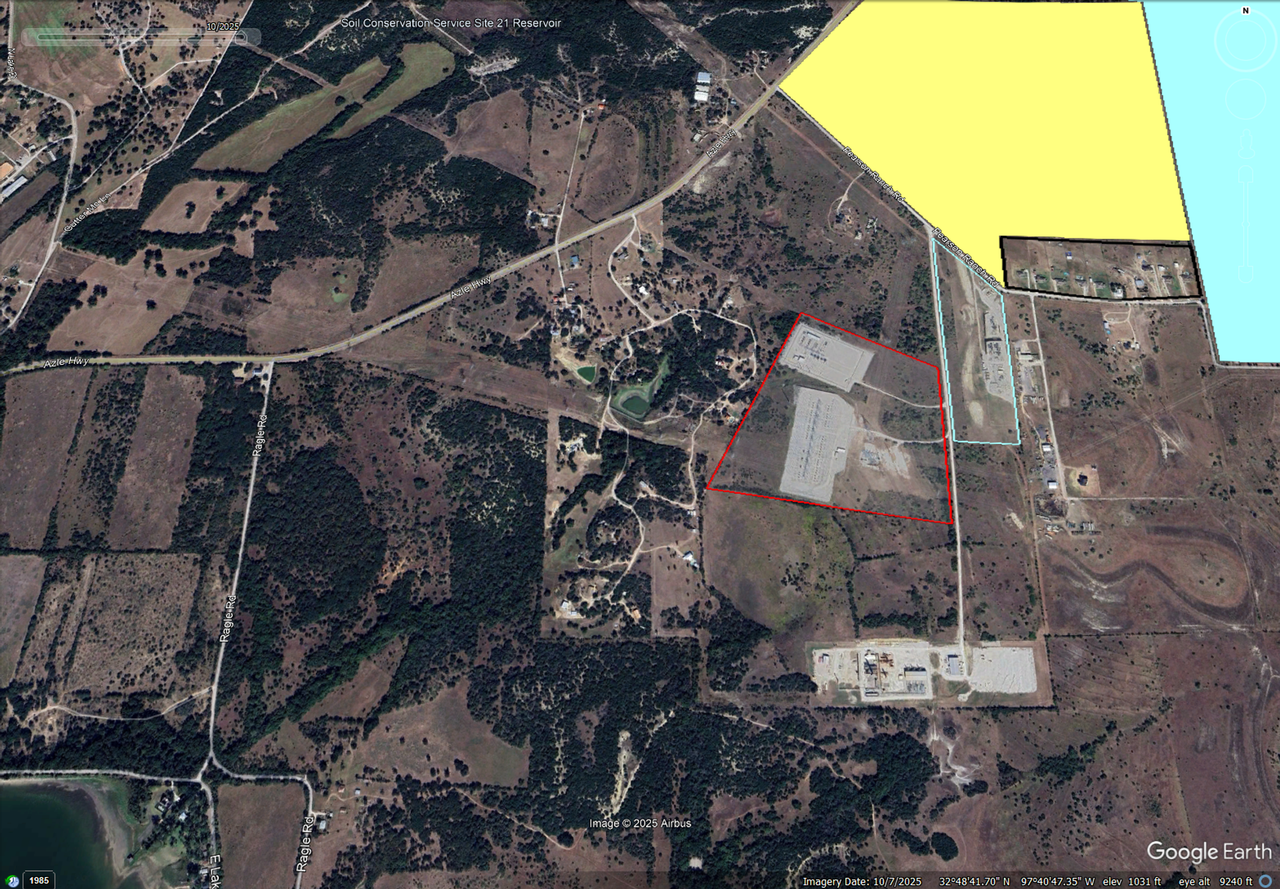
Here is a quick overview of the proposed site. [1] You can see in yellow the 200 acre section where turbine generators will be sited. In the light blue area adjacent you can see a small part of the larger parcel where the data centers will be built. This is part of one of the last large ranches in this part of the county. The others are actively being developed for large (>50000 residents) developments that were supposed to be self-contained communities but which have evolved to be large residential areas that dump traffic onto undersized freeways which are currently under construction to handle the huge volume of new traffic and traffic from all the other losers who will live out there.
The red polygon show existing grid substation intertie where high tension power lines converge or radiate out across the countryside. The light blue polygon is an active natural gas production and compressor station. There is more natural gas infrastructure just below the red polygon too. The lake is obvious in the lower left corner. The natural gas wells and compressor station date to early Barnett Shale production in the county, before 2008. The electrical substation is legacy and has been expanded more than once during the last 15 years.
The black polygon is a small rural subdivision of 8 ~2.2 acre ranchettes around one original ~4.2 acre home site. Those people bought a small plot of ranchland for their own slice of rural Texas. That section was subdivided into lots about 9 years ago so every one of those people bought homes next to an operational gas compressor station. I wonder whether they will be at the meeting.
Comment by BobbyTables2 2 days ago
Comment by protocolture 2 days ago
*The US should implement this policy for real for my personal amusement.
Comment by stldev 2 days ago
Can someone please merge crypto with llm training/inference somehow?
Comment by m-hodges 2 days ago
Comment by rickydroll 2 days ago
Comment by Pxtl 2 days ago