CSS Grid Lanes
Posted by frizlab 1 day ago
Comments
Comment by culi 1 day ago
Comment by ChadNauseam 1 day ago
[0]: https://developer.mozilla.org/en-US/docs/Web/CSS/Reference/P...
Comment by rendaw 21 hours ago
Comment by extra88 9 hours ago
Comment by hombre_fatal 15 hours ago
Comment by al_borland 1 day ago
Comment by concinds 1 day ago
I can't think of a single good reason why they don't adopt an "evergreen" 4/6-week update model except Not Invented Here syndrome or "it's not Apple-like, we prefer the OS team (and therefore Marketing) dictating our release schedule, users be damned".
It's an own-goal for no reason.
Comment by simondotau 23 hours ago
I recognise that this is a controversial take, but in my opinion what Google is doing is a variant of “embrace and extend”. Traditionally, this meant proprietary extensions (e.g. VBScript) but I think this a subtle variant with similar consequences.
Comment by concinds 23 hours ago
Comment by simondotau 21 hours ago
The web platform doesn't need to move so fast.
Comment by hu3 12 hours ago
The ever current adage of distortion field applies here.
Just like Safari not having webgpu was touted as a feature and now that it has support, webgpu suddenly turned into a feature. Apple can do no wrong to some. Whatever they do is a feature. And if they don't do, it's a feature too.
Comment by alwillis 6 hours ago
That hasn't been true for a few years now.
Even now, when a site breaks in Safari, more often than not, it's because that particular site is using a Chrome-only feature that hasn't shipped in Safari or Firefox yet. These developers need to be reminded that progressive enhancement is a thing.
There are web developers who only test their sites on Chrome, which makes no sense, given mobile Safari has around 50% marketshare in the US [1] and about 21% globally [2].
> Just like Safari not having webgpu was touted as a feature and now that it has support, webgpu suddenly turned into a feature.
I must have missed this one, but anyone paying attention would have noticed WebGPU had been available in Safari (behind a flag) long before it became official; it was always on track to becoming a real feature.
[1]: https://gs.statcounter.com/browser-market-share/mobile/unite...
[2]: https://gs.statcounter.com/browser-market-share/mobile/world...
Comment by simondotau 11 hours ago
Implying otherwise is itself a bad argument.
It is true that Safari sometimes lagged in ways that are legitimately open to criticism. There are instances where Safari had incomplete or broken feature implementations. But many claims of “broken sites” are really just evidence of lazy developers failing to test beyond Chrome or to implement graceful fallback. Relying on bleeding-edge Chromium features before they've been broadly adopted by browsers is, IMHO, a infatuation with novelty over durability. It's also, IMHO, a callous disregard for the open web platform in favour of The Chrome Platform. Web developers are free to do whatever they like, but it's misleading to blame browsers for the bad choices and/or laziness of some web developers.
Comment by concinds 10 hours ago
Correct. People test Chrome first and often only. That'll never change because people are lazy and you have a humongously long tail of websites with varying levels of giving a shit and no central authority that can enforce any standards. Even if another browser takes other, they'll only test that one.
The solution is formal tests and the wpt.fyi project. It gives a path to perfectly compatible implementations of agreed-upon standards, and a future where *the only* differences between browsers will be deliberate (e.g. WebMIDI). Brilliant.
That's why I wish the gap between Safari TP's wpt.fyi score and Safari stable's score was shorter. Simple!
Comment by saagarjha 11 hours ago
Comment by simondotau 11 hours ago
As a web developer myself, I appreciate the frustration with Safari's flexbox bugs of a decade ago and viewport bugs more recently. I also remember being endlessly frustrated by Chrome bugs too, like maddening scroll anchoring behaviours, subpixel rounding inconsistencies, and position:fixed bugs which were broken for so long than the bugs became the de-facto standard which other browsers had to implement. All browsers have bugs. To suggest that Safari was uniquely bad is to view history with Chrome-tinted glasses.
Comment by runlaszlorun 23 hours ago
Comment by troupo 15 hours ago
Comment by simondotau 11 hours ago
Comment by kyle-rb 20 hours ago
You shouldn't be allowed to use an old device with an updated browser, especially not a browser from a 3rd party, because that doesn't help Apple sell more iPads.
Comment by alwillis 17 hours ago
There's a new version of Safari Technology Preview [1] for macOS every two weeks.
There's a new version of Safari released every September for macOS, iOS, iPadOS, and visionOS. This has been the schedule for several years. Since Safari 26 shipped on September 15, 2025, there have been two updates for these platforms:
Safari 26.1 on November 3rd and 26.2 on December 12th.
The Safari team shipped 7 releases this year, averaging 7½ weeks between releases; not a significant difference from 4–6 weeks. Each major release of Safari for macOS runs on the current macOS version (Tahoe) and the two preceding ones—Sequoia and Sonoma.
BTW, there were 9 Safari releases in 2024, averaging 5.8 weeks apart.
It's not the first time Safari shipped a significant new feature before other browsers; :has(), Display P3 color support, JPEG-XL come to mind. At the end of the day, there's no NIH or Marketing team dictating the release schedule.
Comment by concinds 12 hours ago
I use Safari as my default, and like every Firefox/Safari user I still get some bugs that don't occur in Chrome (not talking about WebMIDI obviously), so watching that 30 point gap between stable Safari and bleeding-edge WebKit (longer than 7½ weeks) on wpt.fyi was quite frustrating. The average Safari user would have a better browsing experience with a shorter fix delay, that's just the truth. Having to wait for macOS updates holds back the browser, unnecessarily.
Comment by alwillis 9 hours ago
Safari is an operating system component, which lots of people don't seem to understand; hundreds of thousands of 3rd party apps rely on Safari's WebKit engine.
I've never heard a normie Safari user complain that Safari updates aren't being released quickly enough; that's something web and app developers care about… which is why Safari Technical Preview is released every two weeks.
Even the release versions of Safari on iOS, iPadOS and macOS allow you to enable web features that are still in development.
Comment by wpm 8 hours ago
Comment by halapro 21 hours ago
Comment by alwillis 1 day ago
Not all of us were surprised; some of us have been watching the Safari team shipping the latest HTML and CSS features for a few years now.
Comment by madeofpalk 1 day ago
Comment by cosmic_cheese 22 hours ago
Comment by MintPaw 22 hours ago
Comment by culi 22 hours ago
https://wpt.fyi/results/wasm/jsapi?label=experimental&label=...
The full test-suite of wasm tests are here:
Comment by neo_doom 1 day ago
Comment by TheCoreh 1 day ago
I think they realized that shipping the features out of sync meant nobody could use them until all browsers adopted them, which took years, so now they coordinate
Comment by lelandfe 23 hours ago
Comment by socalgal2 3 hours ago
Of course Safari pushes to have anything they don't want to support not in that subset.
Comment by pie_flavor 18 hours ago
Comment by jhogervorst 4 hours ago
Comment by meowface 1 day ago
Comment by culi 22 hours ago
Comment by hoten 22 hours ago
Comment by open592 21 hours ago
Their result is: 1974740 / 2152733 (91%)
They also have their own dashboards tracking this [2]
[1] https://wpt.fyi/results/?product=ladybird
[2] https://grafana.app.ladybird.org/public-dashboards/2365098a1...
Comment by culi 16 hours ago
https://wpt.fyi/results/?label=master&product=chrome&product...
To answer your question, yes. Apple requires 80% test passage of all the tests on web-platforms-test in order to be considered as a valid browser for iOS so they specifically targeted this suite to reach that milestone
It's a pretty silly requirement because wpt is not really meant to be representative of all web platform standards. It includes tests for non-standard features and the majority of tests are simple unicode glyph rendering tests.
Comment by nextaccountic 11 hours ago
Comment by extra88 9 hours ago
Apple is fighting it tooth and nail and coming up with requirements for other engines is a small way of doing that.
Comment by nicoburns 19 hours ago
Comment by 65 20 hours ago
It's good they're trying to not make Safari suck as much.
Comment by Unai 13 hours ago
Caniuse is pointless, their new "baseline" score is pointless; as long as enough people keep using their (perfectly fine and working) iPhones after official support stops and as long as they are not allowed to install a different browser (engine), that's the only data point you need to look at when choosing which browser features to use.
Comment by robertoandred 8 hours ago
Comment by alwillis 6 hours ago
Absolutely true! I've said the same thing many times myself.
Stating that Safari is the new IE is one of the answers to:
"Tell me you didn't do web development in '90s and have no idea what you're talking about without telling me you didn't do web development in '90s and have no idea what you're talking about."
Comment by zwnow 17 hours ago
Comment by wackget 22 hours ago
I'm tired of having to use stupid hacks to get nice-looking borders between flex/grid items.
Comment by rahkiin 16 hours ago
It is funny how we keep asking more and more and more even though we already have it so much better than before. Can we never be happy with what we have?
Comment by j-krieger 15 hours ago
I've been developing web stuff for 15 years now and sometimes I can't believe comments like these. We didn't have it "so much better before". CSS sucked hard and getting things right for three devices was an incredible pain in the ass.
Tables have semantic meaning. They don't support fractional units. Reflowing for mobile is impossible and you need JS hacks like splitting tables. You can't reorder natively.
Comment by perardi 5 hours ago
Flex and grid enable layouts that are far beyond anything we could do with table layouts. Anyone who claims otherwise has obviously not done any amount of serious, production FE UI design and development.
Are there bits of DX ergonomics I’d like in flex and grid? Of course. Does the syntax sometimes feel a bit arcane? Yeah. But the raw power is there, and anyone who claims the contrary is either a gormless backend developer, or some troll who is trying to design things in MS Word.
Comment by alwillis 6 hours ago
I reminded that person we had to use floats and positioning hacks and abuse HTML tables for page layout before flexbox and CSS Grid were created.
There was no way simple method to center a div!
Comment by spencerflem 14 hours ago
Comment by sabellito 12 hours ago
Comment by docmars 10 hours ago
Gap decorations allow you to add borders between flex/grid items, but without the woes of dealing with table quirks and behavior.
Common use cases would include mimicking design patterns found in print layouts, particularly newspapers and menus, to help divide groups of items or info.
Comment by jonah 1 day ago
Comment by aag 1 day ago
Thank you to everyone who is making this happen.
Comment by mmis1000 7 hours ago
Adding a new element still need dimension of the element and a bit JavaScript.(The whole page use < 100loc unobfuscated JavaScript) But resizing can be handled by css naturally.
I think the issue here is most people don't really have a good way to specify how masonry should work. And thus don't have a good implementation either.
Comment by nehalem 13 hours ago
Comment by hu3 12 hours ago
I can't check because my wife's iPhone is, regrettably according to her, "updated to the latest glAss version".
Comment by 8n4vidtmkvmk 10 hours ago
Comment by robertoandred 8 hours ago
Comment by mrgoldenbrown 2 hours ago
Comment by robertoandred 26 minutes ago
Comment by emilbratt 1 day ago
Comment by halapro 21 hours ago
Comment by satvikpendem 17 hours ago
Actually that's exactly what they do. They like the animations while some people, especially devs, do not. But they don't use it multiple times, because they would be able to see how it gets annoying after the first time.
Comment by Sharlin 1 day ago
Comment by SahAssar 1 day ago
Comment by Sharlin 23 hours ago
Masonry works well if you have different aspect ratios of the same orientation.
Comment by powersnail 19 hours ago
Comment by bfgeek 7 hours ago
Comment by emilbratt 14 hours ago
Here is an example of the layout of a photostream that I was satisfied with.
https://frifoto.emilbratt.no/?view_mode=photo-stream&tag=All...
Comment by ethmarks 1 day ago
The defining feature of masonry is that it supports mixed aspect ratios. That's its whole thing. If you aren't mixing landscape and portrait images, you shouldn't be using masonry layout.
Comment by Sharlin 23 hours ago
Comment by ethmarks 23 hours ago
- If you stretch all images into a uniform aspect ratio, they get all squashed and look terrible.
- If you crop all images into a uniform aspect ratio, you lose potentially the majority of the content in some images.
- If you display all images at their natural aspect ratio and their full size, there will be huge swathes of empty space in between them because they don't pack tightly.
Masonry layouts allow you to preserve aspect ratio without wasting a massive portion of your user's screen space. It's not perfect, but it's the best layout mixed-orientation content that I know of.
If you know of a better method to handle mixed orientations, I'd love to hear it and would gladly rescind by remarks.
Comment by anonymous908213 20 hours ago
[1]https://safebooru.donmai.us/ (note: this is a "safe" subset of danbooru for reference, but it is still not safe for work)
Comment by satvikpendem 17 hours ago
Comment by anonymous908213 12 hours ago
Comment by satvikpendem 7 hours ago
Comment by anonymous908213 7 hours ago
Comment by satvikpendem 6 hours ago
Comment by hannasm 23 hours ago
Consider a similar layout to OP but the landscape images will span multiple columns as well as everything it already does.
The thing about masonry is that it adapts to the size of the images. You could already do masonry using flexbox if you know the image sizes (https://github.com/hannasm/masonflexjs). Doing it as a true mosaic layout would be a step above current capabilities. At that point it's probably pretty easy to create configurations that don't fit perfectly/ require lots of empty space to layout nicely though.
Comment by ethmarks 23 hours ago
Comment by jrgd 11 hours ago
Edit: doc has this first example https://masonry.desandro.com/layout that you could use but have to imagine images to be twice the size, similar to a Müller Brockmann grid
Comment by uniq7 1 day ago
If you try to go left-to-right, you will quickly realize that at the end of each "line" it is really difficult to know where the next line starts. It is easy to accidentally start again on the same line (and inspect the same elements), or skip one accidentally. Then navigating through the elements one by one requires a considerable amount of cognitive effort, your eyes bounce up and down constantly, and you end up inspecting the same elements multiple times.
If you try to go top-to-bottom, lane by lane, you will then realize that the page also has infinite scroll and you will never go past the first lane.
Comment by ethmarks 1 day ago
Comment by aidenn0 1 day ago
Comment by j_w 22 hours ago
Larger images dominate and flashy images become more important to get attention (if bringing focus to an image is the idea). An extremely poor way to present information.
Comment by sippeangelo 1 day ago
Comment by satvikpendem 16 hours ago
Comment by Tempest1981 1 day ago
Comment by ray_v 23 hours ago
Comment by satvikpendem 17 hours ago
Comment by netsharc 13 hours ago
I do have a website with a lot of images, and at the moment everything is in a 3-across grid layout...
Comment by satvikpendem 7 hours ago
Comment by ray_v 9 hours ago
Comment by satvikpendem 7 hours ago
TLDR: in the user's eyes, a newspaper and this sort of layout are not very different, if the average user can navigate the former for hundreds of years, they can navigate the latter.
Comment by ray_v 6 hours ago
Comment by satvikpendem 6 hours ago
Comment by jlaternman 22 hours ago
Comment by snackbroken 19 hours ago
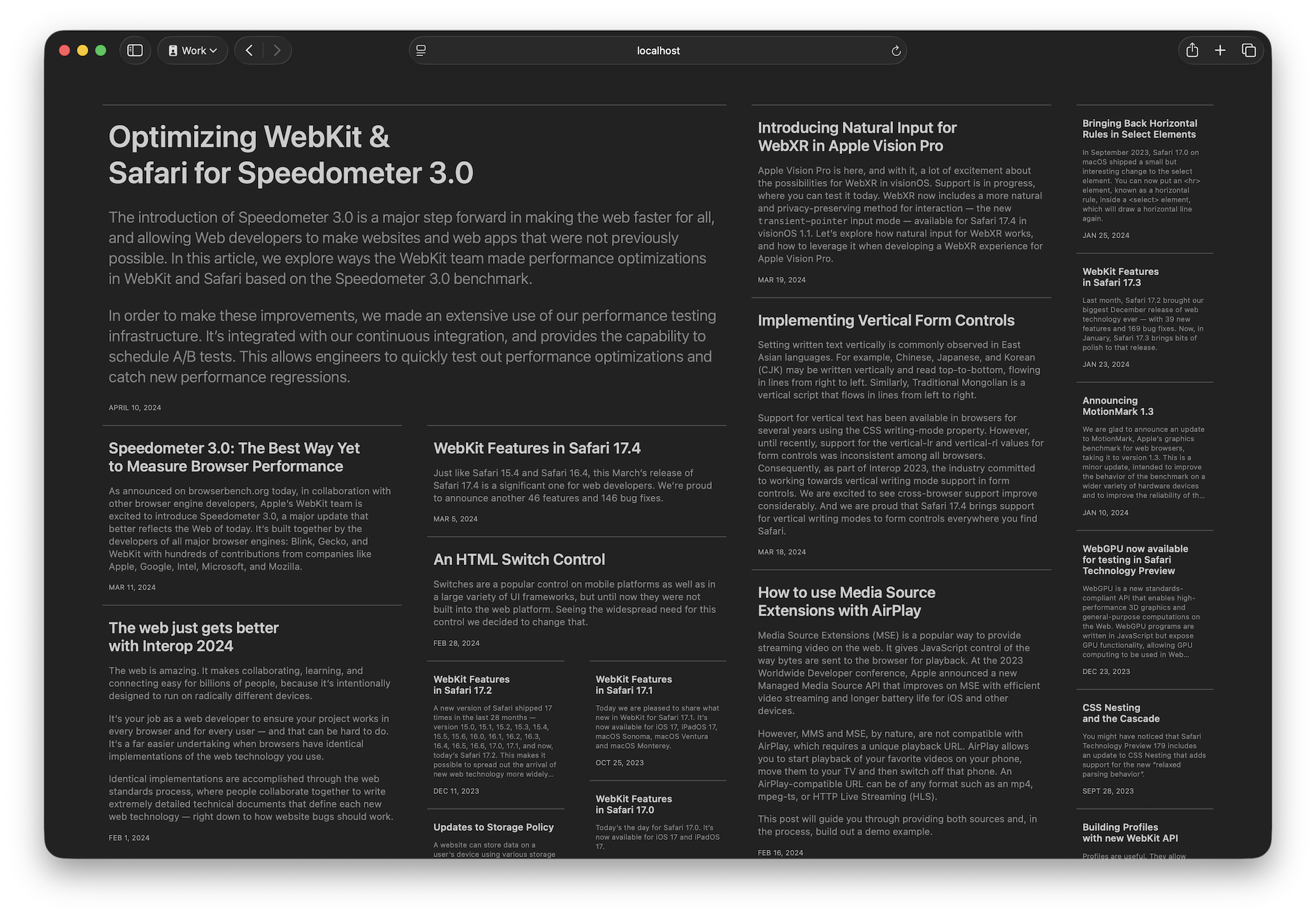
After reading the top-left block of text titled "Optimizing Webkit & Safari for Spedometer 3.0", what the fuck am I supposed to read next? Am I meant to go recursively column by column, or try to scrutinize pixels to determine which of the blocks are further up than the others, skipping haphazardly left and right across the page? A visual aid: https://imgur.com/a/0wHMmBG
Columnar layout is FUNDAMENTALLY BROKEN on media that doesn't have two fixed-size axes. Web layouts leave one axis free to expand as far as necessary to fit the content, so there is no sane algorithm for laying out arbitrary content this way. Either you end up with items ordered confusingly, or you end up having to scroll up and down repeatedly across the whole damn page, which can be arbitrarily long. Either option is terrible. Don't even get me started on how poorly this interacts with "infinite scroll".
Comment by zozbot234 11 hours ago
You can use plain old CSS columns (which don't have the automated "masonry" packing behavior of this new Grid layout, they just display content sequentially) and scroll them horizontally. But horizontal scrolling is cumbersome with most input devices, so this new "packed" columnar layout is a good way of coping with the awkwardness of vertical scrolled fixed-width lanes.
Comment by satvikpendem 17 hours ago
What a weird comment. You read whatever you want next, ever read a newspaper? You scan it all and pick the article you are interested in, then read that. I don't understand these comments, they work perfectly well in real life (and fixed size is arbitrary, I can make a super wide or super long newspaper too, the axis size does not affect this sort of layout, see infinite scroll for example, as there is only a fixed amount of content on the screen at any given time).
Comment by snackbroken 17 hours ago
Okay. What order am I supposed to scan in so I don't lose my place and accidentally skip a block? Scanning column by column gets me cut off partial boxes that I'll have to remember to check again later, while scanning side to side forces me to keep track of each individual block I've already looked at, as opposed to a single pointer to "this is how far I've scanned". Alternatively, I can scan roughly left to right, top to bottom and just live with missing some blocks. That's not ideal either, because hopefully if you didn't think I'd like to look at all of them you wouldn't have included them on the page.
You're right that you can make a newspaper that's really inconvenient to read, but you wouldn't, because the failure case you'd end up with is CSS Grid Lanes.
Comment by satvikpendem 17 hours ago
Comment by snackbroken 16 hours ago
Comment by satvikpendem 16 hours ago
So again, I will contend that this is not a problem for the average reader. I really cannot see where the difficulty you seem to say lies.
Comment by atoav 13 hours ago
Using such a layout for a novel or something like this would be really bad UX. But using it for an image gallery? Or a series of random articles that aren't priorized? Why not?
Comment by meesles 20 hours ago
Comment by 2cynykyl 23 hours ago
Comment by 65 20 hours ago
Comment by arewethereyeta 23 hours ago
Comment by interstice 14 hours ago
Comment by pbowyer 11 hours ago
I've been waiting to be able to have a fully responsive layout (where interleave sidebar content in with the page content on small screens, but have it in a sidebar on larger screens) without using any JavaScript, and this finally makes it possible.
Demo: https://codepen.io/pbowyer/pen/raLBVaV
Previous comment: https://news.ycombinator.com/item?id=46228993
Comment by qingcharles 7 hours ago
Comment by ThatMedicIsASpy 1 day ago
grid-template-rows: masonry;
is going to be outdated then?
Comment by miiiiiike 1 day ago
Comment by JimDabell 19 hours ago
I think that’s an exceptionally uncharitable description of what happened. This is a decision the WebKit team has been repeatedly publicly asking people to participate in for over 18 months.
> Help us invent CSS Grid Level 3, aka “Masonry” layout
> P.S. About the name
> It’s likely masonry is not the best name for this new value. […] The CSSWG is debating this name in [this issue]. If you have ideas or preferences for a name, please join that discussion.
— https://webkit.org/blog/15269/help-us-invent-masonry-layouts...
> Help us choose the final syntax for Masonry in CSS
> We also believe that the value masonry should be renamed.
> As described in our previous article, “masonry” is not an ideal name, since it represents a metaphor, and not a direct description of its purpose. It’s also not a universally used name for this kind of layout. Many developers call it “waterfall layout” instead, which is also a metaphor.
> Many of you have made suggestions for a better name. Two have stood out, collapse and pack as in — grid-template-rows: collapse or grid-template-rows: pack. Which do you like better? Or do you have another suggestion? Comment on [this issue] specifically about a new value name (for the Just Use grid option).
— https://webkit.org/blog/16026/css-masonry-syntax/#footnote-1
> [css-grid-3] Renaming masonry keyword
Comment by miiiiiike 17 hours ago
Comment by dagmx 17 hours ago
Surely they can’t start just pinging everyone who might have cared at some point during the time to get involved.
Comment by miiiiiike 6 hours ago
It got to the point where I believed that subgrid was dead. FF implemented it but absolutely no one else did, for years.
Is it our fault for tuning out of the debate? Yep. But tactics were employed to achieve that exact outcome. I'm fine admitting that I tuned out. But it was a battle of attrition waged by people who were fine holding up progress indefinitely.
Is that how you want decisions to be made?
Ultimately I'm not too concerned what you call the masonry feature. However the debate over what to call it was an extreme case of bikeshedding. I would have rather given up the fight over semantics to resolve the non-issues and ship the feature years ago. As it stands we're still years away from actually being able to use the feature in production.
I've stopped waiting for companies, committees, or projects to change course. I don't have an incentive to build consensus within a group of people who fundamentally disagree that the thing I need should exist. Why bother? I have an incentive to spend my time building features that users will use.
Comment by dagmx 4 hours ago
There’s no incentive to the companies or the employees to draw out the discussion, especially over something so trivial. It’s much more preferable to try and speed through things to get things done in a time frame that can be adopted.
And regardless, if you don’t feel it’s worth your time, then why cast aspersions that it was something clandestine and intentionally hidden? You could have shown up and kept up with it, just like everyone else involved presumably did.
Comment by miiiiiike 1 hour ago
I didn’t ascribe a motive to anyone. Their reasons are their own and it only makes sense that the people who stay in these fights do it because it’s part of their jobs.
There are people who, for whatever reason, keep debates going over small points of disagreement and prevent issues from being settled. Sometimes for years. Right?
The older I get, the more likely I am to recognize and route around or ignore interminable debates. Especially if it’s not for a company, project, or initiative under my direct control.
Remember, the question at the top of this thread was essentially “What happened to ‘masonry’?” Well, there were quibbles over the descriptors.
I don’t care about quibbles. “masonry”, “grid-lanes”, “grid-masonry”, pick one, they’re equivalent. I don’t like it when quibbles block progress.
Sometimes people and companies do want to block things. You’d have to ask them why. Like I said earlier:
> I don't have an incentive to build consensus within a group of people who fundamentally disagree that the thing I need should exist.
Pick your battles… Actually, no, it’s usually better to ignore the fights and just get what you need to get done so you can move on.
Comment by culi 1 day ago
It sucks whenever browsers backtrack on a W3C standard that reached "Working Draft" status but it doesn't seem like it's gonna impact many people
Besides, it's not being "deprecated". It will continue to work as it does. We just have a better alternative that the big 3 all agreed on.
Comment by afavour 1 day ago
Comment by miiiiiike 22 hours ago
Masonry or grid-lanes, who cares? I’m just glad masonry (the feature, Baseline 20XX) and subgrid (Baseline 2023) are finally here.
Comment by dylan604 1 day ago
Comment by karlshea 23 hours ago
Comment by notpushkin 20 hours ago
Comment by acjohnson55 1 day ago
Comment by jbritton 1 day ago
Comment by eurleif 1 day ago
Comment by hansvm 1 day ago
Comment by marcosdumay 8 hours ago
Comment by hansvm 57 minutes ago
Comment by jacobp100 13 hours ago
Comment by ricksunny 18 hours ago
Comment by temporallobe 10 hours ago
Comment by jeroenhd 1 day ago
Chromium still seems to be working on support it seems based on https://cr-status.appspot.com/feature/5149560434589696 so maybe it'll be useful soon? That page indicates that they're still discussing certain parts of the spec.
Comment by qingcharles 23 hours ago
Comment by oefrha 1 day ago
Comment by qingcharles 23 hours ago
One of the biggest arguments over the last couple of years was what to call it. A lot, lot of ideas put forth as alternatives to "masonry" which wasn't thought to be great for non-English speakers. I'm glad they finally nailed a name for it!
The other big argument was over how to activate it. Is it a grid? Is it a flexbox? Is it a brand new animal?
Now I just need to figure out the best way to implement this semantically with a polyfill for the next 30 months until it's baseline.
Comment by oefrha 23 hours ago
Comment by swyx 1 day ago
Comment by qingcharles 23 hours ago
I don't think the smooth reflow made it into the current spec, so I guess watch this space?
Comment by nitwit005 1 day ago
Comment by tom1337 1 day ago
Comment by notpushkin 19 hours ago
Comment by rokkamokka 1 day ago
Comment by jonah 1 day ago
Comment by nitwit005 1 day ago
Comment by jonah 1 day ago
The other posters have good answers. One thing to consider for a smooth interaction would be to eagerly load the next x elements before they scroll into view.
Comment by pcl 23 hours ago
Comment by prakashn27 12 hours ago
Comment by noitpmeder 10 hours ago
Comment by herpdyderp 8 hours ago
Comment by todotask2 17 hours ago
Comment by speedgoose 17 hours ago
Comment by kuekacang 16 hours ago
Comment by alwillis 6 hours ago
Comment by jacobp100 13 hours ago
Comment by memonkey 1 day ago
Comment by nakedneuron 16 hours ago
Comment by mattlondon 14 hours ago
I found the "jumping" ordering quite concerning but further down in the article they mention "tolerance" that seems to be a way to allow the layout to be more consistent in terms of ordering.
Comment by imbnwa 17 hours ago
Comment by satvikpendem 17 hours ago
Comment by alwillis 17 hours ago
Comment by perardi 5 hours ago
I am a fan of: https://www.youtube.com/@KevinPowell
Kevin is a no-nonsense no-hype educator. He will keep you up to date without a lot of engagement hacking.
Comment by cod1r 1 day ago
Comment by ericarogulski 2 hours ago
Comment by snooooooooooore 1 day ago
Hypermedia suffers because these marketing companies waste time on making sure they can build Pinterest in 10 LoC instead of fixing actual long running hypermedia domains.
Comment by pcl 23 hours ago
Shall we call it syntactic umami perhaps? Or syntactic lipids?
Comment by phoronixrly 1 day ago
Comment by brcmthrowaway 1 day ago
Comment by concinds 1 day ago
You should tune out more of the ambient cynicism because it's ignorant and unhinged. People who don't follow any standards discussions, don't talk to web devs, don't read anything except headlines and who are only imitating the attitudes of whatever cynical, depressed social media bubble they fell into.
Comment by fragmede 1 day ago
Comment by GaryBluto 19 hours ago
HTML has become more and more bloated. How many methods do we need to do something that was possible back in the 90s?
Comment by gherkinnn 18 hours ago
That said, CSS masonry looks solid.
Comment by willio58 19 hours ago
Comment by alwillis 5 hours ago
This is incorrect. Lots of old stuff was removed or deprecated from the HTML5 specification; elements like `s`, `u` were repurposed from being presentational to semantic:
- acronym
- applet
- basefont
- big
- center
- dir
- font
- frame
- frameset
- isindex
- noframes
- s
- strike
- tt
- u
- xmp
- noembed
- plaintext
Comment by ezequiel-garzon 18 hours ago
Comment by GaryBluto 17 hours ago
Comment by valleyer 1 day ago
Personally, I use an 11-year-old machine and have had to add userscript hacks to certain major Web sites to work around bugs in CSS grid (not the "lanes" described here).
At least new JavaScript features can be "polyfilled" or whatever. Maybe sites could check for CSS feature support too? But they seem not to.
For example, the demo page linked in the article fails pretty unusably for me. All the images take up nearly the full viewport width.
Comment by crazygringo 1 day ago
What OS are you running that can't run modern versions of browsers, and on what hardware?
Current Chrome runs on Windows 10, which came out 9.5 years ago but was intended to run on older computers, and macOS Monterey, which runs on Macs from ~2014-2015 depending on the model. But even Big Sur before that, the most recent version of Chrome which runs on that is Chrome 138 from just 6 months ago, and that doesn't seem old enough that you need to build userscript hacks.
I'm really curious what you're actually running. Generally speaking, an 11-year-old desktop should be able to run the current browser, and if not, a very recent one.
Comment by throwaway613745 1 day ago
I don't think the world needs to cater to people that refuse even basic internet hygiene.
Comment by mikae1 1 day ago
Comment by alwillis 1 day ago
The version of CSS Grid we're using today didn't ship until 2017; a browser from 11 years ago would be using one of the non-standard versions of Grid. For example, Internet Explorer 11 was the first browser to ship a grid implementation.
> At least new JavaScript features can be "polyfilled" or whatever. Maybe sites could check for CSS feature support too?
First, not every site needs to look exactly the same in every browser; that's why progressive enhancement is a thing.
Second, there are multiple ways to create masonry-style layouts that don't require masonry support in the browser using multi-column layout or flexbox.
Third, masonry can be polyfilled using JavaScript [1].
Comment by spankalee 1 day ago
You want to platform to be able to make progress and not be frozen in amber by what we had at some "magical" year when things were in some Golidlocks powerful enough but not too complex state. Especially since a lot of progress lately has been fixing long-standing inconsistencies and obvious gaps.
The cost of that is that yes, neither my Apple IIe or my Micro Pentium 90 run the modern web... one day my MBP M1 won't either.
Comment by darig 1 day ago
Comment by jimvdv 1 day ago
How do you expect things to ever change if no one ever updates? Certainly even if you decide to lean towards maximum support it’s still a positive these features are being introduced so you can use them in 10 years.
Comment by hackyhacky 1 day ago
Maybe things should stop changing.
We don't really need ten new CSS attributes every year. Things work. The elegant solution is to announce the project is done. That would bring some much-needed stability. Then we can focus on keeping things working.
Comment by idle_zealot 1 day ago
I digress.
Comment by alwillis 1 day ago
I doubt this is going to happen as long as backwards compatibility continues to be W3C's north star. That's why all current browsers can still render the first website created by TBL in 1989.
Sure, official support for certain extensions should happen but HTML/CSS will always be at the core.
Comment by JoshTriplett 23 hours ago
There are two kinds of technologies: those that change to meet user needs, and those that have decided to start dying and being replaced by technologies that change to meet user needs.
Comment by runarberg 1 day ago
Developers deserve nice things.
Comment by hackyhacky 1 day ago
I agree they do. But Python is a bad counterexample. You can upgrade your Python on your server and no one has to know about it. But if you want to use new CSS features, then every browser has to implement that feature and every user has to upgrade their browser.
The intent of my comment was to express a desire to stabilize the web API in particular, not to freeze all software development in its tracks.
Comment by runarberg 1 day ago
People get new browser versions for free, there are more important things to thing about than users that for some reason don‘t want to upgrade. Like I would rather have my layout done quickly with nice elegant code (and no hacks) and spend my extra time developing an excellent UX for my users that rely on assistive technology.
Note that your wish for stabilization was delivered by the CSSWG with the @supports rule. Now developers can use new features without breaking things for users on older browser. So if a developer wants to use `display: grid-lanes` they can put it in an @supports clause. However if you are running firefox 45 (released in May 2016; used by 0.09% of the global users) @supports will not work and my site will not work on your browser. I—and most developers—usually don’t put things in an @support clause that passes "last 2 version, not dead, > 0.2%"
Comment by afavour 1 day ago
Yes. I held off learning about CSS Grid for a very long time and as soon as I did I was converted. Sometimes I think the web doesn’t get enough credit for its ambition: mobile viewports, desktop viewports, touch interaction, pointer interaction, complex documents, webapps… it’s a lot. But you get some complexity as a side effect. The complexity we do see these days isn’t invented out of whole cloth, it’s standardising and improving layouts people are implementing with JavaScript, often badly.
Comment by acdha 1 day ago
If you’ve been at this for a while, it’s important to remember that browsers update a lot faster than they used to. Anchor positioning came out last year, for example, and all of the major browsers support it by now. Very old devices are a problem but security is purging those out faster than used to be the case.
We also have better tools for progressive adoption since you can easily query for things like CSS feature support. In this demo, they didn’t implement fallbacks but in most real sites you’d have something like a basic grid layout which is perfectly serviceable for the fraction of users on old Firefox releases.
Comment by mikae1 1 day ago
Certainly can: https://developer.mozilla.org/en-US/docs/Web/CSS/Reference/A...
Comment by SeanAnderson 1 day ago
Comment by exasperaited 1 day ago
It doesn't even take many things to do this — the knock-on support of a bug in a driver that no-one wants to fix, a package that you like that prevents you from upgrading your host OS, web browser developers abandoning something about your GUI (how long before they drop X?) etc.
In the Linux world, the age of your machine is a limit with a blurry edge, but it's still there.
Comment by OsrsNeedsf2P 1 day ago
Comment by anonymous908213 1 day ago
> If enough consumers aren't able to use the website, then business wouldn't use it.
I sincerely doubt any business owner would approve of losing even 10% of their potential users/customers if they knew that was the trade-off for their web developer choosing to use this feature, but there are disconnects in communication about these kinds of things -- if the web developer even knows about compatibility issues themselves, which you would expect from any competent web developer, but there are a whole lot of incompetent web developers in the wild who won't even think about things like this.
Comment by runarberg 1 day ago
But your GP is in a massive minority, if every developer would cater to 11 year old browsers we would be wasting a lot of developer time to inferior designs, with more hacks which brake the web for even more users.
Comment by anonymous908213 1 day ago
Comment by runarberg 1 day ago
Comment by anonymous908213 1 day ago
After checking further, almost 20% of Chrome users are on a 2+ year old version. If you handle that gracefully by polyfilling etc., fine. If you "simply ignore" and shut out 20% of users (or 50% of users per your own admission of support target), as I have encountered in the wild countless times, you are actively detrimental to your business and would probably be fired if the people in charge of your salary knew what you were doing, especially since these new browser features are very rarely mission-critical.
Comment by crazygringo 10 hours ago
I'm not finding anything to corroborate that -- I'm seeing stats suggesting things like 90% of Chrome users are on the newest version after two weeks:
https://timotijhof.net/posts/2023/browser-adoption/
And Stat Counter shows that the current version of Chrome utterly dominates in any given month:
https://gs.statcounter.com/browser-version-market-share/desk...
The glacial adoption you're describing doesn't make much sense when you consider how aggressively Chrome auto-updates, so I'm quite confused.
Comment by anonymous908213 10 hours ago
I was specifically referencing desktop Chrome, not including Chrome for Android, but other than that, if there are discrepancies, I'm not sure what the cause is.
Comment by crazygringo 9 hours ago
The Timo Tijhof data is based on Wikipedia visits, and shouldn't be affected by adblockers.
Meanwhile, StatCounter is based on sites that use its analytics, and on users not using adblockers that might block it. The CanIUse table makes clear there's a long tail of outdated Chrome versions that each individually have tiny usage, but they seem to add up.
It's fascinating they're so wildly different. I'm inclined to think Wikipedia, being the #9 site on the web [1], is going to produce a more accurate distribution of users overall. I can't help but wonder if StatCounter is used by a ton of relatively low-traffic sites, and the long tail of outdated Chrome is actually headless Chrome crawlers, and so they make up a large proportion relative to actual user traffic? Since they're not pushed to update, the way consumers are. And especially with ad-blocking real users excluded too?
Anecdotally, in web development I just haven't seen users complain about sites not working in Chrome, where it turns out the culprit is outdated Chrome. In contrast to complaints about e.g. not working in Firefox, which happen all the time. Or where it breaks in Chrome but it turns out it's an extension interfering.
[1] https://en.wikipedia.org/wiki/List_of_most-visited_websites
Comment by runarberg 10 hours ago
Furthermore the "baseline widely available" target (which IMO is a much better target and will probably become the recommendation pretty soon) includes versions of the popular browsers going back 30 months, meaning a competent team of web devs with a qualified QA process should not deliver software which won‘t work on your 2 year old browser.
I can‘t speak for the developers of the websites which break on your 2 year old browser... Maybe they don‘t have a good QA process. Or maybe you were visiting somebodies hobby project (personally I only target "baseline newly available" in my own hobby projects; as I am coding mostly for my own amusement). But I think it is a reasonable assumption that user tend to update their browsers every 30 months, and you won‘t loose too many customers if you occasionally brake things for the users which don’t.
Comment by anonymous908213 9 hours ago
Your position sounds reasonable upon elaboration, I only wish more web developers had the same consideration.
Comment by runarberg 1 day ago