Ford kills the All-Electric F-150
Posted by sacred-rat 21 hours ago
Comments
Comment by class3shock 17 hours ago
If you are a top 5% buying this you want it to tow your expensive toy somewhere which ev's suck at currently or you want it to drive to "insert outdoorsy vacation destination", which means long distance in a remote area with few charging stations. So not a great sell.
If you are a bigger business I think this probably makes sense in some cases. You aren't dealing with the maintenance of an ICE, you can keep it "running" inside a building, it can provide on site power, probably has cost benefits in cities where the lack of emissions and noise is helpful. But the expensive really narrows down your customers. Many are also looking for range and towing, which doesn't help, and people that would show up for the ev part probably would be better off with a van.
If they had done a small e-transit, in the $30-35k range and sold it direct for actual msrp they would have had a much better chance at dealing with where we are now (high interest rate and low support for ev's).
Comment by inasio 16 hours ago
Comment by tekno45 16 hours ago
Comment by malfist 13 hours ago
Comment by tenuousemphasis 11 hours ago
Comment by malfist 4 hours ago
Comment by subdavis 4 hours ago
The extension cord thing was interesting too, but “I sold my partner on a feature that turned out to be more trouble than it was worth to set up” is super relevant to discussion!
Comment by malfist 1 hour ago
Comment by brianwawok 6 hours ago
Comment by kimos 6 hours ago
Comment by zeristor 4 hours ago
Comment by xnx 1 hour ago
Comment by elliotec 10 hours ago
Comment by hcurtiss 4 hours ago
Comment by jama211 14 hours ago
What’s more insane to me as an Australian is its 50k USD starting price in America, but in Australia it starts at $149k USD as they’re only sold by third parties that do right hand drive conversions (at imo a way too high premium, 100k for that service + shipping???)
Comment by markdown 10 hours ago
Comment by 2muchcoffeeman 9 hours ago
Comment by labcomputer 2 hours ago
* no gas
* no oil changes
* no annual emissions testing (if they do that in Oz)
* more than 1 second faster 0-60/0-100
* twice the towing capacity
* semi-automated trailer connecting (maneuvering the truck to the trailer)
* longer bed and more rear seat leg room
Comment by unixhero 7 hours ago
Go with the Sharkie mate
Comment by isoprophlex 9 hours ago
Comment by SoftTalker 15 hours ago
Comment by labcomputer 2 hours ago
You can only get the Lightning from the factory as a super crew with a center console, but some people have converted theirs to a front bench and column shifter for a total of six seats.
Comment by qdog 14 hours ago
Comment by markdown 10 hours ago
https://bydautomotive.com.au/shark-6
There's a 100% tariff on top of all the regulatory and political hurdles that prevent BYD from selling in the US, but it shows that a very nice truck can be built for $40k.
Comment by hopelite 8 hours ago
It is easy to understand what the tariffs are attempting and why, but what supporters don’t get is that at the very least it’s all wrong in sequence and timing, not to mention poorly executed due to the schizophrenic and manic nature of American politics that is dominated by the president’s supposed term limits and warfare of memes people believe. “A day late and a dollar short” has probably never been more appropriate.
The inherent problem with empire and reserve currency is that it supplies a drug to a ruling class that is already inherently prone to excess.
Comment by orthoxerox 8 hours ago
Comment by germinalphrase 4 hours ago
Within the category, German manufacturers face among the highest labor costs of $3,307 due to stringent regulations and high wage rates.
The second archetype, electric vehicle-only manufacturers, includes startups as well as more established players like Tesla, which do not operate under organized labor contracts. Their average labor costs range from $1,502 to $13,291, and they face high per vehicle production costs due to low manufacturing volumes. EV-only manufacturers also have been heavily reliant on government subsidies, which are now being cut back by the new administration.
The third archetype, mainstream model manufacturers, has an average labor cost of $880 per vehicle and includes traditional high-volume automakers from various countries. Japanese manufacturers enjoy lower labor costs per vehicle, with an average of $769, compared with manufacturers in the United States, where the average is $1,341 — a labor cost per vehicle that reflects recent historic union gains.
The fourth archetype, Chinese car manufacturers, has an average labor cost of $585 per vehicle, characterized by low wages and high efficiency. The group maintains the lowest overall conversion costs in the industry by leveraging its newer factories, efficient supply chains, and high production volumes” - https://www.oliverwyman.com/our-expertise/insights/2025/apr/...
Comment by red-iron-pine 5 hours ago
Comment by MangoToupe 7 hours ago
Comment by seltzered_ 14 hours ago
Theres also the Chevy Silverado EV WT trim which is a similar base model trim, but with the huge heavy battery its paired with it's still an expensive truck.
Comment by bigtex 6 hours ago
Comment by fragmede 12 hours ago
Comment by kevin_thibedeau 17 hours ago
Comment by qingcharles 15 hours ago
Comment by theshrike79 10 hours ago
A normal van is better in every single way. I can't figure out why someone would put their expensive tools in a pick-up's bed when this is an option: https://modulinecabinets.com/wp-content/uploads/2019/11/van-...
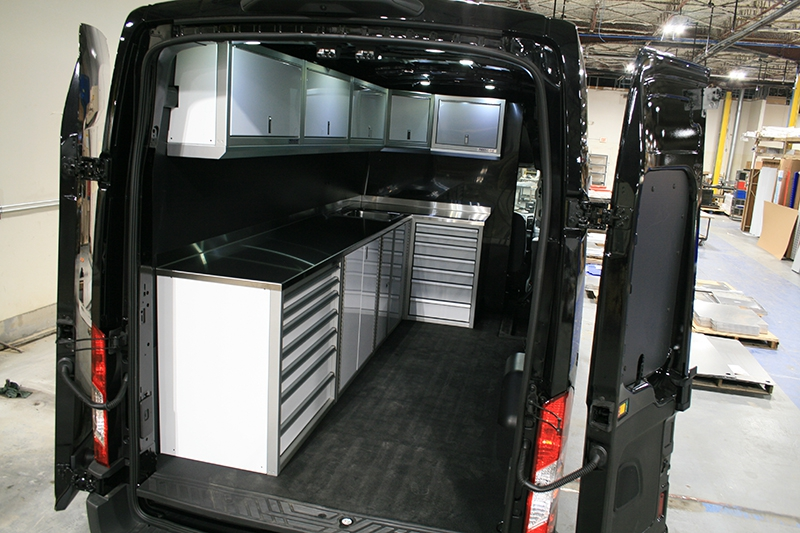
Comment by uep 9 hours ago
Comment by wongarsu 10 hours ago
Comment by red-iron-pine 3 minutes ago
The bourgeoning Van Life movement that is picking up steam on places like TikTok and YT may do more for that, but in a lot of ways it's a statement about doing without, as opposed to being country rich and tough the way trucks are.
Comment by WorldMaker 2 hours ago
Comment by robotnikman 1 hour ago
Comment by imtringued 5 hours ago
Europeans don't use pick-up trucks even for cargo that is suitable for pickup trucks, because small flatbed trucks [0] let you open the bed from the side, making pickup trucks mostly an obsolete concept for work purposes.
Comment by phainopepla2 57 minutes ago
Comment by seanmcdirmid 14 hours ago
If you are living in such an area where they can't even figure that kind of thing out, it sounds like there might be something in the water.
Comment by ssl-3 13 hours ago
Things are not that way anymore; trucks got bigger.
The top of the bed rail of an F150 Lightning is around chin height for a lot of folks: https://imgur.com/ZBOBqJc
Comment by seanmcdirmid 13 hours ago
Comment by ssl-3 12 hours ago
Here's a brochure for the first-year F-150 (1984): https://xr793.com/wp-content/uploads/2022/03/1984-Ford-F-Ser...
Have a look at some of the pictures that have people standing next to the truck.
They'd be giants if they were able to have that kind of posture next to a modern F150.
Comment by seanmcdirmid 12 hours ago
Comment by ascorbic 12 hours ago
Comment by bob1029 8 hours ago
A modern pickup truck can fit the payload capacity of an entire Honda civic in the back of the cab. I've never seen someone put sacks of groceries in the bed of their truck. Maybe packs of water or charcoal, but no one is putting their produce and boxed goods back there.
Comment by labcomputer 2 hours ago
And still have more room for stuff in the back of the cab before you even start talking about the bed.
I’m also confused how groceries in the bed would get wet in the rain… everyone around me has a tonneau on the bed. My guess is that some of these are not real anecdotes.
Comment by tanjtanjtanj 4 hours ago
Comment by kraussvonespy 3 hours ago
Comment by Swenrekcah 10 hours ago
Comment by robotnikman 1 hour ago
Comment by moron4hire 8 hours ago
Comment by Swenrekcah 8 hours ago
Maybe it makes sense, it just sounds unpleasant to me.
Comment by moron4hire 8 hours ago
Comment by mattmaroon 14 hours ago
Comment by somenameforme 12 hours ago
If your observation is accurate, the more likely reason is that people just don't like going out when it's raining. Getting your shoes/pants wet sucks, getting your car (or truck) seats wet sucks, rain traffic sucks, there's more crashes - which suck, and by contrast you could just be sitting at home enjoying the relaxing sounds of rain, which doesn't suck.
Comment by bayesnet 16 hours ago
Then again as I’m typing this I realize that I have a phone with a better processor than most computers on which I … browse hacker news and read email, so go figure.
Comment by eitally 14 hours ago
Comment by ssl-3 13 hours ago
It's really big back there. It holds an enormous volume of stuff.
4x8 sheets of plywood fit inside with the doors closed, and so do 10-foot lengths of pipe.
It's easy to access stuff at the front or the back. It's all contained under a roof in a locking, conditioned space (3 zones of HVAC) and is easy to get to from either sliding door or the back tailgate.
Works great for hauling stuff like sports equipment, outdoors gear, or photography equipment. Mine is full of tools, ladders, and boxes of wire right now, but it's been awesome for taking a mountain of camping gear and a PA system across the country. (Or, you know: Groceries. It does groceries very well indeed.)
(It's not so great at hauling stuff like bulk stone or mulch, but that stuff is usually pretty cheap to get delivered.)
Comment by joleyj 8 hours ago
Comment by orthoxerox 8 hours ago
Comment by IgorPartola 16 hours ago
But I would also trade this truck for an all electric or mostly electric Maverick as long as it had enough cabin space for my needs (children).
Comment by bitexploder 15 hours ago
Comment by MangoToupe 7 hours ago
Isn't this the entire pitch of the cybertruck?
Comment by hypercube33 16 hours ago
Comment by mattmaroon 14 hours ago
You lose about half your range towing so you’re still going to drive two hours, stop for 30-45 minutes, repeat.
So it’s still far from compelling for anyone towing or doing truck stuff.
Comment by NetMageSCW 13 hours ago
Comment by mattmaroon 7 hours ago
Comment by fsckboy 15 hours ago
it's my impression that electric vehicles are 90% grocery getters, unless the drivers are young in which case it's takeout. what else would you use an electric for, commuting? when you commute, on the way home, you shop.
Comment by craftkiller 15 hours ago
Comment by dpark 15 hours ago
Objectively a Ford F-150 is the wrong vehicle for what 90% of its buyers need. But it’s an aspirational purchase. It can go off-road. It can haul a boat. It can haul a bed full of gravel. It doesn’t matter for these purchasers that they rarely if ever actually do any of this.
Comment by Amezarak 8 hours ago
Comment by mrguyorama 1 hour ago
Being "economically efficient" with laptop purchases saves you a few hundred to a thousand dollars.
Being just reasonable with a car purchase saves you $25k.
These are not at all comparable to the average american.
The average new car price is $50k. Almost zero people need that. The Toyota Corolla, which is overpriced, still starts at under $25k. Considering inflation it's about 30% more expensive than the base model from the 90s, but the modern Corolla is more comparable IMO to the old Camry, who's price point it exactly matches.
For that money you get a safer car than the 90s, dramatically so. You get modern infotainment, like CarPlay and AndroidAuto. You get a backup camera and bluetooth connectivity. Aircon, power windows, central locking. You get 170HP from a 2.0L 4cyl that is rather silly for a commuter car. Only 32 mpg City. This is a small family car.
But Americans do not want that. Americans want to put down $50k for 80 months for a MANLY man truck for MANLY MAN things. Or the same money for a stupid box on the same frame as an """SUV"""
This is not "avocado toast" or "Just get a roommate". Americans are spending absurd money on absurd vehicles for absurd reasons.
Advances in the reliability of modern cars made the car market weird. If you have any financial sense at all, new cars almost never make sense, because the 5 year old model is still excellent. That means the only people left in that market are not making decisions on financial merits. But that also means the entire market is controlled by the whims of the easily persuadeable and financially illiterate.
Comment by dpark 1 hour ago
Most people buying F-150s are spending way more than $50k.
But the hate big trucks get isn’t because they are expensive. I don’t care if someone spends 25, 50, or 100 thousand on their vehicle and I doubt most others do either. Trucks get hate because they are more dangerous to everyone else. A collision with a truck is 2.5x more likely to kill the driver of a car than a collision with another car. [1]
But the attacks on the “manliness” and ridiculous cost of modern trucks are more emotionally satisfying than discussions about their safety profile.
Comment by Amezarak 1 hour ago
I’ve driven a Corolla in the last year. Despite not being particularly tall, my head is jammed against the roof. I have to put the driver’s seat all the way back, into the knees of any rear passengers.
The owner’s manual states the car should not be used to tow anything, eliminating the claim throughout this thread of “just buy a trailer when you need to move something big.
Why is it so hard to just admit that trucks and SUVs do in fact offer greater utility and convenience in most situations than small sedans? And that this utility and convenience, even if not needed all the time, is the main reason people are buying them?
I mean, your contention is that the average American, no doubt hard up for money, is so dumb they are willing to pay a 25k+ premium to feel “manly”. Does this really make sense? Economics are not people’s primary motive but they do have an impact.
Despite driving and loving the Honda Fit for 15 years, I bought a large SUV. Can you imagine no other reason for this than I am a madman?
Comment by dpark 15 minutes ago
In general I agree that they do offer a lot of comfort. This is actually a common criticism of these trucks, that they are “pavement princesses” that never haul anything more than groceries. Ironically, a lot of trucks have gotten so tall that they need a step for short people to get into, though, putting the claims of comfort into question.
Personally I think a lot of the justifications about big trucks are true but also not why people buy them. They see more convenient (sometimes; they are a bitch to park in cities). They are more comfortable. They can haul. They can go off-road. But these being true doesn’t mean that’s why most people actually buy them.
Marketing folks understand that. That’s why truck ads show manly shit like rocks being dumped into the back of the truck and off-roading around a mountain even though that’s not how they get used. Consumers are buying the feeling. Just like BMW sells sports cars but showing them whip around mountain roads rather than sitting in traffic.
It’s very much like guns. People who buy guns justify the purchases by saying they need them for self defense or home defense. But the reality is that most guns are never used for any of that and most people who buy guns would move somewhere else if there actually thought they needed them. They are bought because people like guns and find them fun to own. These are of course not mutually exclusive reasons. A gun can be fun and also quell feelings of fear about hypothetical home invasion.
> I mean, your contention is that the average American, no doubt hard up for money, is so dumb they are willing to pay a 25k+ premium to feel “manly”.
Is that actually hard to believe? Americans are notoriously terrible with money and many buy dumb stuff as status symbols when they are missing rent payments.
Again, marketers don’t seem to have any trouble grasping that most money is spent on feelings.
Comment by dpark 3 hours ago
Comment by lokar 13 hours ago
Comment by mattmaroon 14 hours ago
I might not move furniture regularly, but it’s reeeeal nice to be able to do so when I need to. My dishwasher broke on Christmas Eve when I was hosting so I went to the store and got another and installed it within an hour. Not doing that with my Subaru.
Comment by tfourb 13 hours ago
Comment by mattmaroon 6 hours ago
A small car cannot safely transport much of a trailer, and a pickup can tow a much larger trailer.
Comment by dontlaugh 10 hours ago
Comment by stackghost 13 hours ago
There's no way my piece of shit Samsung dishwasher would fit in your car. It's huge.
Comment by unionpivo 9 hours ago
And if you are ok, with having trunk open, and tied down, you can transport fridges (I used reno clio, that is slightly bigger). Done that myself (not two door wide ones, one door fridge).
That's said I just found out you can hire van for 35EUR 20min away from where I live, so nowdays I just do that.
Comment by Amezarak 8 hours ago
It's important to note that American appliances are generally larger than European ones.
I drive a small very useful car almost every day I have moved a ton of stuff in (including a DRESSER) but it's inarguable that trucks simply have greater utility for this sort of thing. And any time I do need to move something...I just use the cheap pickup I bought so I don't even have to worry about it or spend ages trying to squeeze it in.
Most recent purchase: Christmas tree. Yeah, that wouldn't have fit in my car.
Comment by dpark 4 hours ago
An artificial tree that can’t fit in a car would be a big tree.
Comment by Amezarak 50 minutes ago
1. Let the Christmas tree farmer toss a 8’ tree in the back of my truck, tying the base to the anchors behind the cab. Very little overhang with the tailgate down. Drive away. This is what most people do.
2. Spend 15 minutes balancing the the 8’ Christmas tree on the roof of my Honda Fit with substantial overhang, precariously tying it, I guess leaving the windows down in the cold weather and praying the Highway Patrol doesn’t pull me over. This is not what most people do but I’m sure it can be done.
Lots of things “can” be done but people value convenience.
Comment by dpark 35 minutes ago
Is it more convenient in the back of the truck, though? Sure. I didn’t say otherwise.
I will say that buying a giant truck with poor visibility and 2.5x the kill rate of a sedan so that you can haul a tree once a year is nonsense. It’s a shitty tradeoff and a much smaller truck would do exactly the same job. But little trucks don’t sell like giant trucks because people are not actually buying them for their utility.
Comment by Amezarak 12 minutes ago
Comment by ascorbic 12 hours ago
Comment by ghaff 7 hours ago
Personally I have a mid-size SUV but if you regularly need to transport around a lot of people, minivans seem more practical in general than a lot of the big SUVs.
Comment by mattmaroon 3 hours ago
Comment by dpark 3 hours ago
I don’t think smaller trucks get the same level of hate.
Comment by stackghost 1 hour ago
Lots of imported Delicas but also a fair few of those Mercedes Sprinter 4x4s.
Comment by dpark 1 hour ago
It’s a great vehicle for most practical cases, though it is not very fuel efficient.
Comment by themafia 15 hours ago
https://www.youtube.com/watch?v=42BmZ6Rgqkc
Also most people I know who use F-150s in the way you describe also typically have two children or more. It's not as if this was a segment that was particularly hard to pin down.
They just completely wiffed.
Comment by doctorpangloss 15 hours ago
Comment by themafia 15 hours ago
You may perceive that there's "enough" but the market has clearly decided that you are wrong.
Comment by beAbU 8 hours ago
I agree that small commercial vehicles are the right prime target for electrification, but why the pick-up? I would argue that the classic van is a much more sensible small commercial vehicle than a pick-up. As a non-USian, do you mind explaining why the pick-up is so much more popular in this category? The van wins in all tests in my mind, except maybe that it's less manly?
Comment by frameworkeGPU 4 hours ago
worse for storing tools and supplies. So some service techs here also prefer vans depending on their loadout. but generally it's easier to use a pickup truck for van stuff (eg locking jobsite boxes) than the reverse.
Comment by Vinnl 7 hours ago
Comment by black_puppydog 9 hours ago
Seriously, people should take a look at how professionals around tye world are managing just fine with anything from a cargo bike via VW caddy to sprinters....
Comment by pmontra 8 hours ago
Do you mean that dealers ask for bribes to customers to deliver cars, or that customers bribe dealers to skip the waiting list, or something like that?
Comment by labcomputer 1 hour ago
So companies like Ford can only sell what independent dealers want to sell. You can go to the dealer and ask to buy a car sitting on the lot, and the dealer can just… not sell you the car. For any price. And it is also illegal for the manufacturer to force/coerce the dealer to sell it to you.
Of course the dealer can do softer things also, like talk down the car when you test drive or talk up the benefits of other cars. Or tell you that next year’s model will be much better than this one, so you should wait.
Additionally, most dealers do not actually pay for the car until it is sold to the customer (the manufacturer offers financing to the dealer, called “floor planning”).
Independent dealers do not want to sell EVs because of the perceived loss of service revenue. So they simply offer bad deals on the car that most customers would not take. The cars sit on the dealer’s lot, but that costs the dealer nothing (see above), even though Ford wants to sell an EV and customers want to buy EVs.
Comment by pmontra 3 minutes ago
Comment by adrr 17 hours ago
Comment by smackeyacky 16 hours ago
An EV generally has a battery cooling system along with regenerative braking.
EVs have roughly the same mechanical things as an ICE vehicle too, HVAC, suspension, brakes, in car entertainment, heated seats. Lighting. An entire 12v subsystem to power all that stuff as well.
A good old ICE car will be cheaper to make than an EV because the powertrain is cheaper when you account for batteries. Even taking into account the gearbox you don’t need in an EV.
Comment by HankB99 15 hours ago
How much of that is the result of the relatively maturity of the technology? We've been continuously improving ICE based transportation for well over a hundred years. It's been a lot shorter for electric vehicles.
I suspect that there are bigger strides to make with electrics that may eventually turn that around.
Comment by fsckboy 15 hours ago
that's a real effect though, it's not something something you throw overboard, it's the bouyancy that keeps you from sinking.
Comment by echelon 15 hours ago
After many more billions are spent.
Is the American consumer going to eat that cost? The government clearly lost its appetite as it isn't subsidizing EVs anymore.
The US has cheap fuel and it isn't a strategic issue to develop EVs except to keep US auto internationally competitive.
US consumers are still really into big SUVs and trucks and almost all of the models are ICE instead of EVs. The EV manufacturers don't really fit the shape of the American consumer that they haven't already sold to.
China jumped on EVs because they wanted to start an automotive sector for (1) heavy industry, (2) adjacency to national defense, (3) strong new domestic and export market they could corner, (4) it's adjacent to their other manufacturing industries. Critically, they had a deep reservoir of Chinese citizens who were first time car buyers that they could nudge into buying domestic auto. No other nation on earth has the outsized advantage of having such a deep bench of new customers to subsidize a new industry. The stars aligned for China.
America has neither the interest nor the capital to chase EVs or force them down American consumer throats.
Comment by dalyons 13 hours ago
Ok so dont, but take the tariffs off batteries, and allow foreign EVs to compete fairly. We'll get affordable EVs, and then we'll see what the american consumer actually wants. No? Oh, i guess its about something other than consumer choice after all.
Comment by thelastgallon 14 hours ago
But America always has the interest and capital to protect oil interests and supply chains worldwide by being the biggest spender on military, funded by taxpayers.
Comment by ascorbic 12 hours ago
Comment by re-thc 14 hours ago
Only if you see the market continue to be dominated by human drivers. We are potentially moving to self-driving cars like Waymo, Tesla etc then they will get the choice to force what car they like.
> The government clearly lost its appetite as it isn't subsidizing EVs anymore.
More like "the current" government. It can always change.
Comment by NetMageSCW 13 hours ago
Comment by re-thc 12 hours ago
Ballmer in 2007 also said the iPhone was not going to get any significant market share. It didn't even take close to fifty years, did it?
Comment by ghaff 7 hours ago
It did take a few years after 2007 before it became obvious to pretty much everyone that the iPhone was going to be a huge hit but took a little while before some oddities in the original software were corrected and people adjusted to not having a physical keyboard which some thought was going to be a dealbreaker out of the gate.
Comment by lallysingh 15 hours ago
The rest, yeah. The chemical stacks in the batteries are expensive, and dealer markup was a problem (now they're 47-56k new). But the energy costs! $7-12 for a fill-up on home power overnight instead of $75-85 at the gas station.
And maintenance. So little maintenance. For local non-towing fleets these would save a lot.
Comment by kakacik 8 hours ago
Its future but its coming/will come at very different time for various folks
Comment by dmitrygr 12 hours ago
Either disingenuous or ill-informed. one is ~1KW for a few seconds a day, the other is > 100KW of power for dozens of seconds, multiple dozens of times a day. completely engineering
Comment by adrr 15 hours ago
https://www.visualcapitalist.com/why-evs-are-now-cheaper-tha...
Comment by philipallstar 8 hours ago
[0] https://www.reuters.com/business/autos-transportation/china-...
Comment by dpark 14 hours ago
Comment by Qwertious 12 hours ago
NMC and LFP (of the same cost) are about even, but pricier NMC packs can add maybe 10% more range for the same weight. Which is why most EV companies offer a "long-range version" that's just the same car with an NMC pack swapped in. It's mostly an irrelevant gimmick.
The truth is that range isn't limited by batteries, it's limited by weight and cost - a bigger battery weighs more, which means the car (frame) needs to support more weight, which means the car (frame) costs more. Most EVs have a range of ~300 miles (~500KM) and any battery gains don't go into extending the range, they go into reducing the weight (and therefore cost) of the car. Lighter frame, fewer battery cells. Because most people don't care past 300miles (500KM). Not enough to pay an extra $5k, at least.
Comment by dpark 12 hours ago
Comment by al_borland 16 hours ago
Comment by fragmede 12 hours ago
Comment by al_borland 12 hours ago
It seems they’d be better off waiting for better/cheaper battery tech, so they can build out those factories and make cheaper EVs that people might actually buy at scale. Right now the market still feels niche.
[0] https://insideevs.com/news/731721/gm-samsung-sdi-indiana-ev-...
[1] https://www.cbsnews.com/detroit/news/general-motors-permanen...
Comment by bluedino 14 hours ago
Comment by rsynnott 11 hours ago
https://www.ford.ie/content/dam/guxeu/ie/Documents/Pricelist...
Granted, they don't seem to sell the cheap ones in the US.
(For whatever reason you don't see these around very much, though; Citroen and Mercedes seem to dominate the niche, at least here.)
Comment by rjsw 5 hours ago
I am considering the Transit e-Courier or the Chicken Tax variant as my next car.
Comment by foofoo55 13 hours ago
Comment by asciimov 14 hours ago
For those that don't drive in town, noting beats gas or diesel.
Companies need to build a stepping stone truck. Dino-powered generator on an electric platform. Get most of the upside to electric performance, while getting the speed gas refilling.
Comment by standeven 13 hours ago
Comment by markdown 8 hours ago
The worlds biggest electric car company made the Shark, a plug-in EV hybrid. Sold for US$40k in Australia.
Comment by protocolture 14 hours ago
Comment by kjkjadksj 16 hours ago
Comment by shawn_w 15 hours ago
Comment by dboreham 15 hours ago
Comment by eitally 14 hours ago
Comment by nine_k 16 hours ago
Comment by twoodfin 15 hours ago
Comment by frutiger 13 hours ago
This is in Manhattan mostly below 60th St. though, that might be the difference?
Comment by nine_k 13 hours ago
My observations are from lower Manhattan and various parts of Brooklyn.
Comment by dalyons 13 hours ago
Comment by jeffbee 15 hours ago
Comment by NewJazz 15 hours ago
I guess Mach-E beats even the R1S but they're not really the same kind of car. Ioniq 5 beats Mach E in CA, as does the MY.
Comment by throwaway-11-1 59 minutes ago
Comment by jeffbee 13 hours ago
Comment by ProAm 15 hours ago
Comment by lotsofpulp 7 hours ago
Comment by jen20 16 hours ago
I'm almost certain Ford would love to sell direct, but the various franchise laws in different states make it next to impossible. On top of this, dealership owners are typically quite powerful in terms of local politics, which makes such laws very difficult to overturn.
For example:
Texas: https://www.txdmv.gov/dealers/licensing/franchise
Florida: https://www.leg.state.fl.us/statutes/index.cfm?App_mode=Disp...
California: https://www.nmvb.ca.gov/protest/protest_establish_new_fran.h...
Comment by NetMageSCW 13 hours ago
Comment by mattmaroon 14 hours ago
Battery ranges decline by over 50% when towing. The long term health of a battery requires you to keep it within a range of about 60% of the max capacity (ie between 20 and 80). So that’s if anything a generous estimate. You’d increase your labor cost by 25% just charging, not to mention that public charging isn’t any cheaper than fuel. I’m not even factoring in lost job profits or overtime.
The margins the Ford dealer takes are not the issue. The cost of the vehicle itself amortized by the hour is much less than the labor cost of operating it. If I could get any EV truck at the same cost as my diesel, I still wouldn’t. If you’ve got two guys out, that’s $50 burnt every time they charge (at least) and that may be 2+ times a day. Your fuel cost is irrelevant. Five minutes at a gas station and a tank of diesel is still cheaper.
It has some use cases I’m sure (delivery vans since it is one worker, city driving, short range) but most commercial vehicle work is simply not going electric given current battery technology.
Comment by lokar 13 hours ago
Comment by mattmaroon 6 hours ago
The better question might be how often does one utilize the unique shape and capability of a pickup.
Also, define heavy. Half ton and below, sure, those are just differently-shaped SUVs to most people who own them. 3/4 ton and up are work trucks. But every truck owner finds themselves moving things you can’t move in an SUV on occasion.
Comment by lokar 4 hours ago
Comment by mattmaroon 3 hours ago
If you include a half ton, then yeah, that’s basically a differently shaped SUV to many owners.
Comment by NetMageSCW 13 hours ago
This sound like every EVangalist who says road trips aren’t important when most everyone takes at least one a year.
Comment by Mawr 11 hours ago
Either the US has a lot of electricians and plumbers, all those people aren't buying these trucks because they need them.
Just look anywhere outside the US — nobody buys trucks like these. And that's because they're incredibly niche. They're worse than all other options. A regular sedan is a better everyday car and can fulfill most of your "i need a truck" use cases anyway.
BTW, I was kidding with the electricians and plumbers, they have no need for a truck. Nobody does.
For anything you'd actually need a truck for, an appropriately sized van is better. You'd have to be hauling dirt and sand offroad in rural areas on a regular basis without somehow being able to use a trailer for a flatbed truck to make any sense as a purchase. Guess how many people in the US have a need for that. Certainly not enough to push the sales numbers to #1.
> road trips aren’t important when most everyone takes at least one a year
Exactly, optimizing your life around something you do once per year is completely irrational.
Buy all the trucks all you want, just don't claim it's a sensible, rational decision. It's not.
Comment by aboodman 9 hours ago
The pickup is more practical than a van here because you end up hauling a lot of dirty/sandy/wet stuff. Yes, you could put this in your van, but hooray now you have sand and water in your van that you need to clean out (and you do need to because the heat will turn it into mildew immediately if you don't). The bed of the truck is outside. It dries out on its own. The sand falls out on its own.
I can't speak for other parts of the US, but use cases can be subtle and I would be slightly cautious about deciding that 300M people and a several trillion dollar market has been completely irrational for decades.
Comment by mckn1ght 7 hours ago
Right tool for the job. I drive an AWD Prius with winter tires to get groceries in the snow.
Comment by lokar 4 hours ago
Everyone with a truck had to put a bunch of weight in the back to manage the roads in the winter.
Comment by mckn1ght 1 hour ago
Comment by mattmaroon 6 hours ago
Comment by NetMageSCW 13 hours ago
Comment by Qwertious 12 hours ago
The problem is that we built our world around cheap portable energy, so problems that are trivial technically are difficult socially - the client won't let you use the power outlet, if they do they'll make you pay for the power use, asking is weird and unusual and requires more negotiating with the client, it's just not worth it. Like, if oil never existed then residential housing would probably be built with a special "contractor power outlet" that could be billed separately on a pay-per-use basis - call up the number, dial in your Designated Contractor Code or whatever fictional paperwork, and you get charged for the power you pull until the socket is unplugged.
Or maybe some other solution that I can't think of, because people in that world had to think of one and spent decades refining it. Or maybe they invented lithium batteries 90 years ago (~1935) and now they're on par with oil.
Comment by SmirkingRevenge 6 hours ago
EV's still aren't practical for a lot of drivers in such places.
Comment by hirvi74 17 hours ago
Do EVs suck at towing because of battery life? I thought electric engines were often superior to comparable internal combustion engines regarding torque.
Comment by lemming 17 hours ago
Comment by bluGill 16 hours ago
Comment by vel0city 15 hours ago
That said, if it's not the towing but the bed you need, the range but isn't nearly so bad.
Comment by qball 13 hours ago
Comment by bluGill 7 hours ago
Comment by tirant 12 hours ago
But even when you, the amount of time is not 60minutes. If you have kids, the time to go to the restroom, grab a coffee and come back is usually already around 20min, which tends to be enough to charge from 20-60% or even to 80% in newer vehicles. If you have a meal and take around 40minutes, you are probably already hitting 90% or higher.
Comment by throwaway-11-1 53 minutes ago
Comment by vel0city 32 minutes ago
Comment by vel0city 13 hours ago
This is exaggeration. A half hour for a well-loaded truck, sure, but an hour is generally exaggeration.
And as for five minutes for a fill up, it's usually more than five for a regular fill-up on a regular passenger car for me compared to just continuing on.
Comment by kakacik 6 hours ago
I don't know what your family does on the gas station, but my wife and 2 small kids can cover toilet visit (as long as there was no accident) for all 3 combined under 5 mins. So can I with paying, so at the end its 5 mins stop total all counted in. Eating as in lunch is once a day, and when we travel we certainly don't need restaurant experience of sitting around, quick sandwich is more than enough, driving on full stomach sucks anyway.
Never understood people loitering around gas stations for long time, but then again when we travel its often 500km or more, the typical trip cca 2x a year back home is 1500km.
EVs are not for us for quite some time, US EVs seemingly never.
Comment by bluGill 5 hours ago
Comment by vel0city 5 hours ago
It takes a few minutes just getting the kids in and out of their car seats. No way everyone is getting out of the car, through the bathroom, and then back in the car ready to go in 5 minutes.
Seriously, time yourself sometime. You're way underestimating the actual time you spend at a stop.
Comment by lostlogin 2 hours ago
And that’s a race thy would be amusing to watch.
Feed and toilet a family of four and also refuel the car. How long?
Comment by vel0city 1 hour ago
Forget that. Take your time. Be comfortable. You've got a few more hours to go, enjoy yourself. Stretch, have your snack outside of the car so it doesn't get as messy and you're not hungry in a little bit (and as the driver, so you're not distracted trying to eat while driving). Don't get me wrong, don't just be idle at the stop, do what you need to do and get moving again. But you don't need to rush. Its not going to make that big of a difference in the end.
Comment by bluGill 5 hours ago
Comment by vel0city 4 hours ago
But take a look at it from another perspective. Its another 10-15min on a several hour road trip. On a 5hr road trip that's like 3-4% more time for the total time of the road trip, assuming you're definitely doing a fast stop on that 5 hour trip and not sending the kids through the bathroom and you're not stopping for a quick meal. Is adding 3% to your travel time really that significant?
And as pointed out, if you're having to get the family through the bathroom or stop for a quick bite (even just sandwiches in the parking lot, although I usually pull off to a rest stop when traveling in an ICE car when having a quick bite) its not even more time, its the same total time.
On the route I often drive for a road trip (between DFW and Houston), I'm normally going to stop for lunch or dinner anyways somewhere on the route. I just stop where there's a charger (a few good options), have a quick bite, and hit the road. I'd usually do that even with my gas cars even if I didn't need gas, normally stopping at one of the rest stops on the way to stretch my legs, have a quick snack, use the restroom, and continue on my way. On paper taking the EV adds something like 15 minutes or so to the trip (which my EV isn't really great for road trips compared to others: smaller battery AWD Mach-E) but in practice for how I road trip its practically the same.
Comment by eucyclos 16 hours ago
I really think the first obvious use case (aside from bugout vehicles) would be something like the early road rangers - driving all over a farm and bringing back crates of produce from muddy fields without getting stuck or needing a lot of maintenance.
Comment by bluGill 16 hours ago
Comment by UncleMeat 6 hours ago
Comment by fisherjeff 15 hours ago
Comment by dboreham 15 hours ago
Comment by NetMageSCW 13 hours ago
Comment by bluGill 7 hours ago
Comment by vel0city 1 hour ago
Comment by wpm 15 hours ago
Comment by dzhiurgis 14 hours ago
Charging infrastructure was always the key for EVs and it's still relatively behind.
Comment by pertymcpert 14 hours ago
EVs are 90% efficient at converting their chemical energy to useful work. This is a good thing in general, but it also means that drag and extra losses hurt its range much more. If 90% of the energy goes into useful power, than anything that requires 50% more power is going to almost halve the range. Whereas with an ICE engine, the high fixed losses mean that demanding 50% more power doesn’t increase fuel consumption by 50%. Pair that with the higher energy density of gasoline and you’ve got a bad comparison for EVs.
Comment by exabrial 21 hours ago
* The price isn't right for small businesses. These trucks are quite expensive
* They're difficult to repair. A regular F-150 is designed to be repaired; these things are designed like iPhones to be disposable.
* Parts availability is scarce, contrasted with a regular F-150 (even junkyards are full of spare parts, that aren't software constrained)
* They're loaded with useless/barely-functional interior electronics that are poor copies of Tesla
* They're bloated with parts that don't need to exist (excessive exterior accent lighting, badges, over-complicated blinkers)
Oddly enough, single-charge range issues are pretty much non-existent (for non-towing applications).
Comment by bink 20 hours ago
They definitely aimed for the luxury market, like Rivian. Who knows how successful they would've been if they aimed for mid-range like Scout. That's the market they claimed to be entering when they started taking reservations. They also could've offered a fleet ready version without the luxury features, but must've decided not to.
> They're difficult to repair
How so? They are far simpler to maintain than a normal F-150. They're new so they do have parts issues for the electronic components, I'm sure, but I think that's a fair trade-off. In any case, I don't think offering a hybrid version makes the vehicles easier to maintain or repair. If anything it's the opposite.
> Parts availability is scarce, contrasted with a regular F-150 (even junkyards are full of spare parts, that aren't software constrained)
I thought one of the advantages of the F-150 was that most parts were shared with the standard F-150? The battery and motors, maybe not.
Comment by tracker1 20 hours ago
Comment by rootusrootus 17 hours ago
It has breakable expensive headlights and taillights, that is for sure. But so do ICE F150s...
Comment by philipallstar 8 hours ago
The point is they're harder to get because they're rarer.
Comment by bink 19 hours ago
Comment by turtlebits 16 hours ago
Comment by tracker1 1 hour ago
Comment by shmoe 18 hours ago
They did offer a fleet version.. the "Pro".
Comment by sh34r 18 hours ago
Comment by ecshafer 17 hours ago
Comment by hypercube33 16 hours ago
If Chevy came out with a competitive S10 Electric style truck, I'd consider it as well.
Comment by Marsymars 13 hours ago
Comment by kevin_thibedeau 17 hours ago
Comment by aydyn 12 hours ago
Comment by ethbr1 5 hours ago
The issue at root is that auto demand is a finite, population-based amount. Automakers are all pretty good at margin and manufacturing cost control.
So that leaves the only independent variable that can influence revenue and profits as {average sold vehicle price}.
New entrants face a scale issue: it's difficult to compete with the larger manufacturers' production costs with orders of magnitude less sales volume.
Which is why you historically only saw state-sponsored new manufacturers break into the market (read: Japan, Korea, China).
Electrification turned some of this on its head, but not completely. GM, Ford, et al. can still build just enough mid-market electrics to spoil others volumes, without attempting to build something really good and cannibalizing their own luxury vehicles.
Comment by mrguyorama 1 hour ago
Instead of buying a brand new Geo Metro like you would in the 90s, you just buy a used Corolla or Civic. You end up with a better car and it lasts longer anyway.
That means the majority of the "New" car market has already decided price isn't that important.
Which is why the "average" new car price is $50k and people are signing up for 80 month loans on trucks.
Comment by hamburglar 8 hours ago
Comment by tracker1 20 hours ago
The cost is also kind of crazy between inflated factory and dealer pricing as much as $20k over sticker price. Yeah, there was some early demand, but over-charging really cooled that and the demand overall.
I'm with you on some of the interior features, they're cool, but the overall inflated price is just too much. On the flip side, the Chevy "Work Truck" is kinda too far the other direction imo.
Similar on the more complex exterior, though I actually like it, it's not practical for its' prescibed purpose. If Ford could create a stripped down EV equivalent to Chevy's "Work Truck" at even 50% higher cost, I think it would do very well. They're very good for in-city use in terms of range on a charge, it's definitely good enough for most general tradecraft use, but the bloat and pricing really drag it down. Much like most cars in general these days.
Pretty much the only interesting new car I've seen this year was the Hundai Palasade, which IMO was just a good value for what it is. Kind of disappointing to see Nissan drop the Titan line. While I'd prefer to buy American brands, the fact that is that I don't think they deliver on overall value or reliability as well as competing brands. And it gets muddied further with foreign brands with US assembly and American brands now owned or otherwise operated or significantly built outside the US.
Comment by rootusrootus 17 hours ago
The part with the worst availability is the godforsaken shifter, which happens to be shared with the ICE F150s.
Comment by omnimus 20 hours ago
That symbolism goes completely against electric/green vehicles. In other words - people who buy F-150 would never buy electric vehicle and people who are looking for electric truck for work wouldn't buy F-150.
Comment by exabrial 17 hours ago
This is an unfortunate trope that is oft repeated by those that live their life in constant upgrade cycles.
The regular F-150 is a pinnacle of value engineering for Ford. It's infinitely repairable for owners. Look around on the highway, you will see hundreds of 15+ year old F150s on the road, and a few times a day I will see 25+ year old trucks on the road too. There are thousands of aftermarket parts for repair or customization. Owners are happy with them, and they recognize the truck as something they buy once and keep for a long time.
If it is any kind of expression of self, its one of "I don't need to be consumeristic; I picked something simple that will last a lifetime."
Comment by chickensong 13 hours ago
Comment by kalleboo 6 hours ago
Is there any car that can't do that though? That's just the weight of 5 adults.
Comment by NetMageSCW 4 hours ago
Comment by kalleboo 3 hours ago
Comment by omnimus 8 hours ago
Comment by philipallstar 6 hours ago
Comment by mrguyorama 47 minutes ago
In northern maine, the "Manly men" have a road pickup, with a giant cab and all the luxury features and a 7L engine, and an entirely separate "Work" truck that actually has normal work truck features like no infotainment and is easy to clean and is not a luxury vehicle.
They only ever drive the work truck into the muddy farm. They might go "Mudding" in their pavement princess and then take it through a drive through car wash.
Then in the winter, when they need to plow the snow, they have yet another truck, usually an old work truck, that they slap a plow on.
Trucks are a lifestyle brand.
They don't tow things other than once a year, and that thing is a giant RV for the yearly camp trip, because they don't actually like camping. They don't need to tow their Skiddoo in the winter because they just drive it all over the state from their back yard, which is great fun.
My dad bought an F350 for "work" that is full of all the luxury options of course, and is usually towing an oversized box trailer full of tools as a work space, but normal people that don't have free rent and have to work for a living just take the damn tools out of the back of the truck before doing the work. But it doesn't matter because that $80k status symbol is "owned" by his company and is treated as a depreciating asset for tax purposes, so he buys a brand new one every 5 years.
Ironically, he actually does tow multiple times a week, but 90% of his usage WOULD be covered by an electric truck.
Comment by SoftTalker 15 hours ago
Comment by Mawr 10 hours ago
What you do is get a regular car that's great for everyday stuff and buy a trailer. You get a flatbed that's what, 4x the size of the one on your truck? And it's cheap, at knee-level, and detachable, so you only pay the cost of inconvenience and extra fuel when you use it, not all the time.
You won't use it much anyway, because a regular car fits more than you think.
Comment by Amezarak 8 hours ago
> And it's cheap, at knee-level, and detachable, so you only pay the cost of inconvenience and extra fuel when you use it, not all the time.
You can also hook a trailer up to a truck, giving yourself even more capacity. Many people do this. However, people in urban or suburban areas may not have trailer storage areas.
Comment by NathanielK 15 hours ago
We have pickups and the minivan and I often prefer to haul with the van. Better fuel efficiency and lower load floor are nice.
Comment by SoftTalker 14 hours ago
Comment by jasonkester 12 hours ago
I think that’s more down to choice than possibility. I’ve hauled all those things home from the diy store in my boring Volvo with its roof rack. Had 600-odd pounds of sand in the back just last week.
4x8 plywood isn’t particularly heavy, and little consumer “150 pounds max” roof racks can hold a lot more than they claim.
Comment by Ekaros 12 hours ago
Comment by Marsymars 13 hours ago
Comment by vel0city 14 hours ago
Even then, my minivan can pack some pretty long and pretty large things inside. Meanwhile it's got a better turning radius than most trucks, it has way better visibility, it's far less pedestrian unfriendly, it's got an easier loading height, sliding doors make it easier to fit the back five passengers in and out, the stuff I'm hauling doesn't have to risk getting wet or affected by the outside environment. Seems like the minivan is way superior than a bed for suburban life if one needs such a large vehicle.
I've needed to move homes requiring the need for a 24' box truck more than I've needed to haul a stack of drywall around. Should I daily drive a uhaul truck?
Comment by SoftTalker 14 hours ago
A utility trailer could do a lot of that too, if you have a suitable tow vehicle. Sometimes the extra space taken by a trailer is inconvenient.
Comment by defrost 13 hours ago
It's a good idea to use anti-sway bars on, say, a Hayman-Reese hitch when things get technical and loads want to skid sideways.
Rig your trailer right and you can have a removable gull wing hutch for sleeping in / tool security, etc.
IMHO there's more room on a dedicated heavy load trailer than an SUV "truck" bed and there's usually better tie down with a custom trailer as the rope rails run full length for hitching.
Comment by tracker1 1 hour ago
Comment by vel0city 36 minutes ago
And if your answer is "well you'd go to the workshop and do that"...well there's your answer on where to park the trailer.
Comment by SoftTalker 3 hours ago
You may get away with it but it is not suitable. It doesn't have the brakes or the weight to safely pull a large trailer, and you'll likely burn up the transmission as well. Now, if you're talking about a body-on-frame GM sedan from the 1970s, with a 350 or larger V8 engine, maybe. A 4-cylinder typical family sedan of 2025? Not a chance.
Comment by Mawr 10 hours ago
Comment by tracker1 1 hour ago
Comment by vel0city 13 hours ago
I've mostly just had that delivered when doing a big job, but I have just laid a tarp before. It's not that big of a deal really. And I don't even bother with a tarp for the smaller jobs, it's already bagged. Just don't grab bags with holes in it, and use the vacuum later. It's fine.
> Or a bed-load of tree limbs and cut brush?
I live in a suburb. The trash service picks up brush. If it's more than what I can fit in a few bags I just put in a bulky trash request and the send a truck with crane to pick up the pile. Welcome to living in a society, it's quite nice.
> Hauling furniture, firewood, lawn mowers, trash
Once again, large furniture moves have been easily handled with cheap rentals. One-off pieces have usually been easily partially disassembled to load even into a hatchback. I've had no issues putting my lawn mower even into my old Accord, they're not that big when you fold the bar down. Spend a couple of minutes unscrewing things and suddenly you no longer need a truck. Not that I need to move my lawn mower much, I'm not in the lawn service industry. I'm also not in the piano moving industry. But maybe most Americans do move pianos on a quarterly basis.
And once again, a small tarp and I've carried plenty of firewood for my fireplace. But once again like the majority of Americans I live in an "urban" area and don't rely on multiple chords of firewood to make it through a winter. But the family I had that did live in a rural area that did mostly heat by firewood just had it delivered. You might as well argue one needs a trailer rated to carry fuel oil or large quantities of liquid propane.
You know what's inconvenient? Navigating urban spaces every day with a giant oversized monstrosity that my kids can't even easily climb into on their own. A vehicle where I can barely open the doors on an average parking spot. A vehicle that gets less than 20mpg compared to 35+ (or even way more than that with my EV). A vehicle where each tire costs $200+ compared to $100. A vehicle where a brake job costs way more than it needs to.
Comment by NetMageSCW 13 hours ago
Comment by vel0city 13 hours ago
Don't get me wrong, some people definitely have a legit need for a truck. I've eyed them as I've been contemplating the pros/cons of a camper trailer vs. an RV. Some people own businesses that actually need it. But most people don't have a camper trailer or horses or work a small construction company out of their home and yet trucks are most vehicles bought these days.
Comment by jandrewrogers 16 hours ago
The entry of Japanese automakers into the F-150 market is instructive. While the Japanese trucks looked similar, the early versions had a bad reputation for slowly coming apart under the typical workload and stresses people put on the F-150, which Ford had been refining for many decades. Those trucks often get used hard, and because people know an F-150 can take it they aren't afraid to use them hard. The median abuse significantly exceeded what the Japanese engineers anticipated. Japanese trucks are much better now but the attention to survivability is a big part of the F-150's enduring reputation.
I've taken the Ford platform through situations where I've seen many other vehicles get destroyed. That's where the loyalty comes from and why it is a default choice for many. Most people aren't using them as hard as I have but it does provide a safety blanket.
Comment by tracker1 1 hour ago
Also, the most green vehicle is the one you keep operating over any new vehicle, electric or not. Truck owners tend to measure their ownership in decades.
Comment by formerly_proven 20 hours ago
Comment by sroerick 18 hours ago
Comment by bryanlarsen 17 hours ago
Comment by sroerick 16 hours ago
Comment by bryanlarsen 16 hours ago
Comment by vel0city 14 hours ago
Comment by omnimus 8 hours ago
Comment by harpiaharpyja 18 hours ago
Comment by eucyclos 16 hours ago
-owner starts you up from the hotel parking lot
-3-5 guys get in, you get your morning coffee via a drive through
-You pick up a 'slip tank' of diesel (think a metal box with its own fuel pump that sits in the bed and holds about a ton of liquid when full). You might fill up your own tank at the same time, typically on the employer's dime.
-you drive 1-3 hours over dirt roads and ice to get to the work site
-you fill up the heavy equipment from your slip tank, then stand for about 10 hours - you might be idling for part of that depending on temperature
- you drive another 1-3 hours back to the hotel parking lot. the owner plugs in your block heater so your fuel doesn't solidify overnight and you get ready to do it again the next day.
Trucks look impractical when they're getting groceries in the city, but everything about them - the height, the large cabs, all of it - is highly optimized for a particular kind of job. It might not be as common a job as it was when this design rose to prominence, I have no insight as to that, but there is a reason for everything about them being the way it is.
Comment by vel0city 14 hours ago
This is way more extreme of usage than 99.99% of trucks made will ever see.
Comment by tracker1 1 hour ago
That said, my SO has a large SUV, mostly in that I have trouble getting in and out of a low car now, and I'm no longer able to drive myself. My daughter has a smaller SUV/Truck (Hyundai Santa Cruz) with a smaller bed, that suits her needs nicely.
For that matter, there are plenty of people here that would do well if they could import the Japanese sized smaller trucks, which have a lot of import restrictions.
That said, I wouldn't want to drive such a thing offroad, up and over hills etc. regularly. I know a lot of Jeep/Pickup drivers that tow heavier things than you can with a car and go offroad to places you can't get to in a light vehicle regularly. Being functional for workloads as well is another benefit even if it isn't your job. That doesn't cover tradesmen who need the utility regularly and includes those who live in an apartment and can't otherwise just keep a large trailer parked at a random spot.
And yeah, it might be a status symbol... so is a typical super car, large suv or things like a Range Rover. There's nothing wrong with it, if someone wants to have it and anyone who has a problem with that can fuck right off.
Comment by vel0city 47 minutes ago
If it's the same person doing the same activities, why would you prefer if it's a large truck instead of an SUV? Shouldn't we prefer people realistically right-size their vehicle choices? If it's just a small person driving around running small errands shouldn't they probably be in something other than a large SUV or a large truck?
Also, you mention the SUV has less utility than the truck. That's all about perspective and needs. I used to drive a large Durango back in the early 2000s. We regularly rented and towed camper trailers a few times a year, so we needed the towing capacity. But we regularly also needed to seat six or seven. A truck would have had less utility for us and been a worse fit for our needs.
IRT small trucks, while import restrictions limit bringing those exact cars there's nothing legally stopping them from making similar-ish small trucks in the US. Examples are like the Santa Cruz and Maverick, but I understand many Kei trucks can be significantly smaller than that. But in the end there's tax incentives for vehicles that have a GWVR > 6,000lbs, so as a company truck fleet machine buying a tiny truck is a non-starter. There's also the image of "not a real truck" of these smaller trucks that make them unpopular with a lot of traditional US truck culture. Between safety regulations, emissions regulations, tax incentives, and the market demands such a truck would probably be hard to sell at any kind of big profit compared to the giant trucks they sell today.
> I know a lot of Jeep/Pickup drivers that tow heavier things than you can with a car and go offroad to places you can't get to in a light vehicle regularly
Sure, I get it. I too know people who actually do take their vehicles off-road, or who actually do regularly haul things or tow their boat to the lake every other weekend or whatever. I'm not against someone buying a machine and actually using it, that's cool. Have fun. As mentioned above, I did the same when I had camper trailers often. But for everyone I know buying a Wrangler or FJ to go do off-roading, I know several who would never do so. For every truck owner I know who actually use it as a truck I know several who just use it to commute to their office job and pick up the kids from school. I know several who bought a big truck specifically because they could expense it better with their small businesses, even when their business was insurance sales or real estate sales or marketing or whatever.
> And yeah, it might be a status symbol... so is a typical super car, large suv or things like a Range Rover. There's nothing wrong with it
There is a lot of things wrong with people massively oversizing their vehicles to their actual needs. It makes our parking lots bigger as they restripe for ever larger vehicles. It makes our roads wider and harder to cross as a pedestrian. It means you're more likely to die as a pedestrian in a collision. It means you're more likely to die in a car accident when a larger vehicle hits you. It means we're releasing more emissions and making the air less healthy to breathe. It means we're worse off just because someone wants to feel big in their big pick up truck.
Comment by eucyclos 12 hours ago
Comment by sroerick 16 hours ago
- To be able to help your friends move.
- To be able to purchase supplies and move big things over long distances.
- If you raise horses, you have to have a truck to pull your trailer.
- If you own a tow behind or fifth wheel, you have to have a truck to pull it.
- If you like canoeing or camping it is a lot easier if you have a truck.
- If you live in a seriously rural area, or you enjoy hiking, you will need a truck or other vehicle in order to reach your home or many other destinations. I've gone up mountain roads in a Camry, and it's not a great experience.
- To comfortably haul a family
Comment by tracker1 1 hour ago
Comment by Thlom 10 hours ago
Comment by conorcleary 4 hours ago
Comment by ascorbic 11 hours ago
Comment by vel0city 14 hours ago
The vast majority of people don't have horses.
The vast majority of people don't have a fifth wheel.
I've tossed canoes on top of a focus hatchback. You don't need a truck to go canoeing. A canoe is like 50lbs, you don't need a few tons of towing capacity to carry a canoe. I've also gone camping in small cars. Get this, I've gone camping with just what I've carried in person for many miles! You don't need a few tons of towing to go camping.
I comfortably carry multiple kids and a spouse in vehicles other than a pickup truck. In fact, other vehicles have generally been comfier and easier. In the minivan the little kids can easily get in their seats and buckle up on their own. In the truck I had as a rental, there was practically no chance they had to climb in on their own, much less open the doors.
And yet trucks make up the majority of the most sold vehicles in the US.
Comment by WalterBright 17 hours ago
When I was working at Boeing, my lead engineer explained it to me this way. When the airplane is flying with a payload (note the word "pay" in payload), the airline is making money. When the airplane is sitting on the ground, it is losing money at a prodigious rate.
The point of making an airliner is so the airline can make money, and that means minimizing time on the ground and maximizing time in the air carrying payload.
Comment by worthless-trash 18 hours ago
How do you (I assume american) define it ?
Comment by sroerick 16 hours ago
People buy vehicles based on their needs. The F150 is sort of a hybrid between a work truck and a prestige family SUV like a Ford Explorer. If people are doing serious towing regularly, they will probably upgrade to a 250/350 class (3/4 ton or 1 ton). Plenty of people buy smaller trucks like the Ranger, which is basically like driving a crossover mini-SUV with a bed. People who are doing really serious transport may have a flatbed on an even bigger truck, but nobody uses those as family vehicles. I know people who have those little RHD mini trucks, which seems super useful to me.
I don't know Utes, which by googling, basically looks like a midsize (Ford Ranger, Toyota Tacoma) with a flatbed. We don't really use those.
Actually, it's kind of a market problem. Tons of people I know have expressed desire for a smaller truck like that little barebones Toyota Truck, but they don't make them here and we aren't allowed to import them.
Comment by omnimus 19 hours ago
Comment by userbinator 18 hours ago
Comment by ascorbic 11 hours ago
Comment by vel0city 14 hours ago
Comment by ActorNightly 1 hour ago
Man, Tesla apologists are rewriting reality now.
In no way shape or form is Tesla interior even remotely good.
Comment by fragmede 1 hour ago
Comment by ActorNightly 53 minutes ago
Comment by whamlastxmas 24 minutes ago
Comment by NegativeK 17 hours ago
But that doesn't address any of your other points, and I can't imagine a business owner that has very little incentive to change how they're buying vehicles to even care about the Lightning if they aren't seeing their friends or themselves in the modern minivan that's called a truck today, just electrified.
Comment by giantg2 17 hours ago
Comment by nebula8804 18 hours ago
Comment by wsc981 18 hours ago
The nice thing about diesel, in case of emergency is you can have a couple of filled jerrycans around so you can always move if needed. I like the reliability, it feels more anti-fragile, if that makes sense.
I wonder if the Gibraltar company that produces Toyota trucks for UN [0] is going fully electric anytime soon, if ever.
---
[0]: https://www.offgridweb.com/transportation/toyota-gibraltar-t...
Comment by opan 16 hours ago
Comment by ta9000 17 hours ago
How many times has this been a problem for you?
Comment by wsc981 17 hours ago
I live in the north-west Thailand, close to the border with Myanmar. An area known as the Golden Triangle [0].
About once a month or so we don't have electricity for a about 10-12 hours or so.
I also experienced a quite big earthquake here about a year ago.
---
[0]: https://en.wikipedia.org/wiki/Golden_Triangle_(Southeast_Asi...
Comment by elcritch 16 hours ago
Comment by defrost 16 hours ago
* https://www.solarbatterywarehouse.com.au/solar-battery-shop/...
In an emergency you can leave the house in regular vehicle leaving trailer behind to power the freezer.
In other times it's handy for powering tools away from a main supply.
It's also a honeypot of nickable stuff so it'd be good to invest in quality locks and towball / wheel locks.
Comment by moduspol 17 hours ago
* Bed size is fairly small
* Towing capacity is low (Just 1000lbs)
* RWD -> AWD
I liked the idea of buying a barebones truck and customizing it myself, but if it can't tow much, can't carry much, and can't go off-road, it's only really a truck in terms of its shape.
Comment by baby_souffle 18 hours ago
The vehicle itself may be a runaway sales success but if there's only or two locations in each major state where you can get it serviced, that runaway success will be extremely short-lived.
In theory the simplicity means that it shouldn't be difficult to partner with any independent shop... No complicated or proprietary software theoretically means that any shop with tools and a lift can do the work.
Time will tell, though. I remain optimistic and eagerly await delivery of my truck.
Comment by onionisafruit 17 hours ago
Comment by pavon 16 hours ago
Comment by onionisafruit 16 hours ago
Comment by TylerE 16 hours ago
Comment by nebula8804 18 hours ago
Comment by baby_souffle 3 hours ago
Comment by api 18 hours ago
Comment by nozzlegear 18 hours ago
Comment by mrguyorama 15 minutes ago
Why? People always say this. AWD doesn't help you stop faster. It won't help you get around the corner. You aren't on a racetrack.
Buy better tires. A real set of winter specialized tires will do better than any powertrain option. If you are absolutely insistent that no really you are totally special, get studded tires.
The best snow performance I've ever had out of a vehicle came not from the AWD trucks people around me owned, but from $34 walmart winter tires on a Dodge Neon. Because being light is a benefit.
Or, and this is the big one, stop being so bad at driving! My mom would spend $350 a tire on the best best best snow tire money could buy and fill it full of studs and still feel like she was out of control in the snow, because if you put your foot down on the pedal, any vehicle with more than 20HP will spin the tires.
Learn how to steer in the snow and slightly out of control. It's pretty intuitive IMO and fun.
Just be gentler. Press the pedal less to start. Or don't, modern ESC has no problem modulating the throttle for you.
Comment by ActorNightly 1 hour ago
Slate is very far from DIY.
A DIY Slate would be conversion kits/service for existing trucks.
Comment by rootusrootus 17 hours ago
I'm on board for a house that cost less than 50K.
Comment by hamburglar 3 hours ago
Ford having set my expectations at a $40k starting price, I canceled my order.
Comment by blacksmith_tb 1 hour ago
Comment by sh34r 18 hours ago
EVs are inherently pretty simple machines. All the complexity is in the battery, and China’s crushing everyone at battery tech. It’s not even close. It’s like a human trying to beat a polar bear in hand to hand combat.
They really need to deregulate the auto industry and let us buy the Yugos with a Jetsons battery. America is a poor country now. Nobody can afford used cars in this economy, never mind new ones.
Comment by shmoe 18 hours ago
Comment by nozzlegear 17 hours ago
Comment by rootusrootus 17 hours ago
Comment by JojoFatsani 17 hours ago
Comment by rootusrootus 17 hours ago
I paid 50K. A comparable powerboost was 10% more expensive.
> They're difficult to repair. A regular F-150 is designed to be repaired; these things are designed like iPhones to be disposable
Huh? These share a lot of parts with a regular F150. Just not the motor.
> They're loaded with useless/barely-functional interior electronics that are poor copies of Tesla
You mean it has a normal infotainment system like every other F150?
> excessive exterior accent lighting, badges, over-complicated blinkers
Are we talking about the same truck? Aside from some trims with the light on the tailgate, I don't know what you're talking about. ICE F150s have the same sorts of lights and badges and as far as I know exactly the same blinkers.
> single-charge range issues are pretty much non-existent (for non-towing applications).
Hey, we agree on something after all.
Comment by nunez 15 hours ago
Comment by 01HNNWZ0MV43FF 20 hours ago
Readers might enjoy this, though I can't find the conclusions section at a glance: https://www.youtube.com/watch?v=UmKf8smvGsA
"The Truth about Electric Towing" - The video author says that weight doesn't make much difference, but aerodynamics does. Towing a big flat piece of plywood that weighs 50 pounds but catches the wind is much worse for your range (or MPG) than towing an entire second truck, if the towed truck is aerodynamic.
Comment by rascul 19 hours ago
Side note, if he set the parking brake when getting loaded then the second tailgate denting might not have happened. It'll also help save the transmission.
Comment by rootusrootus 17 hours ago
Comment by jacquesm 13 hours ago
True but they also break, a lot. Workmanship and materials are poor, things that should be made for the life of the car break well before they should. And not just trim, engine and transmission supports, supension and steering components and so on.
They were good cars. In the 70's or so, and it has been steadily down hill from there, even though the engines themselves have improved considerably the rest of the car has only become more and more fragile.
Comment by stonogo 18 hours ago
My guess is that grid operators are offering more money than carbuyers, with the wild popularity of solar and wind.
Comment by chasd00 18 hours ago
Comment by NetMageSCW 5 hours ago
Comment by stonogo 18 hours ago
Comment by JumpCrisscross 18 hours ago
Is this due to the parts problem?
Comment by rootusrootus 17 hours ago
Comment by Teever 18 hours ago
So many companies will not prioritize serviceability unless mandated by law.
Comment by JumpCrisscross 18 hours ago
Ford is “expected to take about $19.5 billion in charges, mainly tied to its electric-vehicle business” [1].
If serviceability was the problem, that sounds like a solid incentive to get it right.
[1] https://www.wsj.com/business/autos/ford-takes-19-5-billion-c...
Comment by Teever 18 hours ago
The way I see it is if there was sufficient enforcement of regulations around spare parts and serviceability then there's no way Ford could have stood up a factory that spat out a bunch of electric trucks without also producing a bunch of spare parts so the unreasonable delay to end users trying to repair their vehicles didn't occur.
I don't have to worry about getting a car battery or sparkplug because these things are standardized and mass produced. That's due to regulation.
The regulations just don't go far enough and the enforcement of them is obviously lax in 21st entury America
Comment by tw04 16 hours ago
Having owned both an EV Ford and a Tesla I can say with absolute certainty that the ford runs circles around the Tesla. Outside of having steam games on the screen, Tesla’s infotainment does literally nothing better, and the interface itself feels like an early 2000s Linux gui. Oh, and Ford actually supports carplay and android auto.
Comment by Zambyte 15 hours ago
Comment by dzhiurgis 11 hours ago
Comment by iknowstuff 15 hours ago
Comment by Marsymars 13 hours ago
And tangential to the infotainment system, Tesla dropping sat radio receivers is pretty annoying if you're frequently outside of cell service.
Comment by iknowstuff 11 hours ago
Comment by Marsymars 3 hours ago
> Tesla owners don’t care for android auto or carplay much
I suspect you're actually hitting a point, but it's not "people who buy Teslas realize that carplay doesn't matter", but rather "people who care about carplay don't buy Teslas".
Comment by unethical_ban 12 hours ago
Tesla is to blame for my parents thinking EV = complicated iPad on wheels. An electric drivetrain doesn't have to come with a touchscreen UI for everything.
Comment by decimalenough 11 hours ago
Not being able to adjust climate with a tactile control is mildly annoying, but the "temperature X degrees" voice control works fine.
Comment by iknowstuff 11 hours ago
Comment by platevoltage 11 hours ago
Comment by giantg2 17 hours ago
Comment by tshaddox 18 hours ago
Comment by driverdan 18 hours ago
Comment by rootusrootus 17 hours ago
Comment by khannn 18 hours ago
> * They're difficult to repair. A regular F-150 is designed to be repaired; these things are designed like iPhones to be disposable.
Add in the crap tow range and it looks like Ford upmarket, as it's known to do, and failed. Just reading these points makes me think that it was designed to fail.
Comment by nospice 19 hours ago
So are RAM trucks and I don't think they're hurting for customers.
I think there are two fundamental issues. One is that pickups are a weirdly-politicized lifestyle choice in the US - i.e., if you're progressive, you're supposed to hate them and see them as the symbol of the gun-totting macho redneck culture, and if you're conservative, you're supposed to love them because they're gas-guzzling freedom machines that "own the libs". An electric pickup straddles these political choices in a hard-to-market way.
The other problem is that electric pickups don't really solve any pressing problem for the buyer. They're more expensive up front, more expensive to keep running (unless you also invest a lot of $$$ into solar), and harder to repair, but they don't boast better specs... well, except for acceleration, which isn't a huge selling point for trucks.
Comment by roadside_picnic 18 hours ago
Based on my personal experience traveling, there's a more practical reason for the political divide.
I spend a good portion of my life in rural parts of the US these days, where most of the residents are pretty conservative. But these are also parts of the country where I get nervous when I'm on 1/4 tank of gas. If you're routinely out in places where the nearest gas station might be > 50 miles away, you also see a dip in e-vehicles for very practical reasons.
When I'm at home in a city, it makes perfect sense to own an e-vehicle: typically I'm only driving a few miles a day, and the car spends most of it's time at my house or in a parking garage. When I'm out on business, and driving across hundreds of miles of barely inhabited land, I cannot imagine the stress of having an electric truck. It's not just about being 50 miles from a gas station, it's about the time it takes to charge on top of that.
In rural parts of the country, especially when you're out working, you can easily be putting on mileage combined with being far enough away from a charger that it just doesn't make sense to have an e-vehicle.
Comment by ghaff 18 hours ago
Comment by WalterBright 17 hours ago
Comment by NetMageSCW 5 hours ago
Comment by foobazgt 7 hours ago
In addition, for superchargers, you can see real-time stall availability, so if a particular site was crowded, you could just opt for the next. (Easy enough to do since there are so many).
Comment by cyberax 18 hours ago
At 100 miles of range, you only have a couple of blank spots.
With third party chargers, there's really only one blank spot in Montana. At this point, the range is already a solved problem.
Earlier this year, I did experiments with placing stations manually on the map and using the US road networks to calculate the isolines. With just about 70 more stations, you can make any point on the public road network in the entire contiguous US lie within 50 miles of the nearest charger.
So the charging availability is likely going to be solved completely even during the current shitty admin.
> It's not just about being 50 miles from a gas station, it's about the time it takes to charge on top of that.
At 325kW charge rate (common on recent chargers), you're looking for maybe 20 minutes to get enough charge to reach your destination.
Comment by jandrewrogers 17 hours ago
I've had several situations in the Mountain West when roads suddenly closed <25 miles away from my final destination (and fuel). Some of these required upwards of 100 mile detour on rural roads with almost no civilization. That detour was not part of the original range calculation. For an EV the detour may not even be an option, you have to go backwards to a major highway to find a charging station that may be in range.
Hell, I've nearly come up short in an ICE vehicle a couple times. I try to keep 150-200 miles of spare range on my vehicle when I am in that kind of country. That is hard to do on a typical EV.
Comment by otoburb 16 hours ago
Plus the additional anxiety of trying to figure out if dropping temperatures will add massive downside variance to your initial range estimate.
Comment by foobazgt 7 hours ago
Comment by silisili 17 hours ago
I'm not really against electric anything, but not following the logic of the examples in this comment.
Comment by cyberax 14 hours ago
Then after 3-4 hours of driving (200 miles with towing) you stop for 20 minutes to charge to 80% and continue on your journey.
Comment by roadside_picnic 36 minutes ago
For gas this isn't a problem because gas stations are not just within a certain radius of me, they are on my route. But in your map, one of the towns I'm frequently in would require a 75 mile detour to charge, which doesn't really work.
Comment by EgregiousCube 18 hours ago
Comment by rootusrootus 17 hours ago
Comment by bluGill 16 hours ago
Comment by cyberax 14 hours ago
With some fairly limited changes, they won't require any detours.
Comment by roadside_picnic 28 minutes ago
If you're up in Neah Bay, WA (and I have been out there in the past so this isn't a fantasy scenario) and suddenly realize you need to charge, you need to drive over an hour and ten minutes to Forks, WA. But they only have a 250kW charging station, so you're going to need to wait 30-40 minutes. Now if you need to get back to Neah Bay, you're going to spend a total of 3 hours.
And, for my case, Neah Bay, WA is closer to the nearest charging station than where I most typically am for work.
Comment by bluGill 5 hours ago
Comment by NetMageSCW 4 hours ago
Comment by cyberax 18 hours ago
Comment by wkat4242 18 hours ago
Comment by nandomrumber 17 hours ago
Comment by WalterBright 17 hours ago
Comment by rootusrootus 17 hours ago
Comment by WalterBright 1 hour ago
This involves crossing the Cascades.
Comment by grogenaut 14 hours ago
It turns out friction and drag are still things. On a pure downhill you would be able to roll, but it's not as good as going down is bad.
I also found that the car did a lot worse rolling down hill than my mini-cooper manual when I just put the clutch in, which got up to hairy speeds. Heck vehicle seemed to have more inbuilt resistance to just rolling than the fire engine I've run down that hill.
Overall I got 90 total miles of range and hit the flat at 10% battery. I was able to get 290 miles driving in seattle with the same vehicle.
Comment by WorldMaker 2 hours ago
For instance, one pedal modes (across manufacturers) tend to much highly favor regenerative breaking over friction brakes. Of the models I've driven such modes often seem to give you better feedback in the sweet spots of the pedal curve when you are just rolling and not braking/accelerating.
Additionally, in my experience rental cars are more likely to be in sports modes when you pick them up (I think some of the rental car places may even do this as policy to make customers happier when they rent them?), and down shifting them to more balanced energy modes (Ford's is called "Engage") can mean a huge difference in practical range.
Comment by grogenaut 19 minutes ago
I have several fun to drive relatively fuel efficient cars that are sunk costs. I work from home, they're just getting old. I have a pickup to go do dirty things like duck hunting.
The ev seems great for driving to work (I work from home) or around town. I was very unimpressed with it's short trip range and efficiency on a hill (whole trip empg was 44). I spent half as much time at the charger as I did driving. I'm sure it'll get better. Much higher charging speed would help a lot (Mach-e is limited to 150). The extended range battery would help.
Any other sub 3.5s 0-60 under 70 evs out there? If you can't tell I don't care about pure efficiency, I care about a fun to drive car that's got better efficiency than an IC and a usable range.
Comment by Marsymars 13 hours ago
Comment by foobazgt 7 hours ago
Comment by cyberax 13 hours ago
And this was during the wintertime, so with a reasonable amount of heating.
Comment by cyberax 14 hours ago
This leaves mostly mountain passes around the Sierra mountains. And by some strange coincidence, they have plenty of superchargers in the vicinity.
The rest of the country can be, to the first order, considered flat. E.g. elevation change between Charlotte and Charleston is mere 300 meters.
Comment by NetMageSCW 4 hours ago
In general charger penetration appears slower on the East coast to me.
Comment by dalyons 17 hours ago
Comment by NetMageSCW 4 hours ago
Comment by dalyons 9 minutes ago
[1] https://www.americantrucks.com/pickup-truck-owner-demographi... [2] https://usa.streetsblog.org/2021/04/21/suv-and-pickup-purcha...
Comment by jandrewrogers 18 hours ago
Getting caught out in the middle of nowhere with a dead EV because conditions beyond your control changed the range requirements is a nightmare scenario. ICE trucks do much better in these situations.
Comment by ericd 14 hours ago
Comment by WorldMaker 1 hour ago
Won't charge you fast, sure, but can be the difference to charge you enough to make it to the next stop, in some cases.
Comment by ActorNightly 1 hour ago
Im legit suprised this isn't a thing yet. I saw the Rivian gear tunnel when it got first announced, and I was almost sure that they are gonna offer a generator+fuel tank to fit into there for range extension.
You can do an efficient diesel or multi gas 1 Cyl engine, and you can make a system where you can put one or 2 of them in the bed along with any aftermarket gas tank, and now you have something that is "mission configurable".
Comment by jandrewrogers 12 hours ago
Comment by sroerick 18 hours ago
If you need a truck for work, you're probably going to be towing in it. Now, some of those guys who are hauling are gonna need a 250 or a 350, but a lot of them will do just fine with the 150.
Even if your job isn't hauling, per se, if you work on job sites you wanna be able to haul stuff. Imagine if you showed up to your new Tech Lead job with an 8 year old Chromebook. You'd look a little bit silly.
In addition, it's 2 hours to the nearest big city. So as a practical matter, you're adding an hour to your trip every time you go into town. I like Teslas a lot, but gave you ever been on a road trip in one? It's pretty brutal.
Plus, I feel like, aesthetically, there is a weird block. I would have no problem dumping a load of sheetrock trash in the bed of a new gas truck. For a brand new electric truck? It kind of feels wrong, don't you think? Maybe that is just me being a Luddite, but I really don't have a sense of an electric car as a tool, the way a good truck is.
I think EVs are great as a recreational car, or a useful commuter in the city. I've never seen a Rivian doing blue collar anything.
I drive a Camry btw
Comment by kyralis 18 hours ago
That said, we have an F250. I'd love to have an electric truck, but I use mine for towing almost exclusively. If I'm hauling a trailer hours away, I really don't need to deal with the hassle of stopping along the way to charge. I've yet to see a charging station set up for conveniently charging an electric vehicle with a trailer.
When we lived the Bay Area a decade ago, we had a Nissan Leaf, one of the early ones. It only got 95 miles to a charge if you were lucky, but for commuting in the South Bay we absolutely loved it.
Here in Vermont? F250 and a Subaru. I'd love to make the second an electric, but no one actually makes a good AWD electric Crosstrek equivalent that's actually designed for dirt roads and not the city.
Comment by sroerick 16 hours ago
My general impression is the product class of a Rivian / 150L is probably closer to a Ford Raptor than it is to a work truck. But interesting to hear that may be changing!
If you're buying a Raptor, that's a luxury purchase for sure. But I do know people who use Raptors to haul, so that kind of makes sense.
With the exception of the most ridiculous of chromosomemobiles, I think most people make a very rational calculation about what they will do with their vehicle, even if it's just being able to help somebody move a couch that one time. Usually it's more than that. And towing is a huge part of that equation.
Comment by dalyons 17 hours ago
Comment by foobazgt 7 hours ago
Maybe 50 road trips? Usually hundreds of miles, with the longest at 1000mi. Literally the easiest road trips I've done in my life.
Comment by Marsymars 13 hours ago
Hey now, my 8 year-old Pixelbook still has 2 more years before it's out of support.
Comment by vel0city 5 hours ago
Not a Tesla but a different EV. I've taken it on about a dozen road trips over the years. It's been fine. I pull off the highway, plug in, go grab a quick snack, get back in the car and go on my way. On a several hour drive it adds an extra 20 minutes assuming I'm not stopping at all in the ICE, not that big of a deal. And honestly I should be doing that stretch break, and I'm often stopping for a meal anyways.
Comment by fragmede 12 hours ago
But that's like rich people. Nouveau rich sport designer fashion to show off how much money they have, but true wealth doesn't need to show off like that. If the tech lead came in with a battle hardens Chromebook running a distro they created on crostini, I would respect them more, not less.
Comment by jdeibele 18 hours ago
The first tire rotation on my car was free, and the next two were about $60 total. The first tire rotation on my wife's car was free. We're both going to need another rotation in a couple of months. Other that that, the original wipers on my car were squeaky and I replaced them for about $40. Oh! And I replaced the cabin air filters myself at the 7500-mile service intervals.
When we lived in a much bigger city, there were time-of-day rates and assistance with the cost of putting in a charger offered by the local for-profit utility. The kWh rate was just over 3X what we're paying now and even that is cheap compared to some regions.
Insurance doesn't seem cheap but we moved from Farmers to Amica and there are a bunch of discounts for having cars with lane departure warning, collision avoidance, etc.
I expect to replace the tires at 40,000 - 50,000 miles based on what other people report they get with their original tires. I do get sad little postcards from the dealer about having our cars serviced because there's no oil changes, the brakes should last forever because of regenerative braking, there's not a catalytic converter to steal, etc.
Comment by ghaff 18 hours ago
Comment by tzs 18 hours ago
Comment by rootusrootus 17 hours ago
Comment by ghaff 16 hours ago
Comment by tayo42 17 hours ago
Comment by homeonthemtn 17 hours ago
Comment by iberator 14 hours ago
Comment by ActorNightly 58 minutes ago
Trucks have the following advantages
* Can drive most anywhere due to high ground clearance and 4wd. This comes in handy quite a bit. Having 4wd + weight + all terrain or appropriate tires means being able to leave the place during a winter storm versus being snowed in.
* Can carry big things or dirty things. Motorcycles, mountain bikes, furniture, landscaping supplies, and so on, without being limited in where you can go or how fast you can go while towing a trailer like you would with an SUV.
* They are safer for the occupants. Can't control if other people drink and drive. Can control if you survive or not if you get hit by a drunk driver.
Comment by tonyedgecombe 11 hours ago
They are pretty much the only consumer good whose price has outrun inflation over the last fifty years.
Comment by kryogen1c 18 hours ago
I know a lot of city kids think trucks are some obnoxious luxury good, but they're basically a functional requirement in most of the (very large) country.
Comment by empthought 18 hours ago
Comment by kryogen1c 18 hours ago
Comment by empthought 18 hours ago
Which is why new pickup truck models are so often not fit-for-purpose as a working truck of any kind. Like an EV F-150.
Comment by acheron 18 hours ago
Comment by empthought 14 hours ago
Comment by NetMageSCW 4 hours ago
Comment by rootusrootus 17 hours ago
I should hope there is. The battery is good for 400-500K miles. The first real maintenance (which is still just flushing the coolant) happens at 200K miles. These trucks will be easier to keep on the road than you think, they're dead simple.
Comment by bsder 17 hours ago
A van is almost always a better choice if you're actually looking at functionality. Shielding from the elements is way more useful than some mythical ground clearance benefit that you will never use.
Sure, a very small number of people go offroad and need that clearance--however, the number is small relative to the number of people who could get away with a van.
Comment by zdragnar 17 hours ago
Spoken like someone who hasn't lived past the suburbs.
I needed some plumbing work done last winter and had to hire someone new because my preferred plumber couldn't access my road with his van.
The lack of AWD/4x4, lack of ground clearance, inability to tow are all massive drawbacks for several lines of business. Tonneau or hard covers and enclosed trailers take care of shielding from the elements just fine.
Comment by Mawr 10 hours ago
Comment by zdragnar 4 hours ago
https://highways.dot.gov/safety/other/unpaved-roads-safety-n...
Vermont, New Mexico and Colorado notably all have more than 70% of their road network unpaved. 80% of all tribal land roads are unpaved.
Comment by jandrewrogers 17 hours ago
Maybe not where you live but there are many parts of the US where you really do want significant ground clearance regardless of vehicle type. The ubiquity of Subarus in several regions of the US isn't because people are fond of Subarus as an automotive brand.
High ground clearance isn't about "going offroad".
Comment by nandomrumber 17 hours ago
My VW T5 van has as much ground clearance as the Subaru Forester / Outback.
Comment by dboreham 15 hours ago
Comment by swolios 17 hours ago
"Offroad" is 60% of the state 50+% of the year
This could be said anywhere with snow, by time the DOT repairs the frost heave after winter its winter again.
Comment by tricolon 18 hours ago
Why is it laughable? I'm not following your argument.
Comment by slimebot80 17 hours ago
Wow, must be absolute crap if they are poor copies of Tesla, given how plastic and uncomfortable Tesla interior/ux is
Comment by iknowstuff 14 hours ago
Comment by dare944 17 hours ago
Comment by ascorbic 11 hours ago
Comment by matty22 2 hours ago
*Also Ford:* WhERe aRe all tHe cUstOmerS?!
I don't understand what's so hard to understand about selling EVs like hotcakes. Make a reasonably sized vehicle, with a reasonable range, at a reasonable price point. They already have the Maverick. An excellent truck for day-to-day driving and weekend tasks. Make a Maverick, but put an electric motor in it instead of the gas-hybrid engine. Sell it for $10k more than the gas model (~$40k). That truck would sell gangbusters.
Instead they think they are Rivian and can sell trucks at Rivian prices, but they aren't Rivian. They aren't a sexy new EV startup who makes something truly new and bespoke. And who can, as a result, charge bespoke prices. They are Ford. They are a known entity. Dare I say, they are boring. Their strength is in volume, not bespokeness. They need to sell a boring truck with an electric motor at volume.
Comment by 1970-01-01 2 hours ago
Comment by matty22 2 hours ago
MSRP might not be the only factor, but it's pretty damn important. Not a lot of people can "risk" $85,000.
Comment by 1970-01-01 1 hour ago
Comment by matty22 52 minutes ago
Comment by vel0city 1 hour ago
Sure you can! You shouldn't, but you can!
https://www.rentacenter.com/en-us/p/electronics/gaming/virtu...
Comment by ActorNightly 1 hour ago
And the ability to keep the truck at 80 mph without ever worrying about range. Which is why a pure EV truck designed for actual hauling will never work.
Comment by 1970-01-01 19 minutes ago
So there are 5 other "pure" EVs with class IV or V hauling capability for sale, and many SUVs. What does "actual hauling" mean?
Comment by ActorNightly 1 hour ago
Nope.
Live in Texas, where there are plenty of people with top level F150s, Raptors, 250s, 350s and so on. Ive seen maybe like 5 Lightnings total since they came out, despite them being the same price. Full size trucks is a different market.
Car frame Trucks like Rivian or Maveric make sense because they are trucks for car people that like the idea of a truck. People don't really carry much in those trucks, and don't really drive that much.
With full size trucks, outside the negligible market that buys them for the size factor, people buy them because the utility value goes through the roof. Quite a lot of people who use the trucks end up putting a lot of miles on them, or using them for carrying lots of stuff (and there is a difference between full size truck bed size and even mid size like Tacoma, namely with what you can carry with tailgate up a and also the depth of bed to prevent things from falling out).
EV in fullsize truck doesn't work that well because a) aero drag is insane, so you are limited in how fast you can go for any real range, and b) any extra battery weight takes away from total payload capacity.
So long as XLT is available (which makes up for 33% of the sales) and gas stations are a thing, you are never going to compete with any equivalent EV.
The easiest thing for Ford to do is make a good plug in hybrid. They already have the hybrid F150 (although reliability issues are still there), but the thing can power your house in power outage, and go like 600+ miles on a tank of gas. Just give it a bigger battery and make it plugin, and pair it with the tried and true 3.5 ecoboost, and you have a winning combo, and people will pay $70k for that thing.
Comment by matty22 54 minutes ago
> EV in fullsize truck doesn't work that well
Yes, you are making my argument for me. Fullsize EV pickup trucks don't work well, so Ford should stop making them...
Comment by ActorNightly 51 minutes ago
Comment by matty22 40 minutes ago
Comment by rsync 17 hours ago
We want an electric F150 or an electric Suburban or v90 wagon or whatever.
But instead we get e-initiative i-mobiles. We get TRON-cars. We get iModels.
There is a reason for this:
The incumbent auto makers understand fully that the ICE version of whatever model they electrify will suffer enormously.
They believe that they can somehow retain all of the sales of the existing ICE model while adding growth sales of a different electric model.
And, of course, they are wrong: because nobody wants an "electric F150". They just want an F150. But electric.
Comment by deckar01 16 hours ago
Comment by themafia 15 hours ago
So you're saying they make _less_ profit on the EVs? That seems dubious.
> They believe that they can somehow retain all of the sales of the existing ICE model while adding growth sales of a different electric model.
Well.. precisely. Isn't the solution to make the EVs more profitable than the ICEs? Meanwhile Toyota's out here killing it in Hybrids.
Comment by WorldMaker 1 hour ago
Dealers are incentivized to sell more ICE than EVs for the good of their own profits. Ford and GM unfortunately can't cannibalize their relationship with dealers under current American regulations and so will feel a lot of pressure to somehow keep EVs "luxury" and low volume/high margin deals for the dealers so they feel less bad about the loss of maintenance profits.
At one point Ford was teasing building their EV division as a mini-startup with direct-to-consumer sales and no pressure to meet dealer needs/demands, because that would be the only true way to compete with Tesla and Rivian and others. That probably would have been the best interest for Ford EVs, but obviously just floating those rumors was enough to stop it by the number of dealers that are also shareholders in Ford. (A problem for Ford all the way back to Ford v. Dodge Brothers.)
Comment by tokioyoyo 13 hours ago
Comment by hcurtiss 4 hours ago
Comment by chris_va 13 hours ago
- Ford & Marie Antoinette
Comment by LeifCarrotson 7 hours ago
Paraphrased from Upton Sinclair
Comment by godelski 16 hours ago
For a long time I had a F150 supercab (made in the 90's) and while it was a great truck it was just excessive for 99% of what I used the vehicle for. That includes the vast majority of times I used it to haul and tow! I always envied my friend's smaller truck. Over a decade I think my truck was the better vehicle in only a handful of situations. (Far better to rent one for the day at that point)
I absolutely hate all the new trucks. That supercab was too large and trucks today feel bigger. Especially the front huge grill (which is also incredibly dangerous). That truck I had was already hard to drive. I loved having a truck but parking is an absolute nightmare, especially in cities where lanes and spaces are not only shorter but narrower. All these big trucks are even harder to drive but people love them because they feel safer (in a perverted and most American arms race imaginable)
But I do like things like power outlets in the bed. I don't give a shit about the infotainment system, but the sockets in the bed is actually helpful. I'd have used that a much larger portion of the time than I used the actual size of my truck. Just being able to plug in a drill (or charge one) is really helpful to more /general/ "truck activities". Not to mention all the things like camping or other things where you take a vehicle like that. But even in those situations you don't need a huge vehicle 99% of the time.
Side note:
I now drive a small compact sedan and am absolutely pissed by how many people drive with their high beams on and are putting in projector bulbs and not properly aiming them. I'm very close to installing a mirror to reflect peoples highbeams back into their own car. Blinding me may increase your visibility, but it also decreases both of our safety. Your brighter lights make you feel safer, but they make you less.
Comment by shawn_w 15 hours ago
I hope the Telo pans out (and comes down in price to where I can afford one). Looks funny but it's such an obvious idea.
Comment by iris-digital 13 hours ago
And then I saw the Telo! Hah, they went too far in the opposite direction. Something between these two is what I'd like.
Comment by shawn_w 10 hours ago
Comment by godelski 8 hours ago
Comment by galkk 4 hours ago
Comment by 0_____0 16 hours ago
Comment by LeifCarrotson 7 hours ago
It comes in a few grades, the better ranks are magnificently, astonishingly bright! You can also get more flexible, stretchy types made to be stitched or glued onto fabric.
I outfitted my classy black bike and bike gear with a bunch of material from reflectivepro.com, they're easy to deal with even for consumers who only need a little bit of material.
Comment by MobiusHorizons 14 hours ago
Comment by godelski 8 hours ago
My running hypothesis is the autobright features on some cars is to blame. My friend drives around with his on and I definitely notice it doesn't properly react.
> they just drive a tesla, which just have blinding lights
Comment by EdwardDiego 16 hours ago
Especially if you could buy some kind of field charging kit - maybe something you could power off a wood fire or flexible solar panels that you could stow. I imagine that's not realistic at the moment, but a boy can dream.
Comment by dalyons 16 hours ago
Comment by jandrewrogers 14 hours ago
People out in the ranch country, oil patch, some mining areas, etc often want a reliable 600-ish miles unloaded. That’s why extended fuel tanks are a common option. Even without an extended fuel tank, you can often achieve that with an ICE and a jerry can.
EVs have great potential as 4WD off-road vehicles. In a lot of ways they are more naturally suited to it. Their main weakness is range and loiter time. In many contexts it will be days before you’ll be able to get to a charging point.
The killer feature of ICE in this context is the tremendous range and simplicity of extending range if you need more. Fuel is very compact, easy to bring with you, and available from other vehicles if you run short. An EV that can augment its range indefinitely with fuel is probably the sweet spot.
I think we’ll get there relatively soon.
Comment by ericd 14 hours ago
Is there electric infrastructure in the places you’re describing? If so, should be really easy to throw down some moderate-speed L2 chargers in various parts as a last resort. They’re incredibly cheap and don’t need much maintenance.
Comment by dalyons 13 hours ago
A max pack rivian has a 400ml range, which is plenty for the vast majority of recreational adventures.
Comment by EdwardDiego 12 hours ago
Comment by jandrewrogers 12 hours ago
The US has vast regions that casual tourists never venture into and have no infrastructure that are nonetheless economically important or excellent for exploring.
If you stay near the Interstates, you’ll be able to manage with electric vehicles. But the best parts of the Mountain West are pretty far from the Interstate Highways. The deep Utah, Nevada, or Arizona wilderness is phenomenal but you’d be an idiot to attempt that with an EV. Just getting caught in a mountain pass during a blizzard in May or September could be enough to cook you.
I’m not against EVs in any sense but the tech is still pretty risky for the realities of the Mountain West of the US. I have learned many lessons the hard way about how you can be stranded or die in the Mountain West that makes me cognizant of the limitations of EV currently.
I am bullish on EV, I’d love to have one if it met my technical specs, but they aren’t there yet.
Comment by EdwardDiego 11 hours ago
> urban bros that do casual offroading on well-developed trails with associated infrastructure.
Yeah, no, that's not what I'm talking about. Not everyone commenting here is from the US.
I'm talking about things like driving up braided riverbeds to places like this, Mathias Hut, just downstream of a glacier or two. [0]
Or like this, Avoca Hut, in an isolated valley two days walk in otherwise. [1]
Or some of the very rugged routes on the West Coast of the South Island / Te Waipounamu. [2]
Trips like this in the Southern Alps. [3]
Or Napoleon Hill. [4]
640km range would get me to that route, from the east side of my island via an alpine pass [5], through the route, and back home again, on one charge, which is awesome.
We don't have the same scale of distance as the USA, that's true, but we have the same scale of challenging terrain, so please don't be so quick to dismiss our use case as "urban bros doing casual offroading", just because the distances are lower, please.
As for well developed 4WD trails, lol.
I used to be a ranger in a national park here, and American tourists were routinely gobsmacked that our tramping (hiking) routes (trails) didn't have bridges, (and also, often didn't have an actual track or trail, you just picked your own way up the riverbed) and you'd have to walk through the rivers - and no, don't take your boots off, because you're going to cross that river another 5 - 10 times, you just have to accept you're going to have wet feet, welcome to NZ hiking.
So if we don't have that many well developed hiking trails, we certainly don't have well-developed off-roading trails.
[0]: https://dea83hfeh03sc.cloudfront.net/media/3171/conversions/...

[1]: https://www.doc.govt.nz/thumbs/hero/contentassets/10442f8efa...

[2]: https://nz4wd.co.nz/article/hard-drive-denniston
[3]: https://www.stuff.co.nz/travel/destinations/nz/97642423/brea...
[4]: https://www.youtube.com/watch?v=OnZ6dMg4yvs
[5]: https://upload.wikimedia.org/wikipedia/commons/5/56/Arthur%2...

Comment by jandrewrogers 11 hours ago
It is the distance scale in the US that makes the difference. In the mountain west, you can blow through a range budget of 640km really easily. There are weather and other events that add 100-200km of unplanned travel that you can’t know ahead of time. There is also no Internet connectivity in much of it! The sparsity of charging stations in more remote regions just makes it worse. If you find you need to re-route, you may be a very long way from the closest accessible charging station and it may be in a direction you did not intend to go.
I wasn’t trying to be dismissive. The US has unique challenges for EV range due to its scale. There isn’t much margin for error on range, especially if the road closes due to avalanches, flooding, etc. You can find yourself hundreds of kilometers from the nearest thing resembling civilization at inopportune times.
Comment by 0xbadcafebee 16 hours ago
Fwiw many vehicles already have this. Mechanical torque vectoring via differentials, electronic controlled differentials, and electronic brake-based torque vectoring. The latter is the most common, works pretty well in modern cars
Comment by UniverseHacker 16 hours ago
Comment by UniverseHacker 16 hours ago
Comment by dzhiurgis 10 hours ago
Comment by UniverseHacker 5 hours ago
Comment by jeffbee 15 hours ago
Comment by SoftTalker 15 hours ago
Comment by pixl97 16 hours ago
Comment by vel0city 15 hours ago
Comment by lern_too_spel 15 hours ago
Similarly, Volvo's EX cars look almost exactly like their XC counterparts.
Comment by rsync 14 hours ago
Interesting you should mention ...
Here is the interior of the 2025 XC90:
... and here is the 2025 EX90:
That's not a mistake and they know exactly what they are doing: they think they can sell the EX90 in addition to the XC90 and the dramatically different UI/UX/styling is an effort to keep the XC money flowing.
If the electric one was just the XC90 ... but electric ... they know they'd barely sell another ICE one again.
Comment by ViewTrick1002 11 hours ago
The EX90 platform is from the a ground up a purely electric vehicle while the 2025 XC90 runs on the same platform with upgrades and face-lifts since 2015.
The EX90 is a couple of years late to the market due to software integration problems.
Previously they’ve been sharing platforms across ICE and BEV like the XC40 and XC40 Recharge now rebranded EX40. But now Volvo is going electric.
Comment by vel0city 12 hours ago
Comment by pembrook 15 hours ago
It's not some evil big business conspiracy. It's just that the F150 buyer tends to travel longer distances for work/play over traditional car buyers (more on the edge of suburban/rural, less urban), hence the range anxiety problem with all-electric. Couple that with higher upfront costs, lower resale values, and cheap fuel in the US, it's pretty obvious why the market would prefer a hybrid or ICE F150.
Comment by izend 21 hours ago
Comment by cogman10 21 hours ago
I think the price just wasn't right.
Comment by privong 21 hours ago
Comment by izend 20 hours ago
Comment by aorloff 18 hours ago
Big fancy expensive powerstroke mega trucks with a person-high wall in the front look cool, and occasionally haul heavy things, but little white trucks that are busted up and 20 years old do all the duty. And those trucks drive way less than the range on the lightning each day. Once these lightnings price down to work truck level, I expect to see them on the road a long time.
Comment by m463 18 hours ago
that said, I'll bet the new one will be interesting for them, as I'll bet the gas motor can be used as an on-site generator which they might buy anyway.
Comment by elliotec 10 hours ago
Comment by ponector 20 hours ago
Comment by turnsout 19 hours ago
Comment by rootusrootus 17 hours ago
Comment by epolanski 19 hours ago
Comment by Workaccount2 18 hours ago
Comment by standeven 13 hours ago
Comment by ninkendo 18 hours ago
Yeah, not everyone has that arrangement though. I was shocked (shocked!) when I realized that for my plug-in hybrid van, running it on gas can be cheaper than charging it, depending on the time of day and time of year.
Where I live, peak hours electricity is $0.22/KWh in the summertime during peak hours, or $0.18/KWh off-peak. My van gets ~32 MPG on its tank, but also ~32 miles on a 16KWh charge. So it’s easy math, 1 gallon = 16KWh, so $0.22 * 16 = $3.52, so gas has to be more expensive than that to be worth it. Off-peak it’s $0.18 * 16 = $2.88, which makes it barely worth it to charge, with gas prices near me being close to $3/gallon.
(I have since bought solar panels and now it’s basically free to charge my car, but I can totally understand why electric vehicles just don’t work out cost-wise for a lot of people, even when accounting for ongoing fuel costs…)
Comment by 0xbadcafebee 16 hours ago
1. Electric trucks don't make sense. In the "I drive my truck to pick up groceries" sense, it's fine. But as a work truck, it's not ideal. You lose both payload and towing capacity owing to that huge battery. Gets worse in winter and at elevation. The bigger the truck, the more it weighs, the worse the EV part does (which is why nobody's making an F350/F550 electric). ICE trucks get over twice the range, more payload, more towing. And if you're using it for work, you can't waste part of the day charging it, you need to gas up and go. It's taking most manufacturers a long time to develop more rugged/capable versions of EVs, so stalling to prepare for an eventual better launch kinda had to happen anyway.
2. In theory, plug-in hybrids could be converted to all-electric, but you get way more utility out of a hybrid. The ability to use either fuel source solves a lot of problems. I wonder if we'll eventually maneuver these away from gas towards LPG; they already sell LPG trucks, why not LPG plug-in hybrids?.
3. We simply aren't ready for mass adoption, practically speaking. Apartments are 40% of all homes and there's no way they can plug-in. There's not nearly enough public chargers and jockeying for position is a joke. The software for chargers and route management is still a huge mess. It will take more government investment, which is dead for the next three years. Selling more EVs with no simultaneous infrastructure investment would be a disaster waiting to happen.
Comment by pensatoio 15 hours ago
I’ve owned a M3P and MY, and I really want a truck, but it needs to be more capable than the electric offerings. An EREV truck would be fantastic.
Comment by 4fterd4rk 15 hours ago
Comment by unethical_ban 12 hours ago
Comment by DoctorOW 7 hours ago
Comment by NetMageSCW 4 hours ago
Comment by skullone 17 hours ago
Comment by jeffbee 15 hours ago
Comment by skullone 3 hours ago
Comment by hnburnsy 21 hours ago
Ford Follows Customers to Drive Profitable Growth; Reinvests in Trucks, Hybrids, Affordable EVs, Battery Storage; Takes EV-Related Charges
https://www.fromtheroad.ford.com/us/en/articles/2025/ford-re...
>As part of this plan, Ford’s next-generation F-150 Lightning will shift to an extended-range electric vehicle (EREV) architecture and be assembled at the Rouge Electric Vehicle Center in Dearborn, Michigan. Production of the current generation F-150 Lightning has concluded as Ford redeploys employees to Dearborn Truck Plant to support a third crew for F-150 gas and hybrid truck production as a result of the Novelis fires.
>The F-150 Lightning is a groundbreaking product that demonstrated an electric pickup can still be a great F-Series,” said Doug Field, Ford’s chief EV, digital and design officer. “Our next-generation Lightning EREV is every bit as revolutionary. It keeps everything customers love — 100% electric power delivery, sub-5-second acceleration — and adds an estimated 700+ mile range and tows like a locomotive. It will be an incredibly versatile tool delivered in a capital-efficient way.
Comment by hcurtiss 3 hours ago
Comment by kerblang 20 hours ago
Edit: Oh, an EREV is fancy way to say "hybrid" ok
Comment by bdcs 20 hours ago
Kind of. EREVs are what locomotives have been doing for a century (and to a lesser extent barges), which is called diesel-electric in that field. I agree the terminology is lacking, but EREVs are quite compelling (and their high market share in China supports consumer demand).
Hybrid: * ICE must run during regular operation (except for ~very short distances at ~very slow speeds) -- this increases operational costs (oil changes, economy, engine designed for torque and wide RPM range). * Complex drivetrain with wheels moved by electric motors and ICE, axles, etc. * Generally 10-40 miles of EV range
EREV: * Basically an EV with a short range, and whenever you want to charge the battery on the go (or use the waste heat from the ICE) it can use an efficient (Atkinson cycle) engine to do so. (Though american EREVs have used poorly suited engines for parts availability and enormous towing numbers) * Generally 50-200 miles of EV range * Think "EV for daily commute; ICE for road trips (and heating)"
IMO EREVs would've been a better development path than hybrids or pure EVs.[0] Immediately lower TCO in various interest rate environments via highly-flexible battery sizes, no cold or range anxiety issues, technically simple drive train and BTMS.
[0] I mean the Prius made a lot of technical strides given the battery technology/costs and familiarity the industry had with ICE at time. Tesla went full EV which is a very optimistic approach, and works well enough if you stick around the charging network, but the batteries are still expensive and heavy compared to a small ICE + tank.
Comment by nixonpjoshua 19 hours ago
https://insideevs.com/news/777407/scout-motors-erev-reservas...
I'm sure this wasn't lost on Ford, 80% of Scout reservations come with the EREV and only 20% BEV.
Maybe one day they will have enough volume in the segment to justify making the pure BEV version again but with parts sharing with the EREV. An advantage to EREV design is that if done smartly you can offer the same vehicle stripped down and BOOM you have a BEV too.
Comment by cogman10 18 hours ago
The reason to do EREVs for a manufacture is, IMO, primarily because they can't get a hold of batteries for a cheap enough price. And I think that's the weakness of the way Ford has attacked EVs. They haven't (AFAIK) really built out battery plants. As a result, they are at the whims of their supplier for their battery packs.
For a truck like the F150, that's a large pack requirement that probably ultimately likely killed their margins.
Edit OK, they've been working on a plant for the last 5 years, but it looks like they've done almost nothing. Like, literally just have some support structs up.
Comment by NetMageSCW 4 hours ago
Comment by jerlam 17 hours ago
https://www.wdrb.com/news/business/all-1-600-kentucky-batter...
Comment by Marsymars 12 hours ago
Comment by pensatoio 15 hours ago
Comment by ehnto 17 hours ago
The absolute sweet spot, as someone from a country with long long distances, is a plugin series hybrid that has ~150-300km EV range and a ~60 litre fuel tank. That's getting me to work entirely electric, and then once a month when I need to see family I can chew down the fossil fuels.
Comment by hcurtiss 3 hours ago
Comment by porphyra 18 hours ago
Comment by bdcs 2 hours ago
Comment by m463 18 hours ago
I recall the bmw serial hybrid was called a range extender, because the gas motor couldn't actually put out enough energy to drive the vehicle on the freeway.
So basically it was an EV with a small +xx mile extra range from the gas engine.
so no "ice for road trips", more like "ice for an additional +xx miles" then you need to recharge.
In comparison the chevy volt had a better hybrid design (not a serial hybrid) and you could drive it on gasoline only.
Comment by NetMageSCW 4 hours ago
Comment by yalok 18 hours ago
Comment by bdcs 2 hours ago
BYD and Geely have similar systems. Their ICE are around 47% thermal efficiency so like ~double what you'd expect in a pure ICE car + regen and other bonuses.
https://carnewschina.com/2025/08/02/im-motors-launches-stell...
Comment by ninkendo 18 hours ago
It’s honestly perfect for us. 32 miles on a charge, we barely touch the gas except for the winter when it’s so cold out we need the engine to warm us up. Any other time and the battery is all we need, and it charges overnight on a simple 110V wall outlet. Long trips are still possible, you just drive. We go through maybe 8 tanks of gas per year with our occasional long trips (compared to having to stop at a charging station for an hour, I’ll take it.)
Comment by rootusrootus 17 hours ago
Comment by WorldMaker 1 hour ago
That was mostly because the electrical conversion from a gas generator is still so relatively inefficient and slow compared to a modern battery. The mechanical efficiency of gas engines is relatively better (which is why ICE has survived as a category for so long). Batteries are far more efficient at delivering high power on demand as needed for torque than a gas generator.
Any EREV is going to have that problem and experience those trade offs. It's a unfortunately defining part of the category. It's also why Chevy has said there's no real future in EREV power trains because they are a worst of both worlds situation with too many unfortunate trade offs to consider, such as needing to be parallel in gas-only operation edge cases to make torque requirements.
Comment by Dylan16807 16 hours ago
Comment by panopticon 18 hours ago
The Pacifica is what you'd call a plug-in hybrid (PHEV) because the ICE is still connected to the drivetrain.
Comment by ASalazarMX 20 hours ago
Maybe keep the trucks as much they are now, just the essential changes to replace the engine? There's plenty of space on those huge trucks.
Comment by jakeydus 20 hours ago
Comment by loeg 18 hours ago
Comment by hedgehog 18 hours ago
Comment by NetMageSCW 4 hours ago
Comment by rootusrootus 17 hours ago
Comment by SkyPuncher 18 hours ago
I literally couldn’t think of a better truck than an EREV. Give me an ICE engine that can haul my trailer into the boondocks knowing I just need a gas station nearby, but can power my trailer off the battery.
Comment by molsongolden 17 hours ago
Price out the cheapest F-150 (XL) with a supercrew cab and 4x4 and you are looking at $50k. Trucks are just expensive. The Lightning is expensive but not that much more than any other truck and the Ford incentives + EV credit brought it down quite a bit. The Lightning Flash (extended range) was routinely selling OTD < $60k with 0% financing.
I'd put off buying a pickup for a decade because I couldn't find the right one and the Lightning is awesome. I was skeptical at first due to range concerns but there are chargers in the middle of nowhere in 2025.
I think a lot of the other commenters might change their thoughts if they drove one for a bit.
Edit: I get somewhere around 50mpg (dollar equivalent when charging at home) in a full-size truck that fits my whole family and our gear + handles better in the snow than any ICE truck + can do plenty of hauling and light towing.
Comment by sroerick 15 hours ago
Comment by molsongolden 15 hours ago
Comment by rootusrootus 17 hours ago
Indeed, I paid 50K for mine. The powerboost F150 I had been shopping for was a good bit more expensive.
Comment by LUmBULtERA 21 hours ago
Comment by delecti 20 hours ago
Comment by wagwang 20 hours ago
Comment by delecti 20 hours ago
IMO, the biggest perk is dependent on the ability to charge at home. If you can, then the price per mile is about half (if Google is right that California rates are about $0.30/kWh) or less than for an ICE. But even if the $/mile were equal, never needing to visit a gas station again is itself the biggest perk.
And sure there are people for whom an EV won't meet their range needs, but probably way fewer than think that's the case for them.
Comment by bradlys 15 hours ago
I don’t have AC. I don’t have anything. That’s just a fridge, computer, and a little bit of cooking. Genuinely have no idea how I even hit 10kwh/day because I have nearly nothing on in this place.
Comment by ghaff 18 hours ago
I maybe fuel up once a month unless I'm doing a road trip. It isn't that big a deal.
Comment by dyauspitr 18 hours ago
Comment by sowbug 17 hours ago
You must be paying about 4.7 cents per kWh, or about 90% less than you'd pay here.
Comment by NetMageSCW 4 hours ago
Comment by rootusrootus 17 hours ago
Comment by sowbug 14 hours ago
Comment by dyauspitr 15 hours ago
Those prices are wild.
Comment by PaulDavisThe1st 18 hours ago
Comment by tooltalk 18 hours ago
China's anti-market tactics in EV/battery supply-chain past 15 years haven't exactly helped promote EVs outside China -- they are now countervailed not only in the US, but also the EU, Canada, Turkiye; even in China-friendly nations, such as Brazil and Russia now are imposing restrictions on Chinese EV imports. Not very realistic.
Comment by Dylan16807 16 hours ago
Comment by dalyons 15 hours ago
Comment by dalyons 13 hours ago
Comment by tooltalk 15 hours ago
1) forced technology transfer/IP theft -- all foreign automakers/EV battery producers forced to give up IP to access China's market (and subsidies). This was litigated before the WTO by the EU in 2018 (see WT/DS549):
  Hybrid in a Trade Squeeze, Keith Bradsher, Sept 5, 2011, NYT

  ... The Chinese government is refusing to let the Volt qualify for subsidies totaling up to $19,300 a car unless G.M. agrees to transfer the engineering secrets for one of the Volt’s three main technologies to a joint venture in China with a Chinese automaker, G.M. officials said.
  Power Play, Trefor Moss, May 17, 2018, WSJ

  ... China requires auto makers to use batteries from one of its approved suppliers if they want to be cleared to mass-produce electric cars and plug-in hybrids and to qualify for subsidies. These suppliers are all Chinese, so such global leaders as South Korea’s LG Chem Ltd and Japan’s Panasonic Corp. are excluded.
  ... Foreign batteries aren’t officially banned in China, but auto executives say that since 2016 they have been warned by government officials that they must use Chinese batteries in their China-built cars, or face repercussions. That has forced them to spend millions of dollars to redesign cars to work with inferior Chinese batteries, they say.
  ... “We want to comply, and we have to comply,” said one executive with a foreign car maker. “There’s no other option.”
  Why a Chinese Company Dominates Electric Car Batteries. Keith Bradsher and Michael Forsythe, Dec 22, 2021, NYT

  The government soon said electric car buyers could get subsidies only if the battery was made by a Chinese company. G.M., which had not been notified of the rule, started shipping Buick Velite electric cars in 2016 with batteries made in China by LG, a South Korean company.
  Angry consumers and dealers complained that local officials were denying them subsidies, people familiar with the episode said. G.M. switched heavily to CATL for the huge Chinese market.
  Why a Chinese Company Dominates Electric Car Batteries.  Keith Bradsher and Michael Forsythe, Dec 22, 2021, NYT

  ... A rival had released a video suggesting that a technology used by the company, CATL, and other manufacturers could cause car fires. Imitating a Chinese government safety test, the rival had driven a nail through a battery cell, one of many in a typical electric car battery. The cell exploded in a fireball.
  Chinese officials took swift action — by dropping the nail test, according to documents reviewed by The New York Times. The new regulation, released two months later, listed who had drafted it: First on the list, ahead of the government’s own vehicle testing agency, was CATL.
re: subsidies. China's consumer direct purchase subsidy ended in Dec 2022, but was extended again as tax credit for another 4 years in Jun 2023. Just to be sure though, there are many other subsidies besides the consumer subsidies at every layer of China's EV/battery supply-chain. The EU's anti-subsidy probe last year (see Regulation 2024/1866) for instance evolved around "export subsidies."
Comment by Dylan16807 14 hours ago
2,3) Okay, yes, half-separating China from the rest of the world is anti-market. But then they did a lot inside the country that was pro-market. With a population of over a billion, I don't consider that picking winners.
4) That's obnoxious of them but doesn't really affect what I was saying.
subsidies) I was unaware of extensions, and I thought the supply chain subsidies were already gone? But okay, let's assume this is accurate, 17% duty on BYD. Man. As I've said before when Trump was talking about 25% on everything, I wish the US was putting 25% tariffs on Chinese EVs instead of whatever dumb number it is.
Comment by tooltalk 14 hours ago
2) restricting market access (and subsidies) to foreign automakers isn't exactly pro-market -- especially to those who were already in China and manufacturing products that local "champions" weren't able to mass-produce. All domestic, foreign Automakers forced to source inferior, yet also costlier, batteries. ie, anti-market.
3) demonstrates Chinese consumers wanted GM Velites with LG, but their choice was denied. Limiting 1.5B consumers' choice in the name of promoting national "champions"? anti-consumer and anti-market. Definitely picking winners and loser, or foreign over domestic.
4) just another example of arbitrary safety regulation restricting market access to foreign companies. ie, anti-market.
re: subsidies. China's EV subsidies have been around since 2009; renewed/extended every 2-4 years. That's also in addition to provisional subsidies thrown around time to time, eg, ICE-to-EV conversion subsidies between May-Dec 2024 to prop up slowing EV sales.
EU is quite silly with countervailing measures against China's dumping/anti-subsidies. Despite 100+ ACTIVE counter measures, the EU Commission still think the targeted approach against China's anti-market/mercantile practices can work. The EU should also consider imposing country-specific tariff rate of 100%, akin to Biden's tariff.
China's export ban against Sweden has shown that their NEV initiatives aren't really aimed at addressing environmental problem or benefiting their population.
Comment by Dylan16807 14 hours ago
2) Restricting subsidies reduces the pro-market effect, but overall providing subsidies to such a big number of companies was pro-market.
3) Yes that's anti-market but when you're splitting up such a big market into two still very big markets it's not hugely anti-market.
4) It exposes corrupt motives more than it actually affects the market.
Comment by tooltalk 13 hours ago
2) Restricting subsidies to some, but not others based on "local" vs "foreign"?-- ie, anti-market. All NEV subsidies were further conditioned on using Chinese batteries by local Chinese battery "champions" only to funnel them back to local battery industry is an industrial policy, definitely anti-market and anti-consumer.
3) what "two" markets? We are talking strictly about China's internal EV market and the Chinese gov't's anti-market policies; not the rest of the the World.
4) Sure, and the Chinese govt makes the "market regulation" in China. China's NEV market is likewise anti-market, anti-consumer, and corrupt.
Comment by Dylan16807 13 hours ago
2) You seem to be refusing to acknowledge that some actions have mixed consequences. Having many of those subsidies helped the market. Restricting them hurt the market compared to not restricting them. You can't look at just the restrictions to make the judgement, you have to look at the whole picture. Without the restrictions, they wouldn't have enacted the same subsidies.
3) If we're looking at just the internal market, then those policies made many more companies prosper and compete. I don't see how you can possibly say that they hurt the internal Chinese market! The EV market internal to China is far stronger than it would have been if the Chinese government sat there and did nothing.
Comment by hajile 20 hours ago
If you use your truck as a truck, that’s simply not feasible. If you just use it as expensive transportation, you probably still try to convince yourself by thinking about how you might use it as a truck sometimes and won’t buy an electric truck either.
There’s not much of a market, so leaving makes sense.
Comment by amarant 20 hours ago
I've seen some people claim the earth is flat, too! That 40 miles figure had 0 connection to reality
Comment by rootusrootus 16 hours ago
See, that's what you get for believing whatever you read on the internet that confirms what you already wanted to believe.
Back in reality, towing does demolish the range, you end up around 1.0 to 1.2 miles per kWh if you put a travel trailer behind a Lightning. Normal 70-75 mph driving is about 2.0 miles/kWh. Around town, depending on your habits, it's 3.5-4 mi/kWh. The battery is 131 kWh. So range can very quite a lot based on your current activity, but someone who told you sub-40 miles was jerking your chain (or had their own motivation for lying).
Comment by bean469 12 hours ago
Let's be honest, most people who have trucks don't use them for work and towing
Comment by lefstathiou 20 hours ago
Comment by bflesch 20 hours ago
And in contrast to the listed items above, for civillian cars you can choose from dozens of countries who produce them. And if you cannot accept security risk of owning a "kill switch" car then you can still go back to gasoline or diesel.
I feel it's crazy to collectively accept security risks in vital electric equipment but suddenly cars are the one product that becomes a political issue. An unlike cars there are very limited alternatives with electrical equipment.
Comment by scottbez1 20 hours ago
The scale of car travel plus the inherent kinetic energy involved make a correlated risk particularly likely to lead to a mass casualty event. There are very few information system vulnerabilities with that magnitude of short-term worst case outcome.
Comment by viccis 19 hours ago
Comment by beeflet 17 hours ago
Surveillance technology is nessisarially selective, so these "all or nothing" hypotheticals do not apply.
See also "slaughterbots". https://www.youtube.com/watch?v=O-2tpwW0kmU
Comment by viccis 8 minutes ago
Comment by epolanski 19 hours ago
I'd expect HN crowd to be smarter than nonsense security propaganda, yet it seems to work.
Comment by swolios 16 hours ago
Comment by PaulDavisThe1st 18 hours ago
"security" and "war" come in all sizes and shapes. Even inter-national warfare can be of the "cold" variety, in which nobody is nuking anybody else, but making automobiles randomly unreliable could be extremely effective (for a while, anyway).
Comment by bflesch 20 hours ago
No need to design & ship another low-cost car model for this.
Comment by beeflet 17 hours ago
I agree with your point. But cars are the last line of defense, and they are technology most people understand. With computers, you can just unplug them at the end of the day. A backdoor in a car or a drone or something just kills you.
Comment by epolanski 19 hours ago
Occam's razor suggests that the simplest solution is the most probable: they are scared of the competition, because they know that if those cars enter the market they will dominate it.
Comment by JumpCrisscross 18 hours ago
Their production infrastructure is.
> the idea that China would turn off their EVs or starting to use them as weapons from the other side of the world is borderline absurd
Is it? If we got into a shooting match with Beijing, would we not try to hijack Tesla’s OTA features to disrupt their economy?
Comment by TheDong 17 hours ago
I'm confident that even if at war with China, the US would not hijack random civilian cars, yes. That's absolutely absurd.
Comment by ben_w 8 hours ago
The USA isn't at war with Russia right now, despite what Russia may think about NATO (despite Ukraine still not even being in it) and proxy wars.
Comment by JumpCrisscross 3 hours ago
Of course we fucking would. Maybe not in a shooting match, which I guess means a proxy war. But if we went to war? If Americans were dying? It would be ridiculous not to.
Do you think China would permit vehicles it could disable to allow Americans to travel to and from jobs that might involve attacking it? Do you think they have some moral obligation to allow that?
Comment by rootusrootus 16 hours ago
You mean Ukrainian Teslas. We are currently on Russia's side.
Comment by epolanski 9 hours ago
Yet we don't ban those on security concerns.
Thus, this points to the fact that it's merely being scared of competition, not security.
Comment by ben_w 8 hours ago
Sure about that?
https://www.reuters.com/world/us/us-congressional-committee-...
https://www.techtarget.com/WhatIs/feature/Chinese-companies-...
Comment by dalyons 16 hours ago
Comment by oldpersonintx2 18 hours ago
Comment by xoa 21 hours ago
It's frustrating seeing all the potential and then having to wait and wait for somebody to finally execute. Same as with PDAs/smartphones until Apple finally shook things up or countless other examples throughout tech history. Maybe it'll be China who actually does it this time around, and a small silver lining might be that could also go along with some actual anti-feudalism and pro-privacy laws in the US if we're very lucky :\.
----
0: https://www.greencars.com/expert-insights/all-electric-all-a...
Comment by johanvts 21 hours ago
Comment by brandonmenc 18 hours ago
To haul dirt. To haul junk out to the dump. Etc.
Do people load their Transits with piles of dirt and mulch? I doubt it.
I live in the US and have a small house in the city, and I haul stuff like this all the time.
Yes, you can rent a pickup truck as needed from U-Haul, but that gets old real quick.
Yes, I would love it if there was a nice small or mid-sized truck with an extended bed available, because most trucks are overkill for my use case.
But this idea that no normal person needs a pickup truck a dozen times a year is just weird.
Comment by johanvts 11 hours ago
For personal use, like you mention, people use a small trailer. You own one or borrow it freely from many places, hitch it to your car, haul dirt, and then detach it. No need to drive a truck everywhere because you need to haul some stuff once a month.
> But this idea that no normal person needs a pickup truck a dozen times a year is just weird.
Yet the US is the only country where office workers own trucks. The only real use of a F150 style truck is offroad hauling, which is not something most people have to regularly do.
Comment by NetMageSCW 4 hours ago
Comment by galkk 4 hours ago
Comment by ascorbic 11 hours ago
Comment by sefrost 17 hours ago
I am from the UK but live in Canada. I only see three types of businesses using those Transit style vans here in North America: food delivery, parcel delivery and landscaping businesses. I assume the landscapers are carrying dirt at least some of the time.
Comment by sroerick 15 hours ago
Comment by tired-turtle 17 hours ago
Comment by dboreham 14 hours ago
Comment by rossjudson 13 hours ago
Trucks think only trucks can tow.
I tow a 24 foot boat with an Audi Q7. Reasonably frequently, truck guys say something like "You tow that, with THAT?"
Uh, yeah. 7700 pound tow capacity (nearly as much as a base F150). Tows really well.
Comment by cogman10 20 hours ago
Not sold (really) in the US. There's the VW electric van but that's more of a gimmick than anything else.
In the US, there's also just a pretty big infrastructure around tooling trucks for professional work. Not that that doesn't exist for vans in the US, it's just somewhat more common to see trucks having full toolsets on the side for quick access with a decent sized bed. The F350 is a major workhorse for that sort of thing.
Comment by rootusrootus 17 hours ago
Comment by LightBug1 20 hours ago
Really? ... I'm seeing them adopted more widely in Europe now by businesses. Perhaps as second hand or lease prices are coming down. Maybe that doesn't translate to the US ...
Quite nostalgic seeing them run around Central London with business signs on their side... much like the originals. My point: not a gimmick in my experience.
Comment by anonymousab 18 hours ago
Comment by xoa 20 hours ago
It'd be nice if it could be a reasonable price too and not include a lot of the bling, though I'm perfectly aware a huge percentage of the truck buying audience cares about that a great deal vs having their truck all beat up and just wanting it to go forwards/backwards/left/right on demand reliably with a bunch of random stuff every day. But it'd be good to see anything at all that tried to work with the advantages of electric vs the limitations and both give a good truck experience and improve the experience for others that share the land, like with greatly enhanced visibility and better shapes that enhance safety for pedestrians. Don't need a ginormous engine to have very good torque with electric. I'm hopeful somebody will get there eventually but I guess the path has proven more winding then I'd once thought it'd be, I'd expected the iteration to be going pretty hard and fast by now (in America/EU I mean, it does seem to be moving real quick now in China).
Anyway, hope that gives some answer to your question. Just one solitary data point, I don't mean to do any extrapolation from this to the wider market, but I do actually use my truck pretty hard for truck things. We have compact efficient cars as well though for long distance travel and the like, my truck at least will spend 99% of its time within a 150 mile radius for work or any other use.
Comment by PaulDavisThe1st 18 hours ago
1. you don't need straps and bungees for the van - ours can take pipework, framing lumber and other "long" stuff up to 16', straight on the floor, fully interior.
2. you don't need the gate down - it handles 4x8' sheet goods with all the doors closed, either vertical or horizontal
3. security concerns are much better
4. weather concerns are much better
5. for some folks, you can have highly effective work space inside the van (granted, I've seen some loose equivalents on custom work trucks)
6. mileage is generally significantly better
From my POV, the two wins of the truck form factor are (a) easy of loading/unloading bulk material (e.g. the van is 100% useless for gravel) (b) tall loads. That said, I don't think I've ever need to move anything that was too tall for our Sprinter - worst comes to worst, it gets laid down.
Comment by xoa 10 hours ago
Comment by brandonmenc 17 hours ago
Not a big deal, but things still slide around in a van.
Comment by brikym 11 hours ago
Comment by ChrisMarshallNY 21 hours ago
Comment by hnburnsy 20 hours ago
Dead last...
https://www.usatoday.com/story/cars/research/2025/10/24/cons...
And have you seen the stories about fender benders?
https://www.thedrive.com/news/rivian-r1t-fender-bender-turns...
https://axleaddict.com/news/a-small-rivian-r1t-dent-just-cos...
https://www.rivianforums.com/forum/threads/7-months-later-an...
https://insideevs.com/features/669752/rich-rebuilds-rivian-r...
Comment by gammarator 15 hours ago
Comment by hnburnsy 15 hours ago
Comment by JumpCrisscross 18 hours ago
Comment by cpwright 20 hours ago
Comment by psunavy03 21 hours ago
Comment by ChrisMarshallNY 17 hours ago
I remember when pickups were considerably cheaper than cars, but no more.
Comment by cogman10 21 hours ago
Car manufacturers wanting to make EVs premium products is what I think hurts them the most. That along with tariffs keeping the price of Chinese batteries much higher then they should be.
Comment by Qworg 18 hours ago
Not launched yet though.
Comment by brandonmenc 18 hours ago
I thought the Slate looked interesting. Then the price started creeping up.
I'll just buy a Ford Ranger or Maverick instead.
Comment by amarant 19 hours ago
It appears America is not ready for electrical pickups. Maybe other markets will be more eager for them?
Comment by philipwhiuk 17 hours ago
Europe doesn't do pickups.
Comment by hshdhdhj4444 6 hours ago
The real problem with this decision is that the F-150 is pretty much Ford’s only foray into EVs.
It raises the question of how Ford expects to compete in the EV market, which is a bigger concern given that the world market is showing a clear preference for EVs, especially once they allow the world EV leaders from China to enter their markets.
This further reinforces the Galapagosification of the American auto makers who are getting wiped out pretty much everywhere outside the US where they are competitive thanks to government protectionism.
Comment by WorldMaker 1 hour ago
Ford presumably isn't going to also give up on the Mach-E, at least not it is not mentioned in this announcement, but yeah this signals a lack of confidence in America competing with the EV market.
(Ford's recent breakup with SK On, splitting custody on plants, presumably dropping the volume of batteries they are capable of producing, presumably is an influencing factor as well on giving up on the electric F-150.)
Comment by rattus_rattus 4 hours ago
According to Car and Driver the Mach-e was the 4th most popular EV so far this year (around 42k sold) and the Lightning was the 7th (23k units sold.)
Anecdotally I see a ton of Mach-e on the road where I live, and Lightning too. We got a Mach-e this summer and it has been excellent.
Comment by NetMageSCW 4 hours ago
Comment by galkk 20 hours ago
Customer base is quite conservative in how the truck should look like. For example,F150 lightning had to look like F150.
While a look of truck (and even ordinary car) is defined by the function - need to have beefy, but somewhat serviceable/accessible engine in the front. There is no need for this in the ev truck like at all. It's all dead space now.
I suspect that proper EV trucks eventually will look like current box-over-engine trucks (similar to kei trucks). Like Super crew truck with standard bed will probably have the same dimensions as current short bed truck, with better turn radius. But it won't look cool, and probably have the same stigma as minivans.
Comment by SkyPuncher 18 hours ago
I want a truck with flat bed rails so I can put a cap on it. It needs to have a proper frame under the bed so it’s not bending with point loads.
I need a bed that’s a separate piece from the cab so they have flex for uneven grades.
Comment by rootusrootus 16 hours ago
Yeah, it's one of my favorite spaces in the whole truck. A great big trunk protected from the elements and not part of my passenger compartment. I hope we always have that feature.
Comment by tracker1 20 hours ago
Even so, the issue comes to fit for use, cost (initial, ongoing), repairability and value. The F-150 Lightning only checked the fit for use box, since parts backlogs made it unrepairable for potentially months. The initial cost was okay at initial list price, but the actual price for purchase after dealer gouging and the factory raising prices through the roof was kind of insane... on top of a minor fender bender keeping your truck off the road an excessive amount of time killed a lot of momentum.
Comment by xivzgrev 15 hours ago
How the truck looks is important. Outside the bottom end of market, it's a status symbol. I got a tundra TRD earlier this year and I've gotten multiple compliments on it because it's a good looking truck.
The F150 lightning looked cheap. The grill is this crappy plastic. And there was no upgrade feature to make it cooler.
If they had the option to make it look like the Raptor or one of their higher end F150s, it may have sold better.
Comment by mitthrowaway2 14 hours ago
Comment by ryukoposting 14 hours ago
But you're right! An electric pickup truck is a status symbol, but an F-150 isn't a status symbol. The F-150 brand, and the blue oval itself, is associated with being an appliance. The branding is at odds with the starry-eyed futurism that drives EV sales.
Don't get me wrong, plenty of folks buy F-150s and Rams and Silverados who don't need them. But, those people are cosplaying their imaginary blue-collar grandfathers. An electric car goes against that retrospective way of thinking.
As for folks who actually need a pickup for practical reasons, they don't want a Lightning. Ford doesn't sell it with an 8 foot bed. Every time you get plywood or drywall or whatever, it's gonna hang out the back. Can't wait to see the look on your face when a ladder falls over onto the hood of your $75,000 truck.
Comment by xur17 14 hours ago
I've never heard it referred to that way, but you nailed the description.
Comment by unethical_ban 12 hours ago
I can't get over how much Toyota fashioned their trucks after GM. Tacoma is a spitting image of the Colorado.
I'd still buy a Toyota before a GM 10/10.
Comment by ChuckMcM 21 hours ago
Interesting that Rivian seems to be doing fine in this space.
Comment by oconnore 21 hours ago
So instead I got a used Ford F150 (gas) and when the skid steer guy drops gravel into the bed I feel fine.
Comment by ChuckMcM 21 hours ago
Comment by happyopossum 19 hours ago
Comment by rootusrootus 16 hours ago
Comment by csours 20 hours ago
Comment by westurner 17 hours ago
What are some possible attachments?
4-6.5' Truck Bed, Trailer, Camper, Mobile Workshop / Trade Rig, Car hauler, Bed with rack and storage and 270° awning
What all needs to be connected?
Mechanical attachment, 4WD/AWD/RWD axle and differential, CAN bus, backup can, lights
Public link: Open Truck Bed Standard Proposal https://gemini.google.com/share/1e70ae398d26 :
"Kinetic-Link" (K-Link) open spec:
> The proposed Active-AWD Trade Platform utilizes a Through-the-Road (TTR) Hybrid architecture to decouple the mechanical drivetrain while maintaining synchronized propulsion via a Vehicle Control Unit (VCU). By integrating high-topology Axial Flux or Radial-Axial (RAX) in-wheel motors, the system achieves exceptional torque density within the limited packaging of a trailer wheel well. The control strategy relies on Zero-Force Emulation, utilizing a bi-directional load cell at the hitch to modulate torque output via a PID loop, ensuring the module remains neutrally buoyant to the tow vehicle during steady-state cruising. In low-traction environments, the system transitions to Virtual AWD, employing Torque Vectoring to mitigate sway and Regenerative Braking to prevent jackknifing, effectively acting as an intelligent e-Axle retrofit. This configuration leverages 400V/800V DC architecture for rapid energy discharge and V2L (Vehicle-to-Load) site power, solving the unsprung weight damping challenges through advanced suspension geometry while eliminating the parasitic drag of traditional passive towing.
A modular truck bed could have Through-the-road TTR AWD (given a better VCU) and e.g. hub motors or an axle motor.
Comment by bink 20 hours ago
Comment by JKCalhoun 21 hours ago
Wild time—seeing the country in full retrograde—back to the Middle Ages it seems.
Comment by insane_dreamer 2 hours ago
And the current F-150 owners aren't going to switch to an EV version for cultural, ideological or practical reasons related to their particular use (i.e., towing in rural areas).
So, who is the F-150 Lightening target market?
Comment by LUmBULtERA 21 hours ago
Comment by bink 20 hours ago
Comment by LUmBULtERA 20 hours ago
Comment by vondur 20 hours ago
Comment by 1970-01-01 5 hours ago
Comment by WorldMaker 1 hour ago
Comment by hcurtiss 4 hours ago
Comment by NetMageSCW 4 hours ago
Comment by conorcleary 4 hours ago
Comment by strawhatguy 17 hours ago
I was always bothered about how cars were either supposed to be all electric or all ICE. Working together is the smart way forward.
Comment by m4ck_ 16 hours ago
Hybrids have been powering heavy industry and locomotives for the past 100 years or so, it seems like a perfect first step towards mass electrification of vehicles. Plus I imagine it'd be possible to swap the engine for more batteries as that tech improves.
Comment by dalyons 15 hours ago
EREVs are a way better idea than the lie of PHEVs, but their time in the market is still limited. I wouldn’t be making that bet as an auto manufacturer , unless I had protectionism to hide behind.
Comment by NetMageSCW 4 hours ago
Comment by dalyons 6 minutes ago
Comment by xgulfie 17 hours ago
Comment by rootusrootus 17 hours ago
Comment by klardotsh 15 hours ago
Comment by NetMageSCW 4 hours ago
Comment by hnburnsy 20 hours ago
>As Ford Authority recently reported, an aluminum plant in New York, owned and operated by Ford supplier Novelis, recently suffered its third fire since September, making many wonder if the facility was still on track to reach full-scale production by December. Turns out, that is indeed the case, but in the meantime, there's no denying that Ford F-150 production has been impacted - which is also true of several other Blue Oval models.
Comment by zcw100 2 hours ago
Comment by jillesvangurp 11 hours ago
Internationally the trend is actually towards battery electric vehicles that are more affordable than their ICE or hybrid equivalents. If such non electric models are available at all. That's becoming true for a growing number of cars in especially the EU, Australian, or Asian markets. The cheapest cars in the EU are electric at this point. There's a growing number of cars priced well below 20K Euro. And not just from China. 2025 saw a few models for which that was true. 2026 will feature a lot more.
How is this possible? Batteries are now cheap. Electric motors were never that expensive. And the rest of the car is what it always was a bunch of wheels, window wipers, and other components. The cheapest car is the simplest car. That's going to be an electric one from 2026 onward.
Why did the F-150 electric flop? It was more expensive than the petrol variant. You have to pay a very steep premium for them. Ford never really figured out how to source cheap batteries. And even at that steep premium they never figured out profitability. It seems they are getting out of battery joint ventures even and reducing investment. They are giving up and ceding the market to others. Just as others are figuring this market out and are proving it is real.
Technically, if they ever wanted to make a cheaper version of this new range extended truck, all they'd have to do is junk the range extender and cram the vehicle full of cheap LFP batteries. As much as they can get away with. But that would require that they figure out how to source/make cheap batteries. Clearly that's not a problem that is solved in the US yet. They might get back to this topic in a few years.
Comment by WorldMaker 1 hour ago
Comment by pytonslange 12 hours ago
Comment by hbarka 8 hours ago
Comment by Andrex 21 hours ago
Now I'm sitting here wondering when we'll get another small Ford truck again. This same exact story played out with the Ranger and the decades without a smaller option sucked then too.
Comment by bigstrat2003 21 hours ago
It's so bizarre to me because the Ranger used to be small. But then they became the size that an F-150 used to be (i.e. sane truck size), while the F-150 became enormous. Supposedly it's due to perverse incentives from regulation, so I wouldn't hold my breath for a smaller truck if that is indeed the case.
Comment by oconnore 21 hours ago
Quick research: the new Ranger's bed size has only increased 0.9" (width) relative to the 1990 version. Bed length seems to be the same.
Comment by rurp 20 hours ago
Ford knows their market. Most F-150 buyers aren't looking for a functional truck, they want a comfortable commuter car that looks like a cool truck.
Comment by class3shock 16 hours ago
1995 Ford Ranger Extended Cab - 3200+ lbs - 198" long - 69" wide - 6' bed
2023 Ford Ranger Super Cab (last year they had a 2 door) - 4100+ lbs - 210" length - 73" width - 6' bed
1000 lbs heavier, a foot longer, a few extra inches wide, with the same size bed.
https://www.edmunds.com/ford/ranger/2023/supercab/features-s... https://www.edmunds.com/ford/ranger/1995/extended-cab/st-754...
Comment by cogman10 21 hours ago
The new rangers have the height of the old F150 which makes their beds look just weird.
Comment by NegativeLatency 20 hours ago
Comment by rootusrootus 16 hours ago
Comment by JoeBOFH 20 hours ago
Comment by _russross 18 hours ago
Comment by darkstar999 20 hours ago
Comment by charlesabarnes 21 hours ago
I started to appreciate Ford's strategy recently after they lost my faith after they killed off sedans in the US. I'm now confused again by the company's strategy
Comment by nomel 21 hours ago
[1] https://www.carscoops.com/2025/03/only-four-ev-brands-are-pr...
[2] https://www.theautopian.com/ford-lost-36000-for-every-electr...
Comment by rootusrootus 16 hours ago
Comment by api 21 hours ago
That’s not that surprising. It’s very hard to make elephants dance.
If that remains true it means all these auto companies will be dead in 25 years, or eternally strung along on government support.
If there were no tariffs or other market barriers I get the impression that BYD would bulldoze the entire world and there would be one car maker with >80% of the market.
Comment by nebula8804 18 hours ago
Comment by NetMageSCW 4 hours ago
Comment by lamontcg 16 hours ago
Once BYD bulldozes the rest of the world, our domestic manufacturers are guaranteed to fail.
Comment by LightBug1 20 hours ago
Comment by AmVess 21 hours ago
Comment by heresie-dabord 20 hours ago
To the observer, Ford has done nothing right in recent years except to build combustion F150s for US buyers.
Comment by danans 15 hours ago
Comment by TrevorFSmith 19 hours ago
Comment by hnburnsy 21 hours ago
It is believed that this is the largest impairment ever from a company.
Comment by missedthecue 15 hours ago
1. GE took a $22B impairment in 2018.
2. Shell took a $22B write down in 2020.
3. ConocoPhillips incurred a $34B impairment in 2009.
Comment by rootusrootus 16 hours ago
If it is a real number, then I am darkly amused at how much money they could lose and still only make three EVs.
Comment by bpt3 18 hours ago
I think AOL Time Warner still has the record at over $50 billion, unless you're talking about some specific form of impairment.
Comment by hnburnsy 17 hours ago
Comment by bpt3 7 hours ago
Comment by hnburnsy 3 hours ago
Comment by happyopossum 18 hours ago
Comment by rootusrootus 16 hours ago
Comment by Dylan16807 16 hours ago
Comment by rootusrootus 2 hours ago
If they can throw it under the bed, keep the weight under control, maintain a decently big battery, and not lose the frunk ... then I'll be an optimist about this.
I'm planning to keep mine another 7 years, though, and they only announced the current lighting 4.5 years ago, so a lot can change before I'm in the market again.
Comment by vondur 21 hours ago
Comment by tacticus 21 hours ago
given the testing that has been done on this it's the aerodynamics that matter more than the weight.
> I suspect most F-150 drivers barely ever do these sorts of things
I would suspect that most of these oversized "angry boy" utes only ever see a non sealed surface when they're driving to park on footpaths.
Comment by rascul 18 hours ago
At highway speeds with minimal need for acceleration.
Comment by wat10000 21 hours ago
Comment by Workaccount2 18 hours ago
The thing has 800 lb-ft of torque, it has absolutely no problem towing or pulling heavy stuff.
The issue is if you need to tow stuff long distances. That's where is becomes a headache. But bringing your huge boat 30 miles to the lake will be no issue.
Comment by cpursley 21 hours ago
Comment by kelseyfrog 21 hours ago
Specifically for the American male, the F-150 is a form of gender expression and gender affirming transportation.
Comment by repeekad 21 hours ago
I think you misspelled marketing
Comment by cpursley 20 hours ago
(I'm not against pickup trucks when actually needed, but most of the time an enclosed van is better for the trades - and when heavy lifting is needed, it's better to bring in actual big trucks. For all other times, Home Depot rents them by the hour).
Comment by XOPJ 20 hours ago
If they hadn't made the hybrid truck so effective the lightning would have had a chance. I get around 20+mpg on average with a ~600lb load always in the bed.
Comment by rootusrootus 16 hours ago
But the Lightning outperforms it dramatically. There isn't anything short of a tuned powerstroke that pulls like a Lightning.
Comment by sanj 21 hours ago
Comment by xgulfie 20 hours ago
Comment by brikym 11 hours ago
Comment by laweijfmvo 15 hours ago
Comment by DiabloD3 5 hours ago
Comment by NetMageSCW 4 hours ago
Comment by ycui1986 13 hours ago
Comment by tigranbs 21 hours ago
Comment by nebula8804 18 hours ago
Comment by etempleton 18 hours ago
Comment by jermaustin1 21 hours ago
Comment by anticorporate 21 hours ago
Comment by psunavy03 21 hours ago
Comment by Spivak 21 hours ago
Wish granted?
Comment by bpt3 18 hours ago
I'm in the market for an EV truck but none of the current offerings have made me want to pull the trigger, and my 10 year old ICE truck keeps chugging along just fine so far.
Comment by LeoPanthera 16 hours ago
Is the limit supposed to be zero?
Comment by gorgoiler 11 hours ago
The electric F-150 promised to be 100x and it was very appealing. It would have been a vehicle that was also a mobile untethered power station, and much more capable one than my power pack or even a mains outlet. Presumably with the right connections you could drain the battery at the same rate as the wheel motors. What could you do with a mobile 100+kW electricity supply? Brushless (corded) chainsaw, mobile log splitter, and charge my phone!
It’s a world I’m looking forward to. More utility EVs please.
Comment by greenie_beans 5 hours ago
Comment by gorgoiler 5 hours ago
Comment by dyauspitr 21 hours ago
Also, it’s great for long distance recreational drives (from a very specific perspective)- I like driving 250-300 miles in a day and then parking at an RV spot for the night instead of a hotel room. I can run the heat and AC all night as well as have a “full tank” ready to go.
Comment by Loughla 20 hours ago
Comment by dyauspitr 18 hours ago
Comment by rootusrootus 16 hours ago
Comment by dyauspitr 15 hours ago
Comment by rootusrootus 2 hours ago
Comment by happyopossum 18 hours ago
Comment by arunkumars91 12 hours ago
Comment by AtlasBarfed 21 hours ago
Comment by vondur 21 hours ago
Comment by sgerenser 21 hours ago
Comment by hitekker 16 hours ago
Time will tell of their sustainability.
Comment by QuiEgo 19 hours ago
Comment by rootusrootus 16 hours ago
> Running your house off it in a power outage was a super cool idea
Yes, it is fantastic, can confirm.
Comment by MPSFounder 18 hours ago
Comment by rootusrootus 16 hours ago
Comment by tonymet 16 hours ago
Tesla is the only company making money off of these products .
People keep complaining about the AI bubble but we sustained an EV bubble for 15 years without it popping .
Comment by missedthecue 15 hours ago
Comment by iknowstuff 14 hours ago
Comment by partiallypro 15 hours ago
Comment by diogenescynic 16 hours ago
Comment by NetMageSCW 3 hours ago
Comment by honkycat 17 hours ago
They are a status symbol for middle class workers with no taste
Comment by rootusrootus 16 hours ago
Comment by homeonthemtn 17 hours ago
Comment by moneycantbuy 17 hours ago
Comment by analog8374 16 hours ago
Comment by sh34r 18 hours ago
And you know, I’m already compromising here, because it really ought to be a wagon instead of a van, if Detroit had any brains left.
Can’t wait until someone figures out how to smuggle those $15k BYDs in from Mexico. The North American car market needs to be disrupted badly. By China, not by some meme stock.
Comment by burnt-resistor 14 hours ago
Comment by _jzlw 21 hours ago
Comment by theLegionWithin 19 hours ago