Kids Rarely Read Whole Books Anymore. Even in English Class
Posted by signa11 1 day ago
Comments
Comment by spicyusername 22 hours ago
I live in a rural Red State, a place you'd expect less reading, and my kids, and many of their friends, read full books all the time and have since they were quite young.
The curriculum in our public school regularly requires kids to read full books for class, and the kids you'd expect from the homes you'd expect read plenty.
So whatever the problem is, if there even is one, is less to do with school curriculums, english classes, screen time, or the availability of books, and more to do with the culture of many homes not prioritizing reading.
Comment by mmooss 5 hours ago
Comment by apparent 18 hours ago
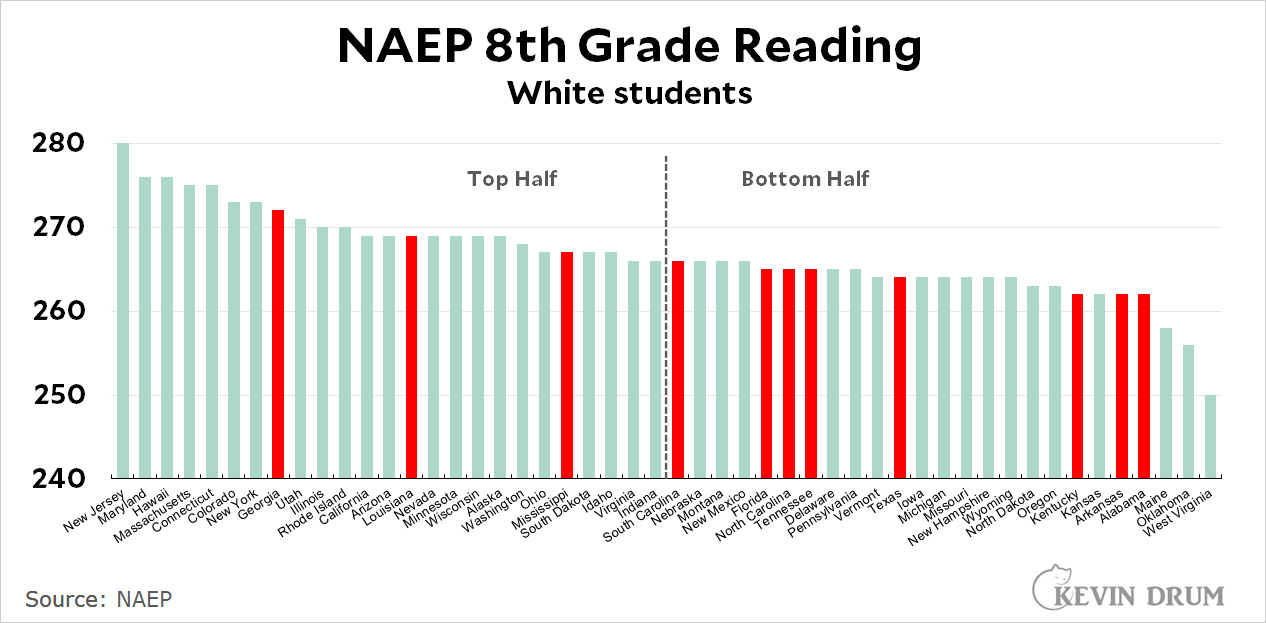
I would not assume this, given that the states with the highest literacy rates are mostly rural and at least half red (NH, MN, ND, VT, SD, NE).
Comment by rayiner 9 hours ago
Comment by apparent 6 hours ago
Comment by j_w 1 hour ago
"White students" is likely just the cleanest set of "almost certainly English native and parents are English native speakers."
Comment by theultdev 17 hours ago
Comment by dragonwriter 4 hours ago
Not true; in both red and blue states, its rural (usually relatively redder for the state) areas that have the highest illiteracy rates.
> Same with crime.
OTOH, with crime its true that higher population density areas (which also tend to be bluer) tend to have higher aggregate crime rates (though some important categories of crime, notably firearms homicides, reverse this.) But the fact that general crime rates do that has been recognized not merely longer than the current ideological divide between the US major parties, but longer than the existence of electoral democracy; the driving factor being density => opportunity => crime. Opportunity scales with dyadic interactions which scale asymptotically with n² (n=density). It's also worth noting that areas within states don't have the kind of Constitutional sovereignty against states that states do against the federal government; with no equivalent of the 10th Amendment protection that states have against federal encroachment. They don't generally have the power define serious crimes, or define punishment for serious crimes (they may have the power to define and punish infractions and misdemeanors), define correctional and rehabilitation policies that apply to serious offenders, etc. All those things are done at the state level. They also have very limited (because of state law) control of public health (mental and physical) policy, taxation levels and distribution, etc. So even if it was policy and not population density driving the difference in crime rates, the local areas aren't the ones in control of most of the potentially-relevant polices, the states are.
Comment by bdangubic 9 hours ago
Comment by mmooss 5 hours ago
But this is social science and we need to apply other cognitive skills, such as understanding empirical evidence, controls, and causal inference. Using those we could generate other hypotheses from factors more strongly correlated than the leading political party, such as funding, generations of systemic discrimination, government violence, or other causes.
Regarding political party, generally the better educated someone is, the more likely they are to be in the Blue party. The most highly educated institutions, including those of science, education, arts, etc., tend to be overwhelmingly Blue.
Comment by decremental 3 hours ago
Comment by ku-man 14 hours ago
Comment by aleph_minus_one 19 hours ago
> The curriculum in our public school regularly requires kids to read full books for class, and the kids you'd expect from the homes you'd expect read plenty.
Reading the expected books for school is very different from reading a lot privately at home.
I know quite many fellow pupils who read a lot privately, but detested reading the required books for school (they at best got some summaries somewhere, which in my opinion actually prepared you better for the tests since the people who write summaries typically know quite well which parts/topics of the books teachers consider to be important, and thus do quite some explanations on these).
On the other hand, I know fellow pupils who barely read anything in their free time (they had different interests), but for some reason actually liked (and liked reading) the books that you had to read for some classes.
Comment by 1718627440 1 hour ago
Comment by nomdep 10 hours ago
The only book I ever read for school was by accident. I was already deep into it on my own when the teacher assigned it to us
Comment by marbro 11 hours ago
Comment by idontwantthis 21 hours ago
Comment by smelendez 19 hours ago
I remember teachers assigning “read chapters 4-6 by Thursday” and then giving a quiz to make sure people read and remembered the details.
Comment by eudamoniac 19 hours ago
Comment by serf 14 hours ago
if we use grades as a yardstick for elementary progress and efficacy then you'd think it would be a bigger deal if a single cog in the system decided to systematically add inaccuracy to the measure simply because a failing student irks them.
Comment by eudamoniac 12 hours ago
Grades are a yardstick merely for which district gets more prestige and funding. There is absolutely no incentive for anyone with authority to fail bad students. Reprimands or terminations result from a teacher giving consistently below average grades.
Comment by mattkrause 17 hours ago
Comment by JumpCrisscross 16 hours ago
This sounds like a bad quiz, unless the story was set in e.g. the American revolution.
Comment by lelanthran 5 hours ago
Maybe things have really changed a lot since I was in school, but that was certainly not the type of questions that were asked of set works.
The questions were asked such that, the more the student got into the book, the higher the mark they were able to get.
Easy questions (everyone gets this correct if they read the book): Did his friends and family consider $protagonist to be miserly or generous.
Hard questions (only those slightly interested got these correct): Examine the tone of the conversation between $A and $B in $chapter, first from the PoV of $A and then from the PoV of $B. List the differences, if any, in the tone that $A intended his instructions to be received and the tone that $B actually understood it as.
Very hard questions (for those who got +90% on their English grades): In the story arc for $A it can be claimed that the author intended to mirror the arc for Cordelia from King Lear. Make an argument for or against this claim.
That last one is the real deal; answerable only by students who like to read and have read a lot - it involves having read similar characters from similar stories, then knowing about the role of Cordelia, and at least a basic analysis of her character/integrity, maybe having read more works by this same author (they'll know if the mirroring is accidental or intentional), etc.
We were never asked "what color shirt did $A wear to the outing" types of questions (unless, of course, that was integral to the plot - $A was a double-agent, and a red shirt meant one thing to his handler while a blue shirt meant something else).
Did I like the set works? Mostly not, but I had enough fiction under my belt in my final two years of high-school that I could sail through the very difficult questions, pulling in analogies and character arcs, tone, etc from a multitude of Shakespeare plays, social issue fictional books ("Cry, The Beloved Country", "To Kill a Man's Pride", "To Kill a Mockingbird", etc), thrillers (Frederick Forsythe, et al), SciFi (Frederick Pohl, Isaac Asimov, Philip K. Dick), Horror-ish (Stephen Kind, Dean R Koontz) and more.
With my teenager now, second-final year of high-school, I keep repeating the mantra of "To get high English marks, you need to demonstrate critical thinking, not usage of fancy words", but alas, he never reads anything that can be considered a book, so his marks never get anywhere near the 90% grade that I regularly averaged :-(
The only books he's ever read are those he's been forced to read in school.
Comment by mattkrause 4 hours ago
However, some of the teachers at my school also had short pop-quizzes meant to ensure that everyone kept up with the reading. These were usually just some details from the assigned chapters and, IMO, often veered into minutia. One really was about the color of something and I don’t remember it being particularly plot-relevant or symbolic, even if it was mentioned a few times.
It wasn’t a huge part of one’s grade, but I distinctly remember being frustrated that these quizzes effectively penalized me for “getting into” the book and reading ahead.
Comment by idontwantthis 17 hours ago
Comment by qball 14 hours ago
Comment by fzeroracer 21 hours ago
Comment by QuadmasterXLII 21 hours ago
Comment by spicyusername 13 hours ago
Comment by ruszki 13 hours ago
That doesn’t mean that kids really need to read any single of those books any time in history.
Comment by tyleo 1 day ago
It’s bizarre stuff to say. What would you have the education system do? Put iPads in front of kids all day?
Comment by lelanthran 4 hours ago
A clear majority of parents that I know actually would have the education system do that. Hence the oftentimes poor results.
A private school I looked at in 2025 required iPads (and nothing else) because their entire management of students was don by an iPad application (that worked on nothing but iPads).
The school admin/marketer/consultant/whatever I spoke to during the sales call literally did not understand what I meant when I said "If your management is so incompetent at decision-making that they got shangaied into buying into this deficient ecosystem when almost any other decision would have worked for both major mobile platforms, why on earth would I think that the other decisions they make would be any good".[1]
------------------------------
[1] Management who make obviously incompetent decisions like "Our study material only works on iPads" are obviously incompetent or otherwise disconnected from reality.
Comment by scoofy 1 day ago
We aren’t a nation of nerds, I doubt we ever were, but nerds really ought to create a support system for each other. I understand why people care so much about which school district they are in. It’s as much about a culture of curiosity as test scores.
Comment by rayiner 8 hours ago
Given the limits academia’s predictive power with respect to complex issues, I think it’s more important to select for and socialize pro-adaptive “gut feelings.” I went to the Iowa Caucuses back in 2019. These were democrats, but not highly educated ones. Mostly farm and farm adjacent people. But watching them ask questions and deliberate, there was a degree of level-headedness, practicality, prudence, skepticism, and caution that was just remarkable to watch. These are folks who don’t have much book learning but come from generations of people who managed to plan and organize their lives well enough to survive Iowa’s brutally harsh winters and short planting window (about 14 days—either side of that and you and your whole family die). You need smart people to do smart people things, but those conscientious normies are the backbone of a healthy society.
Comment by lelanthran 4 hours ago
Outliers.
You cannot come to conclusions based on examining outliers only. The better conclusion is from taking a sample of the population, and checking the correlation between test scores and success.
> Given the limits academia’s predictive power with respect to complex issues, I think it’s more important to select for and socialize pro-adaptive “gut feelings.”
There's plenty of studies that determine the correlation between academic performance and success. Have you possibly even considered that the basic "gut-feeling" only gets better (i.e. more predictive successes) with better academic scores?
IOW, the more you know, the more you learn, the better your heuristic is when making snap conclusions.
Comment by mmooss 5 hours ago
Comment by atmavatar 1 day ago
Even that is multi-dimensional. Another big problem we have in the US is that there are groups of people who don't want their children to learn certain things that most well-educated people take for granted.
For example, it's pretty common to this day for some school districts around the country to skip over teaching evolution. It's also common to misrepresent the causes behind the civil war and gloss over the genocide of native populations.
Others could probably come up with additional examples.
Comment by lelanthran 4 hours ago
Is this actually common? The argument is quite common, but I expected that the actual number of schools who do this is a very very tiny number.
Comment by rayiner 8 hours ago
In terms of being a citizen in America, it’s far more important to understand the English civil war, British history, etc. Those are the instruction manual for the actual society we have inherited. Even in my deep red state public school system, we spent way more time than was warranted on native Americans and other things that people feel guilty about. If you’re born in a multi-generational colony ship, you need to know how the CO2 scrubbers work. It doesn’t actually help you to know that some indigenous population was decimated by the mining of the uranium that power’s the ship’s reactors.
Comment by mmooss 4 hours ago
It does, because for people to survive and thrive, they need politics and institutions that don't kill them and that produce CO2 scrubbers. The politics and institutions turn out to be much harder than the scrubbers - few societies produce the latter, and it's generally the ones with much stronger human rights.
Comment by amanaplanacanal 20 hours ago
Comment by raincole 23 hours ago
The said education system expected this:
> As a high school student less than a decade ago, he was assigned many whole books and plays to read, among them, “The Immortal Life of Henrietta Lacks,” “The Crucible” and “Their Eyes Were Watching God.”
Yeah, sounds like a very great way to filter out perhaps 20% of good readers and make sure the rest 80% will hate reading for the rest of their lives.
Comment by cr125rider 1 day ago
Comment by jhanschoo 1 day ago
Edit: but insofar as media criticism in education is bound to the book rather than the dominant forms of the day, I think children are being done a disservice.
Comment by lm28469 23 hours ago
Books forge you in a way short "content" we consume all day long today will never be able to, there are a few long form podcasts here and there that could be comparable but that's not the bulk of the media kids "consume"
Comment by mfro 22 hours ago
Comment by barbazoo 21 hours ago
Comment by smueller1234 20 hours ago
Comment by barbazoo 10 hours ago
Comment by nobody9999 9 hours ago
I don't pretend to speak for anyone else, but I am more than my economic inputs and outputs, and while it was in a somewhat different context, Heinlein's prose applies in spades WRT your assertion:
“I had to perform an act of faith. I had to prove to myself that I was a man. Not just a producing-consuming economic animal…but a man.” ― Robert A. Heinlein[0][1]
[0] https://www.goodreads.com/quotes/11588525-i-had-to-perform-a...
[1] From Starship Troopers[2]
Comment by onraglanroad 19 hours ago
Comment by pandaman 18 hours ago
Comment by bmitc 20 hours ago
Comment by haizhung 20 hours ago
* Die Vorstadtkrokodile
* Faust I
* Die verlorene Ehre der Katharina Blum
* Antigone
* Die Verwandlung
* Bahnwärter Thiel
* Der Sandmann
* Die Räuber
* Hamlet
* Der Besuch der alten Dame
* Im Westen nichts Neues
* Unterm Rad
* Woyzeck
Im probably missing 5 books or something like that. Many of these books have had a profound impact on my views on the world, more than I would have guessed at the time.
Comment by sureglymop 14 hours ago
Comment by renehsz 8 hours ago
Comment by mmooss 4 hours ago
Comment by apparent 18 hours ago
Not surprisingly, when you're rate-limited by read-aloud speed, you can't get through that many books and excerpts are a natural response.
Comment by techjamie 17 hours ago
I saw some stuff about literacy dropping because they went from teaching to sound out words, to, as I understand it, basically just showing the word and teaching how it's said, hoping kids would naturally pick up the rules. This did not have good outcomes, and last I checked, there was a movement of schools going back to phonics.
Comment by lelanthran 4 hours ago
I've read a lot on this; it's "phonetics" vs "look-see".
For a really depressing read, read "Why Johnny can't read", then the sequel "Why Johnny still can't read", and then look at the dates of those two essays.
We already knew decades ago that some methods never worked in the past, and don't work now, but we still hope that they will work in the future, so we keep them around because there are powerful and mostly invisible (to the parents) interests in keeping these discredited methods around.
Comment by mmooss 4 hours ago
Comment by stevewodil 1 day ago
I’ve started to have a positive association with reading only in the last few years, I wish schools didn’t force books onto children and make them think they hate reading for their whole lives.
Comment by anon7000 1 day ago
Comment by brightball 1 day ago
Never enjoyed the stuff that got assigned in school though. I’d probably like it now.
Comment by wkat4242 10 hours ago
However their books were dusty, tough, whiny and horrible to get through. Yuck. I never read fiction in my own language ever again just in spite.
Comment by Natsu 1 day ago
I read because I wanted to all the time, but every reading assignment was a chore.
Comment by watwut 23 hours ago
It is that books everyone here is said that kids dont read anymore or brags they read ... are just not interesting books for a kid.
Comment by RajT88 20 hours ago
Comment by amanaplanacanal 20 hours ago
I have been amazed at the number of houses I've been in over the years which didn't appear to contain a single book.
Comment by saltcured 15 hours ago
Pride and Prejudice. Last of the Mohicans. A Separate Peace. Tom Jones. Beowulf. Grendel. Crime and Punishment. Waiting for Godot. Tale of Two Cities.
Also, several Shakespeare plays, though I am no longer sure which were read when.
We also had other reading assignments where we chose our own books. The above were assigned to everyone.
Comment by threethirtytwo 19 hours ago
Now with the internet there’s an unlimited stream of zero investment snippets of entertainment. People naturally dive into that because it’s more rational in the short term to do that.
Schools stopped reading but it’s as a result of the way students behave. The causal driver is student behavior.
Comment by expedition32 15 hours ago
Comment by idle_zealot 1 day ago
The problem is that if you don't force them, they never actually become literate enough to discover that reading is fun later in life.
Comment by BeFlatXIII 21 hours ago
Comment by Ekaros 20 hours ago
Comment by Telaneo 18 hours ago
If 'why are the curtains blue' were consistently explained together with Chekhov's gun, then maybe we wouldn't be here having this discussion.
Comment by UncleMeat 14 hours ago
Being able to perform critical analysis of text is an essential skill today. It might be more essential now than any other moment in history. Understanding how narrative writing uses symbols translates cleanly into understanding how political messaging or any persuasive writing uses symbols.
Comment by TitaRusell 21 hours ago
I can read a 1000 page history book but after 50 pages of Dutch literature I want to throw it in the garbage bin. High school KILLS reading. Few survive.
Comment by DaSHacka 1 day ago
Comment by aaplok 1 day ago
Comment by lotsofpulp 23 hours ago
Or even figuring out if it was created with the intent to have any utility at all for the reader.
Other than avoiding any written works made after 2020, I am not sure what to tell my kids. Even trusting the claim that something was written after 2020 seems difficult, unless you have a physical print showing its age.
Comment by Telaneo 1 day ago
It's a tough position to be in, although I'd imagine it could be remedied by having the kids pick whatever book they want. So they can read whatever they want, but they do have to actually read it. Form a learning/teaching point of view, this is probably ideal, but I'd imagine it's not really possible from a logistical point of view, since the teacher would likely have to familiarise themselves with as many books as they have pupils, which isn't viable unless the class is fairly small.
Comment by amanaplanacanal 19 hours ago
From what I understand, if parents read to kids when they are little, they become readers who enjoy it.
Comment by 1718627440 48 minutes ago
Yes. (n=1)
Comment by Telaneo 19 hours ago
I nearly did to me, or atleast the continual assignments did. It took a long time for me to pick up a fiction book again. School never assigned me technical writing and encyclopedias, so I continued to enjoy those, thankfully.
Comment by bgbntty2 1 day ago
Maybe if I wasn't forced to read a book in an outdated language about some Christian farmer 300 years ago while I was not in school, and if I could access a succinct version 1/10th of the length of the book, I'd read it.
Maybe if I wasn't asked to describe minor details to prove I read the book, I'd actually focus on the story and not on every irrelevant detail.
Maybe if my teacher didn't force their religious holier-than-thou attitude and allowed us to form our own opinions, I'd be more engaged.
What school taught me was how to get away with not reading the books. I skimmed books by skipping tens of pages at a time or asked friends for the TL;DR or just got an F.
Now I have a feeling of uneasiness and dread when I try to read fiction for fun. So I don't.
Most 300 page fiction books I had to read could've easily been condensed to 30 pages without any loss of information.
Being forced to read and memorize poetry was the absolute shit. A lot of people won't care about poetry no matter how hard you try to force them to like it. And half of it was propaganda - how $nation survived $struggle, how $nation is so great or beautiful or how $hero did $ethical_thing.
Comment by saltcured 14 hours ago
I imagine it would be interesting to read early texts in other proto languages too. Sadly, I'm not a polyglot and can't really access that experience first-hand.
Comment by rawgabbit 14 hours ago
Comment by ThrowMeAway1618 8 hours ago
So you've encountered Sturgeon's Law[0] in the wild. It applies to pretty much everything, so perhaps you might broaden your focus when considering that.
Were you aware that this is actually a thing?
Comment by floren 1 day ago
no cap Mr Darcy ur parties are bussin fr fr
Comment by bgbntty2 1 day ago
Comment by opello 1 day ago
Is the complaint about the dictionary at the end because it wasn't comprehensive? I'm unreasonably curious about the book and which phrases were included and which were not.
I think all written works occur in a context that should be taken into account when thinking critically about them. That context is temporal and linguistic and is more apparent when you consider something like Beowulf in Old English or The Canterbury Tales in Middle English. Understanding it requires either a modern reinterpretation or consideration given to the sociolinguistic context in which it was written.
[1] https://www.goodreads.com/list/show/180823.Novels_with_Gloss...
Comment by dooglius 19 hours ago
Comment by opello 18 hours ago
I think there's a trivial answer which is that all things you encounter are fundamentally from an alien context. The degree of alien and intention of the action are the things to consider before proceeding.
For example, why would one choose to read the account of a survivor of tragedy? To develop some amount of (emotional or cognitive) empathy? To learn a broader way of thinking that could apply to a future situation? Most simply: to learn from the past.
If the goal is entertainment, evaluate your participation such that you maximize your utility. If the goal is learning, one should be wary of premature rejection without sufficient context to avoid missing the lesson. And there is an annoying reality in which most situations can teach something.
Comment by dooglius 9 hours ago
Comment by floren 19 hours ago
Are you people for real?
Comment by lm28469 23 hours ago
Meanwhile my grandma still knew how to speak Latin at 70+, which she learned in school as a teenager
Comment by watwut 23 hours ago
If they read 10 interesting books a year adding one like that to the mix or offer them the option is great. If they did not encountered interesting bool after agw of 7 when parents stopped reading them, no.
And interesting books for kids are there. Plenty of them of all kind, including pure action/adventure stuff. Including those related to movies or games they play. It is not lack of resources.
Comment by 1718627440 44 minutes ago
But that is not what is happening. Introduction to reading happens pre-school to class two, historic books come from say class 6 onwards.
Comment by miningape 1 day ago
Comment by ThrowMeAway1618 8 hours ago
Good job!
Do you smash your windows when it's cloudy outside too?
You're blaming others for your lack of interest and failings.
I'm glad I don't know you.
Comment by TitaRusell 21 hours ago
Opera? Ballet? Literature? Poetry? Classical music? Modern art?
Do the numbers it seems most people can do without them and still be functional.
Comment by floren 20 hours ago
Comment by threethirtytwo 19 hours ago
Comment by lelanthran 4 hours ago
That's the thing, though - in English literature class, there is nothing stopping the teacher from using popular media to introduce things like tone, ambiance, character motivations, arcs, etc, and then ask for parallels to the set works.
They don't do it though, the system is not set up to produce a bunch of critical thinkers from English Lit.
Comment by bgbntty2 10 hours ago
But art is also:
* electronic music (if you're not aware, it's not just repetitive dum-dum-dum for 8 minutes, although I enjoy that style, as well);
* rap (it's not just guns, drugs and mysoginy);
* all the other music genres, of course, but I gave electronic music and rap as examples because they're usually treated badly by people who're not familiar with them;
* games (I've been emotionally moved by many flash games, let alone new immersive games);
* movies, series - live action or western animation or anime.
Yet, in school we either learned about classical composers, or about regional composers. Only once, around 10th grade, we had a cool music teacher who played other genres for us - Fat Boy Slim, random metal groups, even a few pretty out-there experimental things. Much better than learning about some composer who lived 50 years ago just because he is from the same country as you.
Same for paintings and similar art. What good does it do a 7th grader to look at Picasso? The context matters, but for people who don't care about such art, it's useless. I won't feel better if I can "intelligently" discuss the art scene in $nation in $year. I have, later in life, read interesting articles that actually mix politics and life in general with the art that was "allowed" to flourish. Like art in Soviet Russia. But that context, if it was given at all, didn't mean anything to a 7th grader, especially if they didn't learn about Soviet Russia in history before the art class. In my experience my education was all over the place.
Comment by threethirtytwo 5 hours ago
Comment by eimrine 1 day ago
Yes and no. I used to start reading at 4 years old, but I forcedly used to memorize some rhymes at 3 years old. Most folk don't believe it is possible to read so early (though Eliezer Yudkowsky has reported about similar age). But my point is - how would I learn reading so early without that poetry?
I don't really like poetry exactly as rest of the fiction genre. And I am still sure it is not shit even for those who are struggling of doing that. I consider poetry exercises as sport exercises: today you claim that some specific muscle is not important for you, but tomorrow you get some injury which happened because of some weak muscle.
But you have also said one important word - propaganda. This is what really shitting any education and propaganda seems like the monster from the Nitzsche's quote "Whoever fights monsters should see to it that in the process he does not become a monster".
Comment by 1718627440 41 minutes ago
Comment by Throaway198712 17 hours ago
Comment by eudamoniac 17 hours ago
Comment by BeFlatXIII 21 hours ago
Comment by bgbntty2 10 hours ago
I've read a couple of scripts for movies and TV, and they're, by far, much better than fiction books for me. Just more condensed, more to-the-point.
That's not to say that I admit I can't finish (or even start) a fiction book now. They're ruined for me. But I don't care.
Comment by Telaneo 18 hours ago
Comment by Throaway198712 16 hours ago
Comment by prennert 3 hours ago
Even in the 90s most people got book summaries to get through the curriculums. I would say, the highest performing language students and teachers pets at school did exactly that.
School unfortunately is largely about reciting of the teachers knowledge, so there is no need to read the source and think for yourself.
Comment by Kim_Bruning 23 hours ago
It doesn't need to be in dead tree format. It doesn't need to be famous authors. Just so long as they read!
For long form original see eg:
* The last angel https://forums.spacebattles.com/threads/the-last-angel.24420...
* The wandering inn https://wanderinginn.com/2017/03/03/rw1-00/
* Or eg https://en.wikipedia.org/wiki/The_Martian_(Weir_novel) which made its way off the net and into print, possibly to the detriment of both. :-P Original location (afaict) (no longer available there) : https://www.galactanet.com/writing.html
Comment by ThrowawayR2 20 hours ago
Ye gods, that's like saying that youth may not be willing to consume a nutritious, balanced diet but we should rejoice that they are at least consuming vast quantities of sugar and fat. With vanishingly rare exceptions, fanfic is crap in textual form, laden to bursting with literary sins both venal and mortal.
Comment by Aerroon 17 hours ago
Comment by badwriter101 15 hours ago
- that nudges readers in interesting (to society) or new (to the reader) directions. Or at least in not in actively harmful ways. Otherwise, OF, livestreaming, or whatever latest social media BS, etc. are king: purposefully designed to create parasocial relationships that trick you thinking you have chance to be noticed.
My main beef with most fan fiction is that in my experience, it unconsciously locks readers into an extremely rigid way of thinking. Of course, this varies from fandom to fandom but woe upon the budding writer who ships the wrong pair or violates the canon.
It mirrors religious dogma, but somehow even worse when compared to all the disputes in Christianity throughout the centuries. (Plus, there's at least a connection between Christianity to modern democracy.)
Comment by eudamoniac 17 hours ago
Comment by corimaith 23 hours ago
It's good that you can get people reading, but reading the equivalent of pulp is very different from real novel that isn't so bounded by tropes or genre limits.
Comment by Kim_Bruning 23 hours ago
--Sturgeon's law.
(ps. and once you get people reading, they tend to keep doing it and develop taste over time. if it's even just a few who wouldn't have done it before. That's good, right?)
(pps. For example: at 2M words, I think pirateaba might exceed the "first 1M words are practice" threshold)
Comment by Kim_Bruning 23 hours ago
HPMOR is written by Eliezer Yudkowsky to promote rationalist concepts, and is somewhat influential in startup and AI circles.
Directly: Emmet Shear {co-founder of Twitch (YC S07)} is apparently superfan and gets a cameo.
So for once I get to post something that's almost on-topic for yc. :-P
[2] https://techcrunch.com/2023/11/21/what-does-a-harry-potter-f...
Comment by onraglanroad 19 hours ago
If you find out, let me know. I wish I could.
I've never read such self absorbed drivel in my life. To be fair, I've not read any Ayn Rand, so I might be judging harshly.
Comment by beepbooptheory 22 hours ago
https://www.thecut.com/article/milo-youngblut-max-snyder-ziv...
Even without the, you know, murder stuff, I think we can do better for kids than another generation of "rationalists", considering the track record here.
Comment by squigz 23 hours ago
Most people, for most of history, have only ever enjoyed what might be considered "low quality" entertainment - pulp fiction, shitty plays, etc.
> real novel that isn't so bounded by tropes or genre limits.
Interestingly, even discounting YA and other stuff like that, you are only describing a very small subset of novels.
Comment by TitaRusell 21 hours ago
Nobody considered those high literature back in the day!
Comment by ThrowawayR2 20 hours ago
Comment by squigz 18 hours ago
Comment by ThrowawayR2 16 hours ago
Comment by SubmarineClub 21 hours ago
I do? Why would I want my kids to be consuming crap when they could be engaging with great works and high art?
Comment by pavel_lishin 19 hours ago
Comment by Aerroon 17 hours ago
Comment by squigz 18 hours ago
Comment by Telaneo 19 hours ago
They can read Minecraft strategy guides and Yahoo auction fan fics for all I care, since that's a lot better than nothing. I remember not wanting to read what school assigned me and how that killed my desire to read most fiction writing, and would prefer that not happen to more kids.
Art is a matter of taste, and if you go counter to your audience's taste, don't be surprised if they disengage.
Comment by impossiblefork 21 hours ago
Thus it can tend to become limiting; and I say this as someone who actually does enjoy fanfiction.
Comment by delichon 21 hours ago
So the Lord of the Rings series counts as one book? I'd believe diminishing returns, but not one and done.
Also, I thought that Yudkowsky's HPMOR fanfic had more interesting ideas than the whole Rowling series, which I like a lot.
Comment by impossiblefork 19 hours ago
Then you do not understand writing. If Yudkowski really had more interesting ideas, then he would have been able to do HPMOR as original fiction.
Rowling is actually really good, inventing very charming things, very fun sentences, and there's nothing even close in HPMOR (I have read it myself, and enjoyed it to some degree), but you really underestimate how good Rowling is.
Comment by Amezarak 20 hours ago
Comment by BigGreenJorts 19 hours ago
Comment by tayo42 20 hours ago
Comment by fgh_azer 23 hours ago
- an entire novel worth of short texts, beginning to end
- an entire novel worth of short excerpts from longer texts
- an entire novel, beginning to end
are the same things.
Comment by Kim_Bruning 23 hours ago
* Last angel: A web serial, sure it's chunked into chapters/updates, but paper novels have chapters too.
* The Wandering inn, same as above, it's at 2 million+ words and counting. People read it.
* The Martian: Actually the shortest text of the bunch. Now available as a traditional paper novel.
Comment by fgh_azer 19 hours ago
Is it? I am not sure either way. Do you lose something by only reading chapters of a novel but never the whole story from the beginning to the end, even if you're still reading the same amount?
Comment by 2OEH8eoCRo0 19 hours ago
Comment by adfm 1 day ago
Comment by brightball 1 day ago
There’s a program called Arrowsmith that has a summer program called the Cognitive Intensive Program. It’s basically 3-4 hours a day of speed reading analog clock for 7 weeks. You start out at 2 handed and work up to 8 handed.
Changed my son’s life. He was a completely different student afterwards, for the better.
Comment by 1718627440 39 minutes ago
Interesting, for me it is the opposite. With a digital clock I need to do a division/comparison to know how much part of the day/hour has already passed. With an analog clock I can read a proportion directly.
Comment by msteffen 1 day ago
Comment by komali2 16 hours ago
Comment by jasonwatkinspdx 1 day ago
Needless to say this trips my crank/cult smell meter.
Comment by brightball 1 day ago
I found out about it from one of my neighbors who has two children with dysgraphia who did the full time program for 3 years each. He tells everybody about it.
I toured that location when my son was going into 3rd grade and we ended up sending doing just the summer program after 7th grade. What I saw on the tour would have helped me when I was a kid and my sons brain seems to work just like mine.
Comment by jasonwatkinspdx 1 day ago
Comment by brightball 21 hours ago
It's hard to explain to random people on the internet but here's the difference we saw.
- Went from doing homework everyday after school until 10pm to always being done by 6pm at the latest.
- Went from forgetting to turn in that same homework and sometimes major assignments frequently to rarely. 7th grade year he had over 20 zero's for assignments that he did and simply kept forgetting to turn in. 8th grade year he forgot two homeworks all year.
- Went from years of extreme disorganization to...still disorganized but a significant improvement.
- Went from uncertainty about whether he was going to be able to keep up with the workload in high school to, for lack of a better way of saying it, a star student. Teacher reports changed. GPA is a 3.7 (he's in 11th grade now). Juggling seasonal sports, Scouts, school, clubs, social life, honors/AP classes with no assistance from us at all.
It's hard for people to understand when you watch the same patterns and struggles for 6 or 7 years and then they just stop being a struggle. That 7th grade year, all that my wife and I did after we got home from work was try to make sure he would get his work done. It consumed our life to the point that, after me trying to convince my wife that this could help (because she was very skeptical too) that it was bad enough that she finally agreed it was worth a shot.
He and I were actually going to fly across the country to stay in Seattle for 7 weeks to have him do the program in person because I didn't think he would be able to pay attention to the virtual. The hotel that we had booked a couple of blocks from the school cancelled our reservation due to renovations and we ended up pivoting to the virtual program at the last minute. He did surprisingly well in the remote class format. The hotel was also close to Microsoft's campus and I got the impression that Microsoft had paid them to renovate to prepare for a lot of people they were going to have in town.
Comment by komali2 17 hours ago
But sorry to clarify I'm still hung up on the "8 handed clock" thing - what does that mean? What information is displayed on the clocks other than hours, minutes, and seconds?
Comment by brightball 11 hours ago
Even with the 6 handed I don’t remember exactly what each was though. I asked Grok and this is what it said.
> In the Arrowsmith Program’s Cognitive Intensive Program (CIP), the primary exercise is the Symbol Relations exercise, commonly known as “Clocks.” This involves reading analog clock faces that progress from 2 hands to up to 8 (or sometimes more) hands. Each hand on the clock represents a separate time (an independent position pointing to a specific hour/minute on the clock face). Participants must interpret the positions of all hands simultaneously, understand the relationships between them (e.g., angles, relative positions, and sequences), and record the times accurately under time pressure. The multiple hands do not represent different concepts symbolically (like hours, minutes, seconds); instead, they increase cognitive load to train the brain’s ability to process and relate multiple pieces of information at once. This strengthens the Symbol Relations cognitive function, which supports logical reasoning, comprehension, seeing connections between ideas, cause-and-effect understanding, and abstract thinking. Progression adds more hands as mastery is achieved, making the task more complex to build capacity in handling interrelated symbols and concepts. The CIP focuses intensively on this exercise to accelerate improvements in reasoning, processing speed, and related skills.
Comment by komali2 1 day ago
Comment by thrwaway55 1 day ago
Comment by komali2 1 day ago
Comment by optionalsquid 1 day ago
Comment by CGamesPlay 1 day ago
Comment by refibrillator 1 day ago
Comment by Telaneo 1 day ago
Comment by inimino 23 hours ago
What? They are the same thing.
Comment by Telaneo 21 hours ago
I'm the wrong person to ask this about, since I prefer digital time, so time is just a number to me. But Technology Connections made a video atleast talking about it,[1] so hopefully that get part of the point across. To him and plenty of other analogue-first people, time is a progress bar, or a chart, or something along those lines, and that's the natural way to perceive time, and converting it to a number is meaningless beyond expressing it as digital time.
Comment by wkat4242 10 hours ago
The only reason we have analog clocks is because digital ones were much harder to build. That time is of course over for good. It was a compromise imposed by limited technology.
Comment by 1718627440 36 minutes ago
Comment by kevmo314 1 day ago
Comment by brightball 1 day ago
Comment by lucyjojo 1 day ago
Comment by thrwaway55 1 day ago
If you care about handwritten your receiver cares they got your letter at all not that it's cursive or not.
Cursive is an outdated skill for when it was the fastest way to get words written to paper.
Comment by 1718627440 27 minutes ago
Comment by jasonwatkinspdx 1 day ago
There was a class signifier aspect to it as well. Poor kids couldn't spend as much time practicing and perfecting penmanship. In a world where much got done through handwritten personal letters, good penmanship would make an impression similar to having properly tailored formal attire vs a tattered coat.
My grandma went to public school but grew up in an era where that sort of thinking was widespread, so she got extra tutoring. She learned to write freehand with a ruler flat baseline and machine like consistency in each letter. You could recognize a card or mail from her instantly just by the addressing on the envelope.
I wasn't taught that strictly but I did spend years of elementary school with those Red Chief notebooks copying letters page after page much to the frustration of my young ADHD brain.
I doubt I could properly write cursive today. I barely ever hand write notes anymore, so there's no real point.
Comment by shoobiedoo 1 day ago
Comment by BeFlatXIII 21 hours ago
Comment by thrwaway55 1 day ago
Comment by squigz 21 hours ago
More than that, I would be curious to see research that controls for proficiency at writing/typing. My theory is that if more kids were taught to properly touch type from an early age, the alleged differences between writing/typing would be far less dramatic. I was taught since kindergarten and there's no doubt in my mind that I absorb and understand information better through typing than writing. I'm also much, much, much faster. Brief Googling suggests I'm at least 10x faster than the average WPM for handwriting
Instead, here we are talking about how cursive should actually still be taught.
Comment by shoobiedoo 6 hours ago
Longcamp et al. (2005) – PubMed or Elsevier (Acta Psychologica)
Smoker et al. (2009) – Human Factors and Ergonomics Society proceedings
Umejima et al. (2021) – Frontiers in Behavioral Neuroscience (open access)
Ito et al. (2020) – HCII conference proceedings (Springer CCIS)
Comment by Natsu 1 day ago
Anyone using paper + pen? Writing a letter or thank you note?
You know, stuff only people who grew up before the internet was popular still do.
Comment by Telaneo 1 day ago
I'll write in (not great) cursive for myself, but for other people? Writing in block or print is basically an accessibility feature. Even if my cursive was perfect, plenty of people would not be able to read it.
Comment by Natsu 19 hours ago
Comment by gambiting 1 day ago
I'm confused. How do you write if not in cursive? Do you just write in block capitals? With each letter on its own? Do you just not hand write anymore?
>>Cursive is an outdated skill for when it was the fastest way to get words written to paper.
But....It still is? Without using some kind of machine of course.
Comment by cogman10 1 day ago
Block capitals? no. It's print. With upper and lowercase letters.
I rarely handwrite now. The last time I really did was in college.
> But....It still is? Without using some kind of machine of course.
But of course this is HN where most people are technical. We all have some sort of machine at our disposal otherwise we'd not be writing back and forth to one another.
Comment by gambiting 1 day ago
So like.......not linking the letters together then? Doesn't that just actually take more effort than just writing cursive? And is slower?
>>But of course this is HN where most people are technical.
For sure, and as a professional programmer I keep a notebook with hand written notes - the fact that I have a keyboard and multiple monitors in front of me doesn't change the fact that hand writing is still the best(for me) way to save and recall information.
Comment by cogman10 1 day ago
Correct.
> Doesn't that just actually take more effort than just writing cursive? And is slower?
Probably yes to both counts.
However, when I'm handwriting I'm generally not in a position where speed or effort is the most important thing. To me, it's not much more effort to print and I get the added bonus of legibility. When I write cursive, it can be hard for me to understand what I wrote when I come back to it. I'm just a little too sloppy. It would take effort for me to get to the point where my cursive is neat and I frankly just don't handwrite enough to warrant that effort.
Consider this, do you use shorthand? I'd assume not. But why not? It's the fastest way to write anything. Cursive, by comparison, is both a lot of effort to write, is slower, and it wastes space.
I'd say for (some of) the same reasons you likely don't write shorthand, I don't write in cursive.
Comment by 1718627440 25 minutes ago
The thing that needs effort is learning to write, why did you waste time on learning to not connect your letters?
Comment by gambiting 1 day ago
I have no idea how to write shorthand. I assume you know how to write cursive, so no I don't think the reasons are the same.
Comment by cogman10 22 hours ago
I can't write legible cursive. To do that would take time, effort, and practice. Much like it'd take that to learn shorthand.
That's my point. You and I write the way we do because writing in other ways would take more effort than we want to spend.
Comment by gambiting 21 hours ago
Comment by cogman10 20 hours ago
Because of this conversation I've been reading up on it. There are multiple systems, but for English they all pretty much revolve around representing words phonetically. One form (Pittman) uses different line widths for different sounds, making it work best with a pencil or fountain pen. Gregg doesn't do that. Gregg is most common in the US and Pittman is common in the UK.
Comment by BeFlatXIII 21 hours ago
Comment by kevinsync 1 day ago
There are a million ways to articulate a glyph, from thick to thin, clear to murky, big, small, harsh, soft, whatever. Some people still use typewriters or typeset a printing press. Others use spray paint or marker.
End of the day for me it's just about communication and expression and aesthetic and clarity (or sometimes intentional LACK of visual clarity in honor of a style), not technique or medium. I dunno.
I do think every bozo should be able to pick up a pen and make his mark, and I think humans should practice the art of crafting a sentence and turning a phrase, but I really don't focus on the how, and more on the what, the message.
Even the Zodiac Killer had a unique and bizarre style with his handwriting and cipher LOL can you imagine if it was just bog-standard 5th grade cursive?
Comment by Zak 1 day ago
Of course to be pedantic, modern pens are machines too.
Comment by gambiting 1 day ago
Is this like....a personal feeling? Or something with actual data behind it? But even if so - why does it matter? If you write short notes, do you not write them in cursive?
>>Of course to be pedantic, modern pens are machines too.
That's beyond pedantic, I struggle to imagine that anyone other than the a professional linguist would call a ball pen a machine.
Comment by Zak 1 day ago
It does make sense to hand write short notes in cursive if you're hand writing short notes at all, but many people never learned it, or are so rusty it would take deliberate practice to restore proficiency.
Comment by esafak 1 day ago
Comment by gambiting 1 day ago
And again, that doesn't really answer my question - if you don't write in cursive, how do you write?
Comment by esafak 1 day ago
Comment by doubled112 1 day ago
On a white board or diagram, block letters seem like the most legible choice.
Everything else is typed.
Comment by thrwaway55 1 day ago
Comment by watwut 22 hours ago
I write with mix of cursive and sorta print letters. The sorta print letters are more readable, actually.
Based on what teachers said, kids use cursive while they are forced to and switch to sorta print when they can. But everyone invents their own "font", so it is a challenge to decipher them.
Comment by komali2 1 day ago
Comment by macintux 1 day ago
I basically had to teach myself all over again. Not much fun.
Comment by ls612 1 day ago
Comment by amitav1 18 hours ago
Comment by 1718627440 21 minutes ago
I maybe give you the stars, but all the others demand a "Citation needed".
Comment by squigz 23 hours ago
Comment by bigyabai 1 day ago
Comment by tssva 23 hours ago
Comment by lm28469 23 hours ago
Comment by chung8123 8 hours ago
Comment by sixtram 17 hours ago
My six year old (who is still in kindergarten) reads about 70–100 pages per week of books aimed at eight to nine year olds.
Comment by tomcam 1 day ago
Comment by eimrine 1 day ago
Comment by tomcam 13 hours ago
Comment by epolanski 1 day ago
Comment by eimrine 21 hours ago
Comment by bitcurious 3 hours ago
If anything, reading has made me recognize the cultural and historic universality of the problems folks attribute to capitalism.
Comment by eimrine 2 hours ago
Comment by 1718627440 19 minutes ago
I for one think people still thinking socialism is a good thing, haven't read enough history books about the 20th century.
Comment by epolanski 18 hours ago
Comment by koinedad 18 hours ago
Comment by credit_guy 12 hours ago
In the latest "War on the rocks" podcast [1], Ryan Evans asked his guest, Swedish Defense Minister Pål Jonson, what books he has read lately (he often, maybe always, asks that question). The guest answered basically that, as a politician, he does not have time to read books anymore, because he is very busy with other things.
I think most listeners of the podcast are absolutely ok with this. Pål Jonson is an important guy, who has a job to do. That job is to keep Sweden safe, and, as Sweden is now part of NATO, by extension to keep NATO safe as well. If he does his job well, then Sweden and NATO together might be able to deter aggression by Russia. If taking time to read books means he has less time to do his job well, then he should not read books.
But if you replace Pål Jonson with somebody else, who are we to say that their job is less important? And if we take a kid, the way the kid understands their jobs is that they need to get ready for life,for their actual, paid, job when the time will come. And if in doing that, they are more efficient by using ChatGPT, then why should they read entire books?
[1] https://warontherocks.com/2025/12/getting-faster-stronger-re...
Comment by phil21 10 hours ago
We have systematically removed any chance for “unproductive” downtime for any high performers if they want to continue to be seen as a high performer.
Not surprising in the least to me, and society as a whole is worse off because of it. Good luck when this person needs to make a hugely impactful and thoughtful decision for society while in their position of power.
Comment by j7ake 11 hours ago
I bet important people don’t even have time to sit and watch a full movie.
Comment by mmooss 4 hours ago
Comment by physicsguy 14 hours ago
I remember doing sections of Romeo and Juliet and Macbeth but we never did the whole thing. We did read Of Mice and Men and An Inspector Calls but that was it for books/plays. Poetry we had a book called Anthology where we had to read and re-read many poems for analysis.
Comment by rawgabbit 14 hours ago
https://internetshakespeare.uvic.ca/Library/SLT/literature/l...
Comment by quasigod 17 hours ago
I think the biggest offender is summer reading assignments. I never knew a single person that actually read their book, and being expected to spend time during break reading for a school assignment definitely creates a negative association.
I loved reading as a child, up until high school. Once I graduated, it took years before I enjoyed it again.
Comment by Aerroon 17 hours ago
Required reading in school killed my interest in reading. When I graduated I was very happy that I wouldn't have to read books ever again.
It took me about 5 years or so until anime and manga got me to try another fiction book. That eventually led to reading more books. But when school was done I really did think that I wasn't going to touch a (fiction) book again.
---
It makes me wonder if kids in the future will have "required reading" where they have to play certain old video games. Will that make them hate video games?
Comment by dybber 16 hours ago
The idea is to get them find genres and books they like and find joy reading it, while not taking time out of their free time.
Comment by Aerroon 14 hours ago
It is a good idea though, as long as they can find things they want to read. I've been sucked into the "bleeding edge" of reading (web novels), so it can be a bit more challenging to find things I really want to read. They are still out there though. Eg The Martian and Project Hail Mary (the former actually started as a web novel) .
Comment by trueismywork 17 hours ago
Comment by functionmouse 1 day ago
Comment by gscott 1 day ago
Comment by BigParm 4 hours ago
Comment by kccoder 4 hours ago
Comment by charles_f 16 hours ago
I don't know how they sourced respondents, anecdotally all my kids a reading books as I type that. They read much more than I did at their age; and their friends read as well. They'd probably spend all their time on snapshat or brawlstars, were they to have a say.
Isn't that the characteristic of each generation to feel like education of the next generation is decadent?
Comment by isatis 1 day ago
Comment by amanaplanacanal 19 hours ago
Comment by oxag3n 1 day ago
Comment by inemesitaffia 1 day ago
Even the "troublesome" ones.
Comment by frompdx 1 day ago
At the end of the day the AP exams didn't test you on your knowledge of The Scarlet Letter or The Great Gatsby. The exam tested you on your ability to read an excerpt and answer questions about it as well as your ability to write a multi-paragraph essay from a prompt while a proctor wearing the most hideous smelling blackberry perfume bathed you in an olfactory assault every time they walked by. In-classroom writing assignments were the most effective way to prepare and we did them frequently. As a reward for doing well you got to skip a couple of 100 level English credits in college.
Sure there are lots of brainrot distractions available to kids today, but it feels like the education system never takes a moment to look inward and acknowledge that The Scarlet Letter and My Antonia are dreadfully boring reads. It took me three tries to finish 1984 because the beginning is such a slog. It is strange to say kids aren't interested in reading (from the article) when a lot of the subject matter is objectively dull. Four of the six books in the article header are books I don't even want to think about let alone read.
Comment by eimrine 1 day ago
Take apart the distractions per se, how is it possible to read book for a kid in 2025 at all? Reading thick books requires having some device with no distructions. In my young ages all computers and all smartphones used to have no distructions, but now all computers (except some Linux distros) used to be bombarded with distructions in such a way that I can not read a book on any proprietary OS without getting some notification about anti-virus software or some updates or a need to restart, or just some events happening on the Internets.
My point is not just that distractions distract people, but distructions have become inevitable on almost any modern device able to render PDF with formulas.
Comment by squigz 22 hours ago
Literally buy books? What about ereaders? Install adblockers and de-shittify your OS? I don't have the problems you seem to have, and I'm on Windows.
Comment by eimrine 20 hours ago
Ereaders can not render PDF/DJVU with formulas. My reading list has nothing able to be read from that kind of devices.
Installing some more proprietary code will not lead to "deshittifying" some existing proprietary code. You just add 1 guy more of your dependances. You even can not do this once for whole life of the device. So many time perfect for reading goes inte nowhere with Woedows OS.
Comment by 1718627440 14 minutes ago
Install Windows Enterprise IoT LTSC then, problem solved.
Comment by amitav1 18 hours ago
Comment by Cayde-6 8 hours ago
Comment by eimrine 5 hours ago
I am very happy to hear that old and cool libraries are still a thing somewhere.
I use to teach local kids how to get pirated books with no DRM but I have a feeling that they will never use my recommendation. They just open their first page with no animated pictures and get lost immediately, their eyes are not even moving through the text in a proper way. They look to me like when I see some new musical instrument which I can not play because I have not observed it earlier.
Comment by squigz 20 hours ago
Still accomplishes the goal of allowing kids to read a book.
> Ereaders can not render PDF/DJVU with formulas. My reading list has nothing able to be read from that kind of devices.
Kids don't usually have these sort of requirements with their reading lists. Also have you looked into KOReader[1], which has support for djvu it looks like?
> Installing some more proprietary code will not lead to "deshittifying" some existing proprietary code. You just add 1 guy more of your dependances. You even can not do this once for whole life of the device. So many time perfect for reading goes inte nowhere with Woedows OS.
Firstly, I wasn't suggesting installing more proprietary code. Not sure where you got that from. Most scripts/guides I've seen that help disable the more intrusive/annoying parts of Windows are FOSS.
Secondly, then install Linux and only use FOSS, for which there are many options to read books with?
Comment by skeptrune 1 day ago
More school districts should experiment with contemporary novels that make sense in a modern context.
Comment by Pikamander2 19 hours ago
While "the classics" may have some educational and cultural value, many of them came off as dry and pretentious.
There are countless anecdotes online of people who loved to read books as a kid but thoroughly hated reading by the end of high school or college, which is a terrible outcome.
I think that English classes in general are far too prescriptive and narrow in what they assign students to read, particularly when it comes to fiction. They seem to adopt the attitude of "These books are well-written classics. You have to read them, and if you don't enjoy them then there's something wrong with you."
Forcing students to read specific boring material might make sense in other classes like History or Science where there are very specific facts that they need to remember, but the required reading portion of English classes doesn't need to be handled in such a rigid way.
I suspect that we would end up with far better results if we gave students a curated list of popular books and had them pick out their favorites to read rather than just telling them to go read Ethan Frome and write an essay on loneliness afterwards.
Comment by kotaKat 23 hours ago
That's why the 2026 remake of Animal Farm in animated form includes a twerking pig[1]. Education with brainrot is the future!
Comment by robcohen 1 day ago
The truth is that pedagogy and instruction is just a lazy way of providing childcare. So who cares what they do with their time.
Comment by lurk2 1 day ago
Most school districts do allow students to test out of classes and get placed at higher grade levels. The majority of people would never have tested above grade level. Your presence here means that you likely would have.
> The truth is that pedagogy and instruction is just a lazy way of providing childcare.
Providing every child with an education has been pedestrian in the developed world for less than a hundred years; it is far more expensive (and generally far more worthwhile) than mere childcare. The majority of people now living on earth never had the opportunities you and I had in school. This wasn’t because their caretakers didn’t love them, it’s because there was a dearth of resources available to educate them.
Comment by lurk2 1 day ago
> The purpose of English class was to provide a field for interdisciplinary subjects. We learned how to write the standard five paragraph essay. We learned how to detect dishonest and manipulative messaging in advertising. We learned to relate themes in literature to contemporary society.
This is how I remember my English classes. We did not spend much time at all on grammar after the 9th grade. We didn’t study any classic literature besides reading a Shakespeare play every year; you had to take a separate course for that. This is also how the classes are treated in most colleges these days; you’ll get English majors who spent 4 years reading critical theory and bad contemporary novels written by friends of the department head, rather than anything with serious cultural cachet.
This is the only serious criticism of the subject, in my opinion; the applications that grammar has in logical reasoning, composition, interpretation, and foreign language acquisition are too significant to shrug off, but it isn’t being taught particularly rigorously anymore.
Comment by wavemode 1 day ago
I would cut almost every other class from the curriculum before cutting English.
Comment by malnourish 23 hours ago
Explains a lot, actually.
Comment by ekjhgkejhgk 1 day ago
This is why I, despite my deep appreciation for the pursuit of knowledge and having spent a significant chunk of my life in the academia after graduating, want my kids to spend as little time as strictly necessary in primary or secondary schools. And the need comes from the fact that I need some of that childcare, not that I need someone else to teach my children anything.
Comment by techblueberry 1 day ago
I objectively find myself to be an independent thinker, and I mostly find it distracting. I could be much more functional to society/work/relationships if I spent more time thinking about the kinds of things other people think about, in the way they think about them.
I observe most of the most successful people in society, are successful _because_ they have mainstream thought patterns, people look up to them because they understand them, and they develop solutions that are in line with what most people need/want/desire.
Comment by ekjhgkejhgk 21 hours ago
> Do you think it’s a competitive advantage
> I could be much more functional to society/work/relationships
> most successful people in society, are successful _because_ they have mainstream thought patterns
Don't care, I'm not optimizing for being competitive, being successful, or any of the other things you mentioned.
See, another symptom of being an independent thinker: I've thought about it on my own and I've concluded I'm not interested in your targets.
Comment by techblueberry 19 hours ago
You know how they say - like in making music - in order to break the rules you have understand them?
I don’t like the take directly, but as a person who makes music, what I realize, and I think this is what they meant, it if you don’t study music, most people are likely to naturally slide into the most simplistic forms of it, because that’s what naturally sounds good, so you’re like naturally more inclined to recreate a 1 4 5 progression, rather than Mozart.
Do you think that you may have accidentally slid into this position, or sort of thinking exactly like a like blase’ counter cultural sameness, copying all the self-defined independent thinkers?, or do you think you have some insight into what makes your perspective unique and clearly in some way spiritually valuable to you?
I would be concerned that purely “thinking about it on your own” would lead to a really narrow set of beliefs. Like no offense, but your answer is a carbon copy of “disaffected youth” I’ve both exhibited and seen exhibited my whole life, with maybe a little less bite, so I’m guessing your not that young. But I’m often wrong.
But I am genuinely curious, what do you think makes you an independent thinker? And what purpose does that serve you?
Comment by ekjhgkejhgk 18 hours ago
At this point I can no longer put effort into responding to you. You think that my conception of "thinking for myself" is "listening to people who claim they think for themselves, and repeat what they say"? You know the HN principle of "assume the most generous interpretation"? This is the opposite.
Anyway, FYI, you sound like you're trying to deradicalize an andrew tate fanboy. You're A) really bad at feigning your concern, and B) extremely off target.
Comment by techblueberry 17 hours ago
This is genuinely a philosophical question I am deeply interested in, what is individual thought?
Comment by ekjhgkejhgk 17 hours ago
If you care, go check my comment history and ask about something specific.
Comment by techblueberry 17 hours ago
A lot of the thinkers I’ve been interested in lately seem to deeply embed their thoughts in a tradition, so I’ve been thinking that in order to have better thinking I should copy more.
> why do you care so much about me?
Sad question, but what is life but a series of attempts to connect to other people. Having a discourse makes it real. Tell me I’m wrong! Maybe having independent thoughts has real value. Usually “think different” is about as deep as an apple ad.
Yes yes, I started this as a bit of a gotcha, I have a bias against people who proclaim to be independent thinkers, and decry others as sheep (“copiers”), but I would love to be wrong!
Comment by ekjhgkejhgk 16 hours ago
Yes, I got this sense. I'm not what you're looking for.
Comment by techblueberry 14 hours ago
I very much doubt that, alas, good day to you sir.
Comment by tayo42 20 hours ago
Comment by ekjhgkejhgk 18 hours ago
Comment by 01HNNWZ0MV43FF 1 day ago
Comment by andrekandre 1 day ago
it seems like thinking is a form of torture for some... but maybe its our work/lifestyle that makes it so.. idk
Comment by miltonlost 1 day ago
And how are you, right now, communicating? You're writing in English. Grammar, spelling, punctuation, all written down, is its own subject that people aren't born knowing or can acquire like they can speak.
In addition, it's English Literature and Language in the same, so yes, about knowing partly a canon, but how how to interpret texts, both nonfictional and fictional and poetic.
> It just seems to me that the entire purpose of school is not clear.
I don't know how to explain to you why it's important to educate humanity.
Comment by tekla 1 day ago
Because they can't read or write, and neither can most adults, including developers.
Comment by Telaneo 1 day ago
That said, maths aren't much different. Being bad at maths is a cultural marker of sorts, since many maths classes are very bad indeed at teaching much beyond basic addition and subtraction.
Comment by tekla 1 day ago
See this very website on people who complain that they can't digest a pretty straightforward article
Comment by Telaneo 1 day ago
Out of all of Žižek's writings, that article really isn't that bad. I agree it could do with some headings, but you shouldn't need ChatGPT to summarise it for you, but I'm not surprised some people do.
Comment by djoldman 1 day ago
Comment by znpy 1 day ago
Nowadays? Yes. And that’s the problem. It used to not be the case in the past.
Comment by bsder 1 day ago
Because people VASTLY overestimate their ability with their native language or their command of native language literature.
The SAT English Achievement tests used to absolutely obliterate even students who got good AP English scores. This isn't limited to English--even native Japanese speakers struggle with the advanced JLPT levels, for example. Grammar is hard, yo.
If you don't actively study your native language, your working vocabulary is quite small and your grammatical constructs are excessively simple.
As for shared literature, we were in front of what was claimed to be the house of Jonathan Swift with a bus full of tourists from various English-speaking countries, and the tour guide cracked a joke about "A Modest Proposal". I snickered a bit but didn't think much else. The tour guide pulled me aside later that I was the first person to get the joke and it was almost the end of the year--we're talking hundreds to thousands of people from the US, Australia, India, etc.
I mean, just ask someone to name three main characters and what they did in the last book they read. Most people will struggle. You need to spend some discussion time in order to affix a book into your memory.