Nuclear energy key to decarbonising Europe, says EESC
Posted by mpweiher 4 days ago
Comments
Comment by DarkNova6 4 days ago
Look, I love nuclear technology. But time has moved on. The costs to rebuild this industry is astronomical and means we lose out on key-future technology like batteries.
Edit: But then there are bombs. And especially French love their nukes due national security. This is the only reason to keep pushing for nuclear, since Russia, the US and China are not gonna change direction on this either. But the very least we could do is be honest about it.
Edit 2: Changed from "World has moved on" to "time has moved on", since evidently China has invested for a good 2 decades to build their own fully functional nuclear-industry. Proving my point that it takes dedicated investment, network effects and scale to rebuild this industry. After all, they too want to mass produce nukes.
Comment by sailingparrot 3 days ago
This is an article about Europe. Do you really believe France alone is operating 57 nuclear reactors, and producing 70% of its energy via fission, without the industry, the knowledge, and with no experts left? Is chatgpt running everything?
Comment by DarkNova6 3 days ago
1: How man reactors were built in the 1970s and are nearing end-of-life?
2: How many reactors has Europe built since 2005?
3: What's the overrun time of reactors in Europe, compared to China?
The only reasonable conclusion to draw is that the industry has existed. It was world class, but the institutional knowledge to bring it back to this quality does not exist and would need to be rebuilt for the new generation of reactors. And we are not even talking Generation 4 here.
Comment by sailingparrot 3 days ago
Its also already operating the 57 french reactors as well as operating reactors in South Africa, China, Korea, Belgium, Finland.
Sure, the industry will need to grow, but claiming it basically has to start from 0 is ludicrous.
Comment by pyrale 3 days ago
> The only reasonable conclusion to draw is that the industry has existed. It was world class, but the institutional knowledge to bring it back to this quality does not exist and would need to be rebuilt for the new generation of reactors. And we are not even talking Generation 4 here.
The only reasonable conclusion from your logic is that it would have felt like an even worse idea to build nuclear reactors in the 1970's. Yet, using today's hindsight, it was a great idea.
Airbus would have been a terrible idea: no one had built commercial airliners before, and only the US had the know-how. Today, we know otherwise.
etc.
Comment by b3orn 3 days ago
That's just plain false, Airbus started as a cooperation between a lot of european aerospace companies, which had different a lot of know-how in different fields. For example Sud Aviation (later Aérospatiale, now Airbus) was the French part of the Concorde, they also had the Caravelle.
Comment by Aloha 3 days ago
England also made what I consider to be the prettiest bomber ever made - the Handley-Page Victor
Comment by okanat 3 days ago
France built majority of their nuclear reactors after 70s oil crisis. So it made sense to have independent resources for them. So they won't need to rely on other nations, some of which were their former colonies that hated them. They had two strong reasons to keep a nuclear base electricity generations.
Comment by ViewTrick1002 3 days ago
If the competition was renewables and storage rather than plants running on imported oil during the oil crisis it would have been.
75% of all new capacity in TWh (I.e. adjusting for capacity factor.) globally are renewables and storage. There’s no need to swim against the river.
Comment by mpweiher 3 days ago
34 nations have committed to tripling nuclear capacity, including the US, China, France, the UK and many others. And they are acting on this as well.
The tide is nuclear, no need to swim against it.
And no, countries also doing renewables in no way negates this.
Comment by ViewTrick1002 3 days ago
Then turning around and not understanding that ”TWh” is already adjusted for capacity factor.
In my eyes it is hard to take you seriously when you don’t comprehend even basic physical properties of our grid and energy systems. Let alone economics, timelines, opportunity cost etc.
Comment by mpweiher 3 days ago
Comment by seec 2 days ago
Comment by ViewTrick1002 3 days ago
Comment by godelski 2 days ago
The tide is neither nuclear nor renewables.
The tide is "we've become advanced enough to know that there is no one-size fits all solution for energy generation and are taking a more nuanced approach to address the local and different energy needs of differing regions/grids".
I hate these online debates that frame things like "renewables vs nuclear" when the reality should be "zero-carbon emission sources vs carbon emission". The only part of nuclear is in that is if it should be on the table or not. But it is absolutely idiotic from that framework to take nuclear off the table because you're not saying "nuclear everywhere" you're saying "if nuclear makes more sense for this setting, then use nuclear".
Don't oversimplify things, it makes everything too complicated.
Comment by ViewTrick1002 2 days ago
As soon as zero fuel cost renewables enters the picture the mix of extremely high CAPEX and acceptable OPEX for new built nuclear makes it the worst companion imaginable.
The problem is that the setting nuclear power makes sense in is for the people living north of the arctic without abundant hydro or a transmission grid.
We’re now down to a handful communities in Russia, the US and Canada and Svalbard.
If these communities pertaining a few hundred thousand people keep running on fossil fuels while we achieve larger impact elsewhere that’s perfectly acceptable.
Comment by godelski 2 days ago
> The problem is that we can’t be wasting money and opportunity cost that could have larger impact decarbonizing
> on handouts from tax money to new built nuclear power.
1) You don't seem to be applying this same measure to other energy sources like renewables, storage, and so on.
2) "Government money" works differently than "people money". I am not the best person to explain this but I'll summarize what my girlfriend and her dad constantly say, both having PhDs in economics (who teach this stuff and work with governments) "An economist can only tell you how much something costs, not if you should do it or if the results are worth the cost." Like a economist can tell you how much a hospital will cost and how many lives it might save, but at the end of the day they can't tell you if that's the right choice or not.
# Costs
You really should check out the Lazard report[0]. They get pretty detailed.
Jump to page 8 and you'll see a table like this (let's see how well I can format this here lol. Won't look nice on mobile)
  Solar (Comm & C&I)            $81----------------------$217
  Solar (Util)          $38----$78
  Solar + Stor (Util)      $50-------------$131
  GeoTherm                   $66-------$109
  Wind (OnShore)       $37--------$86
  Wind+Stor (On)          $44------------$123
  Wind (OffShore)             $70----------------$157
  Gas                                $108^5  $149-----------------------$251
  Nuclear             $34^5                $141--$169^6--$200  $228^6
  Gas Comb Cyc       $31^5 $48-----$107^7-$109

  ^5: Reflects cot of opperating fully depreciated facilities, includes decommissioning, salvage, restoration
  ^6: Based on Vogtle nuclear power plant with "learning curve" being ~30% between units 3&4. Based on 70 year lifespan
  1) *Existing Nuclear* is the cheapest zero-carbon source
  2) Vogtle is Lazard's *ONLY* source of data for new nuclear
    2.1) Removing the "Learning Curve" costs from Vogtle puts competitive with renewables ($118-$160)
    2.2) Including the "Learning Curve" Vogtle is already competitive with rooftop solar
  3) (Page 9) Renewable prices are much cheaper thanks to subsidies.
    3.1) Solar
         $81-$217 --> $51-$178
         $38-$78  --> $20-$57
         $50-$131 --> $33-$111
    3.2) Same for wind but you can look
    3.3) *NOTE* Trump is ending subsidies
> The problem is that the setting nuclear power makes sense
There's no free lunch!
# "[Costs] can't tell you if that's the right choice or not"
And that's the reason I said what I said! You both are vastly oversimplifying things to the point where you think there's one right answer. THERE ISN'T. The whole point of the renewables movement isn't to make cheap electricity, it is *to make the environment better* while still producing the energy we need and at affordable prices. If this was just a price discussion then we wouldn't be where we are and gas and coal would be the cheapest option. *BUT we care about the environment*. Not just the carbon in the air, but the carbon in the ocean, the animals it impacts, the forests and lands (both of which are also a vital part of natural carbon sequestration!), and making the planet a better place not just for humans but all life.
Get out of your internet armchair and go find out what actual experts are saying. Not the dumb science communicators on YouTube. Not the clickbait like "IFuckingLoveScience". Go watch lectures online. Go watch lectures in person! I don't know how to tell you this, but you can straight up email any professor at any university. People respond! Not only that, but you can go sit in on their classes (I'd suggest you ask first, but nobody fucking takes attendance). Go grab actual books (those people will recommend those books to you too!).
Take your passion for arguing on the internet and make sure it is at least equal to the passion you have for learning about the actual subject matter. If your love of arguing is greater than your love of the actual subject then I promise you, you are harming the very community you believe you are fighting for. You can even go ahead and ask those same people I'm requesting you reach out to and I'm sure plenty will tell you the same. I mean for Christ's sake, you got so caught up in me calling you out that you didn't even recognize I called out the person you were arguing with and instead put me into the same bucket! Clearly putting me in the same bucket as mpweiher is a categorical mistake!
[0] https://www.lazard.com/media/eijnqja3/lazards-lcoeplus-june-...
Comment by seec 2 days ago
I'm always tired of the anti-nuclear zealots that make it look like it's an either/or situation.
We can (and should) do both. Even if renewable plus storage ends up being sufficient in some places, it is extremely unlikely that will apply everywhere. And at the current production rates, it would take multiple decades to transition everything. Even if we take forever (10 years+) to build new nuclear, as it happens to be right now, it would still be beneficial. And there is no good reason we can't build fast like China manages to do right now.
Comment by mpweiher 1 day ago
For example, French nuclear capacity factors are currently rising. One reason, as far as I can tell, is that they can now use intermittent renewables for at least some of the peak load, meaning they don't have to ramp their nuclear plants up and down.
Win win!
Also, PV is absolutely fantastic for hot deserts: lots of sunshine and a lot of load that correlates almost perfectly with that very same sunshine.
Comment by ViewTrick1002 1 day ago
In terms of total energy produced France is far off their earlier peaks. [2] They just keep shrinking the nuclear share.
[1]: https://www.nytimes.com/2022/11/15/business/nuclear-power-fr...
[2]: https://ember-energy.org/data/electricity-data-explorer/?ent...
Comment by mpweiher 1 day ago
Until March of 2023, decreasing the nuclear share was the law in France. The law said that the nuclear share was to be decreased to below 50%.
In addition, the absolute capacity of nuclear power was not allowed to increase.
So in order to build even just one new nuclear power plant, for example to maintain industrial capacity, they had to shut down two existing plants.
Which generally makes very little sense. And it precluded building nuclear power plants the way we know how to build them quickly and cheaply: multiple units of the same design, slightly overlapping.
So the law forced France to build Flamanville 3 the exact way we know how not to do it.
Comment by godelski 20 hours ago
So while I agree with part of your response that ViewTrick is missing, but you are also ignoring a critical part of the reality and that makes it so you don't actually address their comment. You completely missed their first point and why it happened. You also completely miss the big reason for why there's a large increase of nuclear share post 2022. You're instead focusing on one plant which isn't representative of the reality of things. So you're not answering their misunderstandings because you don't actually address the data they are looking at.
[0] Which is a good thing! I want new nuclear power, but I also want a diversified portfolio of energy sources.
[1] https://www.worldstopexports.com/electricity-exports-country...
Comment by ViewTrick1002 2 days ago
Why would it be benifical to waste multiples more money on less results taking longer time to delvier? This seems like zeolotry rather than logic speaking.
Comment by mpweiher 1 day ago
1. France decarbonized their electricity sector in 15 years. Cost was €228 billion.
2. Germany has been trying and failing to decarbonize their electricity sector for the last 20+ years, the "Energiewende". Cost so far: €700 billion and rising. Specific CO₂ emissions for electricity are 10x worse than France (2024 numbers, 2025 isn't over yet, but so far it looks like little or no change).
Which is faster and cheaper, in your humble opinion: (1) or (2)?
Comment by ViewTrick1002 1 day ago
1. We pay 2025 (soon 2026) costs for renewables and storage today. Thus a total sum calculated by adding up costs for 2010 solar subsidies is not applicable.
2. We pay 2025 (soon 2026) costs for nuclear power today. Thus a total sum calculated on half a century old French data is not applicable.
But thanks for the admission that as soon as new built nuclear power costs and construction times face our 2026 reality it becomes economic and opportunity cost lunacy to invest in it, unless you have extraneous motives like military ambitions.
Comment by godelski 20 hours ago
> I'm always tired of the anti-nuclear zealots that make it look like it's an either/or situation.
Unfortunately public opinion matters, as every one of these power sources needs government subsides and funding to progress. From direct construction to funding of further research. *That is political*. It shouldn't be, but is because we decide where money gets allocated and with any complex issue it is easy to oversimplify and create malinformation to portray spending as wasteful when it isn't.
I'll make an analogy to programming since we're on HN. People are posting as if they have read all the code their computer is running. There simply isn't anyone that has done that, even the experts. We can only have a narrow understanding and hope that there's an overlap of people who have complete coverage over all the code. So we need to stop arguing "facts" and instead argue "my understanding" as it is just too fucking complex. I mean how many people have even run a very basic weather simulation?
It's totally fine to have opinions. I want people to have opinions! But I want the passion of peoples opinions to be directly proportional to their passion of understanding the things they're talking about. The worst fucking thing we can do is have very strong opinions on things we are not making an integral part to our lives. By having unsupported strong opinions we just drown out the real experts. The opinions that matter the most. For the love of god, it is absolutely apparent with the issue of climate as we're constantly raising voices that have no legitimate experience in the field and calling them experts. We've seen such disinformation campaigns happen for decades! Yet we're still here and we do the same fucking thing with a million topics. I'm just pissed off at everyone having strong opinions about everything. I'm pissed off at everyone wanting to be a know-it-all. Get your passions and dive into them, but recognize your own limits. You're not dumb for not knowing something and your opinion isn't a reflection of you, but rather the information you have. We don't have to waste so much time with all these dumb fights.
Comment by mpweiher 1 day ago
https://www.youtube.com/watch?v=16HVh_Fx6LQ
“We do not, in this study, try to cost out new nuclear” (2:35)
“We think nuclear will be a big part of the future” (2:47)
“the costs of nuclear should go down “ (12:54)
“next five to 10 years the nuclear bar the one that's most likely to change the most in in terms of cost reduction” (14:06)
Comment by ViewTrick1002 2 days ago
I am applying the same measure to both. What renewable subsidies can do is speed up our uptake by stranding fossil assets faster. Which is why the fossil lobby is allying with nuclear power since it knows any money redirected to the nuclear industry will prolong the life of their fossil assets.
https://www.bloomberg.com/news/features/2025-12-09/nuclear-e...
I think you got lost in the statistics. Your figures are for the US which are some of the highest in the world due to tariffs and a complex regulatory regime.
> 2) Vogtle is Lazard's ONLY source of data for new nuclear
Adding Flamanville 3, Hinkley Point C, the proposed EPR2 fleet, Virgil C. Summer and the countless started but then unfinished projects does not paint any prettier picture for western new built nuclear power.
This is an eye-opening list:
https://en.wikipedia.org/wiki/List_of_canceled_nuclear_react...
That only contains the cancelled reactors, there's a bunch which is still in limbo.
> You're also going to be very interested with pages 19-20 for storage costs. In particular the cost of residential storage.
Large scale storage is down to $50/kWh. Home storage less than $100/kWh.
These are prices you can access in for example Europe and Australia, but it won’t be a western company.
See for example:
https://www.docanpower.com/eu-stock/zz-48kwh-50kwh-51-2v-942...
> If this was just a price discussion then we wouldn't be where we are and gas and coal would be the cheapest option
That is where it started. Today renewables are the cheapest energy source in human history. It is cheaper all-in than the cost to run fully depreciated coal and gas plants.
What we are seeing is that for the first time in centuries we are lowering the global price floor for energy. From fossil fuels to renewables.
We’ve seen this happen in the past with hydro. Which famously is "geographically limited" after we quickly dammed up near every river globally
Nuclear power was an attempt at this starting 70 years ago. It didn’t deliver. It’s time we let go.
The renewables movement started as a way make our world better. Now we’re at the cusp of unlocking the next step of available energy for humanity while keeping it green.
Celebrate that rather than locking in useless handouts for new built nuclear power.
The time to invest in all alternatives was 20 years ago. We did that with for example the Energy Policy Act of 2005. The starting of Gen 3+ reactor projects all over the western world and similar measures.
We also started to really invest in renewables.
Based on this investment we can unequivocally say that new built nuclear power is a dead-end waste of taxpayer money while on the other hand renewables and storage are delivering way way way beyond our wildest dreams.
Comment by godelski 20 hours ago
> Large scale storage is down to $50/kWh. Home storage less than $100/kWh.
No need to provide another example, especially when your example includes subsidies.
Given this, I cannot take you as engaging in a serious conversation so I'm going to leave you to it now. It is clear you've treated the data with as much care as you gave to reading and understanding my own comment.
Comment by ViewTrick1002 9 hours ago
The data and examples I pointed out are nowhere to be found in your graph. For residential storage, which you mention when pointing to pages 19-20 they base it on data from page 43.
Where they find an initial battery cost of: $721 – $1,338 per kWh.
I linked you to residential batteries at a cost of $66.1/kWh. Available off-the-shelf today in Europe. Unsubsidized.
This is unsurprising given that you can buy individual A-grade LFP cells for $50/kWh in Europe.
Don't you think lowering the cost by a factor of 11 to 20 is enough to completely rethink the calculus compared to your "graph"?
The western residential storage market is completely out of wack. You can often get a BEV at a lower price per kWh than home storage. And that includes a car.
> No need to provide another example, especially when your example includes subsidies.
Which example of mine includes subsidies?
Comment by mpweiher 1 day ago
...doesn't broaden the data on which you base your conclusions nearly enough to make any broad predictions. Even if things were normal, a couple of hand-picked examples don't show much of anything. But things are not "normal" with that selection.
All of these projects are of just two reactor types, the Westinghouse AP-1000 and the French EPR.
One of these has even been discontinued by its manufacturer, because it was too difficult to build. Do you know which?
All of these builds were also First of a Kind (FOAK) builds. Westinghouse had submitted plans for the AP-1000 to the NRC that were not actually buildable. Do you think that generalizes to future AP-1000 builds, now that they have modified the plans to make them buildable and have, you know, built them?
Speaking of the different between FOAK and NOAK builds (Nth of a Kind): China's first two AP-1000 reactors took about 10 years to build. They are now building a slightly uprated version, the CAP-14000 (so 1,4GW electric instead of 1,0GW), in 5 years. For $3.5 bn.
Coming back to FOAK builds: Hinkley Point C had 7000 changes applied by the regulator to the design while it was being built.
Comment by ViewTrick1002 1 day ago
The currently proposed handout from tax money for the French EPR2 fleet is 11 cents/kWh and interest free loans. Sum freely.
> Do you think that generalizes to future AP-1000 builds, now that they have modified the plans to make them buildable and have, you know, built them?
Yes. The total cost for the proposed three Polish AP1000s is $47B. The final cost for Vogtle was $37B. A near equivalent cost per GW. Poland haven't even started building and thus haven't begun to enter the long tail of cost increases for nuclear construction. Only beaten in size by the Olympics and nuclear waste storage.
> Coming back to FOAK builds: Hinkley Point C had 7000 changes applied by the regulator to the design while it was being built.
Lets blame everything on ”FOAK”. Despite Hinkley point C being reactor 5 and 6 in the EPR series. But that is of course ”FOAK”.
Then allude that the next UK reactor will be cheaper. Despite the projected cost for Sizewell C is £38B before even starting compared to the current projection at £42-48B for Hinkley Point C.
Sizewell C will be two EPR reactors. You know, the reactor you called discontinued. Despite it not being discontinued.
Comment by mpweiher 1 day ago
The framing of an either/or situation is one that renewables advocates (commonly) make, it is not shared by nuclear advocates. Almost all industrialized nations are doing both.
Comment by fulafel 3 days ago
Consider opportunity costs. If all the public money that Europeans invested to nuclear (it started way before the 70s of course) was put into renewables/storage r&d, we would have had great renewables decades earlier, and by now would be swimming in it.
Comment by sigmar 3 days ago
Europe has never stopped working on creating new and better nuclear reactor designs https://en.wikipedia.org/wiki/EPR_(nuclear_reactor) https://en.wikipedia.org/wiki/ITER
Comment by hvb2 3 days ago
We haven't built a reactor in a long time. So those EPRs being built are all way behind schedule and thus costing substantially more.
You can design whatever you want. Building one is a whole different story. That's not an opinion that's just what happened at the first 2 EPRs and Hinckley point isn't going great either
Comment by laurencerowe 3 days ago
Olkiluoto 3 started regular production in 2023, taking 18 years to build at a cost of €11 billion (3x over budget).
Flamanville 3 started regular production in 2024, taking 17 years to build at a cost of €13.2 billion (4x over budget) or €19.1 billion including financing in 2015 prices.
Hinkley Point C (two reactors) is currently estimated to have its first unit come online around 2030, taking 14 years with total costs now estimated at £31-35 billion / €36–41 billion (2x over budget) in 2015 prices.
Comment by golem14 3 days ago
https://www.reddit.com/r/Infographics/comments/1ijcocq/chine...
It would really be great to understand (rather than me guessing) China's rationale to build these plants, and also their safety.
They generate about 5% of their electricity with nuclear. That's a lot, but is it enough to power the country if other alternatives stop being viable (war, shortages, ...?) Maybe it's OK for them that in such a situation, they just turn off enough residential power to last through the night with nuclear and storage. z
Do they see the nuclear research as dual use? My understanding is that nuclear subs and ships do use entirely different nuclear plants. Maybe research into small modular reactors is more dual use. There's also use for those reactors if they really want to build moon bases.
Maybe at their cost of the plans (I heard ≈3B for a 1+GW plant), this is actually competitive with solar+storage. It's definitely competitive with western nuclear power plants, if they want to export in other developing markets.
Comment by laurencerowe 3 days ago
Comment by mikestorrent 3 days ago
Small modular reactors need to be rolling out of a factory ready to go, so we can do large redundant arrays of them, put them on trains to transport them around, etc.
A nuclear power station making a couple MW should cost maybe a few million tops once we have the ability to make hundreds of them a year from a factory instead of creating these 20 year projects for gigantic facilities that are all bespoke
Comment by laurencerowe 3 days ago
https://www.bloomberg.com/news/features/2025-10-30/silicon-v...
Comment by mpweiher 3 days ago
The UK is so disappointed by their HPC project (which is the most expensive nuclear reactor project in history, AFAIK), that they just completed the investment decision for the follow-up Sizewell-C, which will also be 2 UK-EPRs.
Oh, the guarantee price for HPC is the same as that for various off-shore wind-projects. So obviously economically uncompetitive. At 10 pence/kWh the two reactors at HPC will produce electricity worth £200 billion. Which does put the cost of £41 billion into perspective, despite that being the most ridiculously over-time and over budget nuclear project in history.
Actually, Flamanville 3 did not start "regular" production in 2024, they were just given go-ahead to go to full power a few days ago. It was first grid-connected in 2024 and then started a lengthy ramp-up phase. It slowly coming online was the time for the Cour des Comptes to give its verdict, which was pretty damning.
Flamanville 3 was probably the worst run nuclear project in French history. And even so, this "damning" verdict was that it FV3 would only be somewhat and in the worst case marginally profitable. But still profitable. Which is better than pretty much every intermittent renewables project out there, certainly in Europe.
EDF is often accused of receiving heavy state subsides, with the implication that this is to keep the nuclear power plants going or subsidize nuclear electricity. It is true that EDF gets state subsidies. For their intermittent renewable projects. Ba-da-dum-tss. The nuclear party of their business is tremendously profitable, despite being forced to subsidize industry through the ARENH program.
Comment by laurencerowe 3 days ago
Finns should be super happy with Nuclear since the cost overruns were overwhelmingly born by Areva (majority owned by the French state) which accumulated losses of €5.5 billion and went bust!
As a nuclear weapons power the UK has a national security interest to keep its nuclear industry around. It needs to build some reactors to do that, but given the prices of new nuclear I don't expect it to build more than the minimum necessary.
Hinkley Point C comes in at £92.50/MWh in 2012 prices (£128.90 in 2024 prices). At the last auction wind prices were £54.23/MWh in 2012 prices (£75.68/MWh 2024 prices).
Now those prices for intermittent wind exclude the cost of providing backup power with gas but that is still much cheaper than nuclear.
Comment by Mawr 3 days ago
Yes, let's just handwave those concerns away, it's not like the grid needs power 100% of the time or anything. Two weeks without wind? No problem, just burn gas :) It's so cheap, independent of foreign supply, doesn't leak out of pipes and isn't a huge environmental hazard at all.
Comment by hvb2 3 days ago
So the only way to power your grid with all nuclear is to produce at the daily peak load + margin all day. Every day
Comment by mpweiher 2 days ago
And they provide grid stability by having rotating masses on the grid, and thus combine pretty nicely with small to medium amounts of intermittent renewals that can provide some of the peak power.
Comment by hvb2 23 hours ago
My point was that, just like with renewables, a 100% nuclear grid doesn't work either.
They can adjust power but they're typically used as he load with some other source dealing with the peak load needed a short time a day. Typical peak capacity can be off in the middle of the night for example. Nuclear doesn't like that.
I'm not saying you can't. I'm saying it's typically not used for that because it's not flexible enough. Wikipedia seems to agree with that https://en.wikipedia.org/wiki/Load-following_power_plant
Comment by ViewTrick1002 1 day ago
We already have grids operating without traditional baseload. This is a 2015 talking point.
See for example South Australia keeping either 40 MWe or 80 MWe fossil gas in standby (I would presume this is the lowest possible hot standby power level for said plants). They are aiming to phase this out in the near future as storage comes online.
https://explore.openelectricity.org.au/energy/sa1/?range=7d&...
Inertia is trivially solved in 2025. Either through grid forming inverters which today are available off-the-shelf or the old boring solution of synchronous condensers like the Baltic states used to have enough grid strength to decouple from the Russian grid.
Comment by mpweiher 1 day ago
Comment by adrianN 1 day ago
https://www.reuters.com/business/energy/what-caused-iberian-...
Comment by ViewTrick1002 1 day ago
First. The final report of the Iberian blackout is not completed yet. It is taking longer than expected due to how complex the situation was.
They did release an interim factual report in which they specify the facts. The full root cause analysis and recommendations on how to prevent similar events is coming in Q1 2026.
From the factual report we learn that:
1. The cause was a lack of voltage control. Do you see inertia here?
2. They did expect traditional power plants to provide this, without verifying.
3. They did not expect renewable power plants to provide this, therefore they did not.
In about all other grids like, like for example the US, renewable plants are expected to provide voltage control. It is trivially done by extremely cheap off-the-shelf components.
But if the expectation does not exist then it will not be provided since the cost is non-zero.
https://www.entsoe.eu/publications/blackout/28-april-2025-ib...
Comment by hvb2 3 days ago
2 things, 10 pence is a lot. Not for retail but no power plant gets anywhere near that. It's mostly like 6 or 7.
Aside from that, the money you put in today is not spent on other things so there's an opportunity cost there too. That 40 billion at 2% interest is 60 after 20 years for example
> And even so, this "damning" verdict was that it FV3 would only be somewhat and in the worst case marginally profitable. But still profitable. Which is better than pretty much every intermittent renewables project out there, certainly in Europe.
What do you mean? Plenty of renewables are built without any government backing..
Comment by sigmar 3 days ago
France finished Flamanville 3 in 2024. Finland finished Olkiluoto 3 in 2022. Are those not recent enough? both were EPR designs
Comment by hvb2 3 days ago
Yes there are new ones but both of those are perfect examples of the lack of knowledge [1].
I'll quote: > Many of the organisations chosen to work on the different parts of the plant did not have any experience in nuclear, and little understanding of the safety requirements.
We'll get there. But yes, we're rebuilding a lot of lost knowledge and paying for the teething issues.
1: https://www.carbonbrief.org/new-nuclear-finlands-cautionary-...
Comment by t_tsonev 3 days ago
Comment by llsf 3 days ago
Comment by hvb2 3 days ago
Building more will help though. This whole thread started about how we had lost important knowledge
Comment by nine_k 3 days ago
Three more were built in EU since 2000: one in Finland (Swedish/Finnish design) and two in Slovakia (Soviet/Russian design).
[1]: https://en.wikipedia.org/wiki/Flamanville_Nuclear_Power_Plan...
Comment by laurencerowe 3 days ago
Comment by ZeroGravitas 2 days ago
There's an awkward middle phase where they lie about how long and how much they will cost because the transparency will kill them before they start if real figures are used. But you only get a few chances to pull that trick.
Comment by godelski 3 days ago
> If you are so smug about this, answer me:
But I'll answer what I can, assuming your are genuine.
> 1: How man reactors were built in the 1970s and are nearing end-of-life?
I think this is a more American-centric comment than you realized... France had a bigger rollout in the 80's and a few from the 90's so there's another decade (*making this time key!*) before a slow decline. Also remember that France is a lot smaller than America so needs less power.
Not to mention, France exports a lot of electricity[0]. I want you to look pretty closely at that graph again. It says they exported 81.8TW this year. What's France's nuclear capacity? 380TW[1]. France exports about 15% of its total energy, more than all its hydro (it's next biggest source). You may be interested to see where that electricity goes....[2]
France can lose those reactors and be fine, Europe is a different story...
> 2: How many reactors has Europe built since 2005?
> 3: What's the overrun time of reactors in Europe, compared to China?
> the institutional knowledge to bring it back to this quality does not exist
Besides, I'm not sure this fear even makes sense. What, China could "start from scratch" but "France" (or anywhere else) couldn't? What would make China so unique that such things couldn't be replicated elsewhere? This is a fallacy in logic making the assumption that once skills atrophy that they can never be restored or restore more slowly. If anything we tend to see skills restore far quicker from atrophy than from scratch! So why paint a picture of "give up"? Isn't that just making a self-fulfilling prophecy?
[0] https://analysesetdonnees.rte-france.com/en/exchanges/import...
[1] https://world-nuclear.org/information-library/country-profil...
Comment by mikestorrent 3 days ago
Comment by godelski 2 days ago
Comment by tokai 3 days ago
Is this satire?
Comment by nosianu 3 days ago
They also rely on imports of uranium - e.g. from Niger, which recently had quite the fallout with France.
It does not look to me at even a casual glance that French nuclear tech could fully work on its own. Similar for the UK.
It is not just about the experts, the supply chain too. Although, of course how much that matters in comparison is the question, since pretty much everything nowadays depends on some faraway place.
Comment by dadoum 3 days ago
Comment by mikestorrent 3 days ago
Comment by StopDisinfo910 3 days ago
Most of the French uranium is produced by Orano which is quite close to being a public company (95% owned by France). It comes from Canada, Kazakhstan and Niger.
Greenpeace is not a reliable source when it comes to anything having to do with the nuclear industry by the way.
Comment by nosianu 9 hours ago
https://www.zeit.de/wirtschaft/2025-12/atomkraft-frankreich-...
> France's dangerous nuclear friendship with Russia
> France promises to support Ukraine. But its nuclear energy supply is closely linked to Russia. Former energy bosses earn a lot of money with Rosatom.
Comment by locallost 3 days ago
Comment by BigTTYGothGF 3 days ago
China's got 27 reactors under construction right now: https://en.wikipedia.org/wiki/Nuclear_power_in_China
Comment by ViewTrick1002 3 days ago
At saturation, given current nuclear build out based on actual construction starts and China’s grid size, China will end up with 2-3% nuclear power in the grid mix.
Enough to sustain a civilian industry to complement any military ambitions, but it does not move the needle.
In terms of electricity China is all in on renewables and storage with a backstop of locally sourced firming coal.
Comment by mpweiher 3 days ago
Not "has". "Had". The whole world held their breath after Fukushima.
Now that everybody knows that nothing really consequential happened apart from state overreaction, Japan, China and the rest of the world are no longer holding their breath.
China has been approving 10 or more nuclear power plants per year the last couple of years. Given the lifetime of 80 years of modern nuclear reactors and Little's Law (https://en.wikipedia.org/wiki/Little%27s_law) that implies an expected fleet size of 800 reactors. At 1.2 - 1.4GW per reactors, that would be slightly above 1 TW of generating capacity, which is enough for 90% of current Chinese electricity production.
Comment by DarkNova6 3 days ago
China has invested so much for so long into nuclear technology that they now have the industry which Europe once had. And to rebuild the same type of industry would take the same amount of effort that China had to do. Meanwhile, the US can't even build their own warships anymore.
Comment by bigbadfeline 3 days ago
You're factually wrong.
China started from 0 but the EU has kept building reactors, the French Areva/EDF finished three advanced 1600 MW reactors just 6 and 2 years ago. They are also building two reactors of the same type in the UK as we speak. The EU has never lost the expertise necessary for building nuclear reactors, they have actually advanced the state of the art since the end of the initial European wave.
Don't be confused by the lack of finished reactors in the EU, 2 of the completed Areva plants are in China and were built for a third of the time and cost of the same type reactors currently under construction in the UK. Therefore:
1. Looking at completed reactors in the EU cannot be used for judging the level of Nuclear Power Plant (NPP) expertise in the EU.
2. Cost overruns in Europe are due to politics and civil engineering chaos there while the EU's NPP expertise is the best in the world.
3. Technology-wise, a new EU buldout of NPPs won't start from zero but from the the very top of the NPP technology ladder.
Comment by derriz 3 days ago
Comment by StopDisinfo910 3 days ago
At the moment, they are quickly building gaz-fired capacity to supplement the renewable during peak demand and when production is low. Their base load is mostly coal. Nuclear will allow them to phase out most of that. They are clearly targeting zero coal and are gaz poor anyway so nuclear allows them to limit their exposure to imports. That's basically France strategy in the 70s except France went all in while China can use renewable for bulk capacity as they produce a ton of the required mineral themselves
The opposition between intermittent and nuclear doesn't exist. Nobody knows how to run a grid purely on intermittent sources.
A lot of the discussion on statistics here don't make sense. China wants to switch off coal and gaz. You are looking at transition numbers focusing on current shares when you should be considering trajectories.
Comment by pyrale 3 days ago
Comment by derriz 3 days ago
In 2024 alone, it added 360GW of wind and solar and the trajectory for renewables is steepening, not declining so this year's number looks like it will exceed this number - 450GW or more.
Capacity factors are just noise when you're dealing with nearly 2 orders of magnitude of difference in scale. Apply whatever adjustment for capacity factor differences that you like but 100GW of nuclear over 15 years is not going to catch up with 450GW of wind and solar per year.
Comment by bigbadfeline 3 days ago
Calling an 4 times higher capacity factor "noise" is actual noise.
Besides, nuclear provides uninterrupted energy supply, no need for storage or special convenient places for installation. That's why China is building capacity of both types as fast as they can.
Europe is in a colder geographic area with less sunshine and more needs of energy during the cold/rainy days, nuclear is an absolute necessity there.
Comment by ViewTrick1002 3 days ago
https://www.nytimes.com/2022/11/15/business/nuclear-power-fr...
> That's why China is building capacity of both types as fast as they can.
Nuclear power as a percentage of the Chinese grid mix is backsliding. Will likely land somewhere in the 2-3% range when their grid is fully built out.
China is building renewables and storage as fast as they can and provide a token investment (in terms of their grid size)for new built nuclear power.
Comment by derriz 3 days ago
China will add 450GW or more renewables this year alone.
Even after dividing by 4 this represents more additional energy production capacity in ONE year than their 15 year target for nuclear. This is after your capacity factor adjustment.
Nuclear’s contribution to Chinese electricity production at the end of their 2040 nuclear plan is likely to be below 5%. Even less than nuclear’s current global share of about 9% - down from just under 20% in the mid 1990s.
Comment by t_tsonev 3 days ago
> In the 12 months to June 2025, wind and solar (2,073 TWh) generated more electricity than all other clean sources (nuclear, hydro and bioenergy) combined (1,936 TWh). Just four years ago, wind and solar generated half as much electricity as other clean sources combined.
https://ember-energy.org/latest-insights/china-energy-transi...
Comment by bigbadfeline 3 days ago
Comment by yongjik 3 days ago
When you think about it, until recently there were no experts in stabilizing the electric grid on a continental scale using renewables, because it was literally never needed before! Didn't stop experts from sprouting out when it became necessary.
There were no experts in building continental scale EV charging frameworks, either, until we needed them, and then there were.
Same thing all over again.
What we can say about nuclear is that it's been continuously supplying a non-negligible part of Europe's energy need for generations, and there are people who've been maintaining that. That's more than what we can say about a lot of our industrial needs in 2025.
Comment by scythe 3 days ago
You could say most of the same things about batteries. There is a little lithium in Europe. But Europe doesn't have a battery industry. It's in China. And you could buy batteries from China, but we aren't doing that and the political trends don't support more energy dependence on China. You could also buy nuclear reactors from China, but of course Europe doesn't want to do that either.
What they are proposing is that Europe is going to pivot from not making batteries to not building nuclear plants. They will, however, write lots of papers about the reactors (neé batteries) they would like to build, if only the prevailing wage or regulatory regime or other economic excuse du jour wasn't stopping them.
It has increasingly become my impression after watching these debates unfold that the core technology is not the real problem. The problem is a lack of political will to encourage the growth of new industries in green energy, failing both at regulatory and industrial policy. Solar is succeeding, not because it is the best form of energy (though it is) but because it is mostly paid for and installed by individuals and small businesses (with a little capital you can own your own solar farm!).
Comment by belorn 3 days ago
Comment by scythe 3 days ago
Certainly this is some kind of failure. But this is Hacker News. Surely we can appreciate that you can't just blame the core technology when a company fails. History is full of companies that failed. Japan and the USA have battery companies despite high wages. There is something to be learned here, but I don't have the determination to figure out exactly what it is.
Comment by belorn 3 days ago
Comment by ViewTrick1002 3 days ago
The UK case is even looking like it won’t be making profit as per recent cost overruns. Not sure how else to interpret:
> The French government has unsuccessfully tried in recent years to convince the UK government to help finance the nuclear plant.
And that is starting with an already unfathomably expensive CFD.
Comment by DarkNova6 3 days ago
100% this, no doubt about it. There is a collective lack of investment into the future and I'd say we are witnessing managed decay more than anything else.
Comment by nixass 4 days ago
Come again?
Comment by derriz 3 days ago
We have better/cheaper ways of producing electricity than attaching a heat source to tank of water, boiling the water to produce steam, then forcing the steam through a turbine, capturing the kinetic energy in order to turn the rotor of an alternator. Whether that heat source is coal or nuclear, you're still looking at what is fundamentally a 19th century design - attach a steam engine to an alternator.
Gas turbines remove the boiling water/steam engine part. Wind turbines remove heat from the process completely and solar PV removes the mechanical part.
All 3 technologies are base on mass production - particularly solar PV. And so all have seem massive price decreases which is expected to continue. Meanwhile nuclear gets more and more expensive.
Globally, nuclear peaked about 2 decades in terms of energy production ago, 2.5 decades ago in terms of number of operating turbines, 3 decades ago in terms of share of electricity production and 4 or 5 decades ago in terms of plants under construction.
Comment by iknowstuff 4 days ago
We are below $1B/GW for solar. China just opened a $100/kWh ($100M/GWh) battery storage plant. All deployable within a year.
Contrast this to $16B/GW for recent nuclear plants, and you don’t benefit from starting a build for another 20 years
Comment by solarengineer 3 days ago
Consider a city like Mumbai that needs about 3.8 GW per day. One would need lots of windmills and large solar farms that would need to be positioned in a different state having more sunlight throughout the year. Mumbai often experiences cloudy weather and intermittent wind. I cannot imagine only wind and solar supporting the needs of Mumbai.
There are countries other than the US who do not take 20 years to build a reactor. Out-dated regulations, punitive paperwork, and perhaps poor project management are the reasons for the oft-cited delays in the US. Other countries complete their builds in 6 to 7 years. https://thebreakthrough.org/issues/energy/chinas-impressive-...
Comment by mpweiher 3 days ago
First, it was a FOAK design. Which always takes longer to build, it is a prototype.
Second, the nuclear build know how in the nuclear engineers, construction workers, and supply chain was not really there any longer.
Third, they used a new permitting system, which in theory should have been better and probably will be better in the future: instead of ongoing individual checks and modifications, which made every nuclear power plant in the US a unique unicorn, you are now allowed to submit a master design and once approved you can build that over and over. Without changes.
Alas, Westinghouse wasn't actually done with the design when they submitted. So when they started building, they noticed that they had submitted plans that could not actually be built. Oops. That cause massive delays. And delays = cost.
And the suppliers fought each other, one went bankrupt etc. COVID also didn't help.
So how can we guarantee that the same won't happen in the future and that NOAK builds will be better? Well, for one they now have plans that are obviously buildable, because a bunch of AP-1000s have been built. So that exact thing absolutely can't happen.
Also, we can look to China. Turns out, China also built 2 FOAK AP-1000s. These also took about 10 years, despite China usually building in 5. And it turns out, China built some more AP-1000s after that. NOAK builds. And these took 5 years to build with buildable plans, experience building that reactors and a mature nuclear industry to back them.
So there is good reason to believe that future NOAK builds of the AP-1000 and of comparable reactors will be much faster and much cheaper than what we've seen so far.
Comment by _aavaa_ 3 days ago
Delays and cost overruns for nuclear are absolutely not atypical. Pick anywhere in the world you want and you’ll find them building reactors easy 50% over time and budget, and many >100%.
Comment by solarengineer 3 days ago
One observation is that Small Modular Reactors could take much less time: https://www.sustainabilitybynumbers.com/i/111356564/modular-...
Edited to add: China estimates 10 new reactors at 27 billion in total: https://www.reuters.com/sustainability/boards-policy-regulat...
Comment by nixass 4 days ago
It's going great!!!11
https://app.electricitymaps.com/map/zone/DE/live/fifteen_min...
Comment by seec 1 day ago
They can go from having over 50% of their electricity generated from renewables, but then suddenly it falls to barely over 20% in a single day. But the low production can last multiple days (for reference, look at the 3rd, 4th, and 5th of December 2025).
For reference, to store a single day of Germany's electricity at the current battery storage price ($66/kwh) you would need over a hundred billion dollars. Even if battery storage is to be divided by 3 in the coming years, we are still talking tens of billions of dollars for something that isn't even reliable and has a hard limit (go over the 3 days of storage capacity, too bad, you're fucked).
Even considering how nuclear construction is stupidly expensive nowadays, that would still be cheaper and more reliable (in large part thanks to German bureaucracy, fuck you by the way for the sabotage at Flamanville).
Renewable is the German superiority complex applied at scale. They can't help themselves from overengineering cars, so that makes sense.
Comment by nuxi 3 days ago
Comment by notTooFarGone 3 days ago
Thanks for cherry picking and not linking averages.
Comment by nosianu 3 days ago
Also, Germany currently has the problem of much more and more reliable wind generation in the north, but not enough network capacity to send it all south when needed. It is being addressed, but as expected, it is very complicated because infrastructure across the whole country touches the interests of a lot of groups with very different interests.
We might need much better tunnel building equipment and a deep sub-terranean network... (useful sci-fi idea, needs to be able to cope with mild earth quakes in some regions).
Comment by Phil_Latio 3 days ago
The energy mix in Germany leads to a situation where electric cars are dirtier than diesel (for the first ~200000 km / 125000 miles driven).
Comment by derriz 3 days ago
Renewable share of electricity production is about 56% so this claim is not at all credible.
https://www.cleanenergywire.org/news/germany-covers-nearly-5...
Comment by Archelaos 3 days ago
Comment by lawn 3 days ago
Comment by Archelaos 3 days ago
Comment by lawn 3 days ago
Comment by ViewTrick1002 3 days ago
Let’s not stare us blind at perfect in one sector wasting money and opportunity cost which needs to be spent on harder to abate industries.
Comment by lawn 3 days ago
Comment by nixass 3 days ago
Comment by Archelaos 3 days ago
Comment by mpweiher 3 days ago
And since nuclear power plants last about 4x longer than renewables, you actually have to install 4x the production to have an equivalent fleet over time.
So by your numbers, the world is shifting towards a nuclear fleet.
Comment by iknowstuff 3 days ago
Comment by mpweiher 3 days ago
The increase in renewable production needs to be 4x greater initially, because of the longer life of nuclear plants. Queueing theory/Little's Law. So this is entirely expected if you are targeting (a) a fairly constant fleet and (b) fairly constant production rate, both of which are desirable.
Under the Messmer plan, France ignored this and built 50+ reactors in 15 years. Which means that they were pretty much done after 15 years, their nuclear industry had basically nothing to do for the next 40 or so years and withered. Bad idea.
The current rate of new construction starts in China implies a build rate of at least 10 reactors per year. With an expected life of 80 years, that implies a target fleet size of around 800 reactors if the rate remains constant.
Comment by nine_k 3 days ago
Comment by laurencerowe 3 days ago
Surprisingly it seems worthwhile to build solar in places like the UK/Netherlands/Denmark since solar production is negatively correlated with wind.
Norway and Sweden have large hydropower resources too.
Comment by goatlover 4 days ago
Comment by iknowstuff 4 days ago
Comment by mpweiher 3 days ago
And you are incorrect: renewables are not competitive without heavy subsidies and preferential treatment, such as being allowed to shift the cost of their intermittency onto the reliable producers.
Comment by DarkNova6 3 days ago
Comment by jandrewrogers 3 days ago
You can buy a floating nuclear power plant in the form of an aircraft carrier for a lot less than $16B. The US Navy builds these things as a matter of course in a few years using standard designs they crank out by the dozens.
Comment by hvb2 3 days ago
And yes, carriers have a lot less rules because it those have issues we're already in big trouble. You'll need strict rules given the big impact a failure has. No one has an aircraft carrier or sub in their backyard (not constantly that is)
Standardizing a design and building N of them would help though
Comment by mpweiher 3 days ago
And of course the capacity factor for PV is about 10%, so you need 10x the capacity to get the same output even on average. Never mind that you get nothing at night, and very little in winter.
Comment by g8oz 3 days ago
Comment by mpweiher 3 days ago
Comment by g8oz 3 days ago
- European electricity review 2024 by Ember
https://ember-energy.org/latest-insights/european-electricit...
Comment by mpweiher 3 days ago
Comment by ViewTrick1002 3 days ago
In Germany 51 GW is already approved with another 400 GW/661 GWh in interconnection queue.
https://www.ess-news.com/2025/11/12/german-network-operators...
Comment by mpweiher 1 day ago
https://energybadboys.substack.com/p/the-baseload-solar-beat...
Comment by ViewTrick1002 1 day ago
I will take that as an admission that storage will unlock the curtailed/cannibalized renewables and further reduce the economic outlook for any fuel driven electricity generation like coal, gas and nuclear power.
Comment by DarkNova6 3 days ago
Contrary to capitalist believe you cannot solve all issues fast by throwing unreasonable amounts of money at it. You must built industries that synergies with each other, have deep institutional knowledge and capable workers that can deliver the tiny tolerances required to make nuclear safe and effective.
We simply do not have the (intellectual) capacity for this anymore and the effort is better spent on battery technology if Europe actually wants to have any stake in future of EV and renewables. It is significantly less capital intense too.
Comment by nunobrito 3 days ago
Comment by goatlover 4 days ago
Comment by mpweiher 3 days ago
There is a massive nuclear renaissance in-progress.
According to the following tracker:
https://globalenergymonitor.github.io/maps/trackers/nuclear/
There are currently 419 reactors in operation, 76 in construction, 140 in pre-construction and 290 planned/announced. I have a slightly older version of that chart, where those numbers were 69, 92 and 178, respectively.
Note that both the numbers are pretty large compared to the installed base (more than doubling the installed base), that they are increasing for the earlier stages (indicating more is in the pipeline than is currently being built), and that all the pipeline stages are increasing over time.
Which is of course consistent with the fact that 34 countries have now signed the international pledge to triple nuclear output that was first agreed at COP28. These countries include: France, the United States, China, Japan, Poland, Sweden, etc. India has plans and is on track to triple by 2032, but hasn't signed the pledge.
I am also not sure why you think that "all existing experts" have retired and there is no nuclear industry. The World Nuclear Exhibition in Paris November 4-6 of this year had over 1000 exhibitors, and more than half of those were from Europe.
https://www.framatome.com/en/evenements-clients/world-nuclea...
Even phase-out-Germany still has substantial nuclear engineering capacity, there's even a nuclear fuel factory in Lingen. And of course the actual nuclear component of a nuclear power plant is only around 20%. About the same effort/cost goes into the steam turbines, of which Siemens is a major worldwide supplier.
And of course civil nuclear programs have next to nothing to do with military nuclear programs. There are many more users of civil nuclear power than there are military nuclear powers, and the military nuclear powers invariably got the bomb first, and added a civil program later, with some like Israel only having a military nuclear program, not a civilian one.
In fact, there's a fun anecdote from the beginnings of the French nuclear program, since you mention France: when the Messmer plan got started, the military wanted to deploy an indigenous type of reactor for the civilian program that was more suitable for military uses, but in the end the government decided to standardize on a US Westinghouse pressurized water reactors that was not useful for military purposes.
Comment by rstuart4133 3 days ago
At about 1 GWatt per reactor, thats about 500 GWatt total new nuclear built over what must be decades, if it is built at all. A fair chunk of the existing 419 reactors will be retired in that time.
Meanwhile, Gemini tells me the planet added well over 100 GW renewable generation in 2024. That 100 GW is dispatchable. It was over 500 GW peak. Almost no renewables were retired in 2024. The rate new renewables are being added is growing at least quadratically.
Maybe Europe sunshine and wind resources mean they have no choice, it's nuclear or nothing. But renewables are being added at the pace they are for a reason. In the places that do have the renewable resources, they are far cheaper. If Europe is forced to go down the nuclear path, they are going to be paying far more than other places on the planet for their energy.
Comment by 7bit 3 days ago
Comment by retrac 4 days ago
We pay less in practice than the rates given above for power, because the government also subsidizes it. But even without that I understand such rates would be relatively cheap in most European countries.
Comment by ViewTrick1002 3 days ago
The problem is that new built western nuclear power requires ~18 cents/kWh (Vogtle, FV3, HPC etc.) when running at 100% 24/7 all year around, excluding backup, transmission costs and taxes.
Now try sell that electricity to a home owner with solar PV and maybe a battery and you will get laughed out of the room almost the entire year. A firming new built nuclear plant with ruinously high CAPEX and acceptable OPEX is economic lunacy.
This does not even take into account that new built nuclear power requires ~15-20 years from political decision to working plants.
As soon as new built nuclear power’s costs and timelines are confronted with reality it just does not work out.
Comment by 0x457 3 days ago
In EU, the split between flats (apartments) and houses is roughly 50/50, depending on how densely populated the country is. In the US, it about 1/3 in apartments. Canada is roughly 50/50, with a slight detached-house bias.
Not that it doesn't mean houseowner vs renter. Landlords have next to zero incentive to install solar PV because renters pay for electricity. In the US about 7% of homes have solar, I don't know about EU and Canada.
Solar can't provide baseline and even in sunny SoCal, you will go back to the grid often enough that being off-the-grid isn't reasonable for the typical household.
Anyway, we still need new nuclear power plants.
Comment by adrianN 1 day ago
Comment by ViewTrick1002 3 days ago
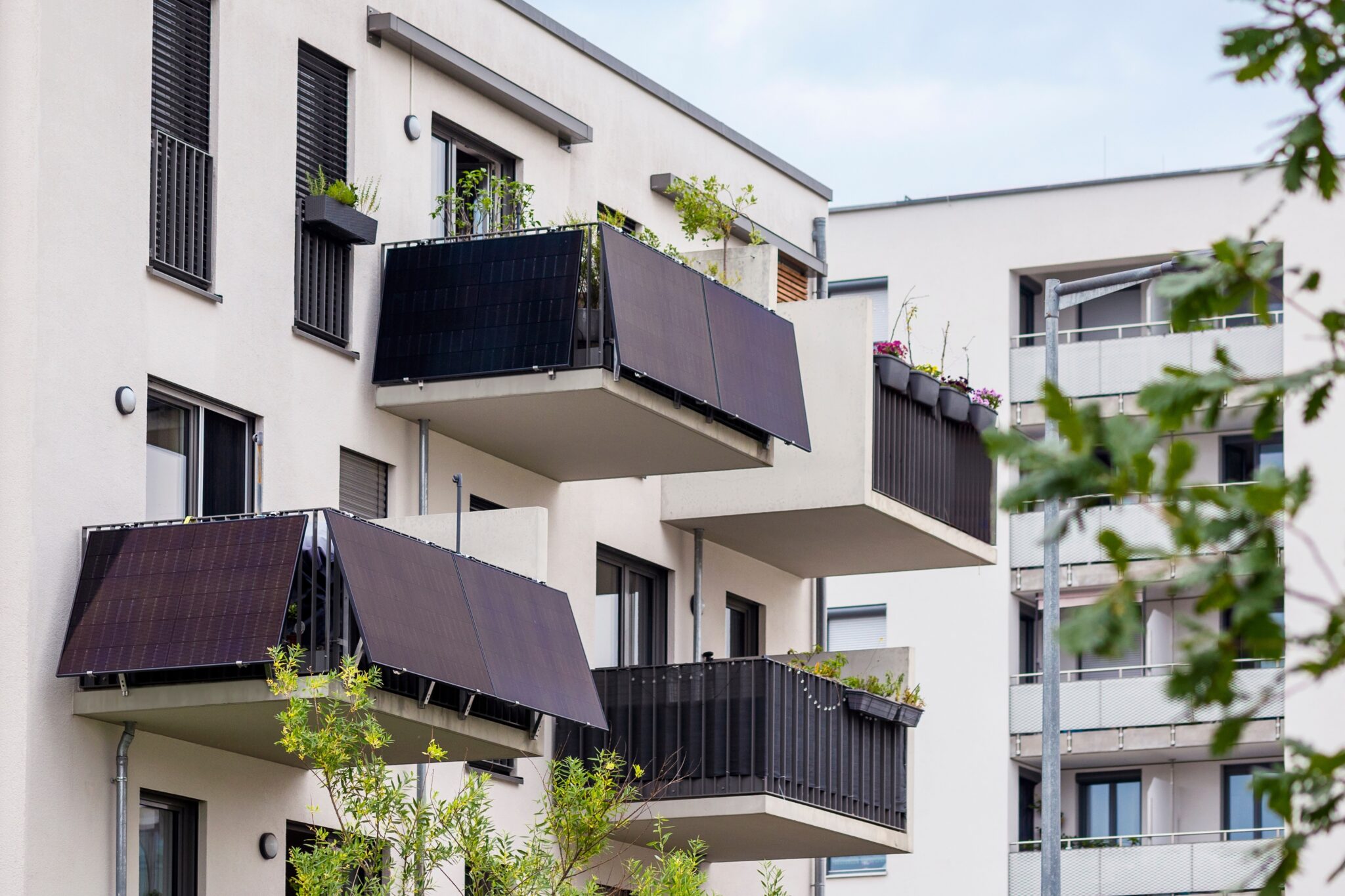
https://en.wikipedia.org/wiki/Balcony_solar_power
So you want a peaking nuclear plant for firming?
Vogtle costs 18 cents/kWh when running at 100% 24/7 all year around. A typical gas peaker runs at 15-25% of the time.
Running a peaking Vogtle now costs somewhere like 60-90 cents/kWh.
As soon as new built nuclear power with ruinously expensive CAPEX and acceptable OPEX hits the raw physical incentive systems of the our energy system it just becomes stupid.
Comment by 0x457 1 day ago
Sure, let me throw away everything I grow on my balcony so I can get some storage and panels. Still not going to work for me because my balcony is west facing. I have a bunch of solar-powered devices on my balcony, and metrics tell me realistically I get 2 hours of sunlight that matters a day.
Comment by ViewTrick1002 22 hours ago
West facing is perfect, means you get to take advantage of everyone else producing cheap power during the day and optimize your own delivery for when you are home in the late afternoon/evening.
I find it curious that the entire thought of balcony solar seems to upset you?
[1]: https://solarmuseum.org/wp-content/uploads/2025/01/shutterst...
Comment by mpweiher 3 days ago
Anyway, even if that were correct numbers, it would misleading on several fronts, as the only new western reactors were unrepresentative FOAK builds, and also troubled beyond just regular FOAK status.
Furthermore, the costs tend to be calculated for the period while they are repaying the loans, so it's mostly capital costs. Once the plant is paid off, the price drops dramatically.
The average build time is currently 6.5 years, median slightly less, trend downwards.
Comment by ViewTrick1002 3 days ago
That is with the first reactor coming online 2038 with a perfectly executed project.
I suggest you stop referencing unsourced statistics when the topic at hand is new built european nuclear power.
Edit - toned it down
Comment by mpweiher 3 days ago
Which you did not answer.
And then you accuse me of referencing unsourced statistics and lying.
Hmm...
The 6.5 years figure is from here:
https://www.sustainabilitybynumbers.com/p/nuclear-constructi...
"Current european nuclear" is completely atypical and unrepresentative. The numbers are too low to be statistically significant anyhow, but on top of that they were all FOAK builds, all of a single (base) design that has been deemed too difficult to build by its manufacturer and thus discontinued, and mostly built in countries with little recent nuclear experience.
The HPC build, for example, was very explicitly intended to build up the UK nuclear industry, which was a significant part of the cost.
Comment by ViewTrick1002 3 days ago
1. Start with ignoring the EPR2 costs.
2. Cherry-pick data that does not represent western timelines. Of course ignoring the best case for the first EPR2 reactor is 12 years if they start today.
3. Blame everything on ”FOAK”. Despite Hinkley point C being reactor 5 and 6 in the EPR series. But that is of course ”FOAK”.
4. Allude that the next UK reactor will be cheaper. Despite the projected cost for Sizewell C is £38B before even starting compared to the current projection at £42-48B for Hinkley Point C.
Sizewell C truly shows the state of new built European nuclear power. EDF is too financially weak to take on any further nuclear construction liability like a fixed price contract, and the CFD would be ruinously expensive.
Instead it is a pure cost-plus contract where an extra surcharge is added to all ratepayers as soon as construction starts having people today pay for electricity hopefully delivered 10-15 years in the future. Hiding the true all-in cost in terms the average tax payer doesn’t understand rather than a trivially understood CFD.
Like I said. As soon as new built nuclear power is confronted with reality it becomes economic and opportunity cost lunacy unless you can motivate it with for example military ambitions.
Comment by credit_guy 3 days ago
Was this really necessary?
Comment by solarengineer 3 days ago
Comment by ViewTrick1002 3 days ago
https://en.wikipedia.org/wiki/Balcony_solar_power
Why should industry buy extremely expensive new built nuclear power when grid based zero marginal cost renewables are available?
If they’re having worries about price fluctuations then we already have markets for electricity futures. The perfect market for stable new built nuclear power.
The problem for new built nuclear power is that they need enormous tax payer based handouts to close the gap between the price of electricity futures and production cost. Let alone making a profit.
How does industry deal with 50% of the nuclear capacity having outages for months on end like happened in France during the energy crisis?
Comment by throw0101a 4 days ago
Provincial regulatory report from 2025-2026:
* https://oeb.ca/sites/default/files/rpp-price-report-20251017...
Search for "RPP Price Report" for previous ones:
* https://www.oeb.ca/consultations-and-projects/policy-initiat...
Comment by belorn 3 days ago
Comment by retrac 3 days ago
For a real example, I'm on flat rate and if I use 1000 kWh my monthly bill will be 211 CAD (effective rate 0.21 CAD / 0.13 EUR per kWh) including taxes, connection, delivery, everything, but without subsidy. The amount I pay after the subsidy is applied would be less at 165 CAD.
Comment by belorn 3 days ago
The reason for the high kW/h is because limited wind/solar during that month and high gas prices which result in high market price at the power exchange. The given reason for the fixed fees is because of the need to expand transmissions and build out more reserve energy to handle the increase variability of the grid as a result of the increase use of renewables and the outcome of decommissioning a few nuclear reactors in the south of Sweden.
Comment by hvb2 3 days ago
Would be very curious about the rationale for it if not. Why would you subsidize increased energy use
Comment by retrac 3 days ago
One is to offset the cost to the consumer for phasing out fossil fuels. Coal has been shut down and wind and storage and new nuclear is being built. Politically it has been presented as a matter of fairness; poor people are least able to pay for increases or to retrofit. A kind of wealth redistribution. (Though when you remember large corporately-run farms are included in the subsidy it's maybe not the most progressive form of redistribution.)
In Quebec where they have a great surplus of hydroelectric they also partly subsidize residential electricity with the profits of the surplus sale to the United States. The energy is so cheap there than resistive heating is cheaper than natural gas for home heating. Avoiding dependence on oil and gas imported from either the US or western Canada, or rather trying to lessen that dependence, is a standing issue for both Quebec and Ontario.
Comment by scotty79 3 days ago
Comment by nine_k 3 days ago
Bulk prices at exchanges are way lower, like 2.2¢ per kWh: https://www.ieso.ca/Power-Data/Price-Overview/Ontario-Market...
Comment by apatheticonion 3 days ago
Comment by rstuart4133 3 days ago
The outcome was surprisingly close. Sydney seemed to be a little more expensive, with a spot market average of CAD$73/MWh vs CAD$65/MWh. A wash really.
I don't know what is going on with the retail prices. My rule of thumb is multiply by 3, but your multiple is closer to 4.5. I live in Brisbane for example, where the average price is $100/MWh and we pay around $.30/kWh retail. Have you looked at https://www.energymadeeasy.gov.au/ ?
Comment by tokai 3 days ago
Comment by klipklop 4 days ago
Comment by esafak 4 days ago
Comment by thenaturalist 3 days ago
About reactor malfunctions and fallout?
Yes, I know the chances are slim and you know as well as I do they're not 0.
Comment by mpweiher 3 days ago
The actual safety is almost entirely unrelated to the fears people have. There is even a term for this: radiophobia.
https://en.wikipedia.org/wiki/Radiophobia
Radiophobia is an irrational or excessive fear of ionizing radiation, leading to overestimating the health risks of radiation compared to other risks. It can impede rational decision-making and contribute to counter-productive behavior and policies.
Comment by squigz 3 days ago
Comment by laurencerowe 3 days ago
I suspect the UK will only build the nuclear capacity required to keep the industry around on national security grounds.
Comment by mpweiher 3 days ago
Giving a preference to intermittent renewables is not a law of nature, but a rule that is irrational and needs to be removed.
Denmark is just now hitting problems with their wind strategy, and of course dependent on being a transit land between large producers and consumers. And currently looking at nuclear. As is Norway.
One of the reason is that intermittent renewables are pro-cyclical, that is once they reach a certain level of saturation, they cannibalize each other even more than they cannibalize steady suppliers.
The current plan is to quadruple nuclear power in the UK.
Comment by laurencerowe 3 days ago
While you can turn nuclear up and down a little bit the fuel costs are negligible so it costs the same to generate 80% or 100% of rated output. It's done in France because nuclear makes up so much of their generation capacity they have no other option.
> Giving a preference to intermittent renewables is not a law of nature, but a rule that is irrational and needs to be removed.
I think carbon-free generation options should be considered dispassionately with a focus on minimising cost and reducing CO2 emissions as quickly as possible. But there is path dependence at this point. The wind generation capacity will already have been built out before many more nuclear plants come online. I think this will make the economics of expanding nuclear power generation unattractive because we will already have made the commitments to buy the wind generation and we will instead look for the lowest priced options to fill the gaps.
> Denmark is just now hitting problems with their wind strategy, and of course dependent on being a transit land between large producers and consumers. And currently looking at nuclear. As is Norway. > > One of the reason is that intermittent renewables are pro-cyclical, that is once they reach a certain level of saturation, they cannibalize each other even more than they cannibalize steady suppliers.
The fast decreasing cost of batteries will help smooth out fluctuations in wind generation across a day or two. That should reduce the level of cannibalisation between wind projects substantially, though does not remove the need for backup power for longer periods of little wind.
I suspect the proposed SMR projects in Norway and Denmark will depend on whether anyone is able to get SMR build costs down sufficiently to make them attractive. It certainly makes no sense to ban them outright.
> The current plan is to quadruple nuclear power in the UK.
That was the 2050 target from the last government. In terms of actual commitments the only planned plant after Hinkley C is currently Sizewell C. At the same time 4 of our 5 remaining nuclear plants will be decommissioned by early 2030. I think the target is highly unlikely to be met.
There is a £2.5 billion investment in SMRs (if you can call reactors around a 1/3rd the size of existing nuclear power plants small...) but will they really have reduced costs?
Comment by mpweiher 2 days ago
Yes. The only criticism the new labor government had of the previous government's nuclear policy was them not getting enough done:
"Starmer hits out at Tories’ ‘shambolic’ failure to open nuclear power plants"
https://morningstaronline.co.uk/article/b/starmer-targets-to...
> In terms of actual commitments the only planned plant after Hinkley C is currently Sizewell C.
Well sure, they only got those commitments through this summer. At around the same time as they were getting the commitments for Sizewell-C (and pre-construction work has commenced), they also designated the next site.
And, yes, they also selected the winner of the SMR competition.
Here current statements from the government:
"Starmer pledges to ‘build, baby, build’ as green groups criticise nuclear plans"
https://www.theguardian.com/environment/2025/feb/06/starmer-...
Comment by apatheticonion 3 days ago
Australia, for instance, powers 40% of its electricity with renewables.
However, electricity makes up ~20% of _total_ energy consumption which means renewables made up 9% of _total_ energy production.
As the electrification of transport, industry, manufacturing, etc proceeds, the demand for electricity will increase (in the case of Australia, we need to 5x our electricity production).
Ironically, legislators are disincentivized from stimulating electrification as getting to 100% renewable electricity production is easier when electricity is only 20% of our energy usage.
Comment by laurencerowe 3 days ago
Comment by locallost 3 days ago
It could be, for the EU not Norway at least, that there was a consumption uptick but it's hidden because people charge their cars with their own solar panels. But even this is indicative of how the grid will work in the future.
Comment by llsf 3 days ago
Comment by thegrim33 4 days ago
If you take as axioms:
1) Countries have major political interest in whether other countries have nuclear reactors
2) Countries are already, at large scale, manipulating discourse across the internet to achieve their political goals
Then of course it follows that any comment thread on a semi-popular or higher site about whether a country should build more nuclear reactors is going to be heavily manipulated by said countries. That's where (most) of the insane people in such threads are probably coming from.
How are we supposed to survive as a civilization with such corrupted channels of communication?
Comment by cauch 3 days ago
There are countries that have interest of having gas or oil bought from them. It is not clear if they are pro or against other countries going nuclear: on one hand, nuclear will replace part of their market. On the other hand, lobbying to move towards nuclear may impede progress in replacing gas and oil by renewable (a strategy would be to lobby so that the nuclear project starts and then lobby so that the project stagnates and never delivers).
There are countries that have interest in seeing nuclear adopted because they have a market for the ore extraction or waste processing. There are countries that have interest in seeing nuclear not adopted because they have a market around other generations.
Finally, some countries may want to see their neighbors adopt nuclear: the neighbor will pay all the front bills and take all the risk (economical but also PR, or the cost of educating experts, ...), and if they succeed, they will provide import energy very cheap that can fill the gaps the country did not wanted to invest in.
So it is not clear if there is just one stream of lobbying. The reality is probably that every "sides" does somehow contain manipulative discourse from foreign countries.
Comment by fulafel 3 days ago
Comment by tim333 3 days ago
>... composed of representatives from employers' associations, workers' unions (trade unions) and civil society organisations.
I'm not sure how up they are on technical issues like the rapid progress in batteries and solar and the like.
Hinkley C in the UK was approved in 2016 and probably will be producing in 2031 so 15 years on. (cost ~£40bn). In the last 15 years the cost of battery storage and of solar panels have both fallen about 10x. If that goes on they will be much cheaper but the time nuclear comes online.
Comment by solarengineer 3 days ago
Here are some sources of information that helped me understand the two oft-cited nuclear disasters better.
The World Nuclear Energy write up on the Fukushima incident: https://world-nuclear.org/information-library/safety-and-sec...
Some information on the Chernobyl incident: The infographics show: https://www.youtube.com/watch?v=2uJhjqBz5Tk
https://world-nuclear.org/information-library/safety-and-sec...
A lecture in the MIT Courseware on the incident: https://www.youtube.com/watch?v=Ijst4g5KFN0
This lecture is way more informative where the professor explains how the workers took the system beyond the rated capacity as part of a test.
There have been many lessons learned, and the World Nuclear article linked above shares some of these.
Here is a writeup of the Three Mile Island incident: https://world-nuclear.org/Information-Library/Safety-and-Sec...
One regular complaint is the costs of nuclear energy. This is likely true in the US due to regulations that have not been revised for newer technology, but such high costs are cited around the world.
Likewise, the amount of waste and the danger of the waste is not well understood either, and certainly lots of education is needed here. For e.g., most people do not know that the volume of waste is limited and that the same waste can be reused in reactors of other designs.
I do believe that national ego issues get in the way of fixes. I believe that such ego issues got in the way of honest repairs (Fukushima) and timely action (Chernobyl). Certainly, nuclear inspections are still treated with suspicion and hostility, but in fact full transparency and integrity should be the norm.
Corruption and profit-centric thinking are two other problems that plague the nuclear industry. South Korea has had lots of corruption and shortcuts (https://www.technologyreview.com/2019/04/22/136020/how-greed...). One of the accusations in India against France was that France licenses outdated nuclear reactor technology despite having newer technology. I am unable to locate a link supporting this accusation.
With thorium reactors and Small Module Reactors, there are many modern solutions to safety.
ThorCon's Thorium Converter Reactor - Lars Jorgensen in Bali https://www.youtube.com/watch?v=oB1IrzDDI9g
Here is the full training by Thorcon on their reactors: https://www.youtube.com/watch?v=kkvEXm-rMW4&list=PLuGiwaUJYE...
We need to stop citing and quoting US-based costs and problems that are linked to outdated US regulations. There are other countries that have more modern regulations and modern technologies.
Comment by IlikeKitties 4 days ago
Anyways, solar is also cheaper
Comment by belorn 4 days ago
The lithium battery plant in northern Sweden went bankrupt so its difficult to say how to solve the storage solution by both being cheap and financial viable. New battery solutions are being made, but in the end it need to be cheap enough over the long term. The current use of gas for non-optimal weather means prices jump up by a factor of around 100x of what it is during good weather, and the average price in nordpool (the northen pan-European power exchange) is about 20x than what you get with good weather. That should illustrate how much variability there is in the energy price right now, and how much people are paying for that gas powered electricity in periods of non-optimal weather conditions.
A lot of fossil fuel subsidies goes directly to support the high variability power grid, and they more than doubled during 2022 when the gas prices went up. It is incredibly expensive, likely more than nuclear, to have a grid supported by renewables during optimal weather conditions and fossil fuels during non-optimal weather conditions. It also generate a lot of waste in term of pollution which has a bigger issue both short and long term than nuclear waste.
Comment by jltsiren 3 days ago
Comment by exabrial 3 days ago
This is pretty far from the truth. Exactly One Swimming Pool is all that is needed to store the entire "waste" for a country.
If you don't recycle it.
Or if you don't put it concrete.
Comment by exabrial 3 days ago
https://www.bloomberg.com/news/features/2020-02-05/wind-turb...
Comment by ViewTrick1002 3 days ago
In recent news we are seeing the fossil lobby ally with new built nuclear power since wasting money and opportunity cost on new built nuclear power potentially may stymie renewable development.
https://www.bloomberg.com/news/features/2025-12-09/nuclear-e...
Comment by Archelaos 3 days ago
Comment by mrweasel 4 days ago
Where is the fossile fuel being burnt?
Comment by mandevil 3 days ago
There is obviously major ethical issues here. The rich, already developed world- having emitted enormous quantities of CO2 to get there- telling poor, undeveloped people living as subsistence farmers that they can't use any more energy because of all the CO2 already in the atmosphere is a really hard argument to make, locking them into being poor forever while the developed world benefits from all that CO2 consumption. But on the other hand, by skipping right to large scale solar, maybe those inside the circle can do a better job?
Comment by adrianN 1 day ago
Comment by iknowstuff 3 days ago
Comment by dalyons 3 days ago
Comment by alecco 3 days ago
China 50%, India 11%. And that is based on their official numbers so probably a lot more.
https://www.worldometers.info/coal/coal-consumption-by-count...
Comment by terespuwash 3 days ago
Comment by solarengineer 3 days ago
Why does it matter to energy security? Nuclear power plants contribute to electricity security in multiple ways by keeping power grids stable and complementing decarbonisation strategies since, to a certain extent, they can adjust their output to accompany shifts in demand and supply. As the share of variable renewables like wind and solar photovoltaics (PV) rises, the need for such services will increase.
What are the challenges? Nuclear power faces a contrasted future despite its ability to produce emissions-free power. With large up-front costs, long lead times and an often-poor record of on-time delivery, nuclear power projects have trouble in some jurisdictions competing against faster-to-install alternatives, such as natural gas or modern renewables. It also faces public opposition in many countries. Its uncertain future could result in billions of tonnes of additional carbon emissions.
https://www.iea.org/energy-system/electricity/nuclear-power
Do note: There are countries other than the US and France who license nuclear technologies and build-outs. There are innovative technologies by US companies that work with modern regulations and are faster and less expensive to build. We must stop citing US nuclear build times that are largely due to outdated regulations and hostile review processes.
Comment by raverbashing 3 days ago
Comment by accidc 3 days ago
It’s uncanny how the narrative rhymes: we have insanely capable portable computing devices at price points that are accessible to every person across the planet. Similarly, distributed generation (and storage) are already bringing electricity to people who have no real chance of being on the grid ever.
I see no way the economics working out for nuclear, except for niche uses.
I can even imagine the grid being something relegated for long range / high intensity applications (instead of household distribution) in a few hundred years
Comment by Rygian 3 days ago
Consider Germany. 50% is coal + gas, 22% is wind + biomass. At 490 g/kWh.
Italy: 60% gas at 386 g/kWh.
Then compare them to France: 75% of the electricity comes from nuclear, at 47 g/kWh.
All of this despite abundant wind+solar capacity installed in Germany, France, Italy, and Poland.
There is a strong need to remove CO₂-intensive generators and replace them by something that does not send CO₂ into the air.
There is also a strong need to build up capacity to store energy.
https://app.electricitymaps.com/map/zone/PL/live/fifteen_min...
Comment by scotty79 3 days ago
Comment by stuaxo 3 days ago
Comment by thenaturalist 3 days ago
Honestly the main part about nuclear energy is dependence.
In Germany we saw how well that played out in 2022 when Russian gas stopped flowing.
There is a shit ton of innovation around battery technologies, extending the grid and behind the meter micro-grids.
A more diversified, autonomous (as in, wind, solar) energy supply beats Nuclear in terms of national security and long term viability any day.
Comment by mpweiher 3 days ago
https://www.wsj.com/articles/worlds-dumbest-energy-policy-11...
Yep, the Gas that was needed due to ... the World's Dumbest Energy Policy.
https://www.ndr.de/nachrichten/mecklenburg-vorpommern/nord-s...
Schon während seiner Kanzlerschaft sei die damalige Bundesregierung der Auffassung gewesen, die deutsche Energiepolitik aus der Abhängigkeit der Kernenergie zu befreien. "Wir fanden deshalb, dass es Sinn macht, auf Gas zu setzen."
Uranium is cheap, widely available (largest known reserves in Australia, 3rd in Canada, also Sweden recently had a large find), compact, solid, storable.
Security:
https://berthub.eu/articles/posts/the-gigantic-unregulated-p...
In Ukraine, nuclear is what's keeping the lights on.
Comment by Archelaos 3 days ago
Comment by locallost 3 days ago
Which is fine, except putting hopes into a technology that has failed repeatedly for 60 years is in itself irrational.
HN would do itself a favor if it learned the lessons of "worse is better" and applied it to, well, almost anything. In this case, a moonshot to advance nuclear globally might bring realistic results in 10-15 years. By that time the world will already be decarbonized by renewables as it's already happening. At best nuclear might be that last missing piece to get to 100%, but even this I would no longer bet on. There is already insane growth in undeveloped countries which will push demand even further. Renewables are ridiculously cheap.
Comment by throwpoaster 3 days ago
Comment by EricE 4 days ago
Comment by z3ratul163071 4 days ago
Comment by okanat 4 days ago
Comment by mooiedingen 3 days ago
Comment by softwaredoug 4 days ago
When you look at the data though, its political fallout was much worse than the actual toll on human life, etc. Fukushima released a small about of radiation into the environment. But modern reactors don’t have the same runaway reactivity flaws that Chernobyl did.
Not zero risk. But not the level of risk resulting in half a continent potentially being uninhabitable.
Comment by BurningFrog 4 days ago
Such an extreme set of outlier events could happen again, of course, but it's not very realistic.
Comment by mpweiher 3 days ago
That plant had always had the higher wall due to one engineer who insisted, and Fukushima actually had a natural barrier that was higher, but lowered during construction for convenience. And TEPCO dragged their feet on increasing the height to the new norm that had recently been made mandatory. My understanding is that this is one of the reasons TEPCO got dinged.
And even with all that, a German reactor, for example, would have remained undamaged due to various mandatory safety features even without a sufficiently high tsunami wall. For example, multi-sited and bunkered diesel generators, so no flooding. Also Hydrogen recombinators, so none of those lovely hydrogen explosions that blew the roofs off.
But of course Germany had to shut off its nuclear plants due to the regular occurring 1000-year Tsunamis in Germany that German plants would have survived.
We're crazy.
Oh, and still exactly 0 radiation deaths from Fukushima, and no measurable health impact expected. All health effects, including deaths were due to the unnecessary evacuation. And not just unnecessary in hindsight, this was known beforehand, gut officials panicked.
Did I mention that Japan is restarting their reactors and considers nuclear an essential part of their future energy strategy, as it is the cheapest baseload power source? The monetary cost of importing Gas exceeds even the vastly inflated cleanup and compensation costs (due to the unnecessary evacauations) by at last an order of magnitude. And of course the health impact of those fossil fuel plants during normal operations is higher than that of the nuclear accident.
Comment by drtgh 3 days ago
Among others variables, the plant was designed to be constructed on a hill 30-35 meters above the ocean, but someones decided would be cheaper to construct it at sea level in order to reduce costs in water pumping, others decided to license this, and much latter, one decade before the disaster when was requested to reinforce the security measures within all the reactors in the country -in Fukushima for example to elevate critical systems to hills- others decided to ignore it [1][2]
[0] https://warp.da.ndl.go.jp/info:ndljp/pid/3856371/naiic.go.jp...
[1] https://warp.da.ndl.go.jp/info:ndljp/pid/3856371/naiic.go.jp...
[2]https://carnegieendowment.org/2012/03/06/why-fukushima-was-p...
What happens is that nuclear fusion is not here yet, and there is insufficient stable/maintained energy to meet current demand without using combined cycle power plants (combustion), and this without even a transition to full electric vehicles, with right now sounds to pure phantasy (how will be feed).
So the realistic by the moment sounds like to keep constructing new nuclear fission plants and renewables, keeping a diversification of sources, as is doing China with their mega projects. Without this will not be way to compete with their industry.
But more important, I think is needed to end the nepotism, the revolving doors (amakudari), and, of course, to prevent sociopaths from accessing positions of responsibility in any field... what sounds difficult because those positions are like magnets for them. This is what seems we don't learn from the human history.
Comment by goatlover 4 days ago
Comment by mandevil 3 days ago
And as for how realistic it was that it would make large areas unlivable, the threat was of a melt-down going far enough down to hit the water table and contaminating the groundwater. That would make large areas only livable if you brought your own water, even for bathing, basically making the area impracticable. Obviously it didn't happen, but I'm not clear whether it was a 0.5% chance, a 5% chance or a 50% chance.